






Optical image stabilization counteracts unwanted camera shake during handheld photography by moving optical components in the opposite direction of detected movement [11]. The underlying mechanism depends on angular velocity sensors that track rotational movement along pitch and yaw axes [8]. When a camera moves upward, internal actuators tilt the compensating lens group downward so that the projected light beam hits the exact spot on the camera sensor [11]. Early work by Canon and Nikon kept handheld pictures sharp in low light without raising noise [8].
The Reciprocal Shutter Rule
Photographers traditionally rely on the reciprocal rule of focal length, also known as the 1/mm guideline, to choose a safe shutter speed on 35 mm cameras. Under this rule, a shooter holding a 125 mm lens on a Canon or Nikon body needs a shutter speed of at least 1/125 second to avoid blur from hand shake. Optical stabilization systems allow shutter speeds two to 5.5 stops slower, meaning exposures four to thirty times longer. At these settings, a user captures clean pictures at 1/15 or 1/8 second matching an unstabilized shot at 1/125 second [11].
Format factor alters the practical application of this rule because smaller sensors crop the field of view and magnify hand shake. A camera with a sensor half the size of a standard 35 mm film frame, such as an Olympus or Panasonic Four Thirds body, carries a 2x crop factor. On that body, a 50 mm lens delivers the same field of view as a 100 mm lens on film, so steady handheld shooting needs roughly 1/100 second. While optical image stabilization eliminates common handheld jitters, it cannot freeze moving subjects. Fast subject motion demands higher shutter speeds [11].
Optical Image Stabilization in Lenses
In lens-based optical image stabilization, camera brands put a floating group of glass inside the barrel that shifts across the optical axis. Two small piezoelectric angular velocity sensors detect the speed and angle of tilt and pan tremors. Electronic chips calculate the needed offset and energize compact electromagnets that glide the glass into position before incoming light hits the sensor plane [11]. Because the optical path adjusts prior to digital capture, the scene stays steady inside optical viewfinders. This visual feedback aids long telephoto framing [8].
Commercial development of in-lens stabilization began before digital cameras gained mass consumer adoption [8]. Nikon produced the first optical two-axis stabilized lens in 1994, building a 38–105 mm f/4–7.8 zoom into the Nikon Zoom 700VR compact point-and-shoot camera, sold in the United States as the Zoom-Touch 105 VR [11]. Canon followed in September 1995 with the EF 75–300 mm f/4–5.6 IS USM, which was the first stabilized lens for 35 mm single-lens reflex cameras. Canon later introduced the professional EF 300 mm f/2.8L IS USM in July 1999, while Nikon launched its first vibration-reduction SLR telephoto zoom, the 80–400 mm f/4.5–5.6D, in 2000 [8].

Dedicated stabilization modes help shooters work from moving platforms or track fast action. Nikon VR lenses include an active mode engineered to damp large angular velocity vibrations when photographing from a moving car or boat. In contrast, the normal stabilization mode targets slower, lower-amplitude tremors typical of human hands. When tracking subjects along the horizon, panning modes disable horizontal compensation while keeping vertical stabilization active, preventing the mechanism from fighting the photographer’s deliberate sweeping camera movement [11].
Sensor-Shift Camera Bodies
Instead of moving glass elements within lenses, camera designers also place stabilization mechanisms inside the camera body [8]. In these sensor-shift designs, often called mechanical image stabilization, the digital image sensor itself moves along magnetic tracks to counter rotational movements detected by internal gyroscopes. Minolta introduced the first sensor-based two-axis image stabilizer in 2003 with the DiMAGE A1, marketing the feature as Anti-Shake [11]. In late 2004, Minolta announced the 7D digital single-lens reflex camera, bringing body-integrated sensor movement into an interchangeable lens system without requiring dedicated optics [8].
Camera makers recognized the benefits of stabilizing the camera sensor directly. Pentax entered the market in May 2006 by releasing the K100D with Shake Reduction, followed by the K10D, K200D at $699.99, and the K20D. Olympus joined the field in March 2007 with the EVOLT E-510, pricing the stabilized DSLR body at $500 and driving sensor movement through its Supersonic Wave Drive. The unit steadies every lens. Because the stabilization unit sits behind the lens mount, it provides handshake reduction for every attached lens, including vintage manual glass and fast primes [8].
Sensor-shift technology also enables creative applications beyond routine handheld shooting. When paired with the O-GPS1 unit for accurate position data, the Pentax K-5 and K-r cameras shift their image sensors during minute-long exposures to cancel apparent celestial motion. This orbital compensation reduces star trails without heavy mounts [11].
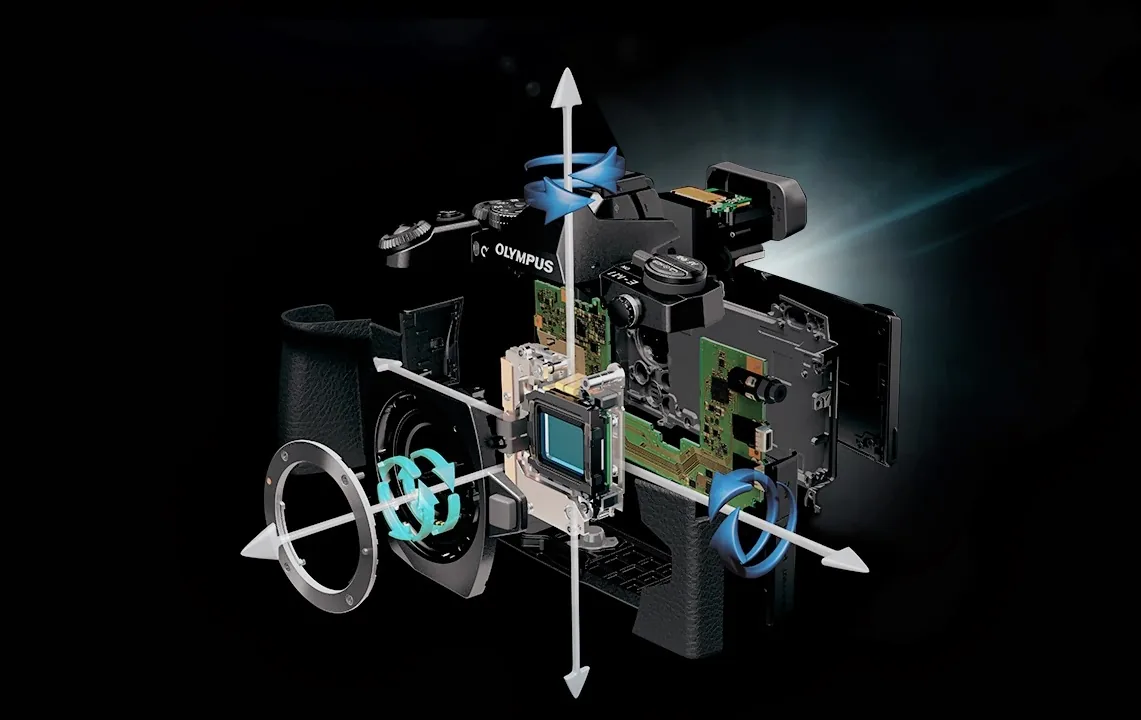
Lens Versus Body Systems
Choosing between optical image stabilization and in-body sensor shift involves clear trade-offs in optical performance, viewfinder behavior, and overall kit cost. Optical stabilization in lenses steadies the optical viewfinder directly, making it easier to track wildlife or sports action at focal lengths above 300 mm. With long telephoto lenses, a very small shift of an internal optical element corrects a large displacement in the image plane [8]. Sensor-shift systems do not steady the optical viewfinder in traditional DSLRs, though electronic viewfinders display the fully stabilized Live View sensor feed without issue [11].
Sensor size presents tough engineering hurdles for in-body stabilization mechanisms. A 35 mm full-frame sensor has about 2.25 times the surface area of an APS-C sensor and weighs nearly three times as much. Moving big sensors takes power. In 2008, Sony solved these mass challenges by releasing the 24-megapixel DSLR-A900, the first full-frame camera equipped with in-body sensor-shift stabilization [8].
Cost considerations also separate the two approaches for amateur and professional photographers. In-body stabilization adds roughly $50 to $100 to the purchase price of a camera body, but that single investment steadies every prime or zoom in the photographer’s bag. In contrast, in-lens stabilization adds approximately $50 to affordable consumer zooms and around $450 to professional lenses like the EF 70-200mm f/2.8L. Combining both systems independently without electronic coordination causes erratic overcompensation, as the moving sensor shifts against an image that the lens elements already steadied [8].


Five-Axis Correction Across Brands
Advanced camera units correct motion across five separate axes. These axes include horizontal and vertical translation (X and Y shift), angular tilt and swing (pitch and yaw), and rotational roll along the lens axis. Olympus pioneered five-axis in-body image stabilization in 2012 with the OM-D E-M5 mirrorless camera for Micro Four Thirds, later expanding the lineup with the PEN E-P5, OM-D E-M1, and three-axis OM-D E-M10. Olympus America product manager Richard Pelkowski stated that Olympus was the first to use Voice Coil Motor units to float the image sensor in magnetic suspension, outperforming older direct-current or piezoelectric motors in speed, movement accuracy, and power consumption [9].
Sony brought five-axis in-body stabilization to full-frame mirrorless sensors in 2014 with the ILCE-7M2, also known as the A7 Mk II. Sony representative Mark Weir said, “It compensates for pitch and yaw, x and y translation, and roll…it’s the world’s first for a full frame sensor system”. Weir explained that the unit uses magnetic repulsion and precision ball bearings, giving 4.5 stops of latitude. The system requires focal length and focus distance data from the lens to calculate accurate pitch and yaw compensation, while roll correction functions independently based on camera gyros [9].
In actuator engineering, A. Heya and K. Hirata designed a three-degree-of-freedom electromagnetic unit driven by three phases, replacing bulkier multi-axis links with a simple magnetic structure [6]. Similar miniature hardware fits inside compact mobile devices, while modern smartphone camera modules integrate physical aperture hardware such as iPhone 18 Pro variable aperture mechanisms with optical image stabilization. Panasonic, Tamron, and Sigma also deploy optical stabilization across Micro Four Thirds and full-frame mounts [11].
Why Turn Off Optical Image Stabilization?
Although image stabilization proves valuable in most handheld shooting situations, keeping the feature active on a solid tripod can ruin an otherwise sharp photograph. When a camera sits locked down on a heavy tripod, the internal gyroscopes still detect minute mechanical vibrations or circuit noise. The control system attempts to counteract these non-existent movements by nudging the floating optical elements or the sensor, creating an artificial feedback loop that introduces noticeable blur during long exposures. Why would a photographer intentionally disable an advanced optical feature on an expensive camera? The answer lies in preventing unintended drift. Modern Canon lenses detect motionless mounting automatically, but turning off the switch manually remains good practice [11].
Power consumption is another practical reason to switch off stabilization when it is not needed. Energizing voice coil motors, electromagnets, and angular rate sensors places a steady electrical load on the camera battery. Tripod shots need no gyro help. Turning the stabilizer off during bright daylight shooting at fast shutter speeds of 1/1000 second or higher conserves battery life without degrading image quality, as hand shake cannot blur exposures that brief [11].

Lens adapters and mismatched optical combinations also create situations where stabilization must be disabled manually. When mounting third-party lenses via dumb mechanical adapters, such as classic Leica or Voigtlander rangefinder lenses without electronic encoders, the camera body cannot read focal distance data. Similarly, if a photographer mounts an image-stabilized telephoto lens like the Canon 70-200mm f/2.8L IS II to a Sony body using a Metabones adapter, the lens and body cannot communicate stabilization data. Mark Weir of Sony pointed out that users should turn off lens stabilization in this configuration to prevent conflicting corrections between the lens and sensor [9].
Video Tools in Final Cut Pro
Video production relies heavily on software tools to smooth out handheld footage and correct progressive-scan sensor artifacts. In Apple Final Cut Pro for Mac, video editors use the built-in stabilization inspector to analyze pixel motion through consecutive video frames. The software provides two stabilization methods: InertiaCam, which smooths pans and zooms with an optional Tripod Mode, and SmoothCam, which lets editors adjust Translation Smooth, Rotation Smooth, and Scale Smooth sliders. Final Cut Pro also includes a rolling shutter correction tool that counters the wobbly distortion produced when fast camera movements sweep across CMOS sensors [7].
In digital video studies, B. K. Savaş, M. K. Pehlivanoğlu, and O. Urhan created an efficient tracking method using Local Binary Pattern representations at 1-bit depth resolution. Their system uses simple Boolean exclusive-OR matching to determine global motion vectors between consecutive frames, applying constant-velocity Kalman filtering to smooth frame positions over time [5]. Computational image processing shares techniques with real-time neural reconstruction, seen in how Sony brings PS5 AI upscaling to base consoles through dedicated temporal filtering algorithms. In related work, W. Dong, Y. Chen, and Z. Xu used support vector machine models to predict camera vibration, verifying stability with signal-to-noise ratio and modulation transfer function metrics [3].

Horizon tracking also stabilizes autonomous marine vision systems. In buoy trials, C. Cai, X. Weng, and Q. Zhu used a catadioptric omnidirectional vision model to calculate sea-skyline ellipses and steady video in real time. By tracking natural boundary lines, their algorithm extracts stable panoramic video from rolling waves while reconstructing invalid regions from key frames [2].
Image Stabilization in Binoculars
High-magnification binoculars present a challenging stabilization problem because magnification enlarges not just distant objects, but every tiny tremor of the observer’s hands. In binocular systems, active stabilization electronically senses attitude changes and shifts an optical lens group or varies the angle of a fluid-filled prism. Passive stabilization systems, by contrast, rely on unpowered gyroscopic mechanisms or disengage the internal prisms from the binocular housing, allowing the optics to remain level while the outer shell vibrates. Leading manufacturers producing stabilized binoculars include Canon, Fujinon, Nikon, Carl Zeiss, and Bushnell [12].
For heavy vibration environments such as aerial photography, photographers turn to external gyroscopic stabilizers. Kenyon Laboratories manufactures Ken-Lab gyro stabilizers ranging from 1.5 to over 15 pounds, featuring two perpendicular precision wheels spinning at over 22,000 RPM. Mounted to a standard tripod socket, the Ken-Lab KS6 acts like an invisible tripod by steadying the entire camera mass along two perpendicular axes. Aerial photographer Adriel Heisey flew a custom-built aircraft with a gyro-stabilized camera rig to photograph the Navajo Nation, while aerial photographer Yann Arthus-Bertrand used Canon stabilized lenses and Pentax equipment from a helicopter to photograph Yellowstone National Park’s Grand Prismatic Spring for his book Earth From Above: 365 Days [10].
Biological vision systems steady retinal images through dedicated brainstem pathways. In laboratory studies, O. S. Dhande and colleagues at the Journal of Neuroscience tracked how retinal ganglion cells project to visual nuclei in the brainstem termed the accessory optic system. Using a transgenic mouse line labeled Hoxd10-GFP, the team demonstrated that direction-selective retinal ganglion cells compensate for horizontal and vertical image slip when the head rotates. Just as optical image stabilization keeps light beams anchored to a camera sensor, these biological pathways steady the visual world over the retina [1].
- ACADEMIC JOURNAL Dhande, O. S., Stabio, M. E., Quattrochi, L. E., El-Danaf, R. N., Nguyen, P. L., Berson, D. M., & Huberman, A. D. (2013). Genetic Dissection of Retinal Inputs to Brainstem Nuclei Controlling Image Stabilization. Journal of Neuroscience, 33(45), 17797-17813. [Article Link]
- ACADEMIC JOURNAL Cai, C., Weng, X., & Zhu, Q. (2018). Sea-skyline-based image stabilization of a buoy-mounted catadioptric omnidirectional vision system. EURASIP Journal on Image and Video Processing, 2018(1). [Article Link]
- ACADEMIC JOURNAL Dong, W., Chen, Y., Xu, Z., Feng, H., & Li, Q. (2011). Image stabilization with support vector machine. Frontiers of Information Technology & Electronic Engineering, 12(6), 478-485. [Article Link]
- ACADEMIC JOURNAL Hao, Q., Cheng, X., Kang, J., & Jiang, Y. (2015). An Image Stabilization Optical System Using Deformable Freeform Mirrors. Sensors, 15(1), 1736-1749. [Article Link]
- ACADEMIC JOURNAL Savaş, B. K., Pehlivanoğlu, M. K., & Urhan, O. (2014). Local Binary Pattern Based Fast Digital Image Stabilization. IEEE Signal Processing Letters, 22(3), 341-345. [Article Link]
- ACADEMIC JOURNAL Heya, A., & Hirata, K. (2020). Experimental Verification of Three-Degree-of-Freedom Electromagnetic Actuator for Image Stabilization. Sensors, 20(9), 2485. [Article Link]
- WEBSITE Apple Support. (2026). Correct shaky video in Final Cut Pro for Mac. [Article Link]
- WEBSITE Atkins, B. (1995). Image Stabilization: Lens vs. Body. [Article Link]
- ONLINE NEWS Gampat, C. (2014). A Comparison of How Olympus and Sony’s 5 Axis Stabilization Work. The Phoblographer. [Article Link]
- WEBSITE WebSiteOptimization.com. (2004). Multimedia: Use Image Stabilization. [Article Link]
- WEBSITE Wikipedia. (n.d.). Image stabilization. [Article Link]
- WEBSITE Wikipedia. (n.d.). Image-stabilized binoculars. [Article Link]


