




Boxy commercial haulers are quietly redefining zero-emission fleet mobility across global highways. Can a modular commercial vehicle satisfy both family passenger transport and dense urban parcel delivery? Korean automaker Kia answered that question by expanding its Kia electric van lineup with the official debut of the PV7 at IAA Transportation in Hanover, Germany. The mid-size hauler represents the company’s second dedicated battery model under its commercial electrification roadmap. [1, 2]
Hanover Debut Expands the PBV Family
Kia took the covers off the PV7 during the IAA Transportation exhibition on Monday, positioning the vehicle as a larger sibling to the PV5. Andrew J Hawkins reported for The Verge that the debut arrives as American minivan sales rose 21 percent in 2025, pointing toward renewed driver interest in spacious passenger vehicles. Minivans are returning. Kia has sold its popular Carnival minivan in the United States since 2021, and the manufacturer is now applying that practical packaging to dedicated commercial electric vans. [1]
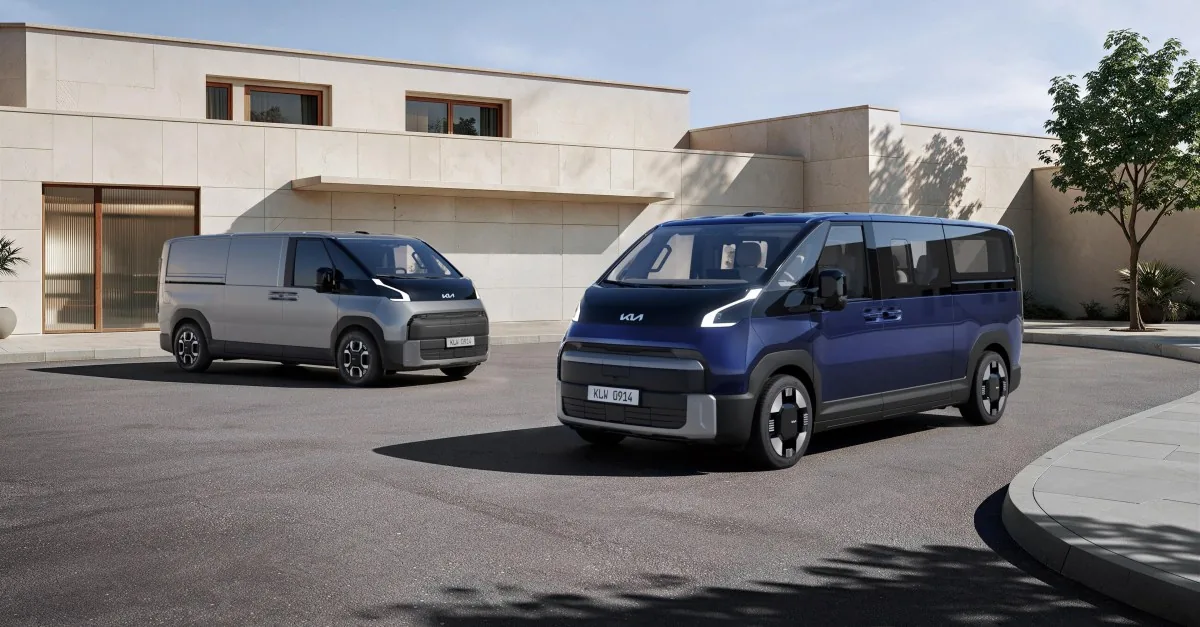
The newly revealed model is considerably larger than the outgoing benchmark. Peter Johnson noted in reporting that the PV7 measures over 17.5 feet (5,350 mm) long, stretching roughly two feet beyond the smaller PV5, which measures 4,695 mm in length. Both vehicles share Kia’s Platform Beyond Vehicle architecture, built upon the dedicated E-GMP.S framework (a dedicated modular electric skateboard) designed with an entirely flat floor to accelerate daily loading operations. That structural foundation allows fleet managers to reconfigure body modules while preserving the core cab structure. [1, 2]
Kia president and CEO Ho Sung Song emphasized in Hanover that the automaker engineered the PV7 specifically for European commercial transport fleets. [2]
Kia Electric Van Battery and Charging
Energy storage choices dictate real-world commercial viability, and Kia provides two distinct nickel-cobalt-manganese battery capacities to balance curb weight against maximum driving range. Buyers can specify an entry-level 71.5 kWh battery pack or step up to a heavy-duty 96.2 kWh configuration for long-distance commercial freight routes. Kia claims the Long Range Cargo variant achieves 460 km (285.8 miles) of operational range when evaluated under the worldwide harmonized light vehicles test procedure, known as WLTP (the European laboratory testing procedure for vehicle efficiency). As industry analysts observe, European WLTP estimates typically yield ratings that are 10 to 20 percent more generous than testing cycles conducted by the EPA in the United States. Dual battery sizes let operators balance payload against daily operating range across regional trade corridors. [1, 2]
Fast charging minimizes fleet downtime during busy delivery shifts. The PV7 adopts an advanced 800-volt electrical architecture, permitting connection to ultra-fast 350 kW DC commercial chargers. Under optimal conditions, the high-voltage system recharges the pack from 10 to 80 percent in under 25 minutes. Rapid charging preserves turnaround times. Integrated vehicle-to-load hardware powers exterior work gear through cabin and cargo outlets (vehicle-to-load bidirectional charging outlets) capable of operating heavy trade machinery at remote job sites. [1, 2]
Charging flexibility directly impacts overall fleet efficiency. Because commercial operators cannot afford lengthy idle periods, pairing 800V architecture with high-output charging stations ensures delivery schedules remain uninterrupted throughout demanding multi-stop metropolitan routes. The platform skateboard positions heavy battery cells low between the axles. That packaging lowers the center of gravity while protecting delicate battery modules from road debris and loading dock impacts during intensive parcel handling. [1]


Cargo Volumes and Modular Passenger Layouts
Commercial parcel carriers demand configurable interior volume to suit diverse business requirements. Reporting published by Electrek shows that the PV7 Cargo model accommodates either 2-seat or 3-seat cabin layouts, creating a cavernous cargo area delivering up to 6.1 cubic meters of storage volume. A dedicated High Roof variant expands storage capacity up to 8 cubic meters for tall freight. Generous volumetric capacity accommodates standardized shipping pallets without compromising driver ingress or cabin ergonomics. Selecting a specialized Kia electric van configuration allows courier services to tailor roof height to urban garage constraints. [2]
Passenger transportation represents the second major pillar of the PV7 platform. In international markets, the Passenger version functions as an airport shuttle or family transporter accommodating up to nine passengers in multi-row seating. In South Korea, Kia plans an 11-seater derivative designed to serve local group transit networks. Large windows and tall interior proportions create an airy ambiance that counters the cramped impression typical of utilitarian utility vans. [1, 2]
The passenger and cargo versions mark the starting wave of a sprawling model rollout. Kia plans to introduce 23 distinct PV7 variants across the vehicle’s lifecycle, adapting chassis lengths, roof heights, and interior cabinetry. Modular vehicle architecture enables multiple commercial body conversions from a single manufacturing template. The Korean brand first demonstrated that swappable body philosophy during CES 2024, showing how a fixed front driver cab could connect to interchangeable rear passenger or cargo modules like interlocking blocks. [1, 2]
Powertrain Specs and Pleos Cabin Software
Digital services inside the driver cab leverage Kia’s latest operating system. Infotainment hardware runs on Pleos Connect OS, an operating environment built on Android Automotive that integrates commercial routing and fleet telematics directly onto the central dashboard display. Natural-language voice inputs run through Gleo AI, allowing delivery drivers to alter navigation destinations and monitor battery range without lifting their hands from the steering wheel. Hands-free controls enhance safety. The flat dashboard layout and elevated seating posture provide expansive sightlines through the broad windshield glass. [1]
Mechanical power matches the vehicle’s generous cargo ratings. Standard models rely on a front-wheel-drive powertrain delivering up to 268 horsepower (200 kW) and 309 lb-ft (420 Nm) of instantaneous torque, providing strong low-end acceleration when pulling away from delivery hubs under full payload. Kia plans to introduce an all-wheel-drive variant later in the production lifecycle to assist fleets operating across snowy climates. Electric torque delivery ensures consistent urban maneuverability when the Kia electric van navigates tight city loading alleys. [1, 2]
Exterior styling moves away from traditional slab-sided cargo vans through purposeful geometric details. The front fascia adopts a two-tone color treatment featuring a dark upper mask that wraps seamlessly around the glass to create a visor-like profile across the cab. Protective plastic cladding wraps along the lower rocker panels and bumper edges, guarding sheet metal against daily loading scrapes. Squarish multi-spoke wheels distinguish both passenger and cargo variants, giving the commercial workhorse a refined, modern appearance. [1]
Production Timelines and North American Testing
Commercial delivery dates are scheduled for the coming year. Kia officially scheduled the commercial rollout of the PV7 for the second half of 2027 across Europe and South Korea, where dedicated assembly plants will manage primary vehicle manufacturing. The Korean brand chose Hanover, Germany, for the public debut because European light commercial transport represents a massive market for mid-size electrified delivery platforms. Hanover hosted the debut (the German trade exhibition for commercial mobility) to demonstrate ready-to-deploy hardware directly before international fleet operators. [1, 2]
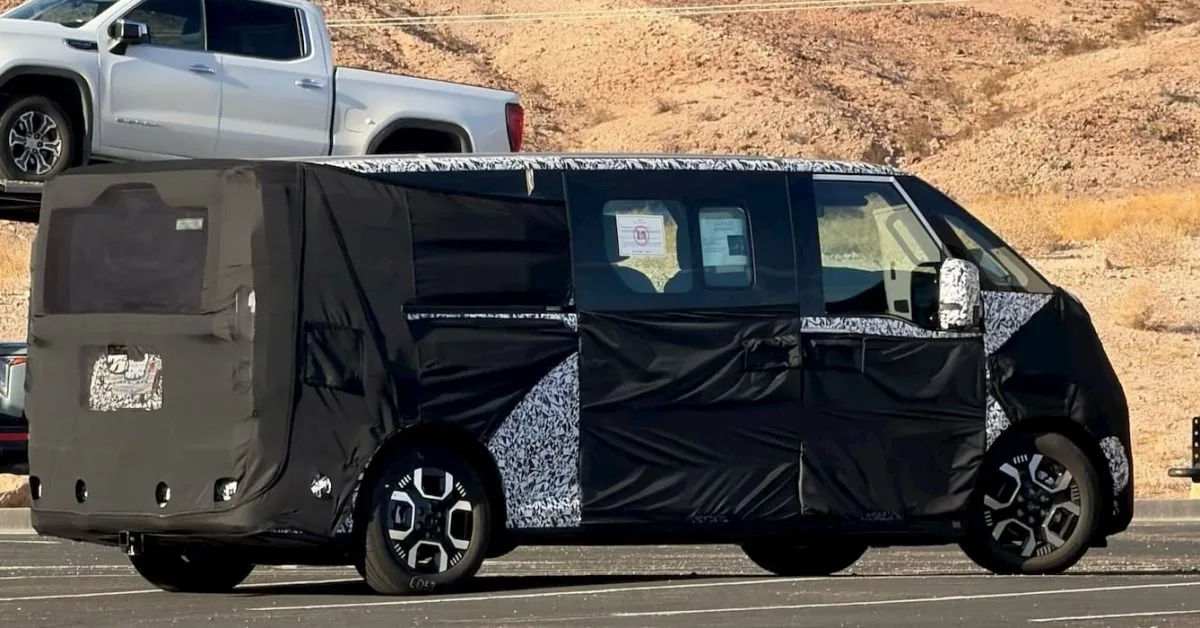
Testing activity has already spilled into North American testing grounds. On the same day Kia unveiled the vehicle in Germany, automotive spy outlet KindelAuto photographed a heavily disguised prototype conducting hot-weather endurance testing across the American desert. On-road prototype testing confirms ongoing technical validation for the broader Kia electric van program across severe North American temperature cycles. While testing sparks speculation regarding a United States release, manufacturing vehicles exclusively in South Korea could expose the platform to import taxes under the Trump Administration. Similar autonomous fleet deployments are reshaping urban streets, as highlighted in PerEXP Teamworks’ reporting on the Waymo robotaxi service launch in Las Vegas. [1, 2]
Will North American logistics operators eventually welcome the modular hauler into active service? The manufacturer maintains that additional overseas markets and derivative conversions will follow the initial Korean and European launches. As the commercial vehicle industry accelerates its transition away from fossil fuels, attention also turns toward upcoming consumer milestones like the second generation Roadster reveal. Official pricing remains unannounced. For fleet managers evaluating total cost of ownership, the arrival of the Kia electric van in late 2027 establishes a formidable benchmark for modular commercial transport. [1, 2]
- ONLINE NEWS Hawkins, A. J. (2026, September 15). Kia’s electric van lineup is getting more interesting with reveal of PV7. The Verge. [Article Link]
- ONLINE NEWS Johnson, P. (2026, September 15). Kia’s new PV7 EV van shows up in the US. Electrek. [Article Link]


