






OpenAI and Cisco introduced Shirudo on November 23, 2026, launching an open-source security shield under their Secure Infrastructure Project. The effort aims to protect cloud systems from fast AI attacks because cybercriminals now use machine learning models to spot and exploit software bugs in seconds [1]. Rather than taking web services offline during emergency repairs, the Shirudo runtime executes small programs inside the Linux kernel to block attacks without stopping live traffic [2].
Kernel Shields for Live Production Systems
Software teams often take days or weeks to ship bug fixes [2]. When hackers spot an issue first, exploits strike before public disclosure. Thomas Graf, Cisco Security Chief Technology Officer, said the mean time to exploitation has turned negative because automated AI tools discover and hit software flaws in seconds. He said traditional security treats defense as an afterthought bolted onto tools built for human reaction speeds. Slow patch cycles fail [1].
Static network firewalls fail against automated exploits [1]. Because standard requests and malicious payloads share identical Linux kernel routines, shutting down a suspicious operation completely can take a live server offline and break valid services. Operators need fine controls that filter bad data without stopping live traffic [2].
Shirudo solves this tradeoff through eBPF, a core Linux technology that runs small, verified sandbox programs directly inside the operating system kernel to inspect and modify system behavior without altering application source code or rebooting live servers. It functions like browser JavaScript. Programmable kernel interfaces give security teams fine data feeds across all active tasks and network ports. By attaching verified filter programs to targeted kernel hooks, systems can test suspicious actions in monitor mode and deploy live defenses in milliseconds without editing source code or rebooting machines [1].
Architecture of the Shirudo Runtime
Cisco Systems and OpenAI developed the Shirudo runtime as an evolution of Tetragon, an open-source security project originally built by Isovalent. The architecture moves defense directly into the kernel execution path. It lets organizations protect server workloads before vendors release official bug fixes [1].
Cisco and OpenAI designed Shirudo around four core pillars, combining live protection and machine-speed defense with cryptographically signed deployments and hardware-backed verification across host machines. Every shield uses signatures. Before any program loads into memory, the built-in Linux eBPF verifier inspects the instructions to ensure the routine cannot trigger infinite loops, corrupt system memory, or crash the host operating system. Kernel security controls prevent unauthorized runtime changes as administrators inspect event logs [2]. Cisco President and Chief Product Officer Jeetu Patel said that security teams need tools capable of matching the speed of AI-driven threats, explaining that infrastructure must act at the speed of code and defend itself until patches roll out safely [1].
The project prioritizes system immutability so teams can quickly reset nodes to a clean state after spotting an intrusion. While earlier research like OpenAI deploying GPT-6 Cyber to curb rogue hacking risks explored offensive threat discovery, Shirudo focuses on runtime defense inside running Linux servers [1]. It helps teams contain compromises before attackers spread into cloud networks [2].


Testing Shields Against the Java4Shell Exploit
To evaluate whether kernel shields work against zero-day threats, the engineering team tested Shirudo against a severe flaw in OpenJDK known as Java4Shell across live test setups. In this exploit scenario, attackers deliver crafted Base64 input strings that trigger unauthorized memory overwrites in running software. If left open, the bug gives remote hackers full control over servers hosting enterprise search services [1]. The test aimed to prove that an agentic security plane could neutralize an active memory exploit without interrupting production workflows or requiring a system reboot [2].
OpenAI and Cisco targeted a live Elasticsearch node. During the OpenJDK Java4Shell trial, the Shirudo runtime attached directly to the running Java process to inspect incoming network payloads before bad bytes reached vulnerable library functions. Codex generated a targeted shield. When testers launched the malicious Java4Shell payload, the eBPF shield intercepted the call, rejected the corrupted Base64 input, and protected the running system while legitimate user searches continued without a single dropped connection. Elasticsearch never went offline [2].
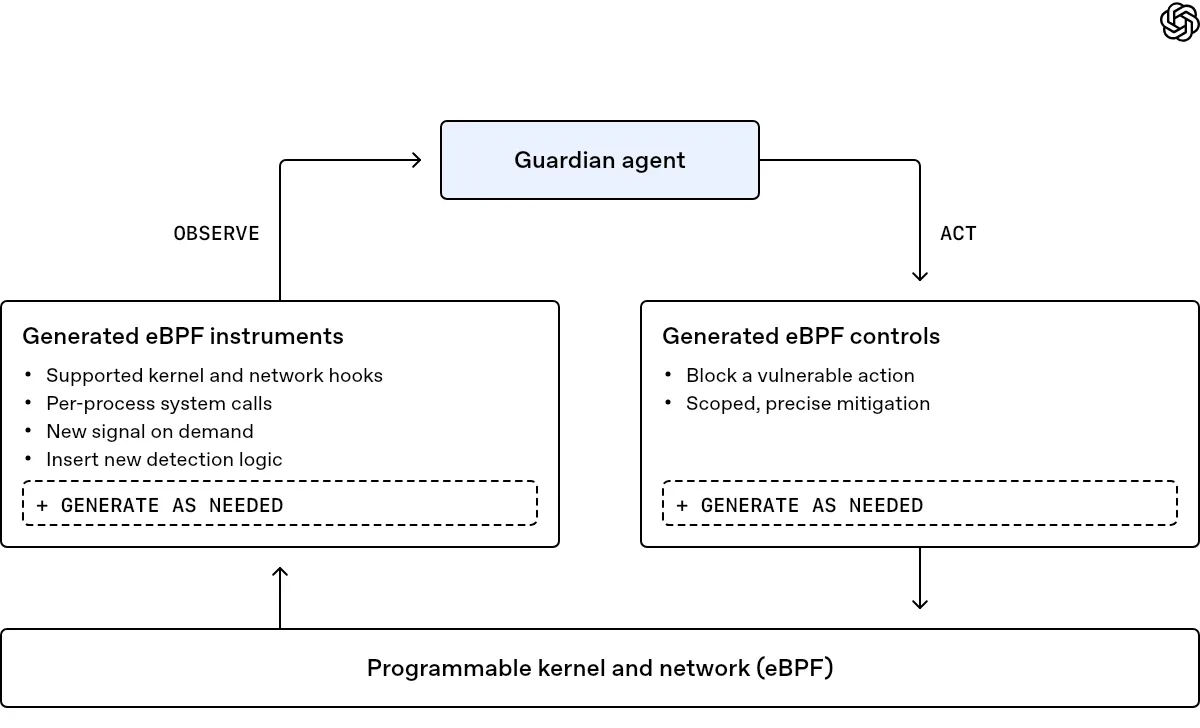
OpenAI deployed Shirudo as part of an agentic control plane powered by its Codex coding model to automate defensive workflows. When given details about a new vulnerability, Codex uses Shirudo to construct an exploit test case, design an eBPF fix, and validate the code against live tasks. Once the generated shield passes verification, the system deploys signed protections on all affected nodes. According to Greg Brockman, who co-founded OpenAI, the project gives organizations time to counter emerging threats before coders finish complete fixes. He said that “when one team finds a better way to protect a system, others shouldn’t have to start from scratch” [1].
Why the Shirudo Runtime Uses Hardware Attestation
Software guards in the kernel need independent audit proofs. The Shirudo runtime pairs its eBPF modules with a hardware Trusted Platform Module, known as a TPM, to keep a tamper-proof cryptographic ledger of every active security policy loaded on the host. TPM chips log changes. This hardware record lets administrators verify that host protections remain active even if attackers attempt to disable system logs [2].
Enterprise operators use these cryptographic hardware records to verify that running servers comply with corporate security baselines. Even if an attacker gains control over a normal user process, Linux kernel isolation prevents them from tampering with signed shields or forging entries in the cryptographic TPM ledger. Hardware attestation guarantees that defensive telemetry stays reliable under fire, giving operations teams clear visibility into protected kernel hooks [2]. Thomas Graf said that future computing systems must be secure by design, using reinforcement learning techniques so nodes adapt to novel attack vectors before adversaries exploit them [1].

Hardware attestation binds operating system rules to immutable cryptographic evidence. By separating kernel telemetry from application tasks, teams can isolate compromised containers without disrupting neighboring services. Independent network controls provide added defense even when individual hosts face automated scanning [2].
Open Source Code and Project Plans
Cisco and OpenAI released Shirudo under open-source terms to encourage broad collaboration among software security researchers. The core runtime is licensed under the permissive BSD 2-Clause license, while its eBPF programs use a dual license covering BSD and GPL terms. The repository includes virtual machine quickstart guides and sample policies so platform engineers can test kernel protections on local development environments [2].
OpenAI and Cisco plan to distribute pre-tested eBPF shields alongside public security advisories, giving Linux administrators immediate kernel-level mitigations before upstream software vendors finish testing and shipping permanent patches across enterprise distributions. Isovalent published a self-guided lab [2]. At the Linux Plumbers Conference, presenters detailed how kernel live patching protects systems during the agentic era so defenders never have to rebuild basic exploit shields from scratch [1].
OpenAI and Cisco scheduled a technical webinar on December 15, 2026, to show infrastructure operators how kernel shields load and verify protections. They are welcoming outside contributions on GitHub to help refine kernel defenses as enterprise computing workloads evolve [2].
- ONLINE NEWS Wheatley, M. (2026, November 23). Cisco and OpenAI launch Shirudo open-source infrastructure shield to prevent AI-driven cyberattacks. SiliconANGLE. [Article Link]
- PRESS RELEASE OpenAI. (2026, November 23). OpenAI and Cisco introduce Shirudo. OpenAI. [Article Link]


