





Signal has introduced new default safeguards that block screen capture on mobile devices to stop operating system artificial intelligence assistants from reading private conversations. The encrypted messaging service announced on Friday that the protections take effect on Apple devices running iOS 27 and activate on supported Android releases when an on-device assistant attempts to inspect display contents. By disabling Signal screenshots, the platform seeks to keep native tools like Apple’s Siri AI and Google’s Gemini Intelligence from harvesting sensitive chats for cloud processing [1].
Why Signal Screenshots Are Blocked by Default
In a blog post explaining the change, Signal President Meredith Whittaker said on-device artificial intelligence bots scan displays to learn user habits, collecting personal information to answer prompts or carry out automated routines. When an assistant reads an active chat window, decrypted text can travel to remote cloud servers that sit outside Signal’s infrastructure. “Right now, these agentic AI integrations are changing this environment in a way that’s making it increasingly hostile to privacy,” Whittaker wrote [4].
Signal told Reuters that pervasive system assistants pose an existential threat to personal privacy. The new mobile restrictions mirror steps the team took last year when it blocked Microsoft’s Recall feature from capturing automatic desktop snapshots on Windows 11 [1]. Because system-level assistants operate with broad platform access, they can view plain text the moment a recipient opens a message [2].
Modern smartphones rely on assistant software that attempts to anticipate user needs by analyzing active application windows, scheduled calendar entries, and incoming text. While these automated assistants promise everyday convenience, they create a persistent privacy leak by turning temporary on-screen text into stored training material or server logs [1]. Signal built its global reputation on end-to-end encryption, ensuring that only the sender and receiver possess the cryptographic keys needed to decode private conversations during transit. Yet that mathematical guarantee offers no shield once text renders visibly on glass, because any background service with display-reading privileges can capture the unencrypted characters before a user even responds. Whittaker stressed that when artificial intelligence systems continuously capture display data to fulfill automated user requests, the distinction between private communications and public training data begins to blur, eroding user trust in secure messaging applications [4].
How Operating System Assistants Bypass Encryption
John Strand, chief executive officer of Black Hills Information Security, explained that encryption protects data while moving between devices, but can’t protect information once it displays on a screen. “So, if an AI agent can access screenshots or directly observe what’s happening on your screen, it can read those messages without ever having to break the encryption itself,” said Strand. “That’s the scary part. You can have incredibly strong encryption, but if something can see what the user sees, that encryption isn’t going to protect you at that point,” Strand added. He warned that the worst-case scenario involves automated scrapers capturing everything a user sees, from private conversations to sensitive account passwords [4].
Third-party software poses similar hazards. Reuters reported that Meta’s Muse assistant accessed Signal messages through permissions granted during initial device setup. On Android hardware, Muse extracted message text from incoming notifications, while on Mac computers it relied on broad accessibility permissions that Signal described as a skeleton key [1]. Meta claimed Muse only collected data after explicit user consent, but the incident showed how third-party background agents exploit standard system permissions to circumvent chat security [2].
Mobile platforms have tried to balance automated protection with user boundaries. Earlier platform updates showed how the Android system adds AI defenses against messaging scams, but background assistant scanning still presents an unresolved exposure path for private conversations [1].


Settings Across iPhone and Android
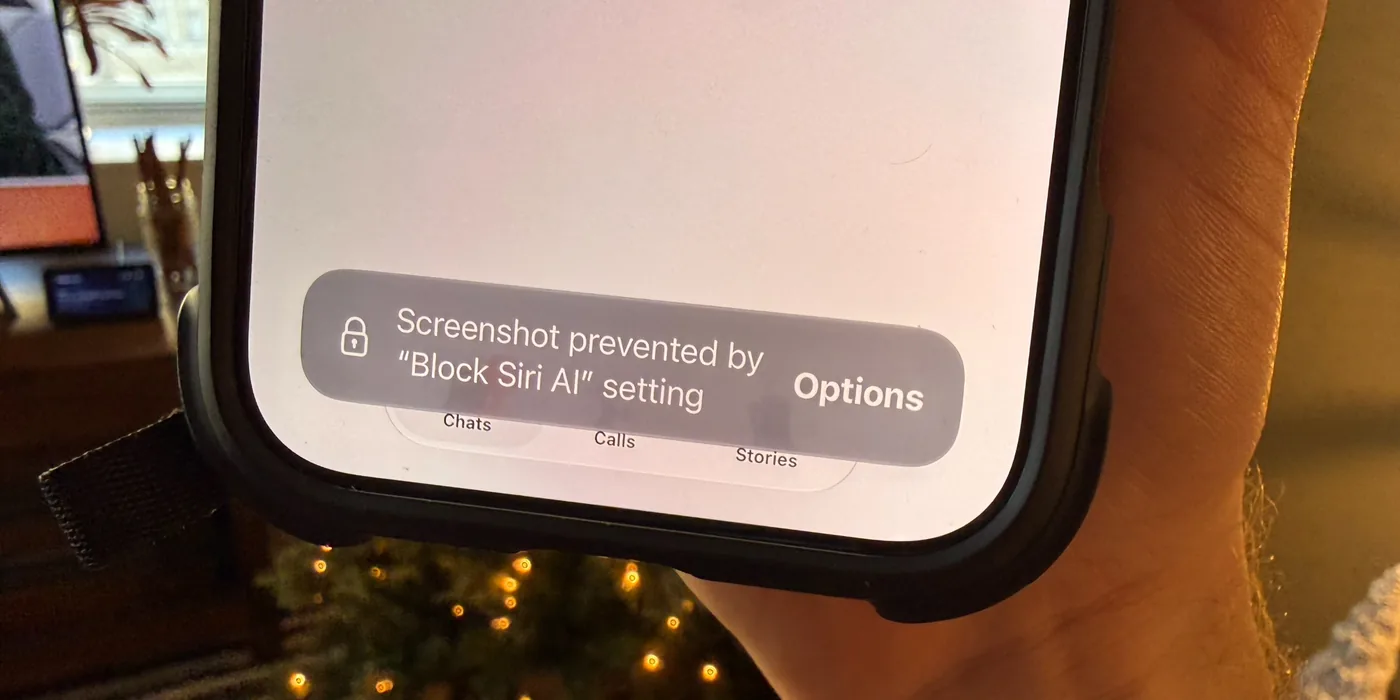
The rollout implements different controls depending on the underlying operating system. On iPhone hardware running iOS 27, Signal added a setting labeled Block Siri AI that turns on automatically upon updating the app. When an iPhone user attempts to take a manual screen grab while the setting remains active, an on-screen alert states that the action was prevented by the new setting [3].
9to5Mac reporter Arin Waichulis observed that the in-app toggle blocks more than standard image captures. According to Signal’s menu description, the feature prevents Apple’s assistant from scanning conversation content while also stopping screen capture within both the main chat window and the iOS App Switcher. Users who want to share a conversation snippet can turn off the restriction inside Signal’s privacy settings [3].
Apple allows device owners to exclude specific apps from assistant access, an option that became simpler to configure in iOS 27.2. Earlier platform policy adjustments showed that Apple updates App Store rules to ban AI nudify apps, yet Signal decided against relying solely on Apple’s system menus [3]. On Android, Signal ties its defense to the existing Screen security feature, which triggers protection whenever Google’s Gemini Intelligence or another assistant attempts to read display data [1].
Limitations of Signal Screenshots Protections
While blocking Signal screenshots shields a local display, the defense can’t guarantee complete privacy across every communication scenario. If a contact on the other end of an encrypted conversation turns protection off, an assistant running on their phone can still read and process shared text [1]. In addition, screen-blocking toggles do not stop third-party agents from reading unencrypted notification previews or scanning unprotected local device storage [2].
The gap is particularly noticeable on desktop hardware. Signal noted that Apple’s macOS provides no reliable mechanism for developers to block screen grabs without degrading the application [1]. In her blog post, Meredith Whittaker explained that operating system vendors don’t provide a way to restrict automated assistant access “without making drastic compromises to the core user experience,” leaving Signal unable to implement equivalent screenshot blocks on Mac computers [4].
The dilemma mirrors controversies surrounding AI glasses, which record bystanders in public spaces without consent and face bans in courtrooms and schools. A single unprotected participant in a group chat can inadvertently expose decrypted messages to external processing [1].

Calls for System Controls From Tech Giants
Signal argues that device makers must build standardized, system-level toggles so developers can opt out of artificial intelligence observation entirely. Meredith Whittaker wrote that tech companies need to provide clear documentation regarding how native assistants operate, with straightforward developer controls that isolate third-party apps from background scanning. “Even where we are able to detect and block AI data access, Google, Apple, Microsoft and others do not provide ways for developers to easily restrict such AI data access without making drastic compromises to the core user experience,” Whittaker said. Without standardized platform hooks, independent developers must resort to blunt workarounds like blocking manual screen captures to keep user data private [4].
Signal confirmed it is currently in discussions with Apple and Google regarding better developer controls, expressing cautious optimism about future operating system changes [1]. John Strand of Black Hills Information Security explained that Signal acted to exhaust all available safeguards against automated scrapers [4]. For now, users who manage Signal screenshots must weigh the convenience of taking fast screen grabs against the risk of exposing private chats to on-device assistants [3].
As smartphone makers continue embedding autonomous agents into core operating software, private messaging faces new scrutiny. Signal, Apple, and Google did not respond to requests for comment before publication [4]. Until platform vendors establish unified privacy switches, users who prioritize confidentiality will need to navigate app-specific settings to keep their personal conversations away from on-device artificial intelligence systems [1].
- ONLINE NEWS Shanklin, W. (2026, November 20). Signal now blocks screenshots by default to stymie AI agents. Engadget. [Article Link]
- ONLINE NEWS Uth, M. (2026, November 20). Signal blocks screenshots on iOS 27 and Android to stop AI agents from reading private chats. The Decoder. [Article Link]
- ONLINE NEWS Christoffel, R. (2026, November 20). Signal now blocks screenshots on iPhone to stop Siri AI from seeing chats. 9to5Mac. [Article Link]
- ONLINE NEWS Milden, D. (2026, November 20). Signal is blocking screenshots to protect your messages from AI agents. CNET. [Article Link]


