





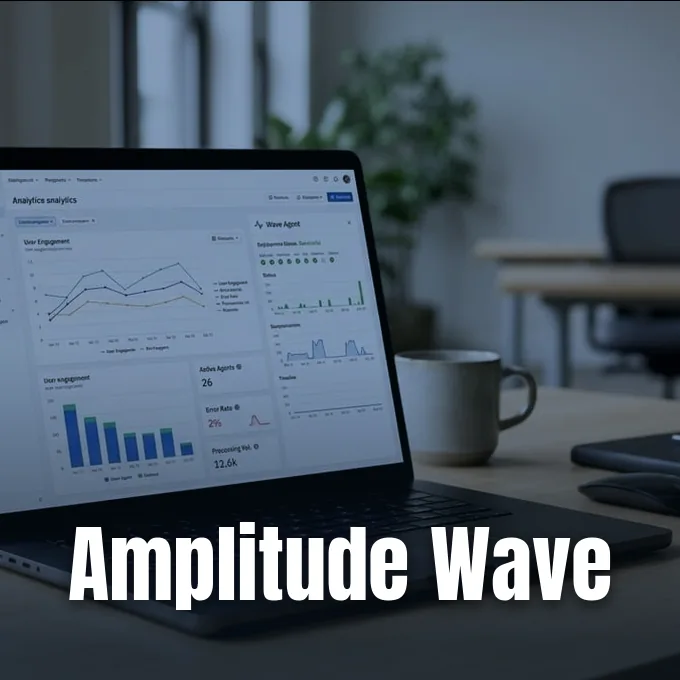
Amplitude rolled out a proactive product tool called Wave on November 12, 2026, aiming to compress software update cycles from weeks to just one or two days [1]. The platform runs roughly 80 percent on OpenAI models and monitors how people interact with apps to spot where users get stuck [2]. Rather than waiting for product managers to pull reports and file tickets, Amplitude Wave drafts plans, hands them to coding tools like Codex, and verifies the outcome once changes go live. Spenser Skates, CEO of Amplitude, said the setup lets artificial intelligence take on real engineering work: “AI can now find useful work we never thought to assign it. OpenAI’s models can investigate a problem, write and run code, and use the results to decide what to try next” [4].
How Amplitude Wave Works
Most software teams still rely on slow, step-by-step processes to update web apps. A product manager spots a problem in user data, files a ticket for an engineer, waits for a sprint cycle, and then asks an analyst to check the impact weeks later [1]. Amplitude Wave connects those disconnected steps into a single loop that runs in 48 hours [3]. It reads analytics logs, watches session replays, and reads code repositories to find real points of user friction [2]. The tool doesn’t just display graphs on a screen; it decides what problems matter most and outlines the code needed to fix them [3].
When the system spots an issue, it creates a blueprint with clear acceptance criteria and passes it straight to Codex and other coding agents [4]. Engineers review the pull requests before merging, but the routine drafting is already done [1]. For small bug fixes, teams let the agent push updates without waiting for multi-week planning meetings [3].
Closing the loop requires checking whether an update actually solved the problem. Standard analytics tools are passive because they sit idle until an employee asks a specific question [5]. Wave operates in reverse by watching production metrics right after deployment to verify if user behavior changed as predicted [1]. Judy AI Lab observed that connecting discovery, coding, and verification into one continuous workflow gives every code change an automatic feedback signal [5].
The Three AI Models
Amplitude built its agent using a split architecture that assigns different tasks to different OpenAI models based on reasoning power, latency, and cost [6]. Deep data investigations and codebase reviews run on GPT-6.1 Sol, which serves as the core reasoning engine [2]. This model powers Wave’s Opportunity Investigator, combing through massive volumes of user analytics, session replays, and underlying code to uncover why visitors abandon specific features [4]. By focusing on root causes rather than surface symptoms, the system formulates detailed technical blueprints that human engineers and coding tools can review with full contextual evidence [6].
Not every task needs a heavy reasoning engine. Amplitude routes lighter, high-frequency jobs to GPT-6 Luna, which scans code and runs quick evaluation checks without driving up cloud bills [2]. Visual mockups and user interface wireframes run through GPT-Image-2.5 Flare, which uses screenshots from session replays as references [4].
This multi-model pipeline lets Amplitude manage latency and compute costs while maintaining solid output. Skates explained why pairing large and small models is central to the strategy: “OpenAI gave us both strong reasoning models and smaller, faster models, so we could balance quality, latency, and inference cost across the product” [4]. By avoiding a one-size-fits-all model setup, the company keeps running costs sustainable as more automated runs deploy each week [6].


Homepage Test Results
To test the agent under real conditions, Amplitude deployed Wave onto its own corporate homepage to evaluate how it handles live user interaction bottlenecks. The page featured suggestion cards intended to prompt visitors into starting a chat with an AI assistant. When the engineering team looked at a sample of 100 session replays, they discovered a glaring mismatch: 80 visitors skipped the prompt cards entirely to type their own text, while only 12 users clicked a card [4]. The generic prompts sat on the screen largely unused [6].
Amplitude Wave diagnosed the issue and suggested personalizing the cards based on recent charts, user dashboards, or the page the visitor had just left [4]. The team approved the blueprint and passed the task to a coding agent for an A/B test [6]. Message volume sent through homepage suggestion cards jumped by 160% compared to the control group within a single day [4].
Eric Carlson, Senior Principal AI Engineer at Amplitude, pointed out that teams usually neglect these small friction points: “It is a great example of how non-groundbreaking things that just get ignored can increase the adoption of features in unexpected ways” [4]. Automating the search for subtle flaws allows engineering teams to resolve blind spots that human roadmaps miss [1].
Investigation Benchmarks for Amplitude Wave
Selecting the right foundation model required rigorous benchmark testing across accuracy, speed, and cost. In Amplitude’s internal tests for the Opportunity Investigator, GPT-6.1 Sol secured an overall score of 4.06 out of 5 [4]. That performance placed it well ahead of three competing models, which scored 3.62, 3.52, and 2.94 on the same test suite [2]. The results gave the team confidence to let the model make automated diagnostic judgments without constant manual oversight [6].
The model led across all five investigation criteria evaluated by the team (corroboration, avoiding false positives, incorporating evaluator feedback, recovering from tool errors, and aligning evidence) while posting a median investigation time of 54 minutes [2]. In a separate evaluation of the Data Science Agent, GPT-6.1 Sol scored 67.5 out of 100, just behind a competing top model that posted 69.3. However, the OpenAI model achieved that score at a mean dispatch cost of $1.28 compared to $2.63 for the rival system, making it twice as cost-effective for high-volume automated analysis [4]. That cost advantage allows teams to run continuous scans across massive user datasets without exceeding operational budgets [6].
Real-world delivery metrics confirm that Amplitude Wave accelerates software deployment schedules. Among customer-launched experiments, feature flags, and guides, one in four went live the exact same day Wave identified the opportunity [4]. Half of all updates shipped in less than four days, and two in three were running live within a single week [2].

Workflow Risks for Software Teams
Compressing development cycles down to 48 hours introduces practical trade-offs that software teams must navigate. Shortening the release window gives engineers far less time to spot subtle edge cases, review third-party dependencies, or run thorough security audits before code reaches production. While Amplitude uses automated checks to validate pull requests, the company hasn’t disclosed its failure rates or explained how frequently human developers must intervene to correct bad suggestions [3].
Market pressures are driving software vendors toward autonomous engineering workflows despite these challenges. OpenAI reported quarterly revenue of $10 billion in the third quarter of 2026, marking a 50% increase over just three months as enterprise customers embedded AI agents into everyday operations. Companies are moving beyond pilot chatbots to deploy tools that generate real business value, such as OpenAI acquiring travel startup Odessia and rolling out business profiles in ChatGPT to expand its reach [3].
This expansion connects to broader infrastructure evolutions across the AI ecosystem, including when OpenAI adopted offline training for frontier AI models to manage resource demands. As enterprise adoption expands, Amplitude Wave shows how analytics platforms are turning into active product builders [1]. Skates outlined that long-term direction when describing his company’s roadmap: “Our ambition with OpenAI is to make self-improving products the way companies build software” [4].
- ONLINE NEWS Muralidharan, S. (2026, November 12). Amplitude Ships Product Improvements in 1-2 Days With OpenAI. Emergent. [Article Link]
- WEBSITE daily.dev. (2026, November 12). How Amplitude ships product improvements in 1–2 days with OpenAI. daily.dev. [Article Link]
- ONLINE NEWS Oretan, B. (2026, November 12). Amplitude Cuts Product Cycles to 2 Days With OpenAI Agents. The Tech Buzz. [Article Link]
- ONLINE NEWS Newsroom America. (2026, November 12). Amplitude’s Wave Agent Cuts Product Improvement Shipping Time to 1–2 Days Using OpenAI Models. Newsroom America. [Article Link]
- WEBSITE Judy. (2026, November 13). Amplitude Cuts Its Product Improvement Cycle to 1–2 Days With OpenAI. Judy AI Lab. [Article Link]
- ONLINE NEWS Ashfaq, M. M. (2026, November 12). How Amplitude Ships Product Improvements in 1–2 Days Using OpenAI Models. Cyberoly. [Article Link]


