






How do orbital flight programs sustain round-the-clock research while cycling astronaut rotations across continents? The international expedition designated as SpaceX Crew 13 reached its primary operational staging site as four astronauts touched down safely at NASA’s Kennedy Space Center on Saturday, Sept. 26, to begin preflight tasks. Flying aboard transport aircraft directly from Johnson Space Center in Houston, the multidisciplinary flight crew arrived to initiate intensive equipment reviews, suit pressurization checks, vehicle simulations, and comprehensive briefings with launch managers. Flight controllers established the targeted liftoff time for no earlier than 11:10 a.m. EDT on Thursday, Oct. 1 [1].
When Does SpaceX Crew 13 Arrive at Kennedy?
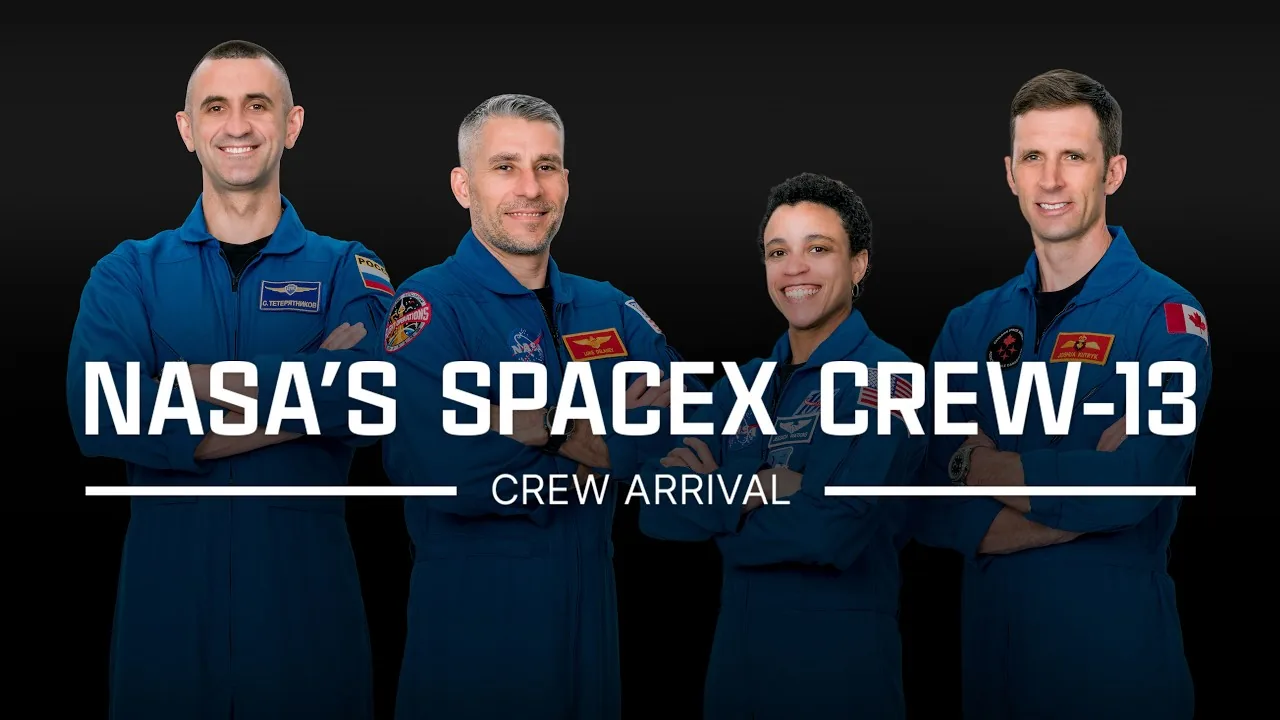
The four flight crew members of the SpaceX Crew 13 mission arrived at Kennedy Space Center at approximately 1 p.m. EDT on Saturday, Sept. 26. NASA astronauts Jessica Watkins and Luke Delaney, CSA Canadian Space Agency astronaut Joshua Kutryk, and Roscosmos cosmonaut Sergey Teteryatnikov traveled from Johnson Space Center in Houston to commence final preflight operations. After landing on the runway, the four crew members delivered brief remarks and answered questions from media representatives before transferring into the Astronaut Crew Quarters at Kennedy [1].
Their arrival marks the formal beginning of an intensive period dedicated to suit checks, technical equipment reviews, and comprehensive mission briefings as the team prepares for launch. Flight surgeons enforce strict quarantine protocols to safeguard the health of the crew and prevent biological contamination aboard the International Space Station. Ground teams previously completed weeks of vehicle simulations and readiness milestones leading up to launch [1].
NASA will broadcast the flight crew’s arrival live at Kennedy across official agency platforms, including the Kennedy Space Center YouTube channel [1].
Why Did NASA Use SpaceX?
NASA contracted commercial launch providers like SpaceX to establish dependable domestic transportation to low Earth orbit under the agency’s Commercial Crew Program. By procuring commercial rotation services rather than developing and operating expensive government-owned booster systems, the space agency substantially lowered transportation expenditures while guaranteeing continuous American scientific access aboard the International Space Station. These commercial partnerships preserve critical institutional funding and technical expertise for ambitious deep space initiatives, including lunar exploration under the Artemis program and future journeys toward Mars [2].
NASA expanded these commercial arrangements as the agency awarded SpaceX additional station flights to ensure robust scientific productivity aboard the complex through the decade. Continuous commercial access guarantees that multidisciplinary science teams conduct hundreds of microgravity investigations each year that generate tangible technological benefits for people on Earth. Regular orbital flights ensure dependable crew handovers for long-duration science expeditions. Commercial flights support Expedition 75 [2].
NASA SpaceX Crew 13 Prepares for October Liftoff
Launch controllers configured ground support infrastructure at Kennedy Space Center to support liftoff targeted for no earlier than 11:10 a.m. EDT on Thursday, Oct. 1. The upcoming flight sends the four astronauts on a rendezvous trajectory toward the complex. Preflight activities build upon extensive simulation drills conducted jointly between flight control specialists in Houston and engineering personnel at Kennedy Space Center. The target time is 11:10 a.m. Engineering teams monitor launch pad systems, propellant loading interfaces, and atmospheric weather conditions throughout each phase of the formal countdown sequence [1].
The four flight crew members observe strict health isolation inside the Astronaut Crew Quarters at Kennedy while reviewing orbital timelines and docking parameters. NASA coordinates public updates on the mission blog, the agency’s @NASAKennedy account on X, and the official Kennedy Space Center Facebook page. These operational preparations parallel the transition milestones detailed in the Crew-12 operational return briefing, which established departure protocols for the preceding station crew. Coordinated orbital handovers require disciplined scheduling between departing and arriving teams to maintain seamless research continuity, robust life support monitoring, and uninterrupted engineering coverage as international flight controllers manage round-the-clock science operations and laboratory systems aboard the orbiting microgravity outpost [1].



Who Are the SpaceX Crew 13 Astronauts?
The flight roster pairs NASA astronauts Jessica Watkins and Luke Delaney with CSA astronaut Joshua Kutryk and Roscosmos cosmonaut Sergey Teteryatnikov. Each crew member brings specialized technical training required to manage orbiting laboratory systems, operate robotic manipulation arms, and oversee scheduled scientific investigations aboard the International Space Station. Watkins provides veteran operational leadership from prior long-duration missions, while Kutryk represents the Canadian Space Agency under international flight exchange agreements that integrate partner specialists into expedition crews [1].
Delaney collaborates closely with Watkins during dynamic flight phases, including automated approach maneuvers, docking sequences, and routine station maintenance. Teteryatnikov oversees navigation telemetry, electrical distribution, and hardware compatibility across the Russian operational segment of the complex. Comprehensive flight integration training prepared all four crew members to coordinate technical responses swiftly when addressing potential microgravity anomalies or unexpected pressure fluctuations during orbital operations [1].
The four specialists completed months of rigorous training across simulation facilities at Johnson Space Center in Houston to master emergency egress procedures and orbital docking logistics. The quartet arrived on Saturday. Their arrival at Kennedy marks the final countdown phase before the four astronauts embark on their scheduled six-month mission advancing multidisciplinary scientific research aboard the orbiting outpost [1].
Crew 14 Assignments Expand Orbital Science Expedition
NASA officially announced flight crew assignments for its subsequent orbital rotation, designating four experienced crew members from three space agencies to launch on the SpaceX Crew-14 mission. NASA astronauts Kayla Barron and Chris Birch will serve as spacecraft commander and pilot, joined by mission specialists Makoto Suwa of JAXA and Arutyun Kiviryan of Roscosmos. Targeted to launch no earlier than spring 2027, the long-duration expedition will dock with the space station to join Expedition 75/76 for months of scientific investigations. Barron, a U.S. Navy commander who earned submarine qualification aboard the USS Maine, logged 177 days in orbit during Expeditions 66/67 aboard NASA’s SpaceX Crew-3 mission [2].
Birch earned undergraduate degrees in mathematics and biochemistry from the University of Arizona before completing a doctorate in biological engineering at the Massachusetts Institute of Technology. Selected by NASA in 2021, Birch competed on the Olympic Long Team for the 2020 Tokyo Games and taught bioengineering at the University of California, Riverside. She also supported the Orion Program for Artemis II, connecting with ground milestones when flight crews toured vehicle assembly booster stacking at Kennedy. Birch was crew lead for Expedition 72. [2]

Doctor Suwa joined JAXA in 2023. Suwa holds a doctorate in geosciences from Princeton University and worked for the World Bank Group and the United Nations World Meteorological Organization before completing basic training to become certified as an astronaut in 2024. Cosmonaut Kiviryan graduated in 2015. After graduating from Saint Petersburg Suvorov Military School in 2010 and studying at Baltic State Technical University, Kiviryan was selected for the Gagarin Research and Test Cosmonaut Training Center Cosmonaut Corps in 2021. Both specialists make their first spaceflight. [2]
How Long-Duration Station Missions Support Deep Space
For more than 25 years, international crews have lived and worked continuously aboard the International Space Station to advance scientific knowledge and uncover breakthroughs impossible to achieve on Earth. NASA emphasized that researchers aboard the complex conduct ongoing investigations “advancing scientific knowledge and making research breakthroughs that aren’t possible on Earth” across biological and physical domains. Microgravity research reveals cellular behaviors, fluid mechanics, and material transformations that cannot be duplicated under terrestrial conditions, providing invaluable biomedical and engineering insights for global industries. Operating the orbiting complex expands commercial opportunities in low Earth orbit while systematically resolving technical challenges associated with extended human spaceflight across ambitious long-duration exploration envelopes targeted toward deep space [2].
Long-duration station increments serve as essential operational testbeds for exploration architectures that reach beyond low Earth orbit toward ambitious deep space destinations across the solar system, including lunar outposts. Technical demonstrations conducted during station increments generate operational data for landing astronauts on the Moon under the Artemis program and preparing for human missions to Mars. Telemetry evaluations refine life support hardware and environmental control mechanisms needed for deep space transit [2]. The arrival of SpaceX Crew 13 at Kennedy ensures that multidisciplinary microgravity research proceeds without interruption as global space agencies construct the future architecture for planetary exploration [1].
- ONLINE NEWS Costa, J. (2026, September 25). NASA’s SpaceX Crew-13 Set for Saturday Arrival at NASA Kennedy. NASA Commercial Crew Program. [Article Link]
- PRESS RELEASE Low, L. E. (2026, September 24). NASA Shares SpaceX Crew-14 Assignments for Space Station Mission. NASA. [Article Link]
APA 7: TWs Editor. (2026, September 26). NASA’s SpaceX Crew 13 Reaches Kennedy for Station Launch. PerEXP Teamworks. https://perexpteamworks.com/en/spacex-crew-13-kennedy-arrival/


