






Most players open a settings screen only to adjust volume or tweak display resolution before jumping straight into combat, but independent developer Sebastian Gioseffi has turned that preliminary ritual into the entire experience. His newly released title, Video Game Menu: The Game, strips away platforming challenges and narrative campaigns to focus entirely on the familiar digital interface. The project reimagines the traditional video game menu as an interactive sandbox where every slider, checkbox, and toggle produces unpredictable comedic consequences. Sebastian Gioseffi launched the Windows release on Steam on September 26, 2026, accompanied by a 10% introductory discount [2].
Sebastian Gioseffi Launches Video Game Menu Parody
The premise behind the release directly satirizes the exhaustive configuration checklists that modern releases impose on players before gameplay even begins. Rather than treating graphic sliders as mundane chores, Gioseffi elevates them to the primary event. ‘Are you tired of video games constantly pestering you with pointless things like challenges, levels or gameplay?’ the game’s official Steam blurb asks [1]. The promotional text invites players to shed those burdens and revel in navigating endless configuration forms without facing dozens of hours of unnecessary gameplay or complex narrative arcs [2].
Writing for Rock Paper Shotgun, gaming journalist Oisin Kuhnke highlighted how the project captures a beloved gaming pastime: pressing arbitrary buttons in preference menus simply to observe what visual elements change across the monitor. Gamers frequently fine-tune graphic fidelity or mute background music to listen to external podcasts, yet Gioseffi transforms those routine adjustments into self-contained gags. The game rejects tense platforming sequences and thought-provoking puzzles in favor of pure interface navigation [1]. By turning system preferences into core mechanics, the title delivers an unconventional comedy experience that questions why modern digital entertainment demands so much administrative preparation before permitting actual play.
Windows serves as the launch platform. While big productions tout cutscenes, this project remains restricted to nested tabs and diagnostic submenus [2]. Menus represent the entire game [1].
Standard Graphics Options Shift Into Interactive Puzzles
Every player recognizes the standard display configuration screen found in contemporary PC releases, featuring vertical synchronization (v-sync), brightness sliders, and targeted frames per second (FPS) caps. Gioseffi includes these familiar toggles, but each adjustment immediately warps the user interface in unexpected directions. Raising or lowering display parameters alters text alignment and layout stability instead of simply optimizing hardware performance. Players seeking a standard calibration process find themselves trapped in an escalating puzzle of competing visual distortions [1].
Manipulating these options quickly exposes the developer’s satirical intent. Instead of offering transparent graphical fidelity, the software introduces options like screen rotation, a glasses toggle, and a dedicated ‘bloat’ slider that deliberately clutters the viewport with unnecessary diagnostic elements. Toggling these controls alters the visual hierarchy, forcing the user to decipher distorted typography across disorganized panels. Navigating graphic options becomes an obstacle course where every confirmed choice compounds the challenge of locating the next functional submenu [1].
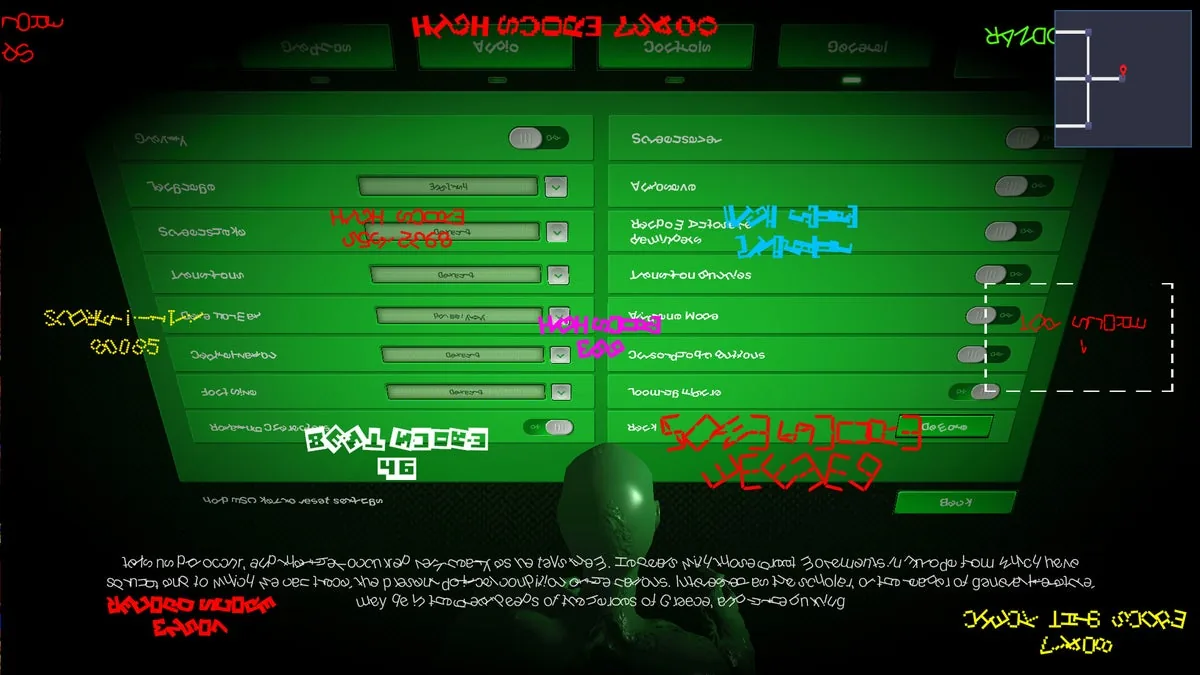
Audio adjustments receive similarly absurd treatment. Modern titles often allow gamers to silence soundtrack tracks to accommodate third-party audio streams, an everyday habit Kuhnke noted when examining the project’s design philosophy. Here, adjusting volume levels or muting specific channels reshapes navigation cues rather than merely attenuating decibels. The project treats player attempts at audio calibration as opportunities for interface subversion [1].

Cursorphobic Buttons Reshape the Video Game Menu Screen
The title reaches peak absurdity when introducing mechanical handicaps designed to frustrate basic cursor movement. Among the most chaotic settings is the ‘cursorphobic buttons’ toggle, which causes selectable icons to actively retreat across the display whenever the user’s mouse pointer draws near. Clicking a target requires timing and positioning strategies akin to competitive action games. In related functionality, approaching text entries causes buttons to shrink in real time, reducing clickable target zones to microscopic dimensions [1].
Another visual distortion involves an ‘airplane mode’ setting. Rather than disabling network connections, enabling this feature superimposes a static graphic (PNG) of a flight cockpit directly across the interface. The cockpit overlays a PNG [1].
Similarly, activating the ‘take off glasses’ switch immediately blurs the entire viewport into an indecipherable wash of pastel colors. Users must navigate purely by memory and intuition, attempting to click obscured buttons without visual confirmation. Layering these chaotic settings creates comedic havoc, transforming what should be a routine configuration process into an unpredictable test of patience [1].
This playful subversion of UI standards highlights the friction between user agency and interface design, reflecting broader discussions across digital platforms where YouTube custom feeds give viewers control over algorithms to reshape layout priorities. In Gioseffi’s satire, user control is pushed to surreal extremes [1].

Hidden Minigames Test Nightmarish Configuration Schemes
Despite the blurb’s insistence that the release contains no conventional challenges, Kuhnke discovered that actual gameplay experiences lurk within the configuration labyrinth. Players navigating through complex dropdown lists occasionally uncover embedded minigames disguised as calibration diagnostics. These brief interactive sequences do not offer standalone adventures, but rather serve as testing grounds for whatever catastrophic visual and mechanical options the player has enabled [1].
Attempting an action sequence while airplane mode obstructs the monitor and cursorphobic buttons flee across the display transforms simple navigation challenges into hilarious ordeals. The minigames force players to live with the absurd consequences of their own customization choices. Minigames function as testing grounds for the self-inflicted interface chaos generated by contradictory settings [1]. Sebastian Gioseffi constructed these interludes to mock how traditional game loops frequently pull players away from enjoying core software design.
By embedding functional play spaces within setup screens, the title presents a rare comedy format that interrogates how modern interfaces either succeed or collapse under excessive options. The satire operates simultaneously as an affectionate homage and an exasperated critique of modern gaming tropes. Players spend substantial time organizing inventories, calibrating controls, and tuning graphical fidelity in contemporary releases [1]. Gioseffi isolates that preliminary commitment, proving that the tools intended to personalize an adventure can easily become an interactive entertainment format on their own.
Steam Discount Accompanies Playable Video Game Menus
Gaming outlet Blue’s News reported that Video Game Menu: The Game arrived on Valve’s digital storefront with an introductory promotional incentive. To celebrate the launch, the game features a 10% discount on Steam, offering budget-conscious players an affordable entry point into Gioseffi’s interface experiment. Steam offers a 10% discount [2].
The release was further showcased through an Official Trailer released on YouTube, where Gioseffi illustrated how quickly an ordinary options screen can deteriorate into absurd chaos. The developer highlighted intricate forms, majestic configuration choices, and scrolling blocks of text that constitute the entirety of the software. Prospective buyers should not anticipate dozens of hours of expansive storytelling or open-world exploration [2]. Instead, Kuhnke described the project as a compact novelty title that delivers brief moments of levity for anyone exhausted by conventional gaming demands and lengthy interactive tutorials [1].
Independent games frequently experiment with interface deconstruction, but few commit to the premise with such absolute dedication as this release. By turning the configuration screen into the complete stage, Gioseffi provides an inventive commentary on the administrative habits of modern gamers [1]. The independent release demonstrates that even the humble video game menu holds comedic potential when freed from the obligation of supporting dozens of hours of traditional gameplay [2].
- ONLINE NEWS Kuhnke, O. (2026, September 26). Video Game Menu: The Game is all about everyone’s favourite gaming pastime: pressing random buttons in the menus and seeing what they change. Rock Paper Shotgun. [Article Link]
- ONLINE NEWS Blue’s News. (2026, September 26). Video Game Menu: The Game released. Blue’s News. [Article Link]


