






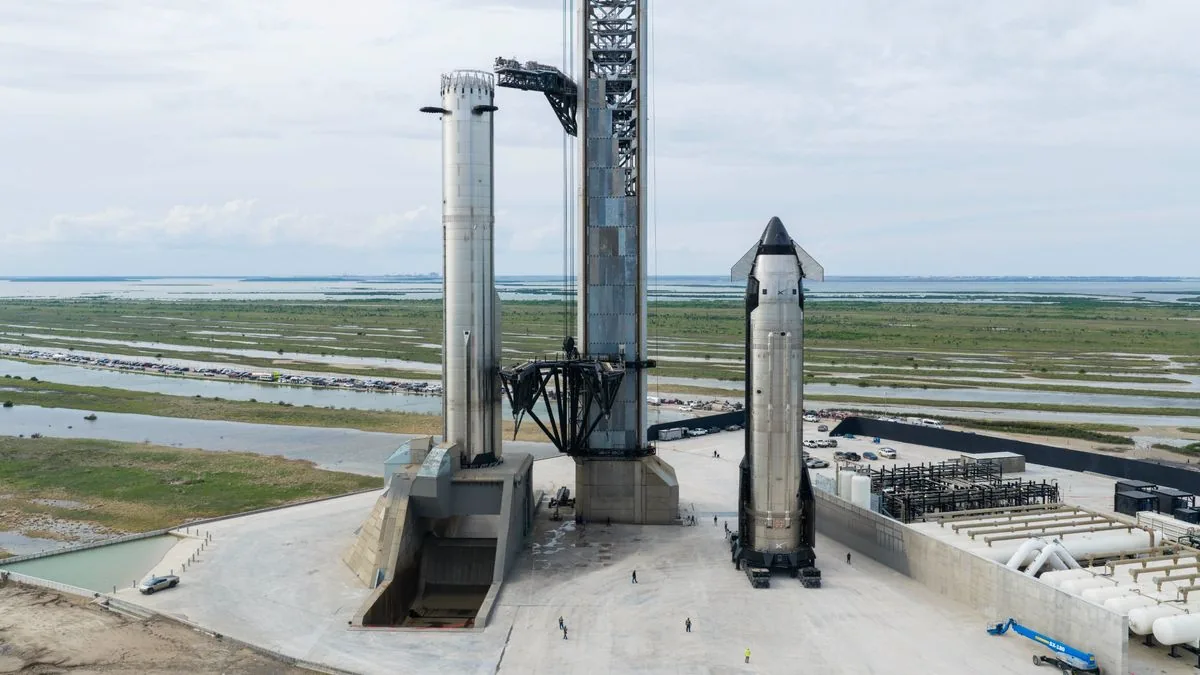
SpaceX is preparing to launch its 124-meter-tall Starship rocket from the Starbase facility in South Texas, scheduling a test flight that aims to recover both flight stages at the seaside launch tower. The mission opens a 75-minute launch window at 16:45 local Texas time (22:45 GMT) on Friday. If successful, this Starship double catch marks the first recovery of both orbital rocket components from the air. BBC News science reporters Rebecca Morelle and Alison Francis reported that NASA is closely watching the flight because the vehicle plays a role in lunar landing plans [1].
Catching Two Flight Stages at Starbase
SpaceX wants to catch both halves of the rocket stack at the Starbase launch tower rather than discarding hardware into the Gulf of Mexico. Launch controllers plan to catch the Super Heavy booster mid-air just six and a half minutes after liftoff, guiding the vehicle back as its Raptor engines slow its descent. SpaceX caught Super Heavy on three earlier test flights. However, Ship 42 faces steeper thermal conditions during reentry [1]. Technicians at Starbase prepared Ship 42 for Flight 15 to test whether the upper stage can survive orbital atmospheric deceleration before meeting the tower arms [3]. Space.com writer Mike Wall reported that SpaceX described the goal in its flight overview. “If successful, this will mark the first full recovery of an orbital launch system and a breakthrough moment in making Starship a reliable, rapidly reusable rocket,” the company wrote [4].
A dual pad recovery would transform spaceflight economics. Prof Malcolm Macdonald, President of the Royal Aeronautical Society, explained the significance of the test. “A successful double catch would be visually spectacular, but full reusability has the potential to fundamentally change the economics of accessing space,” he said. “One successful flight will not prove that model, but it could mark an important transition: from demonstrating that Starship can fly, to demonstrating how Starship could operate,” he added. In 2015, SpaceX vertically landed a Falcon 9 booster for the first time, proving that first-stage rocket recovery was practical and paving the way for an operational fleet that now launches more than one hundred times every year. Starship applies that reuse model to both stages [1].

Flight Path and Chopstick Recovery Sequence
The ascent begins with the ignition of 33 Raptor engines clustered at the base of the Super Heavy booster. The booster produces tremendous liftoff thrust. These 33 Raptor engines push the fully stacked Starship rocket through the atmosphere before stage separation occurs, allowing Super Heavy to flip around and fire its inner engines back to Starbase [2]. Tower arms, popularly nicknamed chopsticks, catch the descending booster as it hovers above the Texas pad [1].
Super Heavy returns to Starbase within minutes. In contrast, Ship 42 follows a prolonged orbital trajectory around Earth, completing 14 full revolutions over nearly 22.5 hours while flight controllers at Starbase monitor vehicle telemetry continuously. SpaceX commits to a tower catch only if all guidance systems function as expected. Sensors monitor tiles [1]. If technicians identify any anomaly during descent, controllers will steer Ship 42 to a controlled ocean splashdown in the Pacific Ocean near Hawaii or Chile [3].
Scientific American writer Lee Billings reported that the Federal Aviation Administration granted the formal launch license on Friday afternoon, clearing the mission after safety reviews. Ship 42 returns Saturday around 16:15 EST (21:15 GMT). Safety rules remain strict because high-speed atmospheric reentry generates severe friction and intense heat across the stainless steel hull. During Flight 14 on September 28, an engine issue forced the upper stage into the sea while the Super Heavy booster splashed down in the Gulf of Mexico [2]. Engineers reviewed data from earlier Starship test flight milestones to refine landing software before authorizing this mission.
How Starship Double Catch Testing Alters Orbit Profiles
Ship 42 carries 26 Starlink V3 satellites. These spacecraft represent the second production batch of heavier broadband satellites built by SpaceX to expand its internet constellation [3]. Deployment begins roughly 35 minutes after liftoff and unfolds during a 42-minute window as the upper stage traverses low Earth orbit above the Pacific Ocean [4]. Mechanisms operate smoothly under zero gravity. This payload release during the Starship double catch provides vital performance data for future SpaceX launches [2].
Technicians stenciled the phrase “Don’t panic” onto Ship 42 before rollout. The wording pays tribute to Douglas Adams’ science fiction classic The Hitchhiker’s Guide to the Galaxy, where the phrase adorns the cover of a travel guide. In that novel, the Deep Mind supercomputer calculates for 7.5 million years to solve the fundamental riddle of existence, concluding that the final answer is 42. Elon Musk has cited the book in his career. During the debut of Falcon Heavy in February 2018, SpaceX launched a red Tesla Roadster carrying a mannequin named Starman into solar orbit with those same words displayed on its screen [3].
Confidence at Starbase is high ahead of the launch. Elon Musk discussed mission expectations during the third-quarter earnings call for SpaceX last month. “I’d say it’s more likely than not that this succeeds next flight,” Musk said [3]. Earlier flights resolved cryogenic pressure drops. SpaceX gathers extensive telemetry on cryogenic propellants by keeping the spacecraft in orbit for 22.5 hours [2].



Payload Delivery and Starlink Satellites
Falcon 9 continues to loft standard satellites, but heavier Starlink V3 models need the larger payload volume of Starship. This deployment of 26 upgraded satellites builds on progress from the first Starship orbital flight that carried test payloads in September. SpaceX plans to launch constellations of orbital data centers to supply distributed computing power for artificial intelligence networks [2].
High launch frequency is critical for SpaceX satellite plans. Musk stated that SpaceX wants to conduct 10,000 Starship missions per year by 2030, a goal that needs fast pad turnarounds [3]. Projections outline a target of roughly one flight per week during early 2027 [2]. Catches at the launch tower avoid saltwater corrosion and ocean salvage delays. Technicians can immediately inspect heat shield tiles and prep the hardware for another launch at Starbase [3].
Connecting Starship Double Catch Progress to Artemis Landings
Government agencies are evaluating the flight just as closely as satellite customers. NASA awarded SpaceX contracts to build a modified upper stage, called the Human Landing System (HLS), to ferry astronauts from lunar orbit to the Moon’s south pole [2]. Flight 15 provides data on whether the spacecraft can return safely to Starbase. Progress on the vehicle shapes NASA’s Artemis schedule, which targets a crewed lunar landing before late 2028. A reliable Starship double catch would validate the structural integrity required for lunar return vehicles [1].
The 2028 lunar landing target requires an intense flight cadence over the coming years. During Artemis III in summer 2027, an uncrewed Starship must launch into low Earth orbit to dock with NASA’s Orion capsule carrying four astronauts [1, 2]. Rival aerospace company Blue Origin, founded by Jeff Bezos, also holds a lunar lander contract for its Blue Moon Mark 2 vehicle [2]. Blue Origin faced setbacks after a ground test accident destroyed launchpad infrastructure in Florida earlier in the year. That accident delayed the debut of its New Glenn rocket until early 2027 [1].

International rivalry adds urgency to the American lunar timeline. NASA Administrator Jared Isaacman stated that the United States is in a race with China, which plans to land taikonauts on the Moon by 2030 [1]. Beyond recovery tests, SpaceX must demonstrate cryogenic propellant transfer in space. The heavy HLS lunar lander needs more propellant than a single rocket can deliver to orbit, meaning multiple Starship tankers must dock in space before a Moon mission begins [2].
Refurbishment Hurdles After Pad Landing
Fast turnaround is unproven. Tower catches prevent saltwater corrosion, but atmospheric reentry heats ceramic tiles and Raptor engines to high temperatures [2]. Technical analysts and public shareholders are monitoring how much inspection and repair work the vehicles need before another flight [1]. Elon Musk stated that conducting weekly launches in 2027 depends on minimizing the days that Super Heavy and Ship 42 spend inside maintenance bays at Starbase [2, 3].
Local politics and environmental rules in Texas create additional challenges for SpaceX expansion. Texas Governor-elect Gina Hinojosa campaigned on pausing approvals for energy-intensive industrial complexes until stronger community safeguards are in place. That changing regulatory climate coincides with SpaceX proposing a $24-billion gas-fired power plant and supercomputer facility at Starbase. SpaceX is seeking local tax incentives for the power project to supply computing clusters supporting space missions [2].

Can SpaceX successfully catch two separate orbital rocket stages in a single afternoon? Controllers acknowledge flight risks [4]. The Starship double catch puts complete orbital launch reusability to a direct test [2]. Whether Ship 42 touches the tower chopsticks or splashes down in the Pacific Ocean near Hawaii, Flight 15 sets the engineering baseline for upcoming NASA Artemis lunar missions [1].
- ONLINE NEWS Morelle, R., & Francis, A. (2026, November 13). SpaceX to attempt double catch of huge Starship rocket. BBC News. [Article Link]
- ONLINE NEWS Billings, L. (2026, November 13). Starship Flight 15 will put SpaceX’s moonshots to the test. Scientific American. [Article Link]
- ONLINE NEWS Wall, M. (2026, November 13). ‘Don’t panic’: SpaceX pens familiar message on Starship ahead of historic double-catch test flight. Space.com. [Article Link]
- ONLINE NEWS Wall, M. (2026, November 13). Watch SpaceX attempt a historic Starship launch and double-catch landing today (Nov. 13). Space.com. [Article Link]
APA 7: PerEXP Teamworks. (2026, November 14). SpaceX Targets Starship Double Catch for Full Rocket Reuse. PerEXP Teamworks. https://perexpteamworks.com/en/starship-double-catch-spacex-reuse/


