





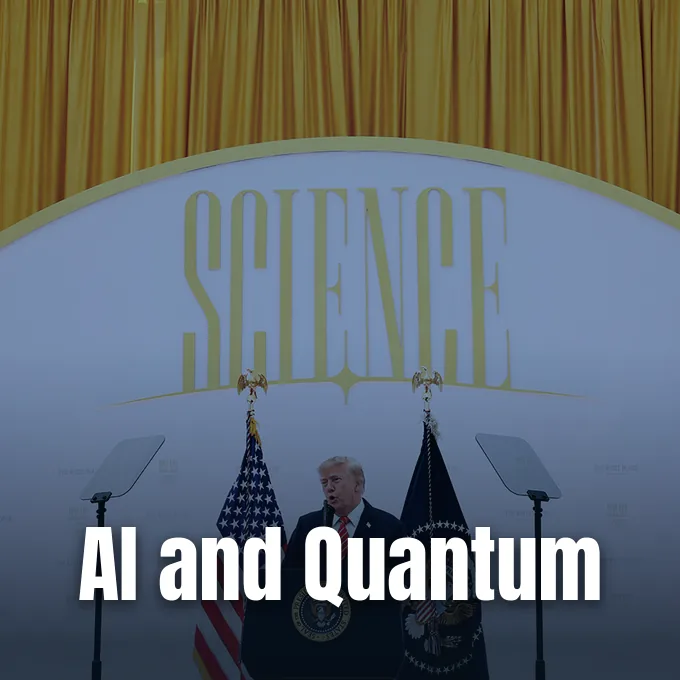
Under President Donald Trump, federal research priorities have shifted toward emerging computational tools. While budget reductions and program delays have affected work in fields such as public health and climate science, artificial intelligence and quantum information have gained strong support. Through presidential directives and coordinated agency programs, Trump science policy has begun channeling billions of dollars into high-performance computing, automated scientific workflows, and advanced quantum hardware. Research leaders at national laboratories have welcomed the influx of computing resources, but university scientists warn that cuts to baseline research grants could quietly undermine the scientific foundation that made these computational breakthroughs possible [1].
How Trump Science Policy Centers on AI
Federal agencies have organized their research agendas around artificial intelligence following directives established under Trump science policy. In November 2025, President Donald Trump issued an executive order establishing the $5 billion Genesis Mission, a federal initiative designed to deploy artificial intelligence throughout government laboratories. The program began inside the Department of Energy but soon grew to include more than 15 federal agencies. Federal agencies spent some $4.2 billion on artificial intelligence research and development during 2025 alone [1].
This federal push shows an approach that views computational power as the main driver of national laboratory progress. Darío Gil, undersecretary for science at the Department of Energy, said that artificial intelligence, quantum science, and supercomputing “are going to be the three legs of the stool that is going to transform how science and engineering is done”. Rather than leaving software development scattered among independent university grants, the mission plans to use federal data collections, computing centers, and experimental facilities to build a shared software ecosystem for laboratory researchers [1].
Earlier White House initiatives explored proposals for a federal AI policy steering force to coordinate technology investments. That framework now guides how government departments evaluate scientific applications. The National Science Foundation and the National Institutes of Health have launched their own Genesis programs centered on national science challenges, which include space exploration, human health, biology, clean energy, and homeland security [1].
The Genesis Mission and National Laboratories
The Department of Energy moved quickly to turn the Genesis mandate into active research awards at national facilities. This year, the department funded nearly 300 projects through Genesis to explore automated engineering and scientific discovery. Supported projects include simulations of the national electric grid, computational studies of nuclear fusion, and methods to accelerate nuclear reactor development. At SLAC National Accelerator Laboratory in Menlo Park, California, scientists are working on 20 Genesis projects and leading two of them. John Sarrao, director of SLAC, said the presidential initiative “really did create an inflection point” for researchers seeking federal supercomputing access. The facility coordinates high-throughput experiments with supercomputing centers to analyze particle behavior in real time [1].
University researchers have also joined the federal initiative to assemble astronomical data. Rachel Mandelbaum, an astronomer at Carnegie Mellon University in Pittsburgh, leads a project that combines observations from the Vera C. Rubin Observatory in Chile, the Dark Energy Spectroscopic Instrument, and the Zwicky Transient Facility. Mandelbaum said that unifying these global datasets to train AI models is “conceptually a very powerful idea” [1].
If the unified database works as planned, machine learning algorithms could uncover subtle astronomical patterns hidden within vast collections of sky measurements. Training complex neural networks on telescope data demands massive computing clusters that single university departments cannot afford. Federal laboratories provide the necessary hardware power so researchers can analyze cosmic expansion and transient events [1].

Quantum Computing Deadlines and Technology Goals
In addition to investments in machine learning, the White House has placed heavy emphasis on quantum information science. In June, the president issued an executive order directing agencies to speed up the development of quantum sensors, quantum networks, and quantum processors. The Department of Energy subsequently established its Quantum Genesis program, setting a firm target to produce scientifically useful, error-corrected quantum computers by 2028. Several funded projects focus on quantum materials and hardware stability [1].
Scientists acknowledge that quantum hardware is far less developed than neural network software. Celia Merzbacher, executive director of the Quantum Economic Development Consortium, said that with quantum computing, “we’re still at mile one or two or three of a marathon”. Even so, laboratory teams hope the two fields can reinforce one another over the coming decade. Artificial intelligence may assist engineers in designing resilient qubit circuits, while future quantum processors could solve specific machine learning equations that overwhelm conventional silicon chips [1].
Federal planners view this technology intersection as a valuable asset for scientific exploration. Quantum sensors could provide precise measurements for physics experiments, while quantum communication links protect sensitive research networks. Both tools need steady engineering progress before they can match current supercomputers. Progress depends on reliable hardware fabrication and error mitigation techniques tested across national user facilities [1].
White House Vision for a Golden Age
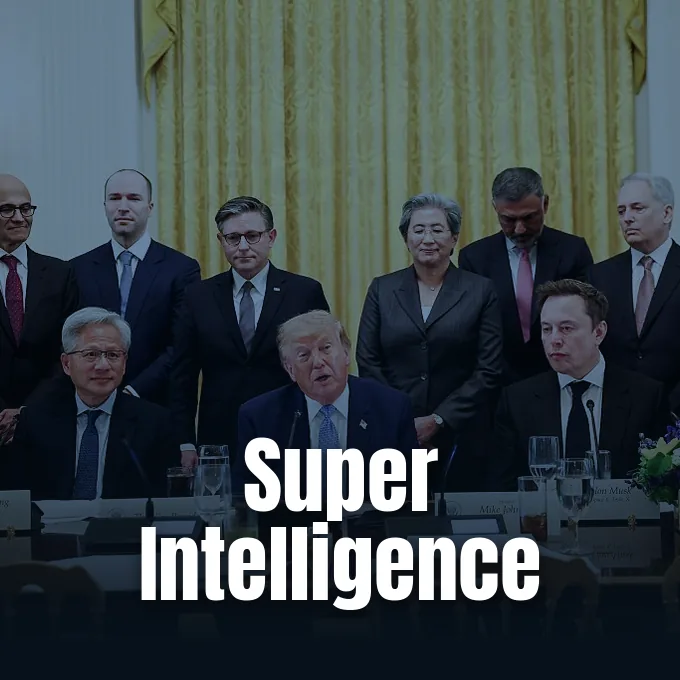
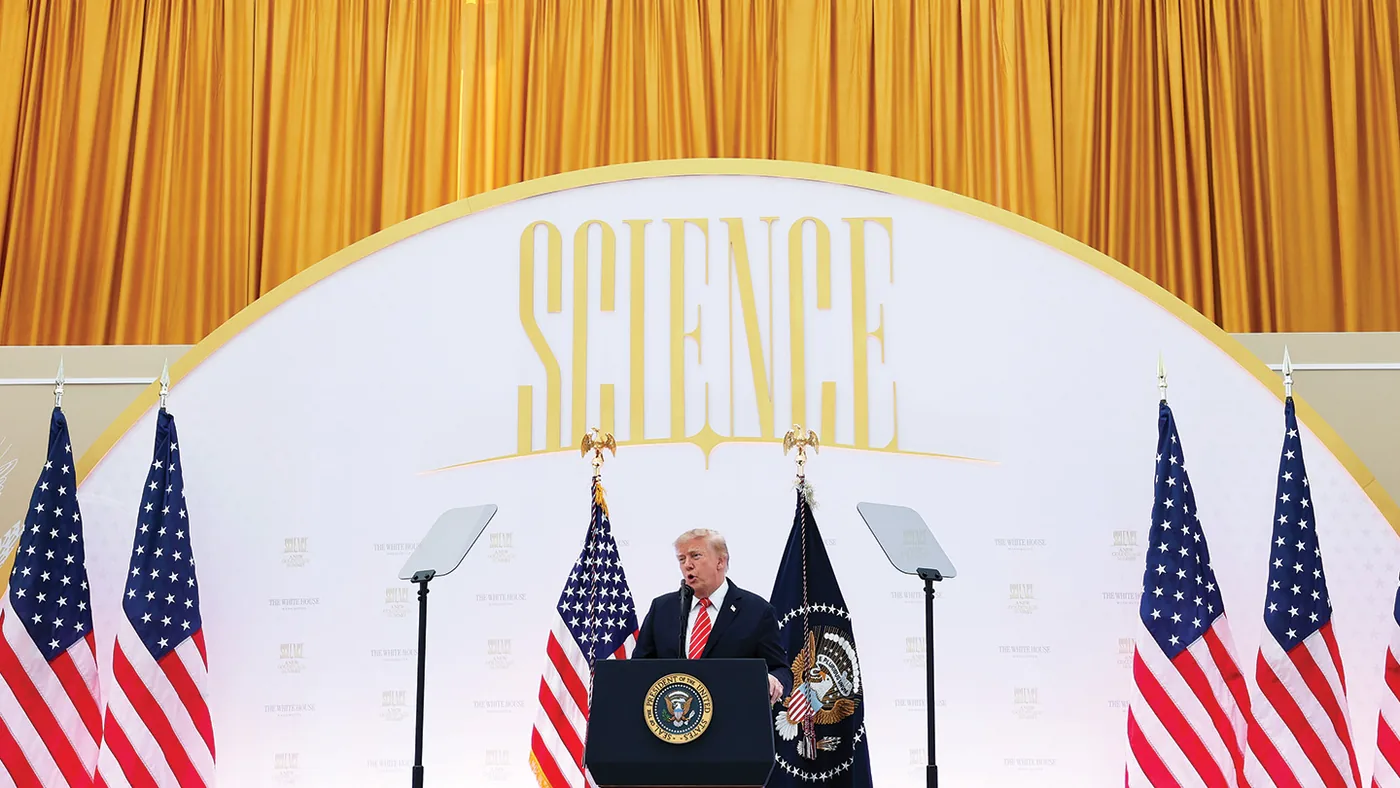
The strategic vision for these technological priorities was detailed in July when the White House Office of Science and Technology Policy issued a 123-page report. The document outlined a plan for a “golden age” of American science, arguing that federal agencies must align their research grants with administration goals [1]. This top-down governance style mirrors the political career of Donald John Trump, who was born in 1946, graduated from the University of Pennsylvania in 1968, and managed the Trump Organization starting in 1971. Before entering national politics as a member of the Republican Party, Trump hosted The Apprentice from 2004 to 2015, building a public reputation around executive control. In 2024, Trump won the presidential election against Kamala Harris, returning to the White House with an agenda centered on deregulation and presidential authority [2].
During his second presidency as the 47th president, Trump has made frequent use of presidential directives, signing major measures like the One Big Beautiful Bill Act in 2025. His administration has faced over 550 lawsuits challenging its executive actions [2]. That reliance on direct executive power explains why Trump science policy has moved forward primarily through presidential orders rather than congressional legislation [1].
Federal policy discussions have followed congressional debates surrounding the national AI race and global technological competition. Basic scientific inquiry has taken a secondary seat as agency managers align discretionary grant portfolios with presidential directives [1].
Budget Trade-Offs Under Trump Science Policy
The rapid expansion of targeted technology programs has created friction within the academic community. While part of the funding for the Department of Energy came from the One Big Beautiful Bill passed in 2025, much of the money was carved out of existing agency budgets. When federal agencies prioritize specific computational themes, other scientific branches inevitably face funding contractions. Researchers in public health, climate science, and fundamental physics have reported project delays and reduced grant allocations [1].
Even scientists who received computational awards have voiced concern regarding the source of their funding. Rachel Mandelbaum said that a separate cosmology grant her research group held with the Department of Energy was reduced because it fell outside Genesis priorities. Mandelbaum said that “if the reality is that some of this [funding] is coming out of the baseline research budget in my field, then I think that it would be beneficial for the DOE to engage the scientific community about those trade-offs” [1].
Federal administrators maintain that the financial impact on core science remains modest. Darío Gil said that the funding allocated to Genesis from the Department of Energy Office of Science totals about $400 million so far, which represents a small portion of the total office budget of $8.4 billion for fiscal year 2026. Gil argued that the investment delivers tools that benefit all disciplines [1].
Perspectives on Federal Research Balance
Scientific leaders emphasize that picking technological winners carries inherent dangers for long-term national innovation. Brad Marston, a physicist at Brown University and president of the American Physical Society, pointed out that artificial intelligence and quantum information were obscure academic specialties before recent neural network breakthroughs. Marston said that “both of those areas … were kind of backwaters until recent advances,” illustrating why federal agencies must support diverse disciplines. He added that “priorities have to be chosen, but getting a good balance is important, because you never know where some advance will come from” [1].
Balancing immediate technical goals against basic discovery remains an unresolved challenge for federal laboratory directors. John Sarrao of SLAC described this tension when evaluating the long-term impact of Genesis. “Are there really exciting opportunities? Yes, 100 percent,” Sarrao says. “Are there risks if you get the balance wrong? Equally well, 100 percent”. Sarrao believes current momentum can succeed if core research programs receive steady backing [1].
Protecting fundamental research ensures that unexpected discoveries remain possible when current computational trends mature. If federal agencies neglect basic chemistry, materials physics, or observational astronomy, they risk starving the next wave of scientific revolutions. A sustainable Trump science policy requires a balanced investment portfolio to foster scientific leadership over coming decades [1].
- ONLINE NEWS Conover, E. (2026, November 16). What the Trump administration’s focus on AI and quantum means for science. Science News. [Article Link]
- WEBSITE Wikipedia contributors. (2026). Donald Trump. Wikipedia, The Free Encyclopedia. [Article Link]
APA 7: PerEXP Teamworks. (2026, November 17). Trump Science Policy Steers Research Budgets to AI and Quantum. PerEXP Teamworks. https://perexpteamworks.com/en/trump-science-policy-ai-quantum/


