





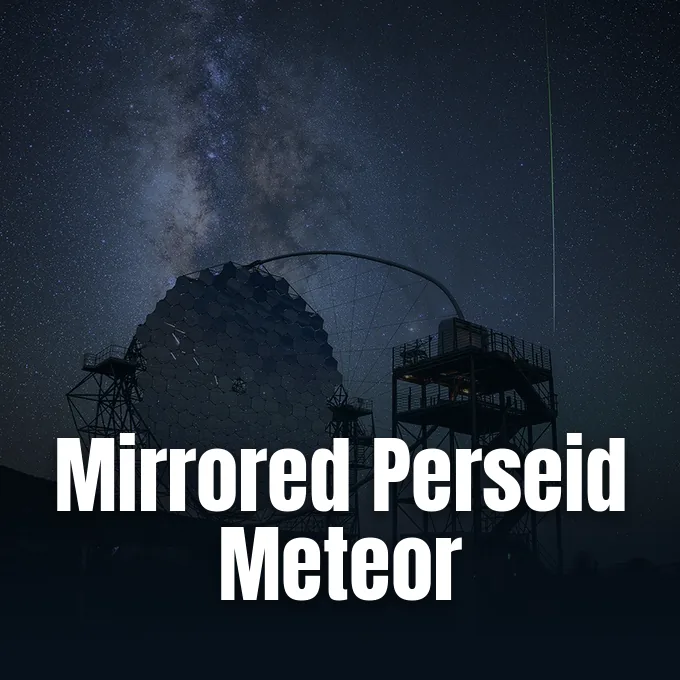
Can an astronomical reflector designed for high-energy cosmic rays simultaneously capture the fleeting streak of a shooting star? The prototype Large-Sized Telescope (LST-1) demonstrated this striking dual perspective when its Cherenkov telescope mirror registered celestial phenomena across its vast optical dish on August 15. Located at the Observatorio del Roque de los Muchachos on the island of La Palma, Spain, the instrument reflected a brilliant Perseid meteor trail against the luminous backdrop of the central Milky Way [1].
What Does the Cherenkov Telescope Mirror Detect?
The Cherenkov telescope mirror detects brief, atmospheric visible light flashes. These flashes occur when energetic cosmic rays and gamma-rays collide with atomic nuclei in Earth’s upper atmosphere. Unlike conventional optical telescopes that track distant stars over prolonged exposures, this detector records secondary particle cascades that illuminate the night sky for roughly a billionth of a second. Jerry Bonnell and Robert Nemiroff explain that these transient flashes originate from extreme cosmic accelerators rather than quiet stellar surfaces [1].
Gamma-rays cannot reach Earth directly. When an incoming high-energy gamma-ray photon strikes an air molecule high above the ground, it unleashes an extensive cascade of relativistic subatomic particles traveling faster than the phase velocity of light in the surrounding air. This superluminal motion generates a faint bluish optical radiation that sweeps across mountain ridges in an imperceptible fraction of an instant. LST-1 operates on La Palma. Its primary operational mission involves collecting these dispersed atmospheric photons before the faint optical footprint dissolves into the dark celestial background [2].
Astrophysicists study energetic cosmic emissions. Ground-based Cherenkov reflectors detect signals that escape standard optical observatories. While orbital instruments like Hubble monitor planetary collisions and atmospheric disturbances from low Earth orbit, mountain facilities provide the colossal collecting areas necessary to trap faint atmospheric air showers. Cecilia Chirenti and Keighley Rockcliffe emphasize that ground-based Cherenkov detection complements space telescopes by providing massive light-gathering architecture capable of resolving rapid subatomic cascades [1].
Structure and Scale of the LST-1 Mirror
Constructing an astronomical reflector of this scale demands rigorous structural engineering. The prototype Large-Sized Telescope incorporates an enormous 23 meter diameter mirror supported by a lightweight carbon-fiber and steel parabolic truss designed to prevent mechanical distortion during rapid slewing operations. This curved reflective dish gathers incoming Cherenkov wavefronts and focuses them directly onto a dedicated sensor array suspended high above the structure. Because ground-based gamma-ray detection requires substantial light collection to distinguish faint subatomic cascades from ambient night-sky luminescence across wide apertures, the Cherenkov telescope mirror must preserve optical integrity across its entire curved expanse [2].
Instead of utilizing a monolithic glass disc, engineers assembled the primary reflective collector using 198 hexagonal mirror segments. Each individual segment undergoes specialized coating and polishing to maximize reflectivity in the ultraviolet and blue optical wavelengths where atmospheric Cherenkov radiation is most concentrated. Motorized actuators situated behind each hexagonal panel enable astronomers to adjust the overall parabolic curvature with micrometer accuracy. The mirror spans 23 meters. Tiling modular hexagonal panels together allows the LST-1 mirror assembly to attain an immense light-collecting surface without introducing the structural vulnerabilities and unmanageable weight of a monolithic glass mirror [2].
The dish aligns 198 segments. Each optical tile aligns within the giant frame to focus incoming light [1].
How Does a Cherenkov Telescope Array Mirror Track Light?
A Cherenkov telescope array mirror tracks light with nanosecond precision. Incoming optical wavefronts focus directly onto an ultra-fast camera engineered for high-energy cosmic detection. When an energetic cosmic particle penetrates the upper atmosphere, it triggers a brief flash of bluish light that sweeps over the terrain for mere fractions of a second. The wide parabolic reflector captures these fleeting photons and concentrates them onto high-speed sensors before background starlight can obscure the signal. Jerry Bonnell notes that sub-nanosecond timing precision is crucial for distinguishing authentic gamma-ray events from diffuse night-sky glow [1].
At the focal plane of the massive reflector sits a sophisticated, high-efficiency, pixelized camera designed explicitly for ultra-rapid photon detection. Standard astronomical cameras integrate light across prolonged seconds or minutes to image stationary nebulae, whereas atmospheric Cherenkov flashes demand nearly instantaneous triggering. As NASA Science reports, these transient optical bursts last roughly a billionth of a second and necessitate advanced photomultiplier sensors that record photons across narrow nanosecond windows. When an air shower strikes the telescope, thousands of Cherenkov photons hit the reflective surface simultaneously. The Cherenkov telescope mirror directs these incoming light rays into discrete camera pixels, forming an elliptical shower image that reveals the primary particle’s arrival energy and celestial trajectory [2].
High-speed readout electronics reconstruct the geometric profile of each air shower within milliseconds to confirm the detection. One camera records the flashes. Because active galactic nuclei and cosmic detonations emit gamma-rays unpredictably, real-time triggering ensures that observational archives retain valid atmospheric flashes while rejecting ambient noise [2].


Astrophysical Sources and Gamma-Ray Bursts
Active galactic nuclei emit gamma-rays. The Cherenkov telescope mirror observes emissions originating from some of the most violent cosmic environments in the universe. NASA Science highlights that these energetic visible flashes are initiated by energetic gamma-rays streaming from distant active galaxies and gamma-ray bursts. Supermassive black holes at galactic centers devour surrounding gas and launch relativistic plasma jets that propel particles to energies vastly exceeding anything achievable in terrestrial particle colliders. Robert Nemiroff indicates that registering these extreme atmospheric signals provides astronomers with critical insight into violent energetic processes taking place billions of light-years away [1].
Active galaxies propel cosmic particles. When these high-energy photons travel across intergalactic distances, they occasionally interact with cosmic background radiation before colliding with Earth’s atmosphere. By measuring the arrival spectrum of these energetic photons, physicists test fundamental cosmological hypotheses, including constraints on space-time fluctuations. Such scientific inquiries connect with broader astrophysical research, including strategic NASA cosmic origins observatory planning that seeks to coordinate multi-wavelength observations across orbital and ground facilities [2].
Investigating extreme energetic emissions also enriches broader research into the evolutionary stages of early stellar and galactic environments. While Cherenkov telescopes focus on sudden relativistic detonations and active galactic nuclei, parallel astronomical programs such as studies exploring ancient stars examine how long-lived stellar generations shaped primordial interstellar matter. Cecilia Chirenti explains that each high-energy photon registered by ground-based Cherenkov sensors provides an essential observational benchmark for mapping the high-energy physical mechanisms operating throughout the universe [1].
Perseid Meteor Trails Above La Palma
Atmospheric conditions at the Observatorio del Roque de los Muchachos on the island of La Palma offer an extraordinary vantage point for deep-space astronomy. Perched high on a mountain ridge in the Canary Islands, Spain, the facility rests above nocturnal cloud layers in an environment shielded from urban light pollution. On August 15, while LST-1 stood operational to record subatomic particle cascades, the annual Perseid meteor shower produced luminous streaks across the clear Atlantic sky. Keighley Rockcliffe highlights that the pristine mountaintop setting enabled observers to photograph bright meteoric fireballs next to the glowing arc of the Milky Way [1].
The central Milky Way stretched overhead, displaying dense interstellar dust lanes and brilliant stellar concentrations reaching above the horizon. As the telescope dish pointed skyward, a luminous Perseid meteor streaked across the dark sky right beside the galactic core. Unlike the subatomic air showers produced by gamma-rays, meteors consist of small cometary debris particles that incinerate due to atmospheric friction at altitudes around one hundred kilometers. The Perseid trail shone brightly. This striking alignment created a dramatic scene where cutting-edge subatomic instrumentation coincided with an ancient seasonal celestial phenomenon [2].
Jeff Dai photographed the event. He documented the spectacular scene, capturing the celestial panorama and the massive optical reflector in a single frame. NASA Science featured this photograph on September 26, 2026, as its official Astronomy Picture of the Day selection. Editorial notes explain that the educational archive is transferring its primary online portal to science.nasa.gov/apod, migrating services from the long-standing apod.nasa.gov domain [1].
Why Do Optical Segments Reflect Meteors?
Individual optical segments specularly mirror ambient visible light. The polished glass facets await high-energy Cherenkov air showers while reflecting ambient optical rays from the night sky. Even though the Cherenkov telescope mirror is optimized for ultra-fast nanosecond flashes, its 198 hexagonal segments remain reflective across the entire visible spectrum. When the Perseid meteor blazed through the upper atmosphere above La Palma on August 15, its luminous wake radiated visible light downward into the open dish structure. Multiple hexagonal mirrors captured this transient trail, producing fragmented optical reflections of the meteor streak across the giant segmented surface [2].
Open optical reflectors operate without protective domes. Because gamma-ray telescopes do not utilize closed optical tubes or protective enclosure domes during nightly data acquisition, their segmented mirrors remain exposed to the open night sky. Mountain winds sweep past the open framework as astronomers monitor incoming cosmic signals from high above the cloud layer. Each hexagonal segment functions as an individual reflector, imaging stars, interstellar dust clouds, and transient meteors across its surface while specialized sensors await the distinct optical signatures of cosmic particles [1].
As the prototype instrument continues its evaluation phase at the Observatorio del Roque de los Muchachos, LST-1 establishes the foundation for the northern array of the Cherenkov Telescope Array Observatory. The successful combination of segmented parabolic mirrors, high-speed pixel cameras, and nanosecond electronics confirms that mountain observatories can effectively unravel energetic phenomena in deep space. By detecting energetic cosmic gamma-rays while mirroring the peaceful glow of the Milky Way, the Cherenkov telescope mirror connects terrestrial astrophysics to the dynamic wonders of the universe [2].
- WEBSITE Bonnell, J., Nemiroff, R., Chirenti, C., & Rockcliffe, K. (2026, September 26). APOD: 2026 September 26 – Mirrored Meteor and Milky Way. NASA Science. [Article Link]
- ONLINE NEWS NASA Science. (2026, September 26). Mirrored Meteor and Milky Way. Astronomy Picture of the Day. [Article Link]
APA 7: TWs Editor. (2026, September 26). Cherenkov Telescope Mirror Reflects a Perseid Meteor at La Palma. PerEXP Teamworks.


