





Evaluating Hubble vs James Webb requires examining how two major NASA space telescopes address distinct physical limits in modern astrophysics. The Hubble Space Telescope operates in low Earth orbit, relying on a 2.4-meter primary mirror to capture the cosmos in UV, visible, and near-infrared light. In contrast, the James Webb Space Telescope launched on December 25, 2021, traveling to the second Sun-Earth Lagrange point with a 6.5-meter segmented reflector optimized for infrared light [6, 13]. Structural design choices dictate which cosmic targets each platform detects, how far back in cosmic time each orbiter looks, and how Webb succeeds Hubble by opening previously obscured spectral realms [13].
- Light Bands in Hubble vs James Webb Observations
- How Primary Mirror Sizes Differ
- Orbits at Low Earth Altitude and the Second Lagrange Point
- Why Is James Webb Located at the L2 Point?
- Five Layers of Sunshield Thermal Protection
- Comparing Hubble vs James Webb Science Payloads
- Deep Field Exposures Tracking Galaxy Redshift
- Hubble vs James Webb in Coordinated Astronomy
Light Bands in Hubble vs James Webb Observations
Cosmic expansion stretches light waves. Light from distant celestial targets shifts toward the red end of the spectrum, dictating the wave bands chosen for space telescopes. Hubble detects electromagnetic energy from 0.1 to 2.5 microns, capturing ultraviolet light, visible colors, and narrow bands of near-infrared radiation from low Earth orbit [13].
Human eyes perceive colors between 0.4 and 0.7 microns. Hubble presents the cosmos in optical colors that match human vision, showing hot stars and glowing gas clouds in sharp detail [11]. Webb sees longer waves. By operating from 0.6 to 28.5 microns, Webb detects light emitted billions of years ago that has stretched into infrared wave bands through cosmological redshift [6, 13].
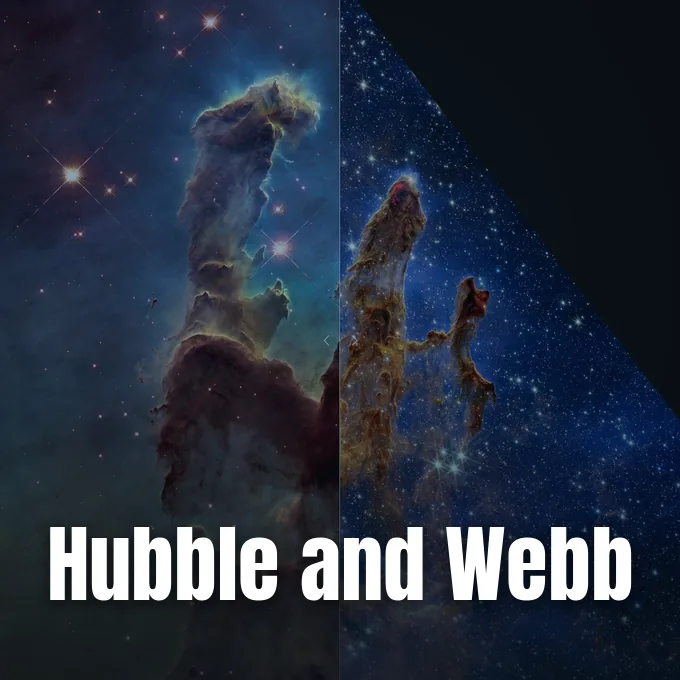
Dust penetration provides another major reason to expand infrared views into deep space. Dense dust clouds in star nurseries scatter short optical waves, hiding young stars from Hubble’s view. Infrared waves pass through thick dust clouds with minimal scattering, letting Webb view newborn stars buried deep inside gas pillars. In October 2022, comparative images of the Pillars of Creation in the Eagle Nebula, located 6,500 light-years from Earth, proved this power clearly. While Hubble’s 1995 and 2014 optical images showed dark, dense pillars framed by glowing dust edges, Webb’s near-infrared sensors cut through those thick clouds to reveal thousands of newly formed stars [11].
How Primary Mirror Sizes Differ
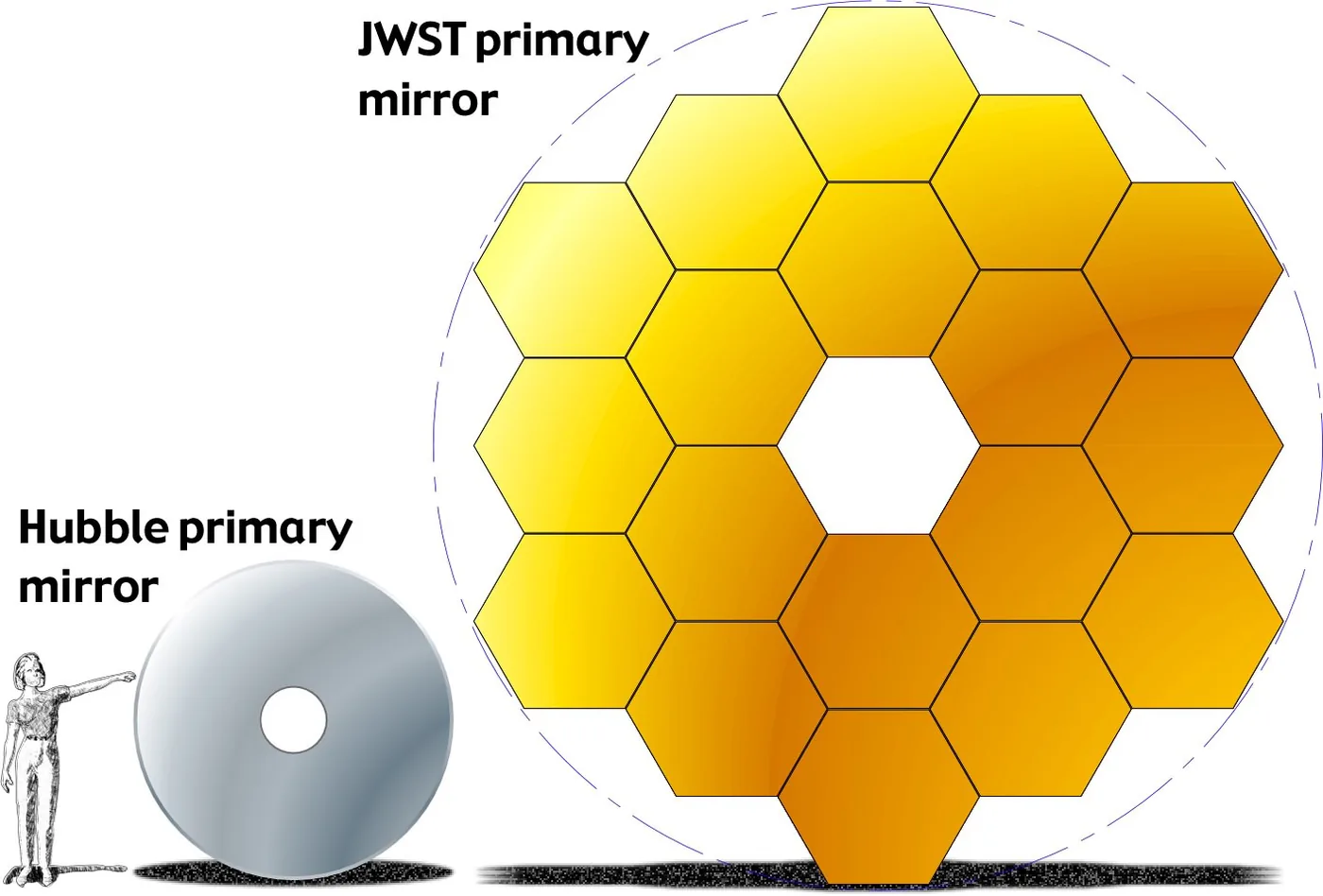
Mirror size governs photon collection. When comparing Hubble vs James Webb optics, light-gathering power depends directly on the surface area of the primary mirror [7]. Hubble uses a single circular mirror with a diameter of 2.4 meters (7.9 feet), yielding a clear collecting area of 4.0 square meters (43 square feet) [13].
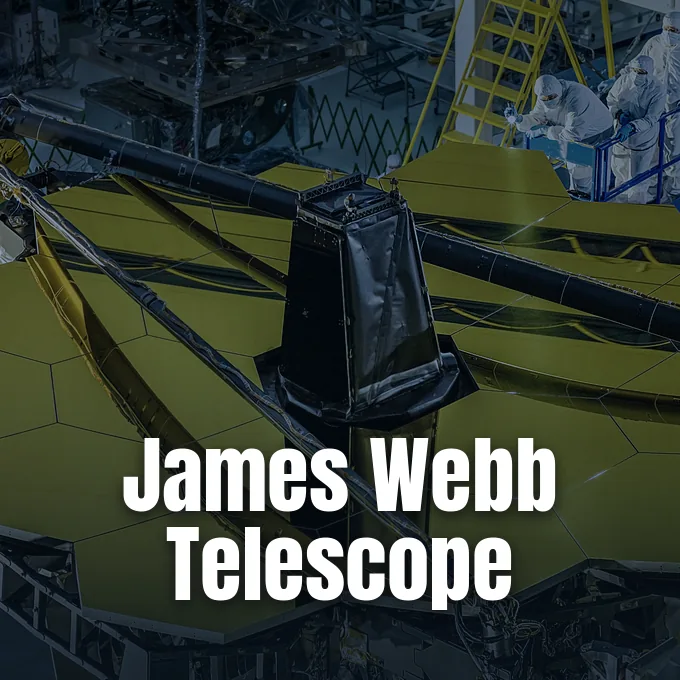
Webb needed a much larger mirror to collect faint infrared light from the earliest stars, producing a main reflector measuring 6.5 meters (21.3 feet) across [6, 7]. Rocket fairings could not hold a solid 6.5-meter mirror, so engineers built a segmented reflector made of 18 hexagonal pieces [7, 13]. Hexagonal units combine to provide a collecting area of 25.4 square meters (273 square feet), giving Webb over six times the light-gathering area of Hubble [13]. Optical Telescope Element Manager Lee Feinberg described the precision needed at NASA Goddard: “Aligning the primary mirror segments as though they are a single large mirror means each mirror is aligned to 1/10,000th the thickness of a human hair. What’s even more amazing is that the engineers and scientists working on the Webb telescope literally had to invent how to do this” [7].
Beryllium proved ideal for the mirror segments because it stays stiff at deep cold temperatures. Mined in Utah and refined at Brush Wellman in Ohio, beryllium blanks traveled to Axsys Technologies in Cullman, Alabama, and Ball Aerospace for cryogenic shaping [7]. Each hexagonal piece measures 1.32 meters wide and weighs 20.1 kilograms. A vaporized gold layer 100 nanometers thick coats the beryllium, using 48.25 grams of gold to reflect infrared light [6].
Orbits at Low Earth Altitude and the Second Lagrange Point
Orbital paths dictate observations. Hubble circles Earth at an altitude of about 550 kilometers (340 miles), making a full loop every 90 minutes [8, 13]. Low orbit kept Hubble near Earth and let NASA astronauts fly five Space Shuttle servicing visits [13]. But close proximity to Earth exposes the telescope to heat radiating from the planet below [8].
Webb works far from Earth at the second Lagrange point, or L2 point, roughly 1.5 million kilometers (930,000 miles) away [8, 13]. Gravity balances centrifugal pull here. At L2, the combined gravity of the Sun and Earth matches the centrifugal pull needed for Webb to orbit the Sun in lockstep with Earth, tracing a wide halo orbit that takes six months to complete. The path avoids shadows. This shadow-free trajectory keeps the telescope out of Earth and Moon eclipses, preventing rapid temperature swings that could distort mirror mounts while permitting uninterrupted 24-hour astronomical views [8, 13].
Data travels through the Deep Space Network using ground antennas in Australia, Spain, and California. Teams at the Space Telescope Science Institute (STScI) in Baltimore, Maryland, send up commands weekly [8, 13]. Because Webb sits far beyond astronaut reach, every deployment had to succeed without human help [7, 13].
Why Is James Webb Located at the L2 Point?
Webb sits at the second Lagrange point because that position places the Sun, Earth, and Moon in one direction behind its sunshield. Lagrange points balance gravity. Eighteenth-century mathematician Joseph-Louis Lagrange identified five gravitational balance spots where a smaller mass orbits in lockstep with two larger bodies, allowing a single sunshield to block all three radiant heat sources simultaneously [8, 14].
Deep cold is essential for infrared astronomy because warm optics glow with infrared light that blinds sensitive sensors [7, 8]. If Webb orbited Earth like Hubble, the telescope would plunge into shadow and back into sun every hour, creating wild heat swings and bathing detectors in Earth glow [8, 13]. At L2, permanent shade allows passive cooling to drop mirror temperatures below 50 kelvins (-370 degrees Fahrenheit) [6, 8]. Detailed reports from mission teams explain how the infrared observatory works while keeping instruments cold in deep space [6, 13]. In that calm thermal void, Webb maintains the rigid optical shape needed to hold 18 mirror segments in alignment down to ten nanometers [6, 7].
Why did mission architects choose a halo orbit around L2 instead of parking at the exact point? A halo orbit needs only tiny thruster pulses to counter orbital drift, saving fuel for years of science [8]. The Ariane 5 rocket launched Webb on December 25, 2021, from Kourou, French Guiana, on such a clean trajectory that onboard propellant will last over ten years [5, 6, 13].

Five Layers of Sunshield Thermal Protection
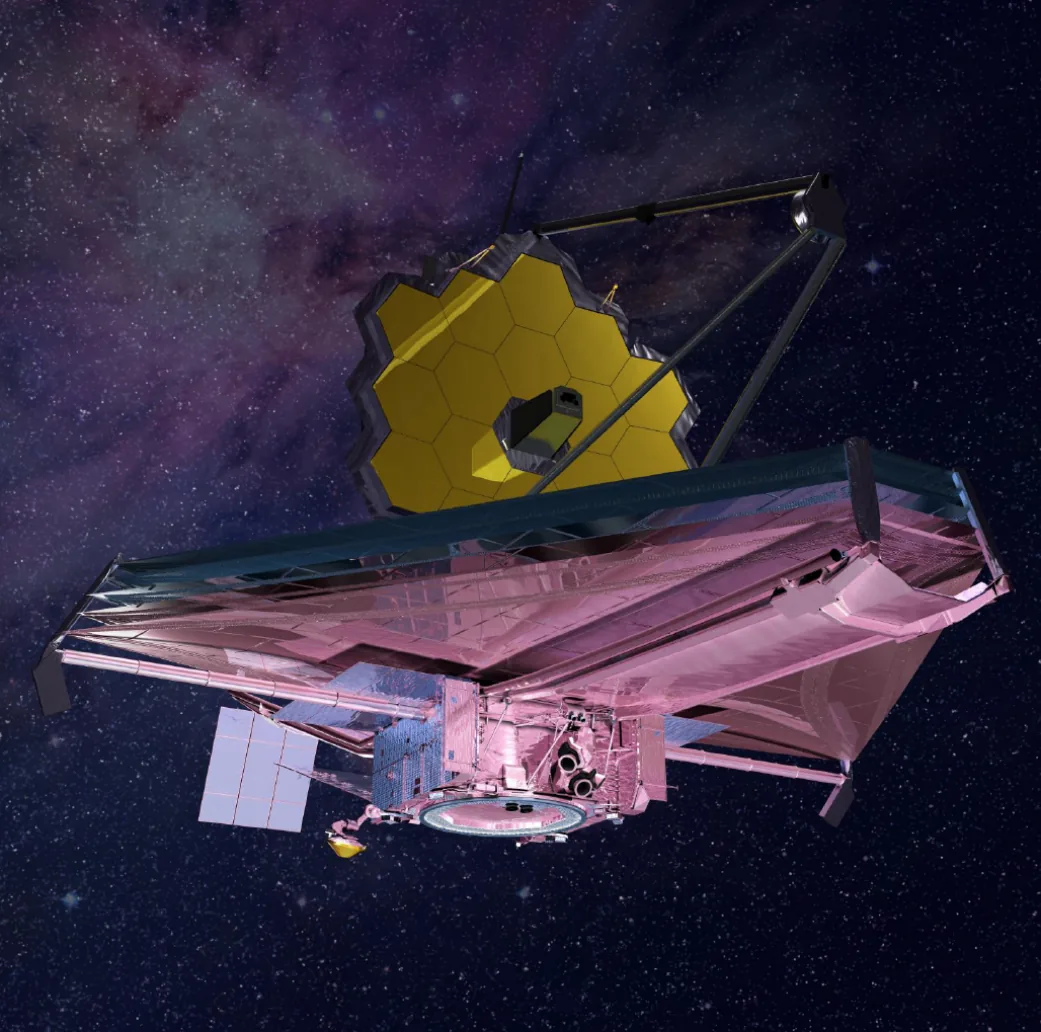
Protecting cold mirrors needs a deployable sunshield measuring 21.197 by 14.162 meters (69.5 by 46.5 feet), roughly matching the area of a tennis court [6, 14]. Heat stays outside. Built by Northrop Grumman in California, the kite-shaped barrier functions as a specialized V-groove radiator that absorbs 200 kilowatts of solar heat while leaking only 23 milliwatts to the cold side [7, 14].
The shield uses five thin layers of Kapton E film separated by vacuum gaps that let heat vent harmlessly out the open sides [6, 14]. Each sheet has a distinct thickness. The hot outer layer is 0.05 millimeters (50 microns) thick, while the four inner sheets measure 0.025 millimeters (25 microns) thick. Both sides of all five sheets have a 100-nanometer aluminum coat, and the two outer sheets carry a 50-nanometer doped silicon skin to shed heat. This design creates a temperature drop of 318 kelvins (604 degrees Fahrenheit) between the front and back surfaces, yielding an effective sun protection factor of 1,000,000 [6, 14]. Cold instruments rest safely behind this thermal wall [14].
Hubble needs no sunshield because its optical cameras work at mild room temperatures, using an aperture door to shut out blinding sunlight. Webb’s five sunshield layers were folded twelve times to fit inside the 4.57-meter Ariane 5 rocket fairing before unfolding ten days after liftoff in January 2022 [13, 14].
Comparing Hubble vs James Webb Science Payloads
Payload designs mirror science goals. Comparing Hubble vs James Webb tools highlights distinct observational targets across the spectrum. Hubble carries instruments built for visible and UV light, including Wide Field Camera 3, the Advanced Camera for Surveys, and the Space Telescope Imaging Spectrograph. These cameras map aurora rings on outer gas planets and resolve bright star clusters in nearby galaxies [11, 13].
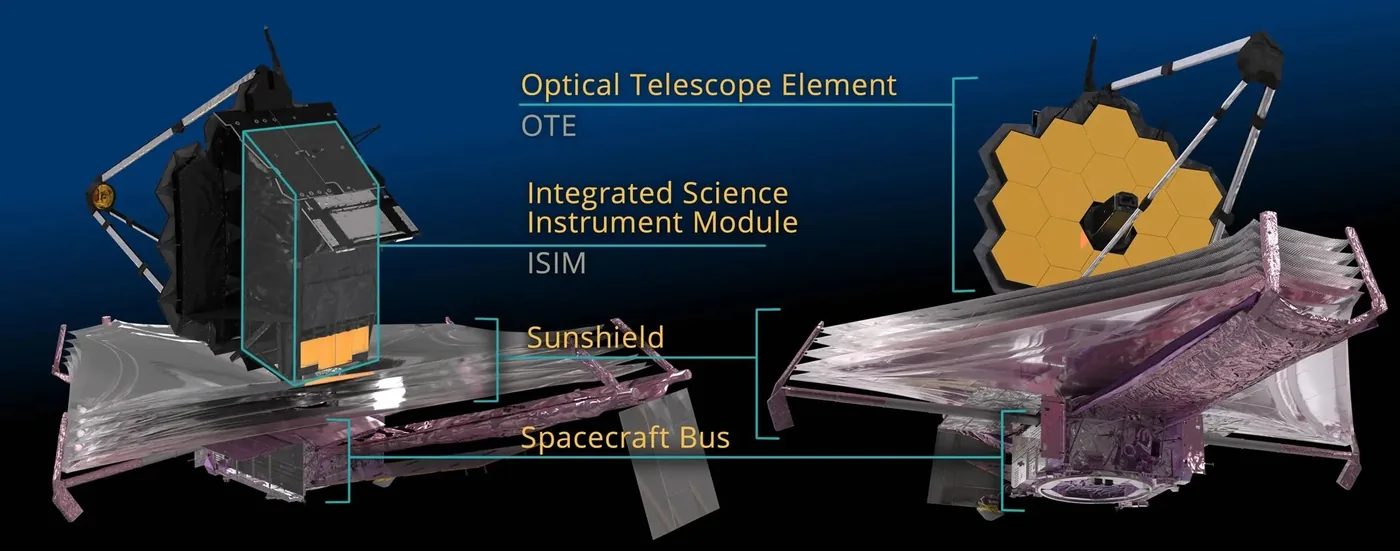
Webb mounts four main tools on the Integrated Science Instrument Module (ISIM) behind the primary mirror structure. The Near-Infrared Camera, or NIRCam, serves as primary imager from 0.6 to 5.0 microns, hunting early galaxies, young star clusters, and icy Kuiper Belt objects. The Near-Infrared Spectrograph (NIRSpec), built by ESA with Airbus, uses a microshutter array with tiny doors to sample over 100 objects at once [4, 9]. The Canadian Space Agency (CSA) contributed the Fine Guidance Sensor and Near-Infrared Imager and Slitless Spectrograph (FGS/NIRISS) to lock onto stars and measure exoplanet atmospheres [9]. These sensors detect faint infrared light that reveals gas clouds around distant stars [2, 4].
Mid-infrared views belong to MIRI, an instrument covering 5.0 to 28.5 microns with an active cryocooler that chills detectors below 7 kelvins [2, 6]. These long waves let astronomers study debris disks in the Beta Pictoris system without stellar glare [2]. Hubble lacks any instrument capable of mid-infrared views [13].
Deep Field Exposures Tracking Galaxy Redshift
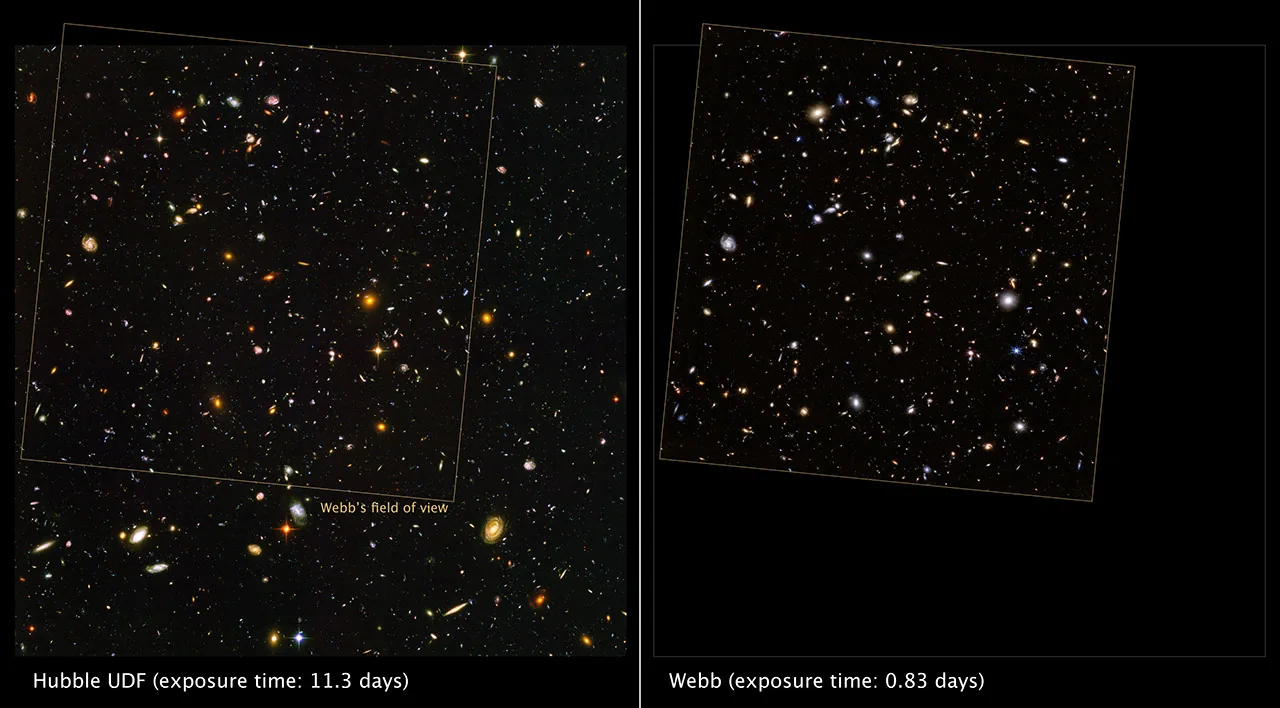
Deep field exposures reveal the gap in light-gathering speed between the two space telescopes. In 2004, the Hubble Ultra Deep Field required 11.3 days of exposure time with Wide Field Camera 3 to assemble its view of distant galaxies [12, 13]. When Webb targeted the same coordinates in the constellation Fornax, it made a deeper image in just 0.83 days. Webb’s image revealed faint red galaxies missed entirely in Hubble’s optical exposures [12].
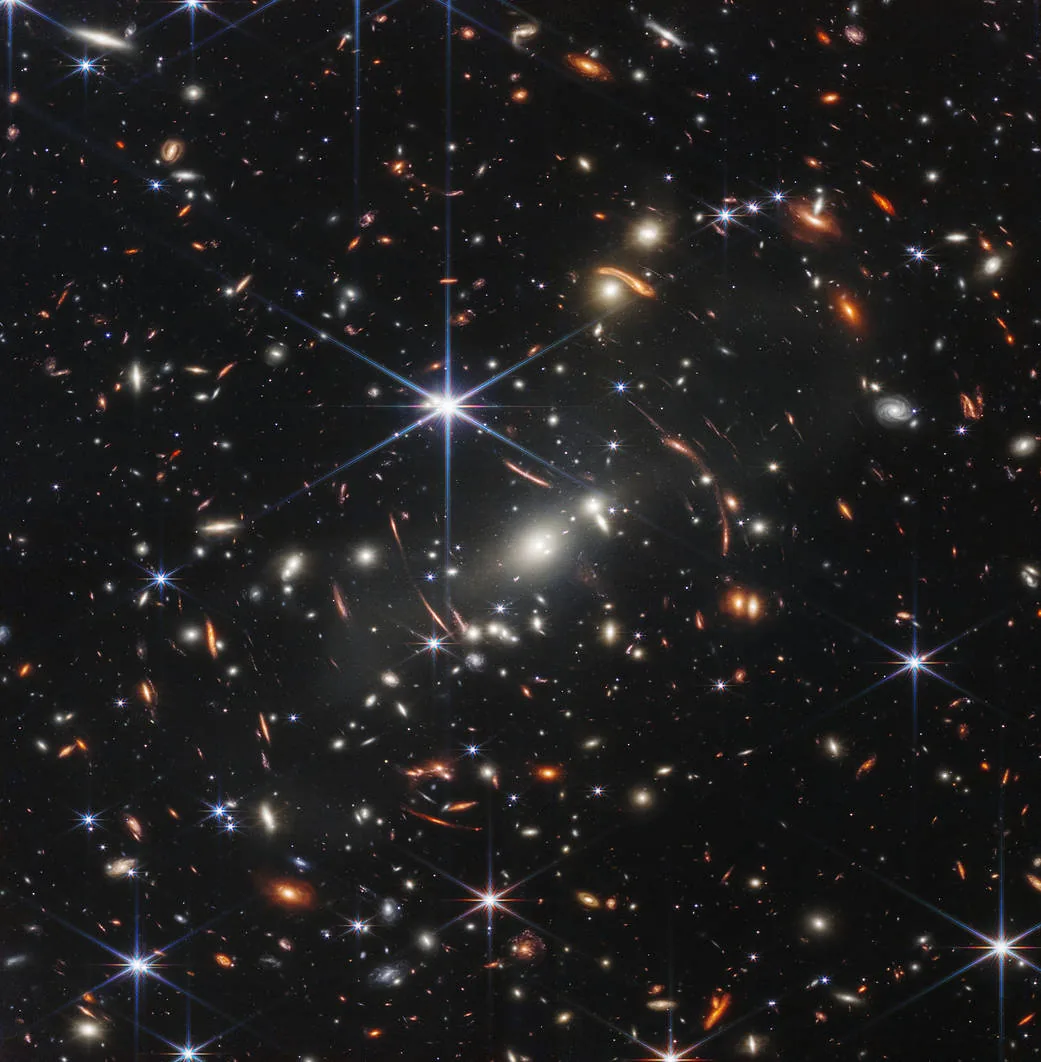
Redshift measures cosmic expansion. Hubble detected distant galaxies out to redshift z ≈ 11.1, capturing galaxy GN-z11 as it appeared about 400 million years after the Big Bang. Because cosmic expansion stretches light from earlier eras deeper into the infrared spectrum, Hubble cannot view the earliest stars. Webb pushes that observational horizon out to redshift z ≈ 20, detecting luminous structures that formed roughly 180 million years after the universe began. In July 2022, Webb’s First Deep Field captured galaxy cluster SMACS 0723 in 12.5 hours of exposure time, using the cluster’s massive gravitational field as a natural zoom lens to reveal ancient background galaxies with redshifts measured up to 8.498 [10, 13].
Early commissioning reports by Jane Rigby and team showed that Webb beat pre-launch sensitivity estimates across all modes. The report characterized optics and detectors, showing that Webb finds faint targets faster than expected [5]. Faint stars in Webb photos show eight diffraction spikes caused by hexagonal mirror edges and secondary mirror struts, unlike Hubble’s four spikes [13].
Hubble vs James Webb in Coordinated Astronomy
Telescopes work as partners. Studying Hubble vs James Webb operational roles shows that astronomers treat the two observatories as complementary platforms rather than competing systems. While Webb explores the infrared sky from L2, Hubble continues daily observations in low Earth orbit, supplying optical and UV data needed to track energetic gas around active galactic nuclei and study stellar winds [1, 3, 13]. Combining visible and infrared datasets gives researchers a full picture of complex cosmic events [1, 13].
Coordinated programs show how pairing data from both observatories speeds discovery. In solar system science, Hubble tracks weather and dust storms on Mars, Jupiter, and Saturn in optical bands, while Webb measures chemical compositions and cold surface temperatures in the mid-infrared. Teams also study expanding supernova debris, tracing celestial structures in stellar debris across multi-wavelength maps [1, 13]. When studying massive galaxy clusters, Hubble maps foreground cluster shapes in visible light while Webb brings magnified background galaxies into sharp infrared focus [10, 13]. This multi-band work answers cosmic questions that neither telescope could solve alone [1, 13].
NASA senior project scientist John Mather praised the international effort: “Scientists are thrilled that Webb is alive and as powerful as we hoped, far beyond Hubble, and that it survived all hazards to be our golden eye in the sky” [10]. Working together, Hubble and Webb provide modern astronomy with a complete observational window from our home solar system to the birth of the first galaxies [1, 13].
- ACADEMIC JOURNAL Gardner, J. P., Mather, J. C., Abbott, R., Abell, J. S., Abernathy, M., Abney, F., Abraham, J. G., Abraham, R. G., Abul-Huda, Y. M., Acton, S. T., Adams, C. K., Adams, E., Adler, D., Adriaensen, M., Aguilar, J., Ahmed, M., Ahmed, N., Ahmed, T., Albat, R.,. Altenburg, M. (2023). The James Webb Space Telescope Mission. Publications of the Astronomical Society of the Pacific, 135(1048), 068001. [Article Link]
- ACADEMIC JOURNAL Rieke, G. H., Wright, G. S., Böker, T., Bouwman, J., Colina, L., Glasse, A. C. H., Gordon, K. D., Greene, T. P., Güdel, M., Henning, T. K., Justtanont, K., Lagage, P., Meixner, M. E., Nørgaard-Nielsen, H. U., Ray, T. P., Ressler, M. E., Dishoeck, E. F. v., & Waelkens, C. (2015). The Mid-Infrared Instrument for the James Webb Space Telescope, I: Introduction. Publications of the Astronomical Society of the Pacific, 127(953), 584-594. [Article Link]
- ACADEMIC JOURNAL Kalirai, J. S. (2018). Scientific discovery with the James Webb Space Telescope. Contemporary Physics, 59(3), 251-290. [Article Link]
- ACADEMIC JOURNAL Jakobsen, P., Ferruit, P., Oliveira, C. A. d., Arribas, S., Bagnasco, G., Barho, R., Beck, T. L., Birkmann, S. M., Böker, T., Bunker, A. J., Charlot, S., Jong, P. d., Marchi, G. D., Ehrenwinkler, R., Falcolini, M., Fels, R., Franx, M., Franz, D. E., Funke, M.,. Jentsch, M. (2022). The Near-Infrared Spectrograph (NIRSpec) on the James Webb Space Telescope: I. Overview of the instrument and its capabilities. Astronomy and Astrophysics, 661, A80. [Article Link]
- PREPRINT Rigby, J., Perrin, M., McElwain, M., Kimble, R., Friedman, S., Lallo, M., Doyon, R., Feinberg, L., Ferruit, P., Glasse, A., Rieke, M., Wright, G., Willott, C., Colon, K., Milam, S., Neff, S., Stark, C., Valenti, J., Abell, J.,. Zonak, N. (2022). The Science Performance of JWST as Characterized in Commissioning. arXiv. [Article Link]
- WEBSITE NASA Science. (2022). Fact Sheet: James Webb Space Telescope. [Article Link]
- WEBSITE NASA Science. (2024). Webb’s Mirrors. [Article Link]
- WEBSITE NASA Science. (2022). Orbit. [Article Link]
- WEBSITE NASA Science. (2024). Integrated Science Instrument Module (ISIM). [Article Link]
- PRESS RELEASE NASA. (2022). President Biden Reveals First Image from NASA’s Webb Telescope. [Article Link]
- WEBSITE European Space Agency. (2022). Hubble and Webb Showcase the Pillars of Creation (Slider Tool). [Article Link]
- WEBSITE NASA Science. (2023). Webb and Hubble Compared HUDF (NIRCam Image). [Article Link]
- WEBSITE Wikipedia contributors. (2024). James Webb Space Telescope. [Article Link]
- WEBSITE Wikipedia contributors. (2024). James Webb Space Telescope sunshield. [Article Link]


