



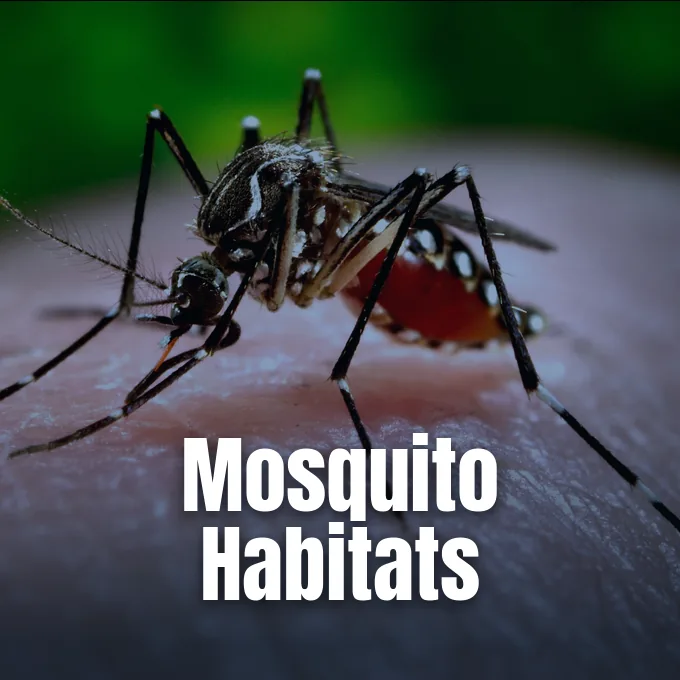
Suburban growth and shifting weather patterns are creating fresh opportunities for disease-carrying mosquitoes to settle in areas where they were once rare. Artificial backyard water collectors, international shipping routes, and warmer winters allow non-native insect species to expand into northern and midwestern communities. As these insect populations grow, public health agencies track rising human infections caused by pathogens such as West Nile virus and dengue. During 2026, local transmission reached record totals in Florida, prompting emergency vector control operations in several counties [1].
Florida Dengue Surge in 2026
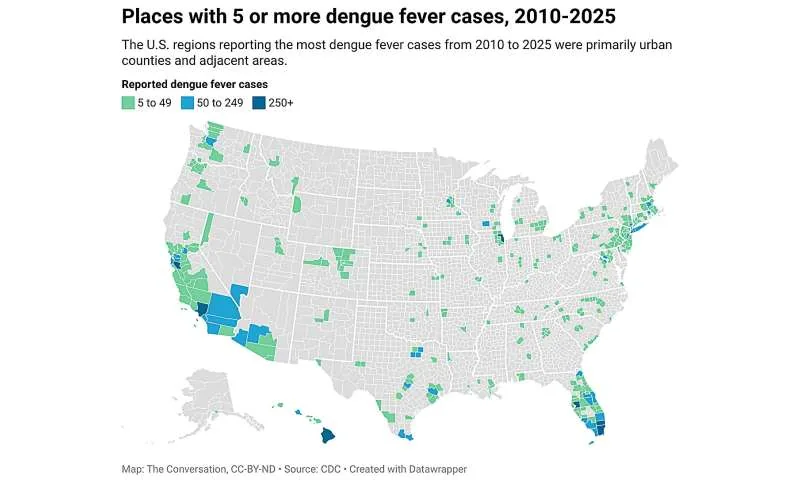
Florida faced its largest recorded dengue outbreak during 2026, logging more than 700 confirmed infections by late October. Hillsborough County, which includes Tampa, identified over 350 cases and recorded one fatal infection. Miami-Dade County reported more than 200 cases during that same outbreak. Tampa reported the lone death. Health agencies also documented at least seven locally acquired infections in the Orlando area [1].
More than 400 of the statewide cases were classified as locally acquired rather than travel-related, showing that mosquitoes in the area actively passed the virus between human hosts. Entomologists Kylee Rae Noel and Sadie Jane Ryan explained that unusually warm weather prolonged mosquito feeding into late autumn. In 2025, Florida took longer than normal to cool down in the fall, leaving mild temperatures and standing pools of water that let Aedes mosquitoes stay active well past their typical season. Climate change also brings erratic storm systems, heat, and heavy rainfall that leave standing puddles where insect larvae mature. Hillsborough County responded by spending millions of dollars on vector control efforts, including aerial pesticide spraying and public warnings to drain yard containers [1].

Trade Routes and Cargo Dispersal
The initial arrival and long-distance movement of invasive mosquitoes connect closely to global trade networks. The primary vector for dengue and yellow fever, Aedes aegypti, entered the Americas centuries ago aboard maritime vessels used in the transatlantic slave trade. In recent decades, cargo shipping networks have carried additional species to distant continents inside commercial freight [3].
A literature review by T. Swan and colleagues evaluated dispersal records from 1940 to 2020, revealing that sea transport was the main route introducing the Asian tiger mosquito into 86 new countries across all habitable continents except Antarctica [3]. Maritime container freight poses a continuing introduction risk for southern seaports along the United States Gulf Coast. In a 2024 study published in PLOS Neglected Tropical Diseases, J. R. Willoughby and co-authors modeled maritime vessel arrivals using an agent-based simulation. They found that in 2012, 99.2 percent of cargo arrivals into target ports had made their preceding port visit at harbors occupied by both Aedes aegypti and Aedes albopictus [2]. Their simulation indicated that inspecting cargo containers and removing mosquitoes when ships unload effectively lowers the chance that new populations will establish.
Once arriving at coastal harbors, mosquitoes disperse inland by traveling inside scrap tires, nursery shipments, and motor vehicles. C. G. Moore and C. J. Mitchell documented that the 1987 discovery of the Asian tiger mosquito in Houston, Texas, stemmed from used tire shipments originating in northern Asia. To curb this pathway, Congress enacted the Public Health Service Act of 1988 to mandate chemical fumigation for imported tires, yet the insect spread along interstate highways to 678 counties in 25 states within ten years. Laboratory assays proved the species can transmit at least 22 arboviruses, including Cache Valley virus and Eastern Equine Encephalomyelitis [5].

Suburban Habitats and Backyard Breeding
Modern suburban housing developments unintentionally create productive mosquito habitats by placing artificial water containers directly beside dense human populations. In expanding residential subdivisions, everyday household items such as flowerpot saucers, clogged roof gutters, discarded tires, birdbaths, and discarded bottle caps hold standing water after light rains. Female Aedes aegypti mosquitoes use these small artificial containers to lay their eggs. A single female can lay more than 100 eggs per batch and repeat that process up to five times during her month-long adult life, producing hundreds of larvae near neighborhood patios [1]. Because these container-breeding mosquitoes generally fly only short distances from where they hatch, residential yards supply both pooled water for egg laying and people for blood meals in a single shared environment.
Urban expansion interacts with warmer winters to enable mosquito survival in cooler mountain cities as well. In the Journal of Medical Entomology, M. C. Pedrosa and colleagues evaluated Aedes colonization in the Brazilian cities of Mariana and Ouro Preto within Minas Gerais between 1961 and 2014 using ovitraps and mosquitraps. Their measurements showed that winter temperatures increased by 1.3°C compared to conditions in the 1960s, when winter averages ranged from 18.9°C to 21.2°C. After 2007, winter temperatures remained higher, ranging from 21.3°C to 21.6°C. These warmer winters enabled Aedes mosquitoes to survive cold seasons, leading to the first local dengue cases in 2007 and a three-fold rise in cases by 2012 before peaking in 2013 [10].


Tiger Mosquito Dispersal in Northern States
Surveillance records indicate that the Asian tiger mosquito, Aedes albopictus, has pushed steadily into northern and midwestern counties. Following an outbreak of Zika virus in Florida during 2016 that caused over 200 locally acquired human infections, public health authorities expanded mosquito trapping efforts nationwide. M. B. Hahn and colleagues gathered county collection records showing that the species inhabited 1,368 counties in 40 states [6].
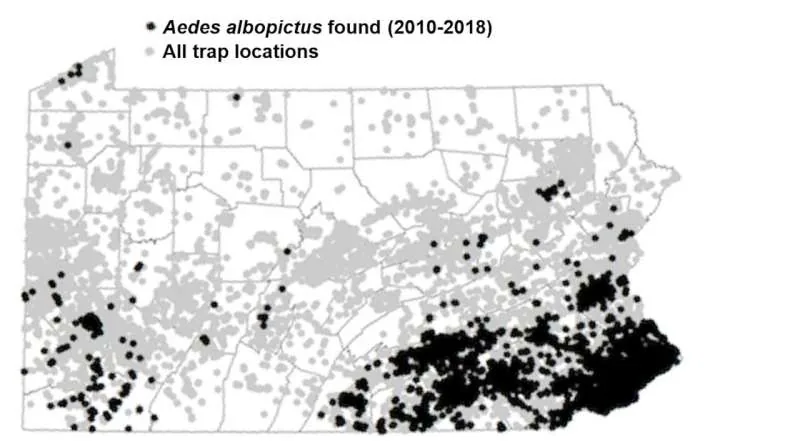
Follow-up surveillance added detections from 127 new counties, marking a ten percent increase in documented county presence [6]. State-level surveillance confirms that human settlement patterns strongly shape vector numbers in mid-Atlantic states. In Pennsylvania, E. A. H. Little and co-authors examined state trapping records between 2010 and 2018 in Parasites & Vectors. Over that nine-year period, vector control teams collected 10,878,727 female mosquitoes representing 51 species using gravid traps and BG-Sentinel traps. The team identified Aedes albopictus in 39 counties, with specimen numbers clustered heavily in populated communities surrounding Philadelphia. While Aedes albopictus accounted for 4.06 percent of all collected mosquitoes, researchers also identified invasive Aedes japonicus across all 67 Pennsylvania counties using mitochondrial cytochrome b gene sequences [4].
Similar northward spread is occurring in the upper Midwest. In Iowa, C. H. Lee, D. R. Hall, and R. C. Smith tracked the expansion of Aedes albopictus from three counties between 2016 and 2020 to at least eleven counties by 2025. Des Moines confirmed early detections. Overwintering populations establish permanent footholds once brought in through freight networks [7].
West Nile Virus in Warming Climates
While recent headlines focus on dengue, West Nile virus remains the most common mosquito-borne infection across the continental United States, with 2,400 reported cases in 2024. The pathogen is transmitted primarily by native Culex mosquitoes, including common house mosquitoes. These insects breed in roadside ditches, storm drains, retention ponds, and wetlands. Because Culex species are already established throughout American counties, warming temperatures do not need to bring them to new regions to increase transmission risk. Instead, warmer weather accelerates virus development inside the insect and prolongs the biting season. Public health researchers increasingly study how shifted temperature patterns lengthen these transmission windows across northern states [1].
In a preprint that has not yet undergone peer review, R. Fay and colleagues evaluated county-level observational data from New York State between 1999 and 2024 combined with climate model simulations spanning from 1860. Average temperatures rose by 1.4°C since the early 1900s. Under these warmer conditions, the annual transmission window for West Nile virus expanded by approximately 19.7 days over a 25-year span and 29.6 days over 45 years [8].
West Nile Virus Risk Projections in Florida
In southern states like Florida, where human population reached 24 million people by 2025, climate shifts threaten to make disease transmission a nearly year-round reality. The southern house mosquito (Culex quinquefasciatus) is present in every Florida county and serves as the primary vector for West Nile virus. Changing temperatures alter transmission suitability across the state [9].
In Vector-Borne and Zoonotic Diseases, Sadie J. Ryan and Catherine A. Lippi evaluated transmission suitability across Florida using five general circulation models and two climate scenarios known as SSP2-4.5 and SSP5-8.5. Baseline models showed that in 2000, all 67 Florida counties experienced five to nine months of suitable weather, but only 2.33 million residents in two counties faced nine full months of risk. Under moderate warming projections, between 8.93 million and 12.26 million people across 10 to 20 counties will experience nine months of transmission conditions by 2030. Under higher emission scenarios, that figure rises to 18.10 million residents across 26 counties, placing approximately 70 percent of Florida residents under extended seasonal exposure [9].
Controlling these rising health risks demands coordinated local action that pairs public municipal drainage maintenance with household yard management. Because mosquito larvae can mature in mere bottle caps or drainage grates, vector control agencies emphasize that eliminating standing water remains essential. Without systematic reductions in backyard breeding sites, expanding suburban footprints will continue to provide mosquito vectors with abundant water and hosts [1].
- ONLINE NEWS Noel, K., & Ryan, S. (2026). Where humans build, mosquitoes follow – bringing dengue, West Nile and other diseases with them. Medical Xpress. [Article Link]
- ACADEMIC JOURNAL Willoughby, J. R., McKenzie, B. A., Ahn, J., Steury, T. D., Lepzcyk, C. A., & Zohdy, S. (2024). Assessing and managing the risk of Aedes mosquito introductions via the global maritime trade network. PLOS Neglected Tropical Diseases, 18(4), e0012110. [Article Link]
- ACADEMIC JOURNAL Swan, T., Russell, T. L., Staunton, K. M., Field, M. A., Ritchie, S. A., & Burkot, T. R. (2022). A literature review of dispersal pathways of Aedes albopictus across different spatial scales: implications for vector surveillance. Parasites & Vectors, 15(1). [Article Link]
- ACADEMIC JOURNAL Little, E. A. H., Hutchinson, M. L., Price, K. J., Marini, A., Shepard, J. J., & Molaei, G. (2022). Spatiotemporal distribution, abundance, and host interactions of two invasive vectors of arboviruses, Aedes albopictus and Aedes japonicus, in Pennsylvania, USA. Parasites & Vectors, 15(1). [Article Link]
- ACADEMIC JOURNAL Moore, C. G., & Mitchell, C. J. (1997). Aedes albopictus in the United States: Ten-Year Presence and Public Health Implications. Emerging Infectious Diseases, 3(3), 329-334. [Article Link]
- ACADEMIC JOURNAL Hahn, M. B., Eisen, L., McAllister, J., Savage, H. M., Mutebi, J., & Eisen, R. J. (2017). Updated Reported Distribution of Aedes (Stegomyia) aegypti and Aedes (Stegomyia) albopictus (Diptera: Culicidae) in the United States, 1995–2016. Journal of Medical Entomology, 54(5), 1420-1424. [Article Link]
- ACADEMIC JOURNAL Lee, C. H., Hall, D. R., & Smith, R. C. (2026). Continued range expansion of Aedes albopictus (Diptera: Culicidae) in Iowa, United States. Journal of Medical Entomology, 63(2). [Article Link]
- PREPRINT Fay, R., Glidden, C., Trok, J., Diffenbaugh, N., Ciota, A., & Mordecai, E. (2025). The impact of climate change on transmission season length: West Nile virus as a case study. [Article Link]
- ACADEMIC JOURNAL Ryan, S. J., & Lippi, C. A. (2026). Management Implications of Shifting Culex quinquefasciatus West Nile Virus Transmission Suitability in Florida. Vector-Borne and Zoonotic Diseases, 26(8), 503-510. [Article Link]
- ACADEMIC JOURNAL Pedrosa, M. C., Borges, M. A. Z., Eiras, Á. E., Caldas, S., Cecílio, A. B., Brito, M. F., & Ribeiro, S. P. (2020). Invasion of Tropical Montane Cities by Aedes aegypti and Aedes albopictus (Diptera: Culicidae) Depends on Continuous Warm Winters and Suitable Urban Biotopes. Journal of Medical Entomology. [Article Link]
APA 7: PerEXP Teamworks. (2026, October 28). Mosquitoes Spread West Nile Virus and Dengue to New US Regions. PerEXP Teamworks. https://perexpteamworks.com/en/west-nile-virus-mosquito-habitats/


