





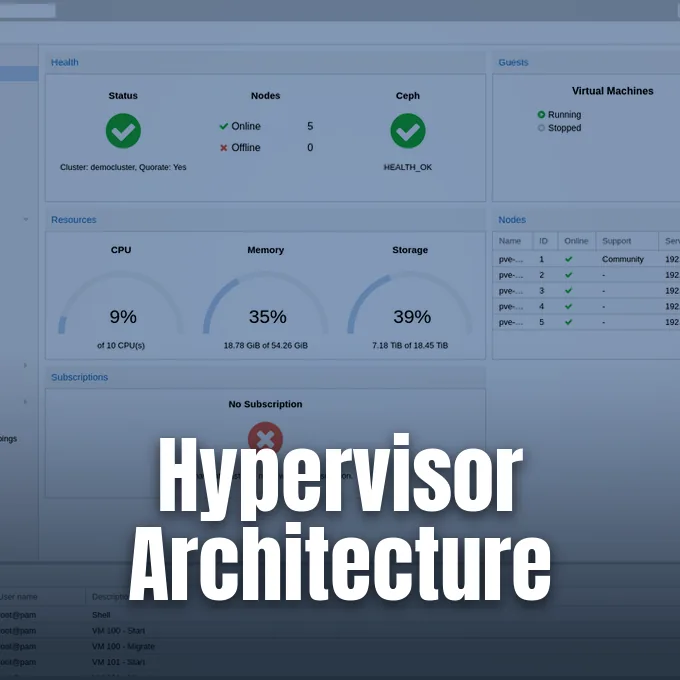
A hypervisor is a specialized software, firmware, or hardware layer that creates and manages virtual machines by abstracting computer hardware. When enterprise IT teams ask what is a hypervisor, they look for the mechanism that allows multiple operating systems to share processor cores, system memory, and storage drives safely. Unlike an emulator that translates machine code into software routines, a virtual machine monitor gives guest operating systems a virtual platform while dispatching raw instructions straight to native silicon. The computer hosting the software serves as the host machine, and each guest OS runs as an isolated guest machine [11].
What Is a Hypervisor?
The word hypervisor began as a stronger variant of the term supervisor, which computer scientists traditionally used to describe an OS kernel running in privileged CPU mode. It supervises other supervisors. IBM coined the designation around 1970 for software running OS/360 and an IBM 7090 emulator together on the System/360 Model 65, letting two operating systems share a single mainframe. In earlier projects like the CP/CMS platform launched in 1967, IBM Cambridge Scientific Center engineers called this layer the Control Program. The design proved that sharing raw silicon prevented a single software crash from disabling host hardware. By isolating running systems in memory partitions, early hypervisors protected continuous business operations [11].
Virtualization differs from container systems that share a single kernel. Container engines isolate user spaces by relying on Linux namespaces and control groups, but a hypervisor virtualizes the hardware interface completely. Each virtual machine runs its own kernel, device drivers, and user libraries. Linux, Windows, and macOS guests can run side by side on a single x86 server because the hypervisor provides an independent execution space for each instance [11]. This isolation model keeps guest failures separated from other host workloads.
Researchers also adapt hypervisor concepts to software defined networking and cybersecurity training grounds. Blenk, Basta, and Kellerer categorized network virtualization hypervisors into centralized and distributed designs that partition switches into isolated virtual networks [1]. Similarly, Tymoshchuk and Vasyliovych detailed how training facilities use hypervisors to build complex cyber polygons [4].
Type 1 and Type 2 Architecture
In his 1973 doctoral thesis titled Architectural Principles for Virtual Computer Systems, computer scientist Robert P. Goldberg divided hypervisors into two main architectural categories that still define virtualization engineering. Type 1 hypervisors, also known as native or bare-metal hypervisors, run on host hardware without a middle operating system. They control host processors directly. By operating above bare metal, these systems eliminate latency from general-purpose host kernels that run unrelated background jobs. Enterprise platforms like VMware ESXi and Microsoft Hyper-V use this bare-metal design to host demanding database clusters and corporate cloud services [11].
Type 2 hypervisors, known as hosted hypervisors, run as regular applications inside a standard operating system. The virtualization layer depends on the host OS to handle device drivers, memory allocations, and thread scheduling. Common desktop examples include Oracle VM VirtualBox, VMware Workstation, and Microsoft VirtualPC, which developers and testers run on client workstations to evaluate cross-platform software [11, 12]. A client hypervisor targets laptops and desktops rather than server racks, letting engineers operate secondary operating systems without repartitioning disks [12].
The boundary between bare-metal and hosted virtualization blurred with kernel-integrated modules. Technologies such as the Linux Kernel-based Virtual Machine and FreeBSD bhyve load into host kernels, turning general-purpose operating systems into functional Type 1 platforms [9, 11]. KVM and bhyve configure CPU privilege modes natively to execute guest code at full silicon speed.
Origins in Mainframe Computing
Virtualization originated in the mainframe era of the late 1960s as IBM sought to build reliable time-sharing systems for enterprise clients. The experimental CP-40 system, developed at the Cambridge Scientific Center, entered production use in January 1967 on a modified IBM System/360 Model 40. Earlier mainframes only shared user applications in systems like CTSS and IBM M44/44X. CP-40 succeeded because engineers virtualized the CPU supervisor state itself, which allowed multiple complete operating system kernels to execute at once in isolated hardware partitions. Programmers soon adapted that software for the IBM System/360 Model 67 as CP-67, which IBM shipped in 1966 with page-translation-table hardware for virtual memory [11]. Both platforms proved that virtualization increased stability.
The company IBM announced its System/370 series in 1970 without virtual memory, but engineers added dynamic address translation in the August 1972 Advanced Function announcement. The 1972 release introduced VM/370, an official reimplementation of CP/CMS that virtualized every hardware interface for commercial customers. VM/370 included a hypervisor-call handler that intercepted DIAG instructions, using opcode x’83’ to bypass complex emulation for file system operations [11]. This technique gave guest operating systems a fast communication path resembling the System/360 Supervisor Call instruction without altering underlying supervisor protections.
Mainframe partitioning evolved further in 1985 when IBM introduced the Processor Resource/Systems Manager (PR/SM) to manage logical partitions. IBM developed the bare-metal POWER Hypervisor for Power Systems, which dynamically distributes processing capacity across Multiple Shared-Processor Pools on POWER6 hardware. HPE deployed Integrity VM on Itanium processors running HP-UX [11].
Hardware Traps in Virtual Machine Monitors
A virtual machine monitor manages CPU privilege levels and intercepts sensitive machine instructions. Under classical computer architecture, processors use hierarchical protection rings, where Ring 0 executes the operating system kernel with full hardware access and Ring 3 runs user applications [10]. To virtualize a guest operating system, the monitor must prevent the guest kernel from executing privileged operations that alter machine state. When a guest kernel issues a privileged instruction, such as modifying control registers or resetting interrupt flags, the processor triggers a hardware trap. The virtual machine monitor intercepts this trap, inspects the requested operation, emulates the intended behavior inside the virtual machine context, and returns control to the guest.
Early x86 processors presented challenges for virtualization because certain sensitive instructions did not cause hardware traps in unprivileged rings. For hardware to be virtualizable under the Popek-Goldberg theorem, all sensitive instructions that manipulate hardware configurations must be a subset of privileged instructions. Because the x86 architecture failed this condition, early platforms used binary translation to rewrite code dynamically. Hardware vendors fixed the gap. Intel VT-x introduced VMX operation modes, while AMD added AMD-V, allowing guest operating systems to run unmodified instructions on native silicon while hardware intercepts privileged actions through clean VM exits [9, 10].
Modern monitors also integrate with advanced kernel tracing tools to inspect runtime behavior safely. Host administrators inspect hypervisor activities and trace device calls by coupling monitoring tools with Linux eBPF tracing programs. In performance benchmarks, Algarni, Ikbal, Alroobaea, Ghiduk, and Nadeem observed that KVM delivers near-native processor throughput across compute-intensive tasks [5].


Memory Management with Extended Page Tables
Memory virtualization requires mapping three address layers: guest virtual memory, guest physical memory, and host memory. In non-virtualized operating systems, the processor memory management unit translates virtual addresses into RAM locations. Under virtualization, guest physical addresses do not match real RAM. Early hypervisors resolved this translation challenge using shadow page tables, where the hypervisor maintained a hidden structure mapping guest virtual addresses to host memory. Every page table modification by guest kernels forced hypervisor traps, creating noticeable overhead during memory-heavy tasks. Software-based shadow tables proved too slow for intensive enterprise workloads [10]. Engineers needed a silicon solution to eliminate trap cycles.
Silicon vendors automated this translation. Intel introduced Extended Page Tables (EPT) with the Nehalem processor microarchitecture, while AMD rolled out Rapid Virtualization Indexing, formerly known as Nested Page Tables. With hardware nested paging, the processor memory management unit handles both levels of address translation automatically in silicon. The guest operating system manages its own primary page tables, and the hypervisor maintains the secondary extended tables that map guest physical addresses to host memory [9]. This hardware support eliminates constant VM exits during memory mapping changes, significantly accelerating database workloads.
Hypervisor deployments impose strict hardware memory requirements. Documenting the FreeBSD bhyve hypervisor, Michael Dexter explained that bhyve requires Intel Nehalem or newer CPUs with VT-x and EPT support. Host systems verify EPT availability through VMX and POPCNT flags in dmesg output, where missing instruction support like invept triggers assembler errors during compilation [9].
Device Virtualization Techniques
Input and output operations represent one of the most complex bottlenecks in hypervisor engineering. Virtual machines must interact with storage drives, network interfaces, graphics displays, and serial ports without interfering with host stability. The oldest approach is full device emulation, where the hypervisor mimics legacy hardware chips entirely in software [10, 11]. For example, a hypervisor might emulate an Intel e1000 network card or an IDE disk controller. Software emulates ancient controller chips. Full emulation allows unmodified legacy operating systems to boot smoothly, but emulating every register read, port access, and interrupt signal consumes host processor cycles and slows disk transfers [8, 10]. This performance penalty led developers to design cooperative I/O models.
To eliminate emulation bottlenecks, engineers developed paravirtualization, where guest operating systems install cooperative device drivers designed specifically to communicate with the hypervisor through shared memory [8, 10]. The industry standard framework for paravirtualized I/O is virtio, which provides standardized ring buffers for network, block storage, and console devices. Drivers batch requests into shared queues. Cloud Hypervisor and bhyve rely on virtio-net and virtio-block devices for storage and network throughput [8, 9]. In bhyve testing, FreeBSD guests use virtio-pci network adapters connected to host tap interfaces [9].
When virtual machines require raw hardware performance, hypervisors employ device pass-through via I/O Memory Management Units. Technologies like Intel VT-d and AMD IOMMU allow PCI Express devices, such as network adapters or graphics cards, to map into a guest address space [9, 10]. The IOMMU translates direct memory access requests and isolates device interrupts.
Cloud Infrastructure and Hypervisors
Modern cloud infrastructure demands lightweight virtual machine monitors that strip away legacy desktop hardware emulation. Traditional hypervisors bundled hundreds of legacy device models, creating a broad attack surface for security exploits in multi-tenant environments. To counter this risk, projects like Cloud Hypervisor focus on cloud workloads, supporting 64-bit Linux and Windows Server 2025 guests on x86-64 and AArch64 architectures. Cloud Hypervisor relies on KVM or the Microsoft Hypervisor (MSHV) to handle core CPU virtualization. By eliminating floppy drives, legacy IDE controllers, and complex ACPI power interfaces, cloud monitors minimize memory footprints and boot in milliseconds. These streamlined designs protect cloud tenants against hardware vulnerabilities [8].
Memory safety represents another vital design priority in next-generation virtualization platforms. Cloud Hypervisor is implemented in Rust, taking advantage of the Rust borrow checker to guarantee thread safety and prevent memory corruption bugs at compile time. Cloud Hypervisor imports foundational components from the open-source Rust VMM project, sharing architecture with Amazon Firecracker and Google crosvm. The monitor supports enterprise features including CPU, memory, and PCI hotplug, alongside machine migration and direct kernel boot options [8]. In security research, Sabahi demonstrated that hardened hypervisor architectures prevent unauthorized cross-tenant data leaks in public cloud clusters [6].
Microhypervisors shrink kernel codebases further. The Hedron microhypervisor, developed by Cyberus Technology GmbH and derived from Udo Steinberg’s NOVA project, provides a minimal trusted computing base. Hedron runs on x86 processors starting with Intel Ivy Bridge microarchitectures, implementing capability-based authorization while delegating device drivers and network protocol stacks to user-space multi-server environments [7].
Energy Efficiency in System Workloads
Data centers spend millions on server electricity. In an extensive empirical study, Jiang, Wang, Ou, Li, Zhang, Wan, Luo, and Shi investigated the power consumption traits of mainstream hypervisors including VMware ESXi, Microsoft Hyper-V, KVM, XenServer, and Docker. The researchers conducted prolonged power measurements on six hardware platforms, spanning three 2U rack servers, an emerging ARM64 server, a desktop machine, and a laptop computer. Their experiments evaluated hypervisors under computation-intensive, memory-intensive, and mixed Web server-database workloads at four distinct activity levels ranging from very light to very heavy. Their data showed that virtualization layers alter power consumption unevenly across hardware platforms [3]. Workload distribution directly impacts data center cooling costs.
Workload characteristics directly determine which hypervisor architecture delivers the highest efficiency. The benchmark results published by Jiang and coauthors showed that lightweight containers reduce power in simple tasks, but full hypervisors manage multi-tenant CPU allocation and thermal throttling more reliably under sustained load [3]. In complementary performance evaluations, Algarni and colleagues found that KVM delivers the best overall performance in general benchmarks, while Xen excels in file system and application throughput. Proxmox VE achieved the highest marks in CPU throughput testing [5].
Hypervisors now control industrial systems. Khan, Zugenmaier, Jurca, and Kellerer examined network virtualization architectures, proposing that hypervisors provide a structural framework to overcome routing bottlenecks on the modern Internet [2]. In industrial automation and automotive domains, hypervisors partition mixed-criticality control units so that entertainment software can’t interrupt safety-critical brakes or engine controllers [10]. Silicon virtualization keeps computing infrastructure flexible, secure, and resilient.
- ACADEMIC JOURNAL Blenk, A., Basta, A., B, M. R., & Kellerer, W. (2015). Survey on Network Virtualization Hypervisors for Software Defined Networking. IEEE Communications Surveys & Tutorials, 18(1), 655-685. [Article Link]
- ACADEMIC JOURNAL Khan, A., Zugenmaier, A., Jurca, D., & Kellerer, W. (2012). Network virtualization: a hypervisor for the Internet?. IEEE Communications Magazine, 50(1), 136-143. [Article Link]
- ACADEMIC JOURNAL Jiang, C., Wang, Y., Ou, D., Li, Y., Zhang, J., Wan, J., Luo, B., & Shi, W. (2017). Energy efficiency comparison of hypervisors. Sustainable Computing Informatics and Systems, 22, 311-321. [Article Link]
- ACADEMIC JOURNAL Tymoshchuk, D., & Васильович, Я. В. (2024). USING HYPERVISORS TO CREATE A CYBER POLYGON. Measuring and computing devices in technological processes, 52-56. [Article Link]
- ACADEMIC JOURNAL Algarni, S. A., Ikbal, M. R., Alroobaea, R., Ghiduk, A. S., & Nadeem, F. (2018). Performance Evaluation of Xen, KVM, and Proxmox Hypervisors. International Journal of Open Source Software and Processes, 9(2), 39-54. [Article Link]
- ACADEMIC JOURNAL Sabahi, F. (2012). Secure Virtualization for Cloud Environment Using Hypervisor-based Technology. International Journal of Machine Learning and Computing, 39-45. [Article Link]
- WEBSITE Cyberus Technology GmbH. (2020). The Hedron Microhypervisor. GitHub. [Article Link]
- WEBSITE Cloud Hypervisor Authors. (2019). Cloud Hypervisor: A Virtual Machine Monitor for Modern Cloud Workloads. GitHub. [Article Link]
- WEBSITE Dexter, M. (2012). Hands-on bhyve. Call for Testing. [Article Link]
- THESIS GRIN Verlag. (2010). Virtualization for Reliable Embedded Systems. [Article Link]
- WEBSITE Wikipedia. (n.d.). Hypervisor. [Article Link]
- WEBSITE Wikipedia. (n.d.). Client hypervisor. [Article Link]
Cover image: Proxmox Server Solutions GmbH / Wikimedia Commons, Public domain


