




The actor model provides a formal architecture for parallel computation that treats independent actors as universal building blocks instead of relying on threads accessing shared memory locations. Each actor encapsulates its own private state, shielding its data from outside interference while sequentially processing incoming events from its mailbox without mutex locks. Communication happens exclusively through message passing between network nodes or multicore processors. By removing mutual exclusion locks, this architecture stops memory corruption and data races in high-throughput applications [10].
Origins of the Actor Model
Carl Hewitt, Peter Bishop, and Richard Steiger created the architecture in 1973 at MIT. Hewitt said the design was “motivated by the prospect of highly parallel computing machines consisting of dozens, hundreds, or even thousands of independent microprocessors, each with its own local memory and communications processor, communicating via a high-performance communications network”. The MIT Artificial Intelligence Laboratory team rejected universal clocks while drawing ideas from quantum physics and relativity, building on packet networks designed between 1961 and 1964 [10], [12].
Earlier systems could not support true parallel work because their models assumed global state transitions across all processing units. In 1963, John McCarthy introduced situation variables in artificial intelligence logic, formally defining a situation as “the complete state of the universe at an instant of time”. Alonzo Church built lambda calculus on variable substitution, but parameter substitution could not share changing resources among parallel processes. Simula 67 pioneered message passing for simulations through modular class methods by Kristen Nygaard and Ole-Johan Dahl, but execution relied on coroutines rather than true concurrency. Smalltalk-72 creator Alan Kay adopted messages, but Dan Ingalls recorded that dynamic token lookups bound execution to sequential machine syntax [12].
Irene Greif created operational semantics at MIT. Henry Baker and Hewitt published axiomatic laws in 1977. William Clinger added power domain denotational models in 1981, and Gul Agha published transition semantics in 1985 [10], [1]. MIT researchers included Russ Atkinson, Giuseppe Attardi, Gerry Barber, Peter de Jong, Ken Kahn, Henry Lieberman, Carl Manning, Tom Reinhardt, and Dan Theriault [10].
Core Primitives and Behaviors
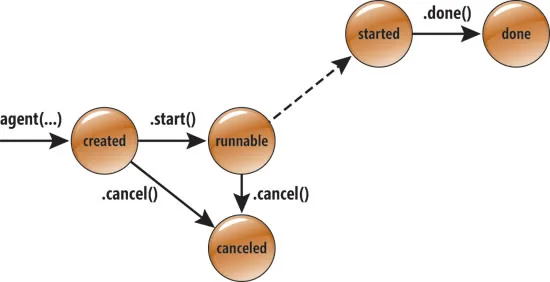
Actors respond to arriving messages through three basic operations, where an entity dispatches new messages to known addresses, creates child actors, and designates future message handling behavior. These steps run in parallel without a fixed sequence. Senders do not wait for replies, and recipients never block senders. Decoupling the sender from message delivery enables non-blocking communication throughout the system [10].
At Caltech, W. C. Athas and N. J. Boden created Cantor as an actor programming system to test message passing on fine-grain multicomputers. Cantor conformed to actor model semantics described by Gul Agha, proving that fine-grain multicomputer computations advance exclusively through asynchronous message passing between concurrent objects. Every computation runs as a set of objects that synchronize solely by exchanging messages. When an object receives a message, it consumes the data, sends zero or more messages, creates new objects, and alters its local state. Because message delivery is the only event that alters global state, Athas and Boden classified Cantor programs as message driven. Communication between paired objects in Cantor is non-blocking, buffered, and order-preserving [1].
Actors communicate over flexible networks by including addresses inside message payloads. If an actor needs another unit to answer a request, it places that recipient’s address in the data packet. Research teams led by Chuck Seitz at Caltech and Bill Dally at MIT built computer hardware to optimize these message routes. Further actor research spread to Stanford University, Kyoto University Tokoro Laboratory, and the University of Illinois at Urbana-Champaign [10].
Why Do Actors Avoid Shared Memory?
Actors avoid shared memory because locking shared mutable variables introduces severe throughput bottlenecks, synchronization deadlocks, and unpredictable latency spikes across modern multicore computing environments [10], [2]. When computers began simulating concurrency on single processors in the early 1960s, Edsger Dijkstra invented semaphores, while Tony Hoare and Per Brinch Hansen designed monitors between 1971 and 1973 to coordinate shared resources. Early computing relied on interrupt handlers that put keyboard characters or network packets into shared buffers. Yet neither tool encapsulated access inside programming language structures [10].
Russ Atkinson and Hewitt built the serializer construct to encapsulate shared access, but hardware growth brought fresh hurdles [10]. Writing in MSDN Magazine, Michael Chu explained that Amdahl’s law limits parallel speedups whenever processors spend an increasing percentage of execution time waiting for data from disks or networks. Developers often try parallel loops, but threads idle at synchronization locks. Chu said actor systems organize software around dataflow pipelines, letting data stream through independent stages without locking shared memory. In an asynchronous email pipeline, for example, a censor block cleans text as a format block styles earlier words, keeping proper order without shared locks [2].
Each actor runs inside its own isolated memory boundary [10], [3]. No two threads can write to the same field at the same time [10]. Data races vanish without locks [5]. Hardware runs faster because processors skip cache synchronization delays [2].
Handling Unbounded Nondeterminism
A parallel system without a central clock must arbitrate when multiple messages arrive at a single recipient. Dijkstra argued that concurrent programs must have bounded nondeterminism, meaning a program starting in a defined state halts in a bounded number of states, claiming that unbounded delays could not be implemented on real hardware. Hewitt disagreed. Hewitt pointed out that hardware arbiters take an unbounded time to settle metastability when dealing with asynchronous input signals [10].
Hewitt’s architecture embraces unbounded nondeterminism, guaranteeing that every message sent to an actor will eventually be serviced regardless of transit delay or arbitration contention. William Clinger proved this property in 1981 using domain theory, establishing that concurrent computations lack a single global state [10]. Actor theory describes computation through activation orderings and arrival orderings. The activation ordering tracks the causal flow of energy as an event activates another, obeying the law of strict causality across all observer frames of reference. Arrival orderings record message arrival on an actor’s world line, governed by relativistic invariance [11].
Henry Baker and Hewitt conjectured that these causal laws guaranteed finite chains between events, but Clinger showed this condition was mathematically independent. He proved that an actor sending itself repeated messages while spawning greeter actors could satisfy earlier laws yet form infinite event chains. Because physics forbids expending infinite energy along a finite path, actor theory adopts the law of finite chains as a foundational axiom [11].

Actor Model Runtime Implementations
Engineers brought actor concepts into software platforms to power cloud infrastructure [8], [2]. On Windows, Akka.NET runs as a .NET Foundation project on the Common Language Runtime. Akka.NET actors process messages one at a time in first-in, first-out order, while the Akka.Remote module provides location transparency, enabling actors on separate cluster servers to communicate through peer-to-peer routing. Petabridge provides training and commercial support for these distributed clusters [8].
Ash Mason created Theron in 2007 as a freeware C++ actor library designed for multicore machines. Mason designed Theron to handle low-latency queuing, false-sharing prevention, and Non-Uniform Memory Access (NUMA) computer architectures. The project reached release 6.00.02 before Mason stopped development due to the burden of multi-platform maintenance [9]. In Visual Studio 2010, Microsoft released the Asynchronous Agents Library (AAL) as part of the Concurrency Runtime within the C Runtime. AAL provided composable message blocks such as unbounded_buffer, transformer, choice, and join to work with the Parallel Patterns Library (PPL) across concurrent pipelines [2].
These runtimes show that actor architectures scale across hardware setups. Akka.NET processes tens of millions of in-memory messages per second on multicore hardware [8]. Automatic thread scheduling frees developers from manual thread management [2].
Industrial Telemetry and Internet Systems
Actor systems form the backbone of Internet of Things (IoT) platforms that monitor millions of hardware devices. In InfoWorld, Leocheung said connected devices manage changing internal state over low-power networks. For example, smart thermostats managed by EcoFactor combine low-cost hardware with ZigBee wireless personal area networks, allowing cloud servers to assign an individual actor to every physical thermostat connected to the grid [3].
Device actors often publish operational state data to subscribers using the industry standard Message Queue Telemetry Transport (MQTT) publish-subscribe protocol across distributed networks. In Akka, built in Scala for the Java Virtual Machine (JVM), actors have lifecycle hooks including preStart(), postRestart(), and postStop(). To avoid mutable variables, Akka actors hot-swap behavior using context.become() to emulate state machines without private thread contention. A worker actor begins in an idle state, switches to a working state upon receiving a work assignment, and returns to idle when the task finishes, notifying master actors of completed results. Akka Streams and Akka HTTP extend this foundation with streaming and REST API tools, allowing high-throughput telemetry ingestion [3].
Hierarchical supervision gives IoT networks resilient fault tolerance. When a device actor fails, its supervisor detects the error and applies a recovery strategy. Parent actors can restart faulted children without disturbing sibling actors [3].
Safety Guarantees in Modern Languages
Several modern languages build actor rules into their compilers to verify safety mathematically. Pony is an ahead-of-time compiled, object-oriented language based on actors. The Pony team follows a “get-stuff-done” philosophy where correctness comes first, runtime speed second, and programmer simplicity third, relying on a mathematical type system to ensure that concurrent programs can’t suffer from data races. Pony code has no locks, no mutexes, and no null values [5].
Pony guarantees memory safety through reference capabilities, which label data to control how it can be shared between concurrent actors. The compiler requires actors to share only immutable values or exchange isolated data structures [5]. In dynamic languages, Ruby provides thread-safe parallel execution through Ractor on CRuby. Each ractor holds its own Global Virtual Machine Lock (GVL) so ractors run in parallel without locking each other. When non-shareable objects pass between ractors, Ruby makes a deep copy or moves ownership using the move option, which permanently prevents the sending ractor from accessing the transferred object. Ractor instances receive incoming messages through an incoming port queue and send results to an outgoing port, closing ports automatically when the ractor terminates [7].
Humus takes another route, combining actors with a pure-functional core defined in the Journal of Functional Programming by Gul Agha, Ian Mason, Scott Smith, and Carolyn Talcott. Unlike Erlang or Scala, Humus expressions are completely free of side-effects. Mutable state remains encapsulated within actors and changes only through messages. Developers can test Humus code in a browser simulator built for Firefox and Chrome [4].
Formal Verification in Actor Model Systems
As cloud applications expand, verifying asynchronous interactions becomes vital for system reliability. Microsoft Research and Imperial College London developed P# to build and test distributed software for Azure services. P# models software as communicating state machines that create child machines, send events, and switch states, allowing programmers to write formal safety and liveness specifications directly in C# on top of the Task Parallel Library (TPL) [6].
The P# framework includes a systematic testing engine that evolved into Coyote. The engine controls scheduling and nondeterministic timeouts, exploring real executable code to detect bugs and specification violations. When a bug appears, the engine outputs a reproducible trace that developers can replay in the Visual Studio Debugger [6]. In telecommunications, the Testing and Test Control Notation (TTCN-2 and TTCN-3) standard similarly models test components as actors that exchange messages across parallel test interfaces, creating dynamic test configurations to validate distributed protocols. Each test component in TTCN-3 operates with its own behavior tree and internal message queue, dynamically creating peer test components to verify complex network architectures [10].
In big data analytics, researchers created Amber on top of the Orleans actor system to support responsive debugging. Amber lets developers pause running workflows, set breakpoints, and inspect actor cluster states [10]. These formal verification systems show that actor models provide reliable foundations for distributed software [6], [10].
- CONFERENCE PAPER Athas, W. C., & Boden, N. J. (1988). Cantor: an actor programming system for scientific computing. Proceedings of the 1988 ACM SIGPLAN Workshop on Object-Based Concurrent Programming, 66-68. [Article Link]
- ONLINE NEWS Chu, M. (2010). Async Agents – Actor-Based Programming with the Asynchronous Agents Library. MSDN Magazine, 25(9). [Article Link]
- ONLINE NEWS Leocheung. (2017). Why Akka and the actor model shine for IoT applications. InfoWorld. [Article Link]
- WEBSITE dalnefre.com. (2010). It’s Actors All The Way Down. Dalnefre. [Article Link]
- WEBSITE Pony Language Team. (2025). Pony Design Philosophy and Reference Capabilities. Ponylang. [Article Link]
- WEBSITE P-org. (2015). P#: A framework for rapid development of reliable asynchronous software. GitHub. [Article Link]
- WEBSITE Ruby Documentation. Class Ractor: Actor-model abstraction for Ruby. Ruby-Lang. [Article Link]
- WEBSITE Akka.NET Team. (2013). Akka.NET: Canonical actor model implementation for.NET. GitHub. [Article Link]
- WEBSITE Mason, A. (2017). Theron (2007). Ashton Mason Portfolio. [Article Link]
- WEBSITE Wikipedia. Actor model. Wikipedia, The Free Encyclopedia. [Article Link]
- WEBSITE Wikipedia. Actor model theory. Wikipedia, The Free Encyclopedia. [Article Link]
- WEBSITE Wikipedia. History of the Actor model. Wikipedia, The Free Encyclopedia. [Article Link]


