



Cloudflare released Clef and Clef-flash on October 1, 2026, introducing open-weight systems designed to provide autonomous software agents with fast, deterministic classifications rather than open-ended conversational text [1],. Unlike traditional large language models that generate variable token streams, Clef Decision Models evaluate specific schema options directly, returning typed answers with exact probabilities [2]. Technology reporter Brandon Vigliarolo noted in The Register that Cloudflare is attempting to outplay Typesafe AI and Jev System One by publishing open weights on Hugging Face under an Apache License [1]. Immediate hosting on Cloudflare Workers allows enterprise engineering teams to deploy these decision checkpoints across edge infrastructure worldwide [2].
How Decision Models Differ from Generative Systems
Automated agent workflows regularly encounter operational intersections where software must route customer support tickets, determine escalation paths, or evaluate system emergencies without human intervention. Standard large language models possess open-ended reasoning capabilities, but their non-deterministic text generation introduces unpredictable formatting errors, high compute expense, and variable execution latency across multi-step agent trajectories. A decision model resolves this limitation by producing bounded, strictly typed classifications accompanied by calculated probabilities. Cloudflare targets agentic workflows. Human intervention is no longer required for routine programmatic routing [2].
Cloudflare evaluated this concept internally by tasking the Cloudflare Threat Intelligence team with automated domain classification. Paired with Browser Run, Cloudflare Clef processed target domains and classified content into weighted categories, identifying a test sample with a 95% chance of being a fashion website, 85% ecommerce, and under 1% phishing. Clef fetched, rendered, and classified the page in 2.2 seconds. In comparison, Cloudflare’s fastest general language model, gpt-oss-120b, required 4.7 seconds while returning only two broad categories. Latency dropped by half [2].
Operating within live execution paths sets decision models apart from static forecasting systems. Computational studies have examined how predictive architectures capture the fingerprints of energy models across historical emissions data, but modern agentic software demands immediate runtime classification to guide subsequent operations. In music theory, a clef marks the beginning of a musical staff to define pitch ranges and inform subsequent notes. Cloudflare selected the name because Clef Decision Models establish domain context and govern subsequent actions executed by autonomous software agents [2].

Cloudflare Clef Outpaces Jev on Critical Latency Benchmarks
Evaluations recorded on the live Jev Decision Index benchmark suite demonstrate that Cloudflare Clef leads competing architectures across diverse functional evaluations [1],. On the BFCL evaluation measuring case exactness, Clef scored 98.47 percent and Clef-flash reached 98.76 percent, surpassing Jev at 95.75 percent, DiffusionGemma Jev at 96.52 percent, and Kev 9B at 94.51 percent. On Home Appliances test suites, Clef achieved 82.95 percent while Clef-flash scored 97.73 percent, exceeding Jev at 52.27 percent and Kev 9B at 25.00 percent. Laya scored zero [2]. Brandon Vigliarolo observed in The Register that Cloudflare aims to outplay Jev with open weights on Hugging Face when local hardware horsepower is available [1].
Clef maintained a measurable performance advantage across several specialized intent and retrieval evaluations on the Jev Decision Index. On API-Bank accuracy, Clef registered 91.93 percent and Clef-flash scored 93.11 percent against 88.19 percent for Jev. ToolRet testing showed Clef leading with an nDCG@10 of 69.19 compared to Jev’s 65.28, while BANKING77 yielded a macro-F1 of 94.20 for Clef over Jev’s 79.74. On CLINC150+OOS, Clef posted 97.43 against Jev’s 89.27, and PhishNChips reached 79.60 percent versus 62.55 percent. Jev maintained an edge on When2Call with 80.97 percent [2].
Speed remains the primary differentiator for production environments. Clef recorded a median latency of 209.3 milliseconds across 43 eval benchmarks, while Clef-flash achieved an ultra-fast median latency of 38.8 milliseconds. In contrast, Jev recorded a median latency of 524.1 milliseconds, while Kev-9B reached 51.4 milliseconds and DiffusionGemma Jev required 84.4 milliseconds across identical evaluation hardware. At the 95th percentile, Clef logged 238.6 milliseconds against 536.0 milliseconds for Jev. On Typesafe workflow tests, Clef led Invoice Processing with 64.7 percent, Customer Service with 76.3 percent, and Security Incidents classification with 62.9 percent [2].


Clef Decision Models Add Vision Encoding and 64k Context
Beyond raw throughput, Clef Decision Models introduce structural capabilities that distinguish them from earlier single-modality classifiers [1], [2]. While Jev remains restricted to text classification, Clef incorporates an integrated vision encoder capable of parsing image content and visual interface data [1], [2]. Brandon Vigliarolo reported for The Register that multimodal processing expands operational utility for teams automating graphical user interfaces, assuming organizations possess sufficient hardware horsepower to host local weights. Jev only classifies text [1], [2]. Local execution requires Hugging Face [1].
Context capacity represents a major architectural enhancement over competing offerings. Cloudflare expanded Clef to a 64k context window, doubling the 32k window supported by Jev. The larger 64k space allows autonomous systems to ingest comprehensive operational histories, multi-turn support dialogues, and extensive Agent Trace Observability logs before reaching a decision point. Context reaches 64k capacity. Engineers can supply complete diagnostic records without aggressive summarization [2].

Programmatic integration follows a typed schema that maintains direct compatibility with the existing Jev interface [2], [3]. Software developers on Hacker News observed that integrating Clef hosted on Cloudflare Workers requires straightforward HTTP requests, submitting state strings with typed decision questions, routing choices, and categorical severity scores [2], [3]. Cloudflare guarantees customer privacy. Operational customer payloads are neither retained nor used to train baseline models across Cloudflare Workers [2].
Non-Autoregressive Routing Powers the Clef Architecture
The underlying mechanism of Clef diverges substantially from standard autoregressive models that generate output token by token. Cloudflare initially experimented with adapting DiffusionGemma to surface log probabilities, leveraging contributions from independent researcher Matt Mastracci, who shared code pull requests with the vLLM inference engine. Rather than continuing with experimental checkpoints, development subsequently pivoted toward utilizing Alibaba Qwen architecture as the foundational pre-trained backbone for all production models [2].
Clef processes requests by executing a prefill-only pass across the backbone before scoring all valid schema options in parallel. Because this classification step is non-autoregressive, the architecture avoids generating intermediate conversational text. Choices derive without intermediate text. Schema choices derive directly from internal backbone representations through a two-stage attention routing process. Each candidate choice extracts relevant context from the prompt, while field parameters cross-reference other inputs and the primary payload prior to final scoring [2].
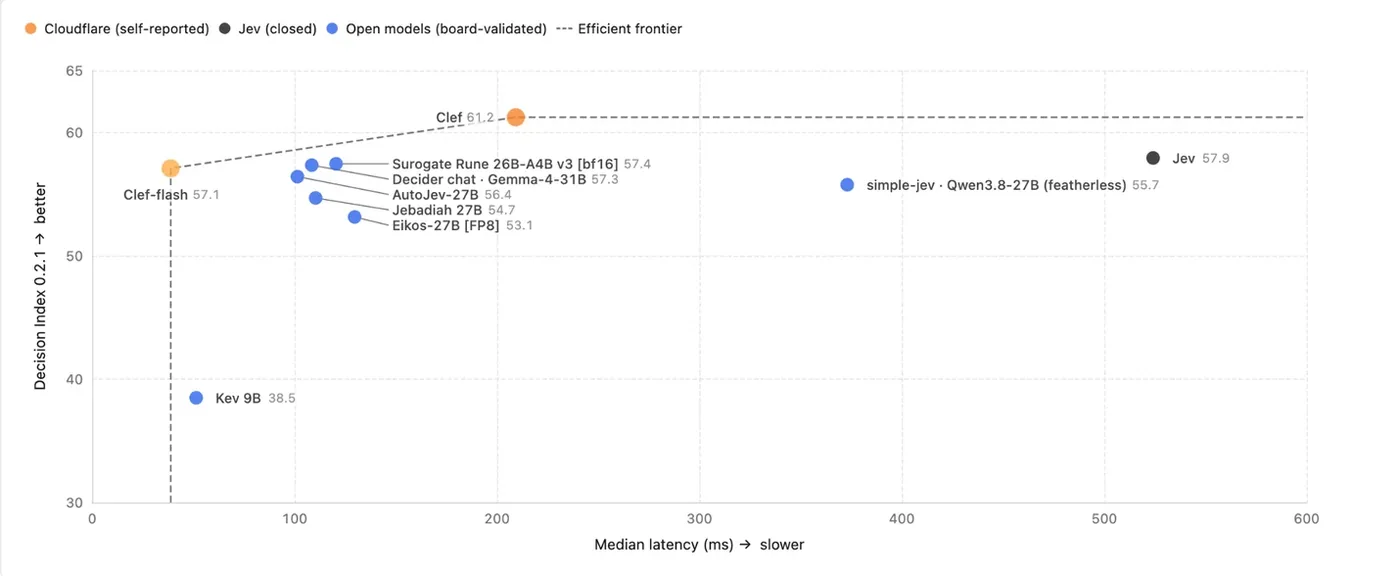
Model construction relies on freezing Qwen3.8-27B for the flagship Clef model and Qwen3.5-9B for Clef-flash, training the routing head with rank-256 low-rank adapters. Post-training combines label-smoothed cross-entropy on valid schema outputs with a Brier loss to guarantee probability calibration. This calibration grounds mathematical outputs in reliable confidence scores, advancing the practical machine learning mechanics of intelligent algorithms across automated infrastructure [2].
Fine-Tuning Clef Open-Source Models with Reinforcement Learning
To tailor decision models to specialized domain logic, Cloudflare formulated Reinforcement Learning for Calibrated Decisions (RLCD) as a secondary optimization target. The RLCD algorithm awards partial credit to adjacent ordinal choices, rewards fully accurate schema outputs, and applies a mathematical reference penalty to prevent distribution shift. This reward structure preserves accuracy while improving generalization across custom organizational categories [2].
Cloudflare paired the open weights with a commercial fine-tuning service for enterprise clients [2], [3]. Organizations requiring custom classifiers can collaborate directly with Cloudflare forward-deployed engineer teams to adapt Clef Decision Models to proprietary datasets. Cloudflare plans to expand this service into a self-serve fine-tuning platform that lets developers train specialized versions and deploy them back onto Cloudflare Workers edge nodes [2].
Weights use Apache License [1], [2]. Releasing open weights on Hugging Face allows developers to bypass proprietary lock-in while leveraging Cloudflare Workers edge infrastructure [1], [2].
- ONLINE NEWS Vigliarolo, B. (2026, October 1). Cloudflare tries to outplay Jev with open-weight Clef models. The Register. [Article Link]
- PRESS RELEASE Cloudflare. (2026, October 1). Introducing Clef: Our open-source decision models, and new RL fine-tuning platform. Cloudflare Blog. [Article Link]
- WEBSITE Hacker News. (2026, October 1). Clef: Open-source decision models, and new RL fine-tuning platform. Y Combinator Hacker News. [Article Link]


