





AMD announced on Tuesday that it expects fourth-quarter revenue of around $17 billion, positioning AMD to outsell Intel for the first time behind surging data center chip sales. The outlook topped analyst consensus estimates on revenue and EPS and paired with record third-quarter financial results reported by Lisa Su [1]. Personal computer shipments face headwinds from high memory costs, but the projected AMD Q4 revenue gives AMD an estimated $1.5 billion advantage over Intel’s guidance midpoint for the same period [2].
Quarterly Target Puts AMD Q4 Revenue Ahead
AMD established fourth-quarter revenue guidance of $17 billion plus or minus 3 percent, or between $16.49 billion and $17.51 billion, easily surpassing the consensus estimate of $16.23 billion and indicating a 66 percent rise over the same quarter last year [2]. Intel projects $15.5 billion at its midpoint. That leaves AMD approximately $1.5 billion ahead, on track to surpass Intel in quarterly revenue for the first time in history and upend a semiconductor rivalry that Rohail Saleem of Wccftech likened to David overcoming Goliath [1].
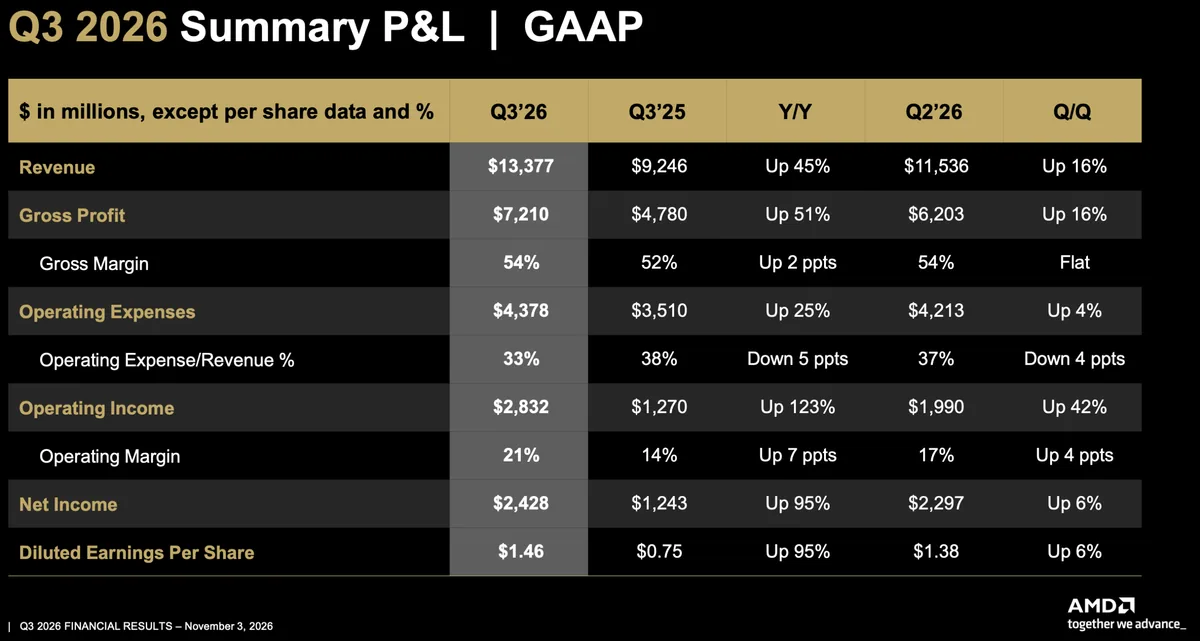
Third-quarter results gave AMD the foundation for that guidance, as total sales reached $13.377 billion, rising from $9.25 billion in the third quarter of 2025 and $11.54 billion in the second quarter of 2026. Gross margin reached 54 percent during the quarter, and net income grew 95 percent to $2.43 billion. Diluted earnings per share reached $1.46, up from $0.75 in the prior-year period. Intel previously led sales by wide margins, but cloud infrastructure spending has reshaped the balance between the two chipmakers as Anton Shilov reported in Tom’s Hardware [2].
The shift follows an earlier period where AMD reached a $1 trillion market valuation ahead of Intel during equity trading. Financial analysts had tracked the narrowing gap for quarters, but product deliveries now reflect that valuation on income statements [1].
Server Processors Drive Record Data Center Gains
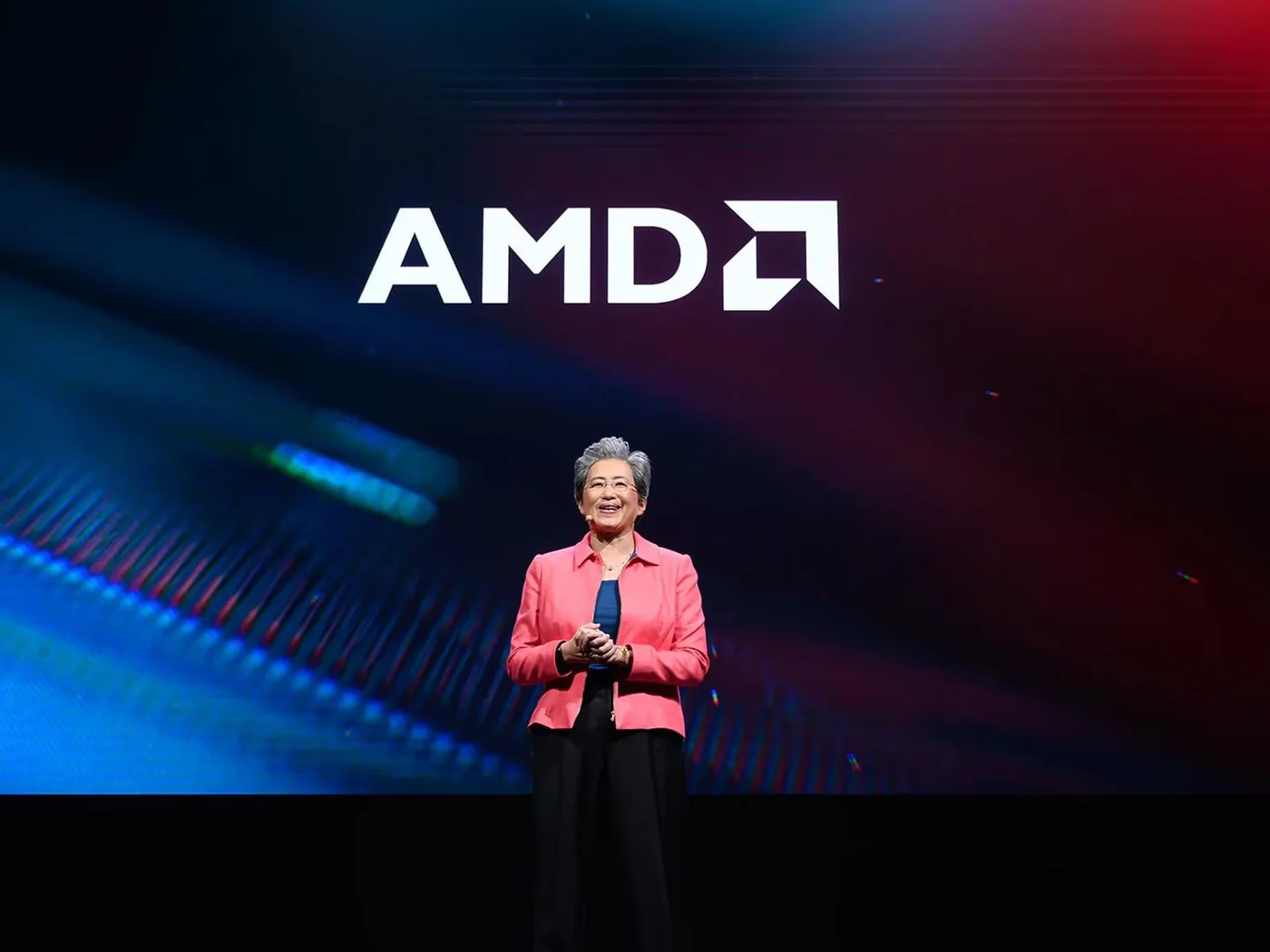
Data center hardware became the primary growth driver at AMD, generating a record $8.55 billion in sales, which marks a 97 percent increase over the prior year and a 27 percent sequential rise. Operating profit jumped 168 percent to $2.88 billion. Operating margin reached 34 percent as enterprise cloud platforms expanded server deployments [2].
Customer demand centered on newer Epyc server processors and the rollout of Instinct MI455X accelerators, which power AMD’s Helios rack-scale systems. AMD recorded initial Helios and Instinct MI455X revenue in the third quarter of 2026, confirming that major cloud providers, including Anthropic, Meta, Microsoft, OpenAI, and Oracle Cloud Infrastructure, are already running workloads on early Helios hardware [2]. Venice server processor deliveries have begun, and Helion CPU racks ship in the ongoing quarter as AMD prepares a broader Helios production ramp in 2027 [1]. Data center hardware accounted for 64 percent of total AMD sales in the third quarter, rising from 47 percent in the third quarter of 2025 [2].
Lisa Su outlined the accelerating transition during an earnings call with analysts and investors. “We now expect server revenue to double year over year in 2027 and data center AI revenue to grow even faster than we projected ninety days ago,” Su said. “As a result, we expect data center to be more than eighty percent of our total revenue in 2027 and to drive the majority of our revenue and earnings growth” [2].

Memory Prices Weigh on Client Hardware
Enterprise infrastructure compute grew, but AMD’s Client and Gaming division recorded $3.722 billion in third-quarter revenue, down 8 percent year-over-year and 3 percent sequentially amid weaker retail purchasing. Division operating profit fell 34 percent to $573 million, pulling segment operating margin down to 15 percent as consumer PC demand softened across global markets [2].
Client processor sales brought in $2.95 billion, contracting from $3.06 billion during the prior quarter and inching above the $2.75 billion recorded in the same period a year earlier. Desktop processors had seen steady support through moves like expanding budget desktop choices on AM4 platforms, but overall personal computer demand slowed. Gaming revenue dropped to $773 million from $1.298 billion a year earlier because Sony and Microsoft purchased fewer custom console system-on-chips. Higher memory prices continue to raise system build costs, leading AMD to project that client sales will contribute less to overall AMD Q4 revenue as the combined client and gaming segment contracts by more than 20 percent sequentially [2].
Lisa Su warned investors that consumer PC markets face prolonged supply hurdles across hardware channels, projecting that PC market unit shipments will decline by a double-digit percentage in 2027. “In this environment, we expect to outperform the market as we deliver our rising roadmap and grow our commercial footprint,” Su said [2].
Intel Reallocates Advanced Fab Wafers to Xeon
Intel projected fourth-quarter revenue of $15 billion to $16 billion, falling behind AMD as personal computer client demand dropped sharply. Intel disclosed that PC-related revenue would drop more than 20 percent on a QoQ basis in Q4, spurred by memory and substrate dislocations that disrupted computer assembly across global manufacturing supply chains. PC demand remains weak [1].
To cope with slumping PC demand, Intel altered production plans at its Oregon fabrication facility by shifting manufacturing lines toward server hardware. Intel diverted silicon wafers from its cutting-edge 18A process node to the older Intel 3 node to boost supplies of Xeon 6 processors, code-named Granite Rapids, to satisfy data center demand. Intel’s chief financial officer stated that those 18A wafers were originally slated for Panther Lake client processors, but weak computer demand provided room for the switch. The reallocated Intel 3 production capacity is expected to come online during the second half of 2027 [1].
The divergence shows how differing product mixes shape financial results between the two rivals. Intel still relies heavily on desktop computing and server processors facing component shortages, but AMD has leaned on surging accelerator demand to drive growth [2]. The widening difference in hardware exposure explains why AMD projects taking the revenue lead [1].

How AMD Q4 Revenue Shapes 2027 Forecasts
The quarterly shift reflects a multi-year transition in AMD’s business structure. AMD now projects its total revenue to grow by over 80 percent in 2027, double the pace management shared during its Investor Day presentation. Server revenue is expected to double during 2027 compared to 2026 levels, powered by higher shipment volume and greater core counts rather than ASP increases [1].
AMD’s Embedded business unit generated $1.11 billion in sales, up 29 percent year-over-year, while division operating profit climbed 60 percent to $453 million behind steady purchasing from aerospace, defense, automotive, communications, and industrial accounts. Lisa Su linked that growth to infrastructure expansion. “Data center build-outs are also driving higher demand for our embedded CPUs and adaptive SoCs in control plane and optical networking applications,” Su said, adding that AMD remains on track to secure more than $18 billion in design wins during 2026 [2].
Revenue generated by artificial intelligence accelerators will surpass traditional server CPU sales during the final three months of 2026 [1]. With customer orders for Helios and Instinct MI455X hardware ramping into 2027, data center products are projected to make up more than 80 percent of total company sales [2]. If current guidance holds, the surge in AMD Q4 revenue will close the year with AMD formally ahead of Intel on the revenue leaderboard [1].
- ONLINE NEWS Saleem, R. (2026, November 4). AMD is set to out-earn Intel for the first time in its history, guiding to $17 billion in Q4 revenue against Intel’s $15.5 billion midpoint projection. Wccftech. [Article Link]
- ONLINE NEWS Shilov, A. (2026, November 4). AMD expects to outsell Intel in Q4 for the first time in history — $17B guidance would exceed Intel’s projections. Tom’s Hardware. [Article Link]


