





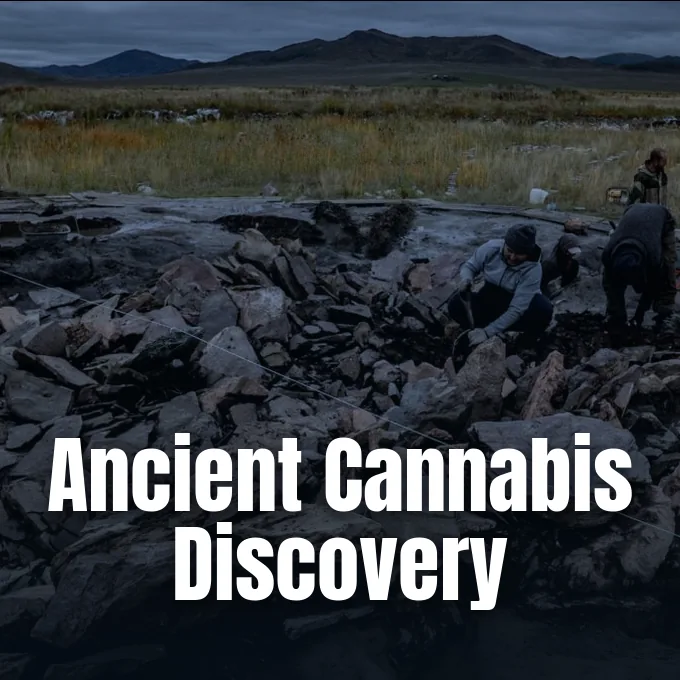
Archaeologists excavating a royal burial mound in southern Siberia have uncovered confirmed chemical traces of ancient cannabis use dating back to the early eighth century B.C. The field investigation at the Tunnug 1 kurgan in the Uyuk Valley brought together botanical seeds and biomolecular hair testing. Led by archaeologist Gino Caspari of the Max Planck Institute of Geoanthropology in Jena, the international team detected psychoactive cannabinoids in preserved human hair with more than 1,000 intact cannabis seeds buried inside central log coffins [1].
The Tunnug 1 Royal Kurgan
The Tunnug 1 archaeological complex sits in the swampy floodplains of the Uyuk Valley in the South Siberian Republic of Tyva. Local people often refer to this geographic basin as the Siberian Valley of the Kings because dozens of stone kurgans dot the landscape. The monument itself is huge. Measuring roughly 140 meters (460 feet) across, the circular mound was built with stone packing over deep timber chambers that sank into waterlogged soils, creating an oxygen-free environment that slowed decay for nearly three millennia. Water logging and seasonal freezing kept fragile organic structures intact, leaving wooden log coffins, beams, textile scraps, and biological tissues preserved beneath the mud [8].
Archaeologist Timur Sadykov from the Russian Academy of Sciences’ Institute for the History of Material Culture co-led the field excavations. His team determined that Tunnug 1 belongs to the early Scythians of the Arzhan culture. These nomadic pastoralists roamed the Eurasian steppe corridors centuries before Greek historians wrote about them [7].

Inside the central mound, excavators reached four timber structures holding several log coffins surrounded by bronze weapons, clothing beads, and horse gear. Siberian permafrost and dry steppes often preserve ancient biological evidence exceptionally well, a preservation dynamic also seen where Denisovan fossils revealed the physical appearance of ancient humans in nearby mountain caves. The burials at Tunnug 1 revealed not just elite bronze adornments but also organic offerings that rarely survive in open ground. Preserved plant parts and human hair braids rested undisturbed inside the chambers, giving archaeologists a rare opportunity to study perishable ritual goods from the dawn of Scythian culture [8].
Plant Remains and Ancient Cannabis Use
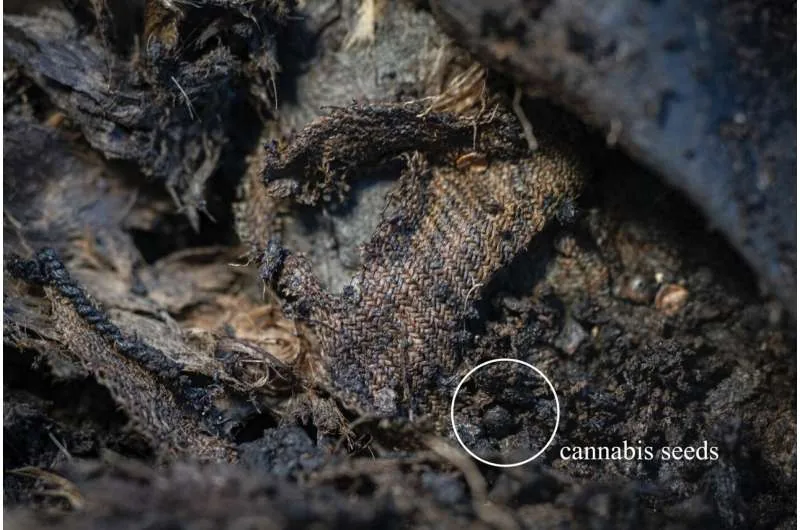
The excavation team handpicked 243 whole cannabis seeds from the floor of the burial chambers. Flotation samples later yielded another 722 complete and 516 fragmentary seeds. The botanical collection consisted almost completely of cannabis seeds, with only a few stray seeds from other wild weeds mixed into the grave soil [7].
The recovered seeds belonged to Cannabis ruderalis, a hardy wild type native to Central Asia that features thick seed coats resistant to moisture. Under magnification, the hulls displayed a reticulated net-like pattern that confirmed their species identity. “We had our suspicions when the little seeds first appeared in the tomb, but when we spotted the netlike pattern on the surface, this was a real moment when we knew we were holding something very special in our hands,” Caspari said in an interview with Scientific American [5]. Six seeds were chosen for radiocarbon dating, including two from the log coffin of skeleton 139 and two from the coffin of skeleton 135. The laboratory results placed the seeds between 800 and 760 B.C., confirming that ancient cannabis use occurred during the funeral itself.
Chemical Traces in Preserved Hair
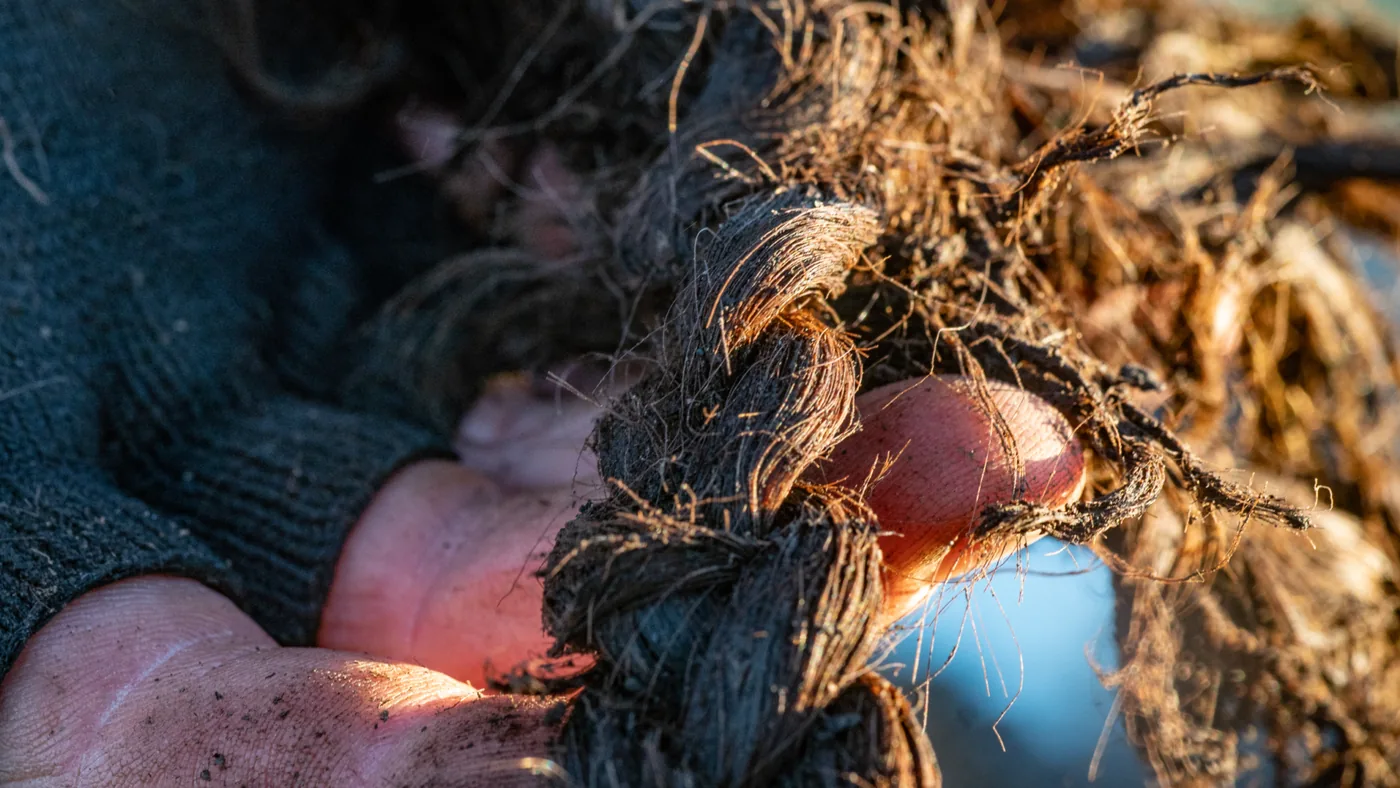
The turning point came when researchers examined preserved human hair recovered from the burial chambers. Hair resists decomposition because keratin proteins form tight molecular bonds. As hair grows, chemical compounds circulating in the blood stream become trapped inside the hair shaft, leaving an enduring physiological record of substances ingested during life [8].
Laboratory teams at the University of Bern used high-resolution mass spectrometry to test the hair braids. The equipment detected clear chemical signals matching cannabinol (CBN), an oxidation product of psychoactive tetrahydrocannabinol (THC). Weaker signals matching THC itself were also present based on molecular mass. Across the tested samples, the average cannabinol concentration was 560 parts per billion (0.56 micrograms per gram) [7]. Testing preserved hair provides a metabolic record that differs from bone analysis or the analysis of aloe residues in Egyptian mummy skulls, showing that cannabinoids passed through the bloodstream during life rather than simply coating the outside of the corpse after death.
Archaeologist Casper Meyer of Bard College called the combined finding of seeds and hair metabolites a “smoking gun of evidence” for prehistoric intoxication [5]. However, mass spectrometry can’t reveal how the drug was administered. The nomads might have inhaled smoke, chewed fresh leaves, or drunk herbal infusions [6].

Burial Rituals in the Uyuk Valley
The discovery of cannabis in Tunnug 1 belongs to a violent mortuary ceremony. In an earlier study published in Antiquity, Sadykov and Caspari documented at least 18 sacrificed horses arranged in positions resembling ghostly riders guarding the tomb [3]. Later excavations uncovered dozens of additional horse skeletons with scattered human bones around the timber chambers. “In this princely tomb, the burials were accompanied by extensive horse sacrifices and, most likely, human sacrifices as well,” Caspari said [4]. The scale of the animal and human sacrifice indicates that the funeral was a major communal event meant to honor deceased rulers and demonstrate royal authority across the steppe.
These burial rituals echo accounts written centuries later by the Greek historian Herodotus. Herodotus recorded that Scythians threw hemp seeds onto heated stones inside small tents to inhale the vapor during purification rites. He also described how attendants were put to death to serve deceased leaders in the afterlife [1].
The authors suggest that cannabis may have had a somber function in calming victims before execution. Sedating attendants with botanical mixtures would have prevented panic during ritual slaughter, an administration dynamic also documented in Inca child sacrifices who received coca and alcohol before mountain burials. Archaeologist William Taylor from the University of Colorado Boulder said that the find reveals deep social connections. “It’s easy to look at this stuff and say, “Oh, the Scythians toked the reefer,”” Taylor joked in an interview with Scientific American [5]. “But in fact, it is a tremendously powerful snapshot into an interconnected world in which the people and cultures of the steppe were starting to shape life on both ends of a massive continent.”

How Ancient Cannabis Use Spread
Before the Tunnug 1 excavation, the earliest confirmed chemical traces of cannabis smoking came from the Jirzankal Cemetery in western China. In that 2019 study published in Science Advances, researchers found cannabinoid residues inside wooden braziers dating to roughly 2,500 years ago [2]. The Siberian discovery pushes confirmed use back by three centuries.
While the Chinese braziers showed that people burned cannabis plants, they lacked direct human tissue residues. Tunnug 1 combines both botanical seeds and metabolic hair chemistry from the same archaeological layer [9]. Botanists believe that people cultivated cannabis in East Asia around 6,000 years ago for seed oil and fiber crops. Over millennia, East Asian farmers selected varieties for cordage and oil rather than psychoactive strength, producing distinct agricultural hemp lines. But wild populations across Central Asia retained high cannabinoid levels. As equestrian nomadic groups built migration routes between Mongolia and southern Siberia, pastoralists learned to exploit these wild plants for ceremonial rituals [7].
Unanswered Questions About Early Domestication
Several botanical questions remain open about the Siberian seeds. Because the seeds are small, researchers can’t tell whether Scythians cultivated local plots or gathered wild plants from valleys. Hair chemistry proves exposure to cannabinoids, but it doesn’t reveal whether ancient nomads bred plants for higher potency [6].
To resolve the origin of the plants, geneticists have begun sequencing ancient DNA from the preserved seeds. “DNA preservation is excellent in this case,” Caspari said about the ongoing laboratory work. “This will help us learn more about the history of the domestication and spread of this crop soon.” Beyond clarifying funerary practices, the authors argue that understanding early drug use informs modern conversations about public health, medicine, and drug law [1]. The findings at Tunnug 1 show that human engagement with mind-altering substances has a long history that began thousands of years ago in the heart of Eurasia.
- ACADEMIC JOURNAL Caspari, G., Sadykov, T., Fomicheva, D., Blochin, J., Armbruster, D., Happel, O., Ryabogina, N., Boxleitner, K., & Spengler, R. (2026). Direct evidence for psychoactive cannabis use 2800 years ago. Science, 394(6824), 649-653. [Article Link]
- ACADEMIC JOURNAL Ren, M., Tang, Z., Wu, X., Spengler, R., Jiang, H., Yang, Y., & Boivin, N. (2019). The origins of cannabis smoking: Chemical residue evidence from the first millennium BCE in the Pamirs. Science Advances, 5(6). [Article Link]
- ACADEMIC JOURNAL Sadykov, T., Blochin, J., Taylor, W., Fomicheva, D., Kasparov, A., Khavrin, S., Malyutina, A., Szidat, S., & Caspari, G. (2024). A spectral cavalcade: Early Iron Age horse sacrifice at a royal tomb in southern Siberia. Antiquity, 98(402), 1538-1557. [Article Link]
- ONLINE NEWS Killgrove, K. (2026). 2,800-year-old tomb in Siberia has evidence of the earliest use of cannabis — possibly as a way to calm human sacrifice victims. Live Science. [Article Link]
- ONLINE NEWS Randolph, M. (2026). Ancient humans were using cannabis far earlier in history than we thought. Scientific American. [Article Link]
- WEBSITE University of Bern. (2026). Cannabis was used as an intoxicant as early as 2,800 years ago. Phys.org. [Article Link]
- ONLINE NEWS Phelan, M. (2026). Siberian burial site reveals first known use of cannabis as drug. Gizmodo. [Article Link]
- ONLINE NEWS Starr, M. (2026). 2,800-Year-Old Siberian sacrificial tomb reveals earliest known evidence of cannabis intoxication. ScienceAlert. [Article Link]
- ONLINE NEWS Martinelli, A. (2026). Study finds evidence of marijuana use in burial rituals 2,800 years ago, with cannabinoids detected in human hair. The Marijuana Herald. [Article Link]
- ONLINE NEWS Dhar, P. (2026). Archaeologists find direct evidence of cannabis use from 2,800 years ago. Chemical & Engineering News. [Article Link]
APA 7: PerEXP Teamworks. (2026, November 6). Siberian Tomb Yields Direct Evidence of Ancient Cannabis Use. PerEXP Teamworks. https://perexpteamworks.com/en/ancient-cannabis-use-siberian-tomb/


