



Can maritime engineering bridge the widening electricity deficits of crowded shorelines without consuming valuable terrestrial real estate? Floating power plants offer a pragmatic answer, mounting utility-scale generation equipment on waterborne hulls that connect directly to terrestrial electrical grids. Rather than competing with agricultural tracts or urban developments, these mobile installations navigate directly to coastal settlements, industrial harbors, and island communities confronting severe energy bottlenecks. Surging coastal populations continue to outpace terrestrial grid expansion, accelerating the deployment of specialized marine generation assets [1].
What Are Floating Power Plants?
Floating power plants are mobile, waterborne vessels or flat-bottomed barges equipped with integrated energy generation systems that transmit electricity directly to terrestrial grids through subsea cabling. The maritime concept dates back to 1931, when engineers converted the cargo vessel SS Jacona into a floating generation station to deliver emergency electricity across Maine during severe winter storms. Navies converted the USS Saranac. Following the second world war, industrial equipment manufacturers such as Westinghouse and Wärtsilä formalized the commercial construction of modular power barges to supply developing economies confronting severe regional infrastructure deficits [1].
Modern marine utility systems operate across two distinct operational environments: permanent baseload deployment and responsive contingency relief [7]. In remote territories like the Arctic port of Pevek in northeastern Russia or the port city of Luanda in Angola, floating platforms provide steady baseload generation that would otherwise require sprawling onshore plants. National disaster agencies deploy temporary units following typhoons, earthquakes, or municipal grid collapses when land-based power stations fail. They also energize coastal mining operations and offshore industrial extraction terminals across developing regions [1].
Conversion of Cargo Hulls into Power Ships
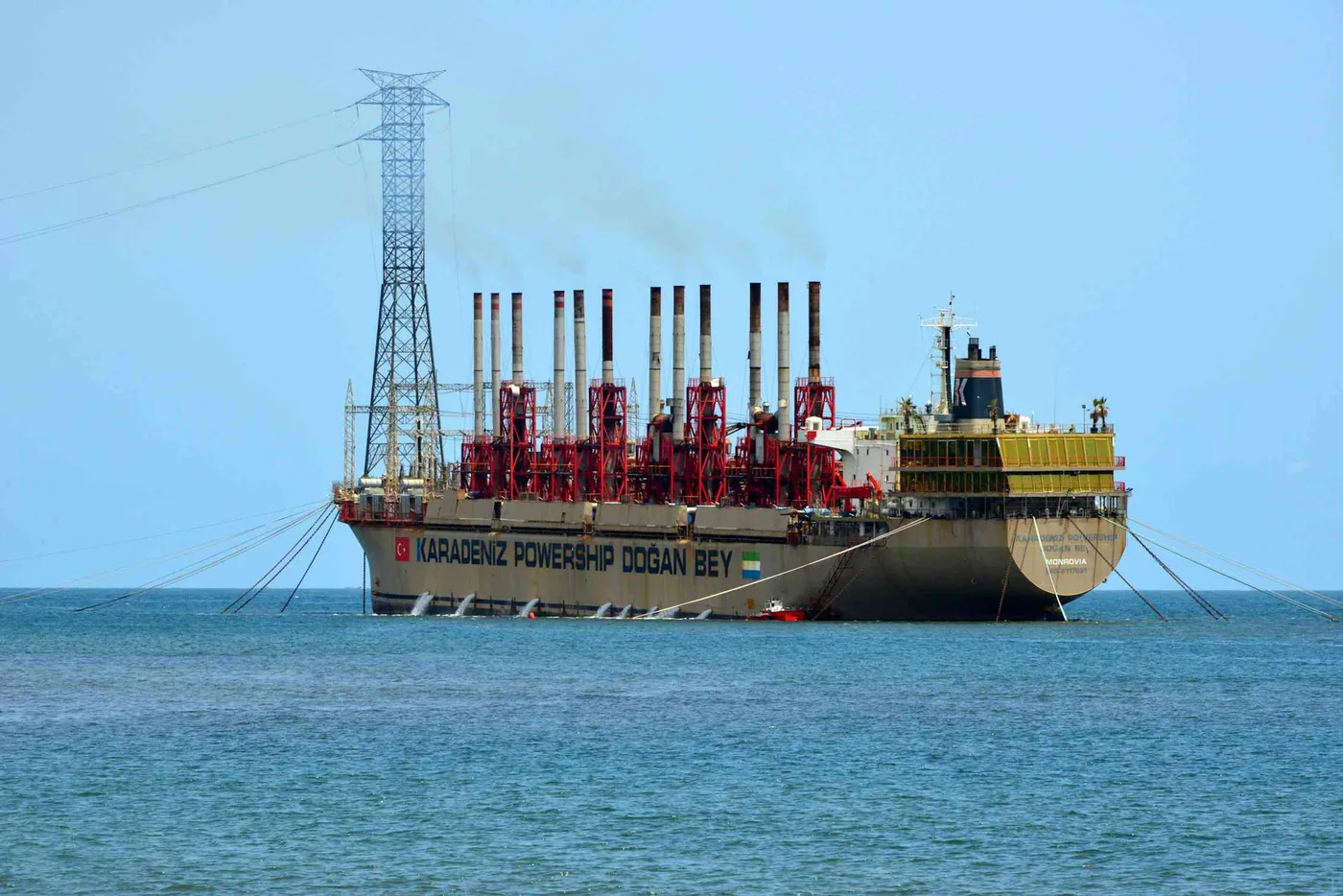
Self-propelled power ships represent the heavy-duty branch of floating generation, constructed by converting single-hull bulk carriers into integrated generating stations. Unlike stationary pontoons, these vessels navigate under their own power to power-starved harbors, anchor quayside, and link directly to regional substations using high-voltage umbilicals. The Turkish vessel MV Doğan Bey became the first modern commercial power ship of this class when it deployed to Basra to alleviate chronic municipal blackouts. The vessel was built in 1983. Originally constructed as a commercial cargo carrier, the converted hull demonstrated that retrofitting existing marine tonnage delivers utility-scale generating capacity far faster than constructing conventional terrestrial power stations on scarce coastal land [1].
The commercial power ship sector has expanded dramatically behind Turkish operator Karadeniz Energy Group, which manages Karpowership. Karpowership operates over 30 floating plants. The enterprise maintains an aggregate operational capacity exceeding 6 gigawatts across 15 countries, supplying critical electricity to emerging markets throughout Africa, the Middle East, and Southeast Asia [7]. Most of these large hulls utilize natural gas or heavy fuel oil engines equipped with dual-fuel converters, allowing operators to switch intake fuels as maritime supply chains dictate. In the Caribbean, propulsion specialist Wärtsilä delivered the barge-mounted installation Dominican II, while offering standardized models like the Wartsila 32 Power Barge ranging from 64.8 to 90 meters in length and 27.4 meters in beam [6].
Modular Renewable Barges for Remote Communities
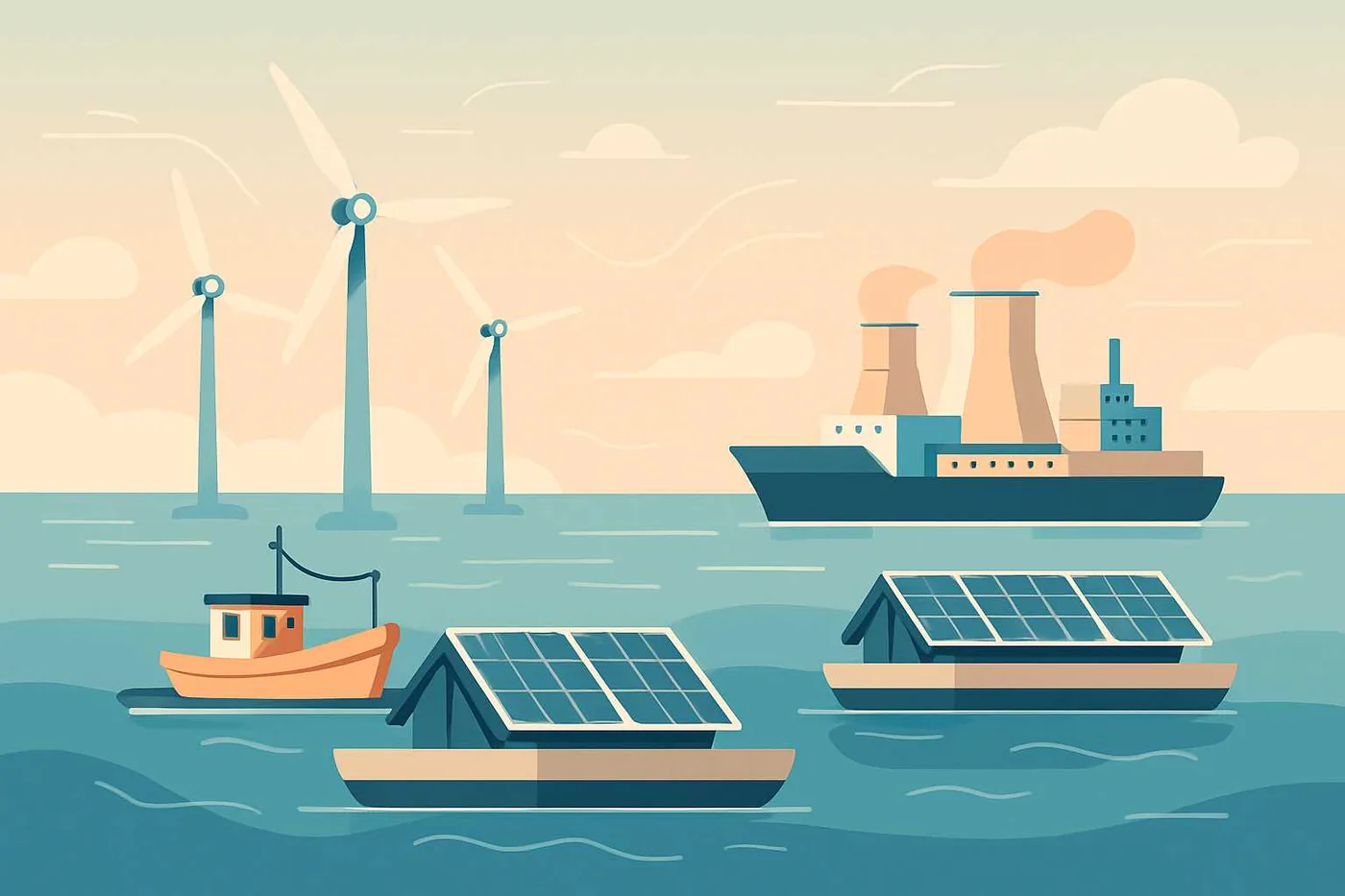
Where heavy fuel oil vessels face growing environmental resistance, modular renewable floating power plants offer a quiet, low-emission alternative for isolated shorelines and marine operations. A British Columbia clean technology firm, Mostar Labs, designed the LilyPad platform to provide self-contained electricity to remote coastal operations along Canada’s Pacific rim. Supported by the Canadian government’s COAST Innovation program together with Canada’s Department of National Defence, the National Research Council’s Industrial Research Assistance Program, and Innovation, Science and Economic Development Canada, Mostar Labs created a scalable system pairing photovoltaic panels, micro-wind turbines, and battery storage. Digital strategy associate Mariana Monsalve noted that the platform targets hard-to-reach shorelines where conventional grid extension remains economically impossible [5].
Unlike stationary floating solar arrays that float on calm wastewater lagoons like the municipal system in Drouin, Australia, solar barges must survive open marine swells [1]. The International Energy Agency Photovoltaic Power Systems Programme (IEA-PVPS) published a Task 13 fact sheet examining these harsh ocean conditions [4]. Their findings highlight how wave-induced mechanical stress, salt crusting, and rapid thermal cycling accelerate system degradation. Comprehensive interdisciplinary literature reviews led by academic researcher Y. Wei and colleagues at renewable institutes confirm that wave motion and marine biofouling reduce solar cell efficiency if mooring dynamics fail to dissipate hydrodynamic forces [3].
Solar power barges typically generate between 1 and 50 megawatts, yet high-latitude Arctic settlements endure four sunless months every winter [1].


What Are Floating Nuclear Plants?
Floating nuclear plants are self-contained marine platforms housing compact fission reactors engineered to supply continuous electricity and thermal heat to isolated shorelines. Russia deployed the barge in 2019. Stationed in the Siberian port of Pevek, the non-self-propelled barge Akademik Lomonosov relies on two modified marine reactors to energize a municipality of 200,000 residents while providing essential district heating across Arctic winters. By displacing legacy diesel generators, the marine installation eliminates hazardous black soot emissions while independent reactor refueling schedules guarantee uninterrupted electricity delivery across severe ice seasons [1].
Operating a nuclear core in coastal waters introduces unique marine safety hazards that divide international environmental monitors. In an extensive marine safety assessment, Norwegian researcher W. Standring and co-authors evaluated the potential consequences of radioactive leakage into northern marine ecosystems, emphasizing the necessity of robust containment during maritime collisions or grounding accidents. Spent fuel storage within floating hulls requires active cooling and rigorous physical security to prevent marine contamination [2]. Modern maritime nuclear designs address these vulnerabilities through passive seawater heat sinks that maintain emergency core cooling even during complete electrical blackouts, an architectural safeguard explored in technical assessments of high-assay low-enriched uranium fuel platforms [1].
In an unreviewed preprint on coastal energy systems that has not undergone peer review, legal researcher Tina Soliman-Hunter observes that several maritime nations are now drafting domestic marine reactor programs. South Korea, Norway, Japan, and India are currently investigating waterborne small modular reactors to overcome terrestrial land shortages. To standardize hull engineering and reactor containment, the American Bureau of Shipping published the first comprehensive regulatory rulebook for floating atomic vessels [1].
Offshore Gas Turbines and Carbon Capture Systems
Beyond municipal power ships and atomic barges, specialized floating power plants incorporate point-source carbon capture directly within offshore gas fields. In Norway, the Blaa Stroem alliance—combining Siemens Energy, process engineering firm Kanfa, and Sevan SSP—designed a floating gas power plant housed within a distinctive cylindrical hull. Conceived by maritime engineer Erling Ronglan, the cylindrical installation uses Ocean GeoLoop technology to strip carbon dioxide directly from turbine exhaust gases. The sequestered emissions are injected into subsea geological reservoirs to maintain oilfield pressure, a mechanism closely studied in relation to carbon sequestration in marine sediments across continental shelves [6].
Chevron invested 10 million dollars. The equity backing from Chevron validated the commercial viability of this maritime capture architecture by accelerating industrial deployment across northern European waters. Offshore generation from these gas-fired floaters produces electricity at an estimated cost of 0.03 to 0.05 dollars per kilowatt-hour, drastically undercutting terrestrial Norwegian power prices that briefly reached 0.70 dollars before stabilizing near 0.27 dollars per kilowatt-hour. Ocean GeoLoop chief executive Oddgeir Lademo noted that flue-gas energy recovery helps finance operational capture costs. Earlier deployments proved the concept in fresh water, including Wärtsilä’s 2016 Kivuwatt facility that extracts dissolved methane directly from Lake Kivu in Rwanda to drive shoreward turbines [6].
Siemens Energy also manufactures marinized, modular power barges known as SeaFloat. Sales lead Stavros Zissis emphasized that land turbines cannot simply be placed on standard hulls without extensive structural dampening. The hull measures 80 meters. The 150-megawatt combined-cycle barge Estrella del Mar III entered service in Santo Domingo in 2022, powered by two SGT 800 gas turbines. Equipped with 5 to 10 megawatts of onboard battery storage for primary frequency response, the vessel occupies half the physical footprint of an equivalent onshore installation [6].
Legal Boundaries for Floating Power Plants
The commercial expansion of floating power plants is accelerating as regional utilities confront urban congestion and escalating coastal property prices. Market research analyst Akshay Dharmadhikari projects the global floating power plant market to exceed 8.6 billion dollars by 2034, registering a compound annual growth rate above 8.2 percent. With global electricity demand anticipated to expand 30 percent over the same decade, archipelagic nations across Southeast Asia and the Middle East are investing heavily in waterborne energy infrastructure. Industrial partnerships between Siemens Energy, Wärtsilä, and Japan’s Mitsui O.S.K. Lines are engineering hybrid platforms that combine liquefied natural gas turbines with renewable collectors, while India’s National Thermal Power Corporation evaluates solar-hybrid barges for inland river networks [7].
Maritime regulators now confront unresolved jurisdictional limits under international maritime treaties. Legal authorities struggle to determine whether moored utility vessels should be classified as commercial ships or stationary power stations under the United Nations Convention on the Law of the Sea. Jurisdictional ambiguities cloud liability frameworks if a waterborne reactor or gas turbine suffers an industrial accident within territorial waters. Until international treaties formally codify vessel standards, environmental oversight, and grid interconnection protocols, utility operators will rely on classification societies like the American Bureau of Shipping to certify these offshore power stations [1].
- PREPRINT Soliman-Hunter, T. (2026). Floating power plants could offer coastal communities a reliable energy source. Here’s how. [Article Link]
- ACADEMIC JOURNAL Standring, W., Dowdall, M., Amundsen, I., & Strand, P. (2009). Floating nuclear power plants: Potential implications for radioactive pollution of the northern marine environment. Marine Pollution Bulletin, 58(2), 174-178. [Article Link]
- ACADEMIC JOURNAL Wei, Y., Khojasteh, D., Windt, C., & Huang, L. (2025). An interdisciplinary literature review of floating solar power plants. Renewable and Sustainable Energy Reviews, 209, 115094. [Article Link]
- REPORT IEA-PVPS. (2026). Floating photovoltaic power plants: A review of energy yield, reliability and maintenance (Task 13 Fact Sheet). International Energy Agency Photovoltaic Power Systems Programme. [Article Link]
- ONLINE NEWS Monsalve, M. (2026). Revolutionizing coastal energy: Mostar Labs’ floating solutions. Ocean Economy. [Article Link]
- ONLINE NEWS Stoichevski, W. (2021). Floating power: Electricity and future fuels. Offshore Engineer. [Article Link]
- ONLINE NEWS Dharmadhikari, A. (2025). Floating power plants: Redefining the future of offshore energy. Research World. [Article Link]
APA 7: TWs Editor. (2026, September 28). How Floating Power Plants Deliver Clean Energy to Coasts. PerEXP Teamworks.


