






NASA has restructured its third Artemis mission from a direct lunar surface landing into an integrated rehearsal in low Earth orbit. Under the updated flight plan, four astronauts will launch aboard the Orion spacecraft to conduct back-to-back docking tests with two separate commercial landers before any crew heads toward the lunar South Pole. The Artemis III Starship demonstration joins a prototype from Blue Origin to test guidance software and multi-vehicle control mechanics in space [2].
Why the Artemis III Profile Changed
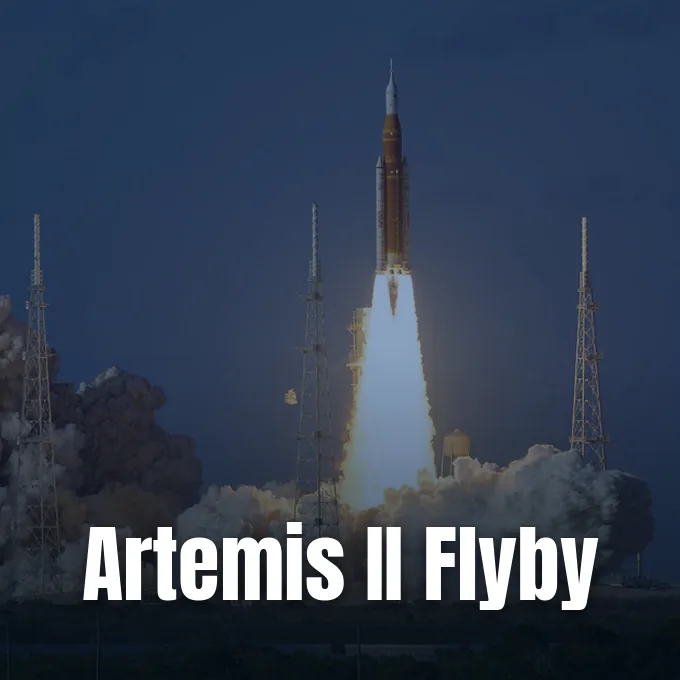
The shift away from a lunar landing occurred in February 2026 under NASA Administrator Jared Isaacman. NASA initially awarded SpaceX a $2.89 billion contract in April 2021 to build the Starship Human Landing System as the sole provider for returning astronauts to the Moon. But development schedules fell behind as technical hurdles multiplied. By moving the first landing to Artemis IV in 2028, managers created time to test hardware near Earth [4].
A March 2026 audit from the NASA Office of the Inspector General found that the lunar lander program lagged at least two years behind its original schedule [7]. To protect the broader exploration timeline, agency leaders replaced deep-space risks with an Earth-orbit integration flight. “Every piece of this mission in Earth orbit is designed to reduce risk before we put astronauts back on the Moon,” said Jeremy Parsons, NASA Artemis program manager. Rather than committing astronauts to a hazardous lunar descent on unproven software, flight controllers will test docking maneuvers where emergency abort trajectories to Earth remain immediately accessible [2].

Schedule pressure also shaped the decision. Eric Berger reported that NASA adopted a clear risk-reduction stance, refusing to commit to firm launch dates until SpaceX met prerequisite test objectives [3]. The agency has invested nearly $7 billion into commercial lander development across SpaceX and Blue Origin [4]. Flight controllers need to see that automated proximity systems work smoothly before crew members ride any vehicle toward the lunar surface [3].
Flight Sequence for the Three Rockets
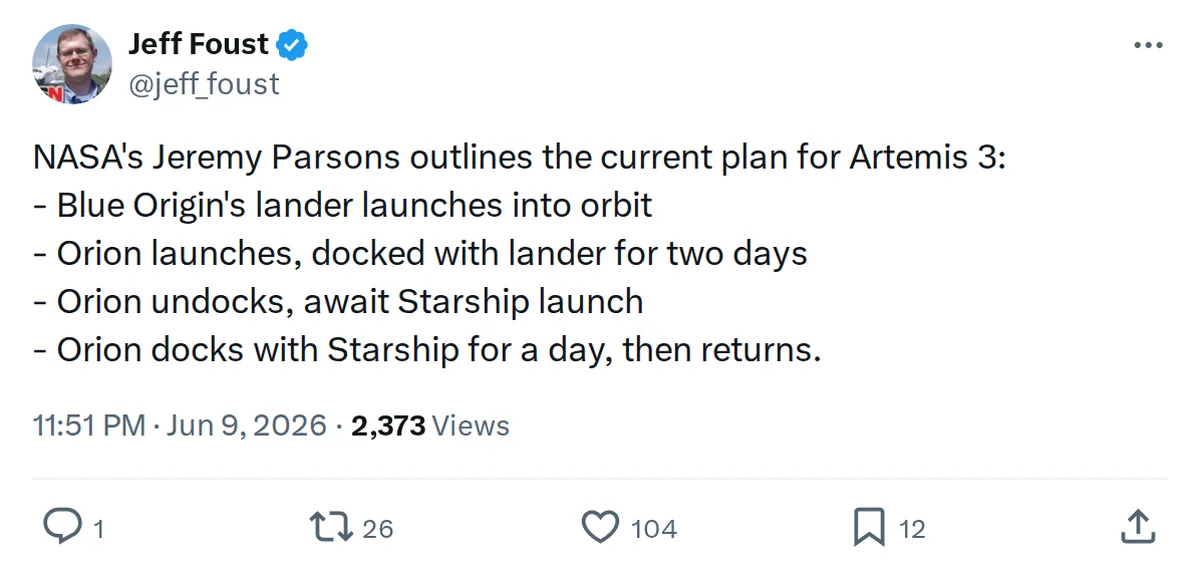
Artemis III will rely on three heavy rockets lifting off from Florida launchpads in tight succession. The sequence begins when Blue Origin launches a pathfinder article of its Blue Moon Mark 2 lander into a circular parking orbit at an altitude of 273 miles [2]. The lander uses storable propellants and can loiter for 30 days [7].
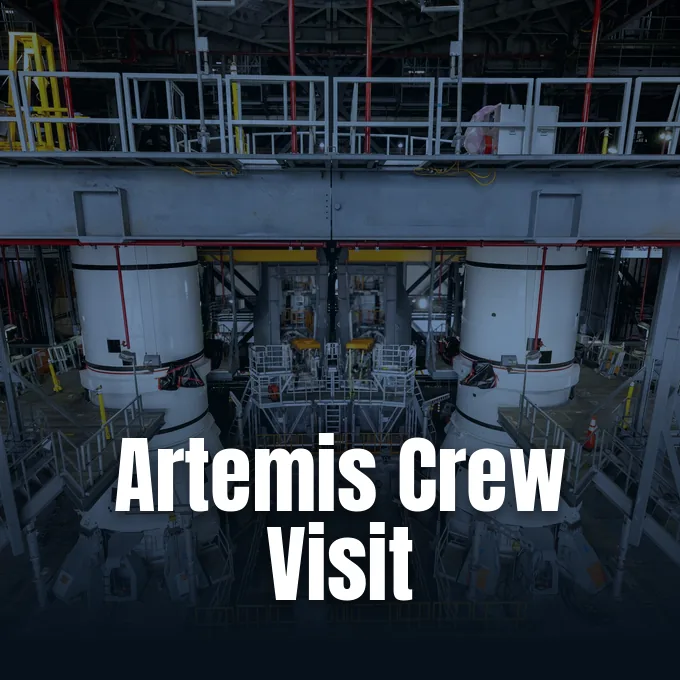
Days later, four astronauts will launch aboard the Space Launch System from Launch Complex 39B at Kennedy Space Center [7]. The crew includes Commander Randy Bresnik, Pilot Luca Parmitano of the European Space Agency, and Mission Specialists Frank Rubio and Andre Douglas [2]. The assigned astronauts previously completed procedural reviews when the Artemis 3 mission crew toured Kennedy booster stacking operations inside the vehicle assembly building.
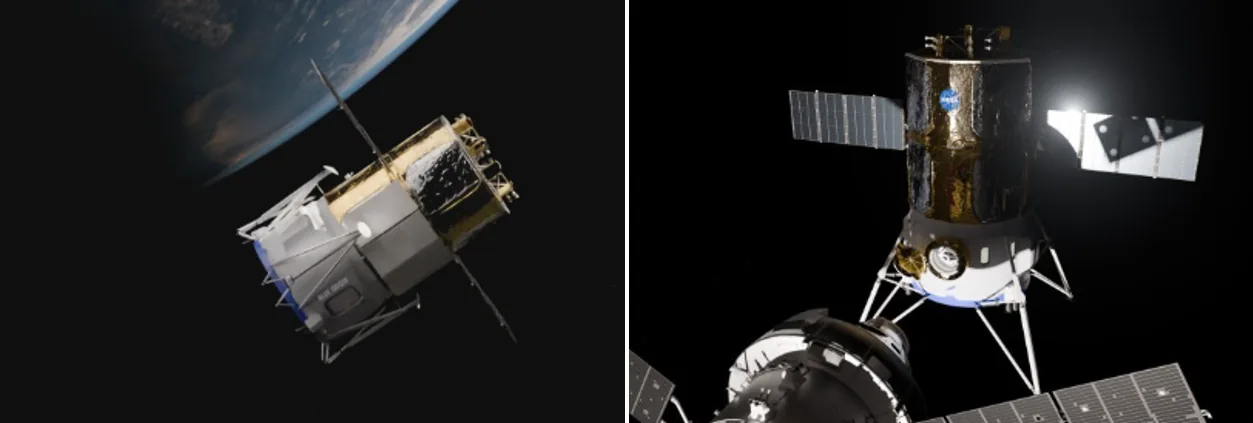
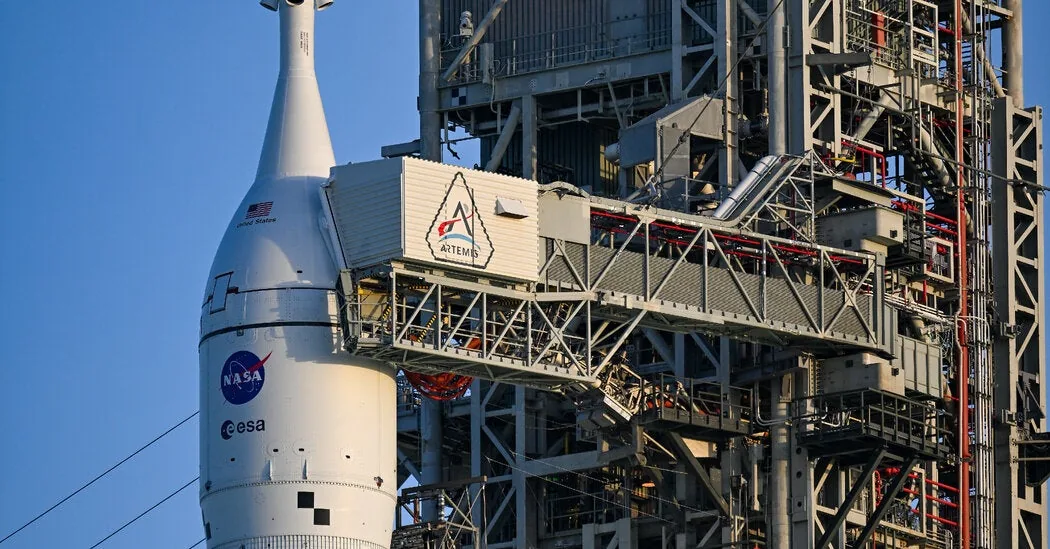
For this flight, the rocket flies without its Interim Cryogenic Propulsion Stage, using a structural spacer instead to preserve upper-stage hardware for Artemis IV [7]. Orion will enter an initial elliptical orbit of 18 by 1,122 miles. Then the European Service Module will fire its main engine to circularize the orbit at 345 miles for thermal stabilization. The crew spends two days checking systems before approaching Blue Moon [2].
Artemis III Starship Docking Profile
Orion will then undock and reposition to meet its second target. SpaceX will launch a Starship Version 3 test vehicle from Florida into a circular orbit at an altitude of 206 nautical miles, an orbital height chosen to optimize communications coverage [2]. The vehicle carries a nose-mounted docking adapter qualified in 2023 [7].
The Artemis III Starship flight profile uses an active-chaser configuration where Orion navigates directly toward Starship’s forward docking mechanism [7]. Unlike the Blue Origin phase where astronauts enter the target cabin, the crew will stay inside Orion throughout the Starship test because the prototype carries no life-support equipment or crew quarters [2]. Measuring roughly 50 meters tall with a diameter of 9 meters, the Starship hull dwarfs conventional crew capsules like Orion, whose pressurized volume is just 19.6 cubic meters [6]. Dan Huot noted that mission controllers retain options to terminate the flight over the Pacific Ocean if land approaches show elevated risks [1]. Orion will remain linked with the upper nose port for up to two hours to gather engineering data on joint structural loads, latch alignment, and radio communications links [2].

Docking geometry differs completely between the two commercial vehicles. Orion connects to a side hatch beside the pressurized cabin on Blue Moon, but meets Starship directly nose-to-nose. These dual tests give engineers empirical data on how Orion interacts with different docking architectures during flight [2].
Software Control Handoff in Orbit
The most unusual objective of the mission involves passing computer control from one vehicle to another while joined in space. During the initial rendezvous with Blue Moon, Orion flight computers retain complete command over the combined stack. But when Orion latches onto Starship, control authority will flip to Starship onboard systems, marking the first time in crewed spaceflight history that a target vehicle assumes steering authority over an active chaser. Steve Creech, program manager for the Human Landing System at Marshall Space Flight Center, said both commercial contractors brought forward ambitious test plans to prove their flight software ahead of uncrewed lunar trials [7].
Validating this software flip in low Earth orbit protects future lunar missions from hazardous control conflicts in deep space [7]. On Artemis IV, the joined Orion and Starship stack must fire Starship Raptor engines to perform the translunar injection burn that propels astronauts toward the Moon [5]. SpaceX vice president Jessica Jensen said the revised profile links the two vehicles in Earth orbit before departure instead of staging an uncrewed rendezvous at the Moon [3]. Because Orion lacks the propulsion capacity to make that translunar burn alone, Starship must guide the entire linked assembly through precise orbital maneuvers while keeping structural loads within safe limits. Testing how the Artemis III Starship flight software interacts with Orion at an altitude of 285 miles ensures that any software bug or sensor mismatch can be resolved while safe abort trajectories to Earth remain accessible [5].
Differences from the Apollo 9 Precedent
NASA officials frequently compare Artemis III to Apollo 9, the March 1969 mission that tested the lunar module in Earth orbit before Apollo 11 landed on the Moon. Both flights share a similar logic of practicing rendezvous procedures close to home before sending astronauts into deep space. That historical flight took place more than 57 years earlier, making Artemis III the first crewed multi-vehicle orbital test since the Apollo era [7].
Yet the historical comparison has clear technical limits. Apollo 9 flew with a finished Lunar Module that matched the exact hardware configuration that landed at Tranquility Base four months later. In contrast, the vehicles flying on Artemis III are pathfinder test articles rather than finished lunar landers. Blue Moon will fly with storable propellants instead of its planned cryogenic propulsion, while the Starship test article lacks both lunar landing legs and surface elevators [7].
After undocking, Orion spends five extra days completing secondary research in orbit. Astronauts will test emergency survival suits, examine autonomous medical tools, and study cellular biology and plant seeds [2]. Several investigations aboard Orion build directly on tests conducted during the crewed Artemis II flight path and crew systems evaluation.
Starship HLS Readiness and Refueling Needs
Before Starship carries crew to the lunar surface, SpaceX must solve orbital propellant transfer [4]. Because the vehicle uses most of its propellant reaching low Earth orbit, it needs an orbital depot to fuel its translunar journey [1]. Orbital Radar estimates that between 10 and 16 tanker flights will be needed to fuel a single lunar lander before departure [6].
SpaceX plans to demonstrate this cryogenic transfer by launching two Starships in quick succession, docking them in orbit, and pumping liquid methane and liquid oxygen between their tanks [1]. The company has also worked to resolve Raptor engine relight anomalies that occurred during Flight 12 in May 2026 [5]. Recent progress was demonstrated during Flight 15, when a 170-foot Starship upper stage returned from orbit at 17,000 miles per hour and was caught by launch tower arms in South Texas while its Super Heavy booster completed a water landing [1].
Ground teams at Starbase in Texas and facilities at Kennedy Space Center continue preparing hardware for these consecutive flight tests [1]. NASA expanded its astronaut corps through ongoing astronaut applications for Artemis lunar missions to staff subsequent exploration windows. By integrating the Artemis III Starship vehicle into the broader lunar roadmap, flight controllers gain practical experience managing multi-vehicle orbital operations before astronauts attempt to land on the Moon [2].
- ONLINE NEWS Chang, K., & Liederman, M. (2026, November 14). Starship will play a big role in Artemis III. The New York Times. [Article Link]
- PRESS RELEASE Costa, J., & NASA Communications. (2026, October 23). NASA’s Artemis III mission to test future Moon lander operations. National Aeronautics and Space Administration. [Article Link]
- WEBSITE BASENOR Editorial Desk. (2026, June 9). How Starship fits into Artemis III and IV: Plans explained. BASENOR. [Article Link]
- ONLINE NEWS Gene. (2026, May 19). NASA updated Artemis III and SpaceX’s role just got more complicated. Teslarati. [Article Link]
- WEBSITE BASENOR Editorial Desk. (2026, July 16). Starship to practice lunar docking in Earth orbit for Artemis III. BASENOR. [Article Link]
- WEBSITE Orbital Radar. (2026, May 24). Starship HLS: Specs, Artemis role & lunar landing plan. Orbital Radar. [Article Link]
- ONLINE NEWS Bensen, E. (2026, July 16). Artemis III docking sequence revealed: Orion hands control to Starship mid-mission. Tech Times. [Article Link]
APA 7: PerEXP Teamworks. (2026, November 15). Starship Joins Artemis III to Test Orbit Docking Operations. PerEXP Teamworks. https://perexpteamworks.com/en/artemis-iii-starship-docking-test/


