





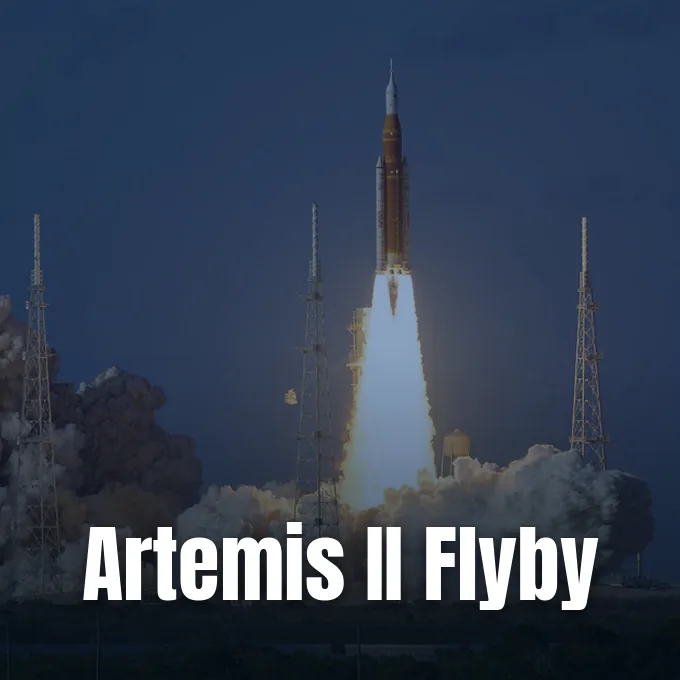
NASA’s Artemis II mission launched four astronauts on an approximately ten-day journey around the Moon to test crewed deep-space hardware for the first time in more than fifty years. Aboard the Orion spacecraft, the international crew tested manual flight controls, life support hardware, and high-altitude communications before returning through Earth’s atmosphere for a Pacific Ocean splashdown [1]. With Artemis II explained as an engineering flight test instead of a lunar landing, the agency verified that its heavy-lift booster and crew capsule can sustain human life on deep-space trajectories [4]. The test proved spacecraft flight worthiness ahead of future surface expeditions.
What Artemis II Explained to Engineers
NASA established the Artemis program under Space Policy Directive-1 to return humans to cislunar space and construct sustainable infrastructure near the Moon [8]. The United States had not dispatched a human crew beyond low Earth orbit since Apollo 17 in December 1972 [4]. While earlier Apollo missions proved that astronauts could reach lunar orbit, the modern architecture was developed to evaluate Space Launch System booster rockets, Orion avionics, and deep-space crew systems under realistic operational conditions [1]. When agency officials established the flight objectives, they described Artemis II explained as the mandatory flight bridge connecting uncrewed test flights with future crewed lunar surface landings [4].
The flight originated under the program designation Exploration Mission-2, which NASA planners initially intended to support a robotic asteroid redirect project before canceling that concept in April 2017. Instead of meeting an asteroid boulder in lunar orbit, planners redesigned the mission into a direct crewed lunar flyby carrying four astronauts on a free-return course [4]. NASA Administrator Jared Isaacman said the mission provided a necessary proving run for hardware carrying humans farther into space than any flight in a generation [1].
Building new space systems requires long component verification schedules in multiple flight centers [6]. “Artemis II is a test flight, and the test has just begun,” said NASA Associate Administrator Amit Kshatriya during launch operations. Engineers gathered empirical telemetry throughout the flight [1].

Why the Mission Did Not Land on the Moon
Artemis II did not land on the lunar surface because its main objective was to qualify the Orion capsule and its life support systems without the compounded hazards of a lunar landing [4]. Returning astronauts to the lunar terrain requires a dedicated lunar lander, such as the SpaceX Starship Human Landing System or the Blue Origin Blue Moon lander, which NASA contracted for later missions [8]. Combining the initial crewed test of the Space Launch System rocket, the Orion capsule, and an unproven lunar lander on a single mission would have introduced excessive flight risk [4]. NASA separated these test milestones across different flight schedules [8].
The flight trajectory followed by the crew closely matched the emergency return path flown by Apollo 13 in 1970 [4]. By steering into a hybrid free-return trajectory, NASA arranged that terrestrial gravity would naturally pull Orion back to Earth even if the spacecraft propulsion engine failed during cislunar flight [3]. This passive abort geometry gave mission controllers peace of mind while checking life support loops [4]. The crew looped around the Moon without firing braking engines to enter orbit [1].
Future missions will conduct the actual touchdowns. “Artemis II is more than a mission to the moon,” pilot Victor Glover said before launch. The agency validated deep-space steering before sending crews to the lunar surface [3].
The Four Astronauts
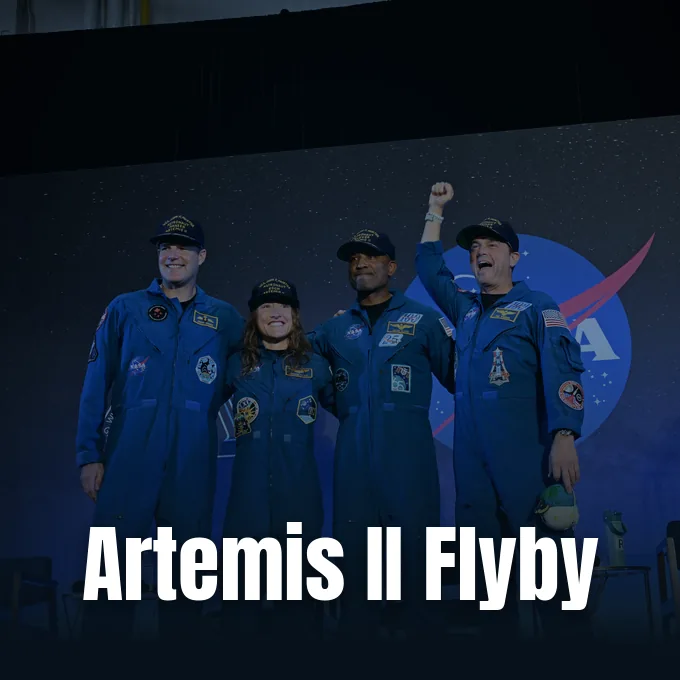
NASA unveiled the four astronauts assigned to the flight during an announcement at Ellington Field near Johnson Space Center in Houston on April 3, 2023, where former NASA Administrator Bill Nelson, flight director Norm Knight, and center director Vanessa Wyche introduced the crew. Mission Commander Reid Wiseman, a 47-year-old former U.S. Navy aviator, had logged 165 days in Earth orbit during a 2014 expedition to the International Space Station and served as chief of the astronaut office under Joe Acaba. Pilot Victor Glover, a 46-year-old U.S. Navy captain and engineer who spent 167 days in orbit piloting the SpaceX Crew-1 mission in 2021, became the first Black astronaut assigned to travel around the Moon [3]. Glover held three master’s degrees before his lunar assignment [2].
Mission Specialist Christina Koch, a 44-year-old electrical engineer, held the world record for the longest single spaceflight by a female astronaut after logging 328 consecutive days aboard the International Space Station in 2019 [3]. She also participated in the first all-female spacewalk before becoming the first woman to voyage around the Moon [2]. Mission Specialist Jeremy Hansen, a 47-year-old colonel in the Royal Canadian Air Force, represented the Canadian Space Agency as the first non-American astronaut to leave Earth orbit under the bilateral Canada-U.S. Gateway Treaty. Hansen had previously trained as an aquanaut in the Aquarius underwater habitat and as a cavenaut in European Space Agency caves [3].

International cooperation formed the core of the crew’s flight preparation. Following splashdown, the crew’s post-flight gathering in Houston allowed mission directors and spacecraft engineers to review human factors from the flight. Wiseman described the program’s resolve, stating simply, “We are going”. The team completed three years of intensive simulator drills before launch [3].
Flight Path to Lunar Flyby
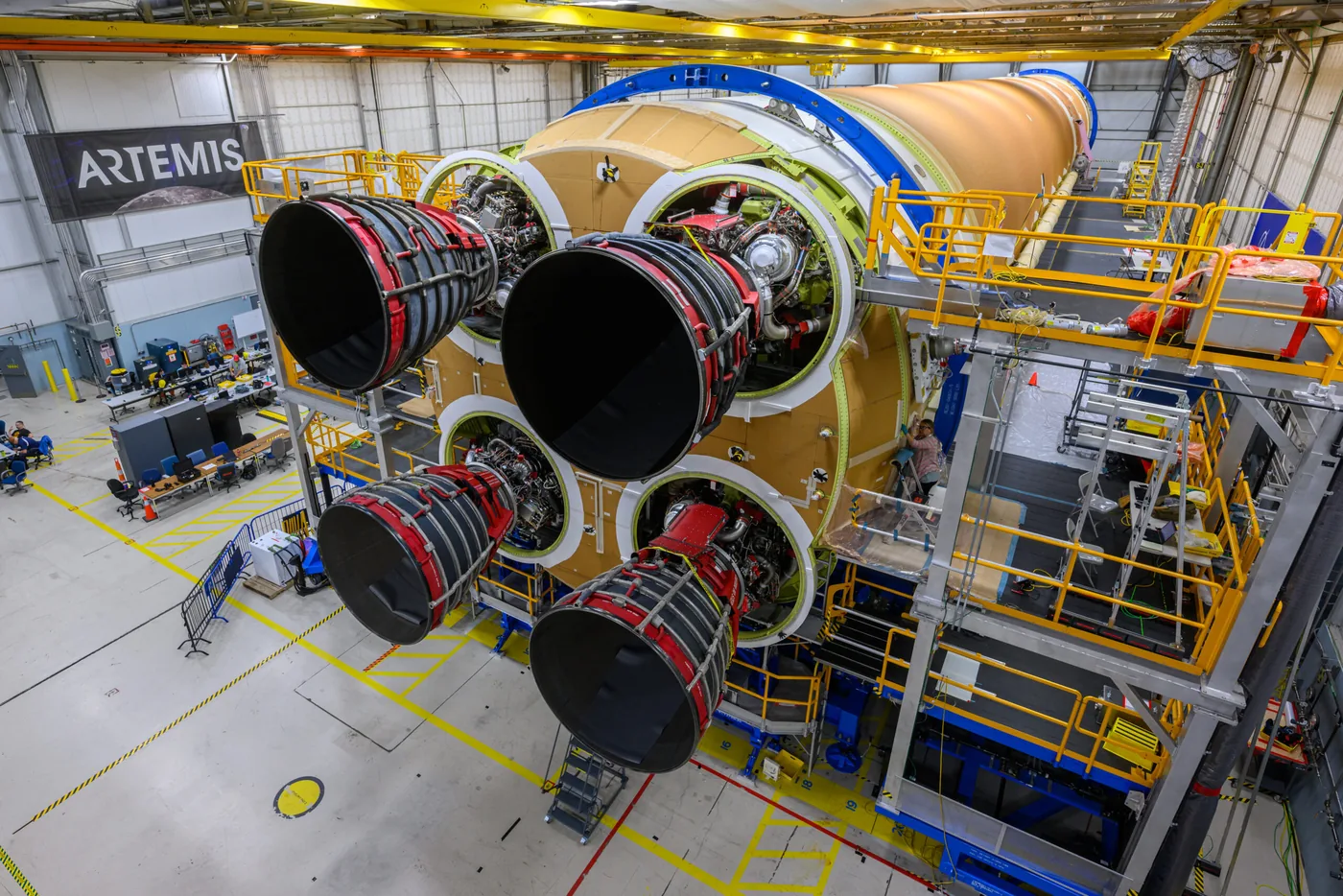
The mission commenced from Launch Pad 39B at Kennedy Space Center at 6:35 p.m. EDT on April 1, 2026, when NASA’s Space Launch System roared off the launch mount [1]. The 212-foot core stage, built by lead contractor Boeing at Michoud Assembly Facility Building 103 in New Orleans, was powered by four Aerojet Rocketdyne RS-25 engines (including serial numbers E2047, E2059, E2062, and E2061) [4]. The core stage burned more than 733,000 gallons of liquid hydrogen and liquid oxygen to deliver two million pounds of thrust during eight minutes of ascent [6]. Twin solid rocket boosters manufactured by Northrop Grumman in Utah provided over 75 percent of the total booster thrust during liftoff [7]. Approximately 49 minutes after liftoff, the Interim Cryogenic Propulsion Stage fired to insert Orion into an initial parking orbit around Earth [1].
A second burn by the upper stage placed Orion, christened Integrity by its crew, into an elliptical high Earth orbit reaching 46,000 miles above Earth. Orion separated from the upper stage ring, which subsequently deployed four research CubeSats sponsored by Argentina’s Comisión Nacional de Actividades Espaciales (CONAE), the German Aerospace Center (DLR), the Korea AeroSpace Administration (KASA), and the Saudi Space Agency. Flight operations for Artemis II explained how manual station-keeping near the spent upper stage verified Orion’s handling qualities before departure. The astronauts spent twenty-four hours in this high orbit executing manual proximity operations, using the upper stage as a visual target [1].
On April 2, flight directors commanded the European Service Module to execute the translunar injection burn. The six-minute main engine firing accelerated Orion onto its lunar trajectory [1]. Gravitational mechanics pulled the capsule around the Moon without extra orbital maneuvers [4].
How Artemis II Explained Orion Life Support
Placing four astronauts aboard Orion subjected its environmental hardware to its first complete flight evaluation [4]. In pre-flight documentation, engineers reported Artemis II explained core engineering questions about whether the Environmental Control and Life Support System could scrub metabolic carbon dioxide and keep cabin pressure under crew occupancy [1]. Cabin scrubbers circulated oxygen, balanced humidity, and managed cabin temperatures across varying thermal conditions as the capsule traveled through deep space [4]. Post-flight data confirmed that cabin atmosphere scrubbers met every crew health threshold throughout the ten-day voyage [1].
On Flight Day 7, the astronauts evaluated orthostatic intolerance garments to determine how well compressive flight suits counter blood pooling when re-entering Earth’s gravity well. Wiseman, Glover, Koch, and Hansen donned the suits and monitored blood pressure telemetry while checking navigational state vectors. Later that evening at 9:59 p.m. EDT, the crew took manual control of Orion’s rotational thrusters, guiding the vehicle into a tail-to-Sun orientation to compare manual handling modes against automated flight software. These manual steering runs confirmed that astronauts could orient the spacecraft safely if primary flight computers encountered software anomalies [5].
Spacecraft monitoring also evaluated machine learning telemetry frameworks. A research dissertation by Pokorny on Zenodo showed that hybrid deep learning models trained on Soil Moisture Active Passive (SMAP) and Mars Science Laboratory (MSL) benchmarks could detect sensor anomalies in real time without waiting for ground controller verification [10]. Automated health monitors tracked avionics and electrical buses continuously. Astronauts monitored health status data throughout flight [1].
Why Launch Preparations Faced Delays
Artemis II encountered launch schedule adjustments because NASA engineers insisted on resolving hardware anomalies discovered following the uncrewed Artemis I test flight in late 2022. Post-flight inspection of the Artemis I capsule identified unexpected char loss and localized cracking in the AVCOAT ablative heat shield. Hot gases generated during atmospheric entry became trapped inside the porous ablative material, forcing small chunks of the shield to spall away prematurely. Although cabin temperatures remained well within safety margins, NASA convened an independent review board in April 2024 to verify heat shield safety margins before committing a human crew [4].
The review team concluded its investigation in December 2024, recommending that NASA steepen Orion’s atmospheric entry trajectory to reduce total thermal exposure time instead of delaying the flight to manufacture a redesigned heat shield. In January 2026, NASA Administrator Jared Isaacman approved flying Artemis II with the existing heat shield after reviewing extensive ground simulation data. Pad operations at Launch Complex 39B introduced additional delays. A wet dress rehearsal on February 2, 2026, revealed a liquid hydrogen leak and an Orion hatch valve pressurization issue that pushed the targeted launch attempt into March [4].
A second wet dress countdown test succeeded on February 19, but a helium flow issue detected on February 21 prompted managers to roll the rocket back to the Vehicle Assembly Building. The rollback began on February 25 at 9:38 a.m. EST and concluded that evening. Pad technicians replaced faulty valves and validated helium flow before the Flight Readiness Review confirmed an April 1 launch date. Rigorous safety margins guided every postponement [4].
Navigating the Lunar Far Side
On April 6, 2026, Artemis II completed its lunar flyby, sweeping within 6,479 miles of the lunar terrain and traveling 6,400 miles beyond the far side [3]. At maximum apogee, the spacecraft attained a distance of 252,756 miles (406,771 kilometers) from Earth, eclipsing the previous human distance record established by the Apollo 13 mission in April 1970. Looping behind the lunar disc plunged the four astronauts into forty minutes of radio silence as the Moon’s bulk blocked line-of-sight communication with Mission Control in Houston [2]. The crew observed stark lunar relief while awaiting radio signal reacquisition [1].
The crew captured detailed photographs of impact craters, volcanic maria, and geological ridges thrown into sharp relief by low-angle solar shadows [1]. In a study published by McMurray, researchers examined how the crew observed a total solar eclipse from space lasting fifty-seven minutes of totality, collecting rare heliophysics observations of the solar corona [9]. Autonomous optical navigation systems processed crater landmarks against the Robbins lunar catalog to estimate orbital state vectors independently of Earth-based radar tracking [11]. The agency preserved these scientific records in the lunar flyby scientific telemetry and imagery archive for outside academic evaluation.
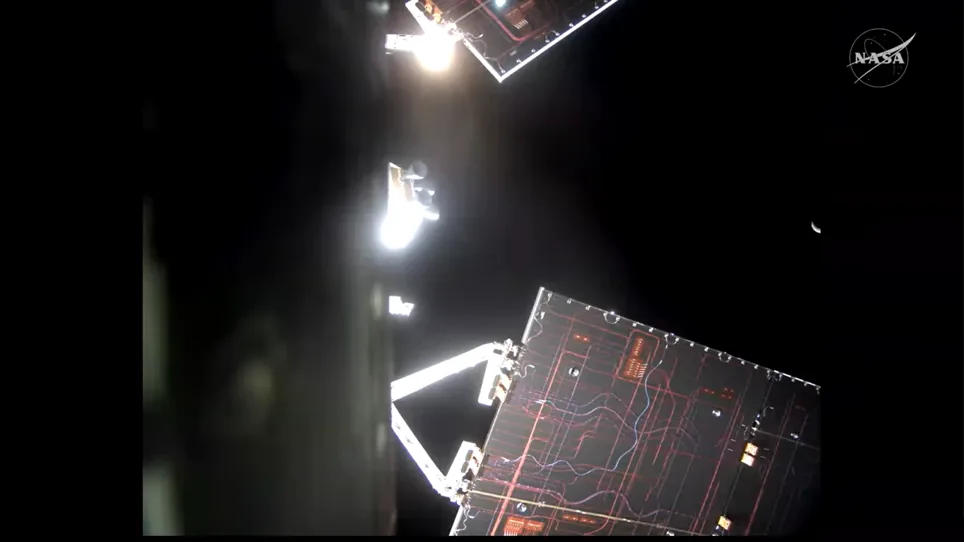
Pilot Victor Glover said that “no adjectives” could convey the spectacle of Earth rising beyond the lunar limb. The astronauts named a previously uncataloged lunar crater in honor of Commander Wiseman’s late wife [2]. On April 7 at 8:03 p.m. EDT, Orion ignited its thrusters for fifteen seconds during Flight Day 7 to adjust its return trajectory toward Earth. The burn produced a velocity change of 1.6 feet per second [5].
Artemis II Explained and Future Lunar Landings
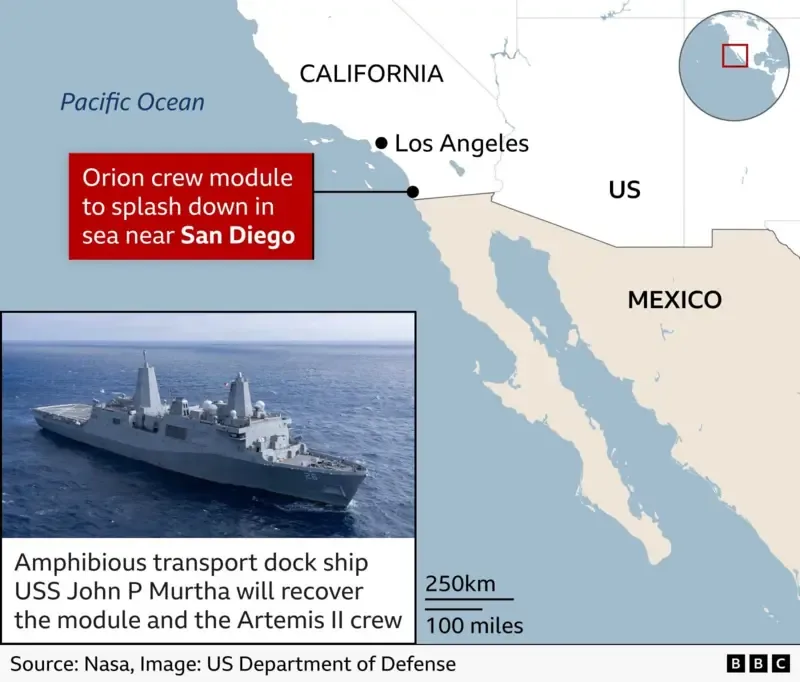
Orion concluded its journey on April 10, 2026, entering Earth’s atmosphere at 23:53 GMT at thirty-five times the speed of sound. The European Service Module separated from the crew module at 23:33 GMT and disintegrated safely above the Pacific. Following a planned six-minute ionization communications blackout, drogue parachutes deployed at 23,400 feet, followed by three main parachutes slowing the capsule to under 200 feet per second. The spacecraft executed a splashdown at 00:07 GMT on April 11, landing within one mile of its target off San Diego [2].
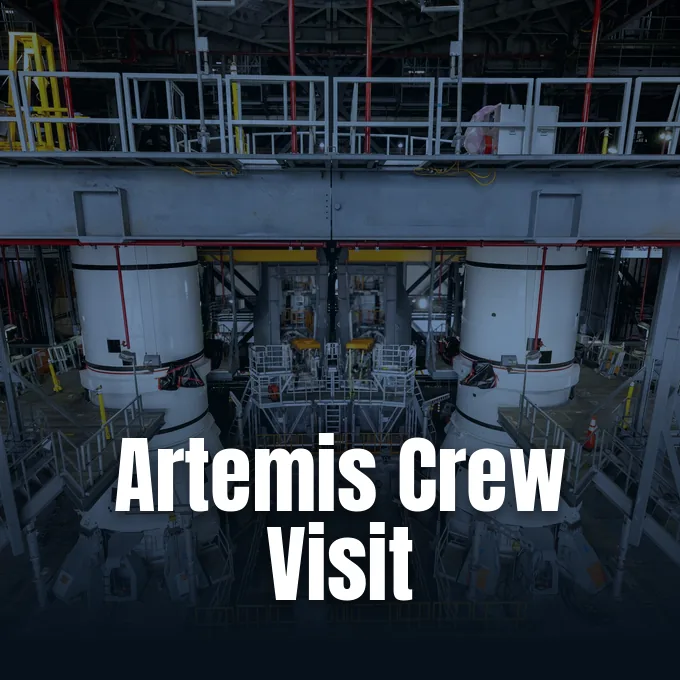
Recovery teams aboard U.S. Navy helicopters hoisted the crew from inflatable rafts and transferred them to the USS John P. Murtha for medical examinations [2]. Reviewing the technical achievements of Artemis II explained how incremental flight testing protects crews before orbital docking and landing attempts [4]. With life support loops and the modified entry profile validated under cislunar velocities, NASA cleared the way for subsequent flights [8]. Ground teams inside the Vehicle Assembly Building proceeded with preparation work for the subsequent Artemis III mission to stack flight hardware.
NASA plans to launch Artemis III in late 2027 to evaluate commercial lunar landers in Earth orbit before landing astronauts on the lunar south pole during Artemis IV in 2028 [8]. By qualifying life support hardware, manual guidance, and high-energy reentry profiles, Artemis II provided the flight foundation for permanent lunar exploration [1]. The mission proved that modern spacecraft can protect human crews in deep space [4]. Future missions will extend human habitation across the lunar surface [8].
- PRESS RELEASE Low, L. E. (2026, April 1). Liftoff! NASA Launches Astronauts on Historic Artemis Moon Mission. NASA. [Article Link]
- ONLINE NEWS Moon, J., Morelle, R., Francis, A., Ghosh, P., & Phillips, J. (2026, April 10). Artemis II crew ‘happy and healthy’ after completing historic mission to the Moon. BBC News. [Article Link]
- ONLINE NEWS Pearlman, R. Z. (2023, April 3). NASA Announces the Astronaut Crew for Artemis II Lunar Flyby. Scientific American. [Article Link]
- WEBSITE Wikipedia contributors. (2026). Artemis II. Wikipedia, The Free Encyclopedia. [Article Link]
- WEBSITE Grimm, L. E., Zakrzewski, J., & NASA Communications. (2026, April 7). Artemis II Flight Day 7: First Return Correction Burn Complete. NASA Blogs. [Article Link]
- WEBSITE Mohon, L. (2023, September 25). All Engines Added to NASA’s Artemis II Moon Rocket Core Stage. NASA Blogs. [Article Link]
- WEBSITE Costa, J. (2024, November 20). NASA Stacks First Artemis II Segment on Mobile Launcher. NASA Blogs. [Article Link]
- WEBSITE Wikipedia contributors. (2026). Artemis program. Wikipedia, The Free Encyclopedia. [Article Link]
- ACADEMIC JOURNAL McMurray, P. (2026). Under the Extraterrestrial Shadow: The Artemis II Total Solar Eclipse Impact on History and Heliophysics. [Article Link]
- ACADEMIC JOURNAL Pokorny, L. (2026). AI-Based Autonomous Anomaly Detection for the Artemis II Orion Spacecraft. Zenodo. [Article Link]
- ACADEMIC JOURNAL Pokorny, L. (2026). AI-Powered Autonomous Optical Navigation and Trajectory Optimization in Cislunar Space: Insights from NASA Artemis II. Zenodo. [Article Link]


