



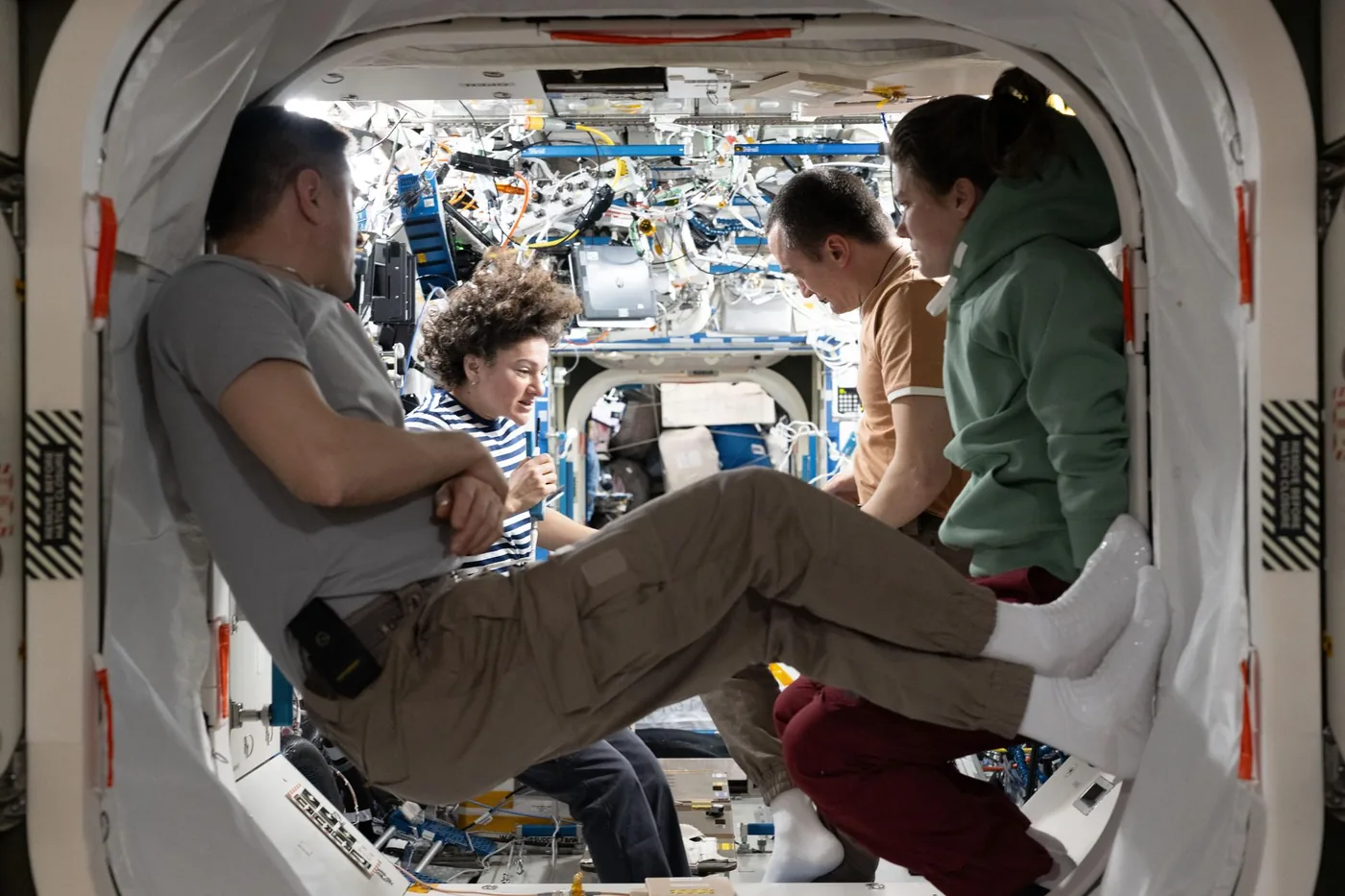
Astronaut exercise can involve a blood sample as well as a workout. In its September 11 update, NASA described how the Expedition 75 crew combined space exercise research with cargo transfers and laboratory maintenance aboard the International Space Station (ISS). Jack Hathaway prepared samples for later analysis on Earth, Sophie Adenot evaluated an exercise device, and Jessica Meir recorded a workout for an investigation tracking astronaut health. [1]
Astronaut Exercise: What Did NASA Report?
NASA called Friday a “light duty day,” yet its account follows seven crew members across laboratories, cargo areas and service modules as they carried out research and station upkeep. The agency described work on muscle loss, equipment usability and health monitoring. The report documents research in progress. It provides no finding that a particular exercise method prevented muscle loss, and it offers no comparison between the effectiveness of the devices involved. [1]
Hathaway and Adenot began with blood collection in Columbus. Adenot represents ESA (European Space Agency); Hathaway is a NASA flight engineer. Later, Adenot used the European Enhanced Exploration Exercise Device, while NASA station commander Jessica Meir filmed herself exercising on another machine. NASA identifies Meir’s recording with the Standard Measures investigation. The account does not give a study name for Hathaway’s blood samples or identify them as part of Standard Measures.
NASA names three distinct research activities. Each produces a different record: preserved blood, a usability questionnaire or workout video.
PerEXP Teamworks’ coverage of astronaut ageing research and its possible relevance on Earth addresses the broader interest in studying human health through spaceflight. Here, the immediate focus is narrower: who prepared the samples, where the crew stored them and what NASA says scientists intend to investigate after their return. The September 11 account gives no date for that analysis.
Why Collect Blood Before Analysis?
With Sophie Adenot assisting in Columbus, Jack Hathaway used a centrifuge to process blood he had drawn. He then stored the samples in a science freezer. NASA says scientists will analyze the samples after their return to Earth. Their research concerns electrical muscle stimulation as a way to counteract muscle loss caused by spaceflight. The report stops at sample preparation and storage; it does not describe what the blood analysis will measure.
The scientists’ question is whether electrical muscle stimulation can help address that loss. NASA supplies no stimulation settings. Nor does NASA specify treatment duration, a comparison group or any change in muscle condition for Hathaway. The account cannot establish how well the approach works. A blood collection confirms a step in astronaut exercise research. The eventual laboratory work will address questions the crew’s daily activity report leaves open.
University of Tsukuba researchers offer a separate example of what blood analysis can reveal. Nailil Husna, Tatsuya Aiba and colleagues examined extracellular DNA and RNA from astronauts in a study published in Nature Communications. Their paper, Release of CD36-associated cell-free mitochondrial DNA and RNA as a hallmark of space environment response, identifies CD36 as a marker associated with circulating mitochondria. The team investigated responses to the space environment. NASA does not identify this published study as the investigation behind Hathaway?s samples, and its findings do not establish the effectiveness of electrical muscle stimulation. [3]
What Did Adenot Evaluate?
Adenot exercised on the new European Enhanced Exploration Exercise Device (E4D). She then completed a questionnaire about its usability for future missions of long duration. Usability is the stated focus. NASA does not reproduce her answers or offer a rating for E4D. The report cannot establish whether she found it comfortable, straightforward or difficult to use. It records that she completed the exercise session and supplied feedback afterward.
Meir used the advanced resistive exercise device. She recorded her workout on video for Standard Measures, which NASA describes as documenting astronaut health and performance before, during and after spaceflight, placing the recording within an investigation that extends beyond Friday’s shift. NASA gives no workout duration. The report also leaves out resistance settings, so it does not support a detailed reconstruction of her exercise routine or a comparison with Adenot’s session.
NASA’s astronaut exercise account brings together two immediate forms of documentation: Adenot’s assessment of equipment use and Meir’s video record of physical activity. Neither entry contains a published outcome. The distinction matters when interpreting the equipment’s role in future missions: a crew member can evaluate how a device works in practice before researchers report whether its use delivers a particular health benefit.

What Were the Robots Doing?
Hathaway later activated the Astrobee robotic free-flyers in Kibo, another laboratory module. He photographed the assistants as they demonstrated autonomous maneuvers inside the station. NASA describes the robots as cube-shaped and roughly toaster-sized. The photographs documented their activity. NASA does not report a navigation score, a failure or a new capability. It does not connect the demonstration to the muscle-stimulation research.
Kibo hosted the robot demonstration. Columbus hosted the earlier blood work. NASA’s account moves between these locations because the crew’s tasks involved several kinds of research equipment, rather than a single experiment occupying the whole day. The robots’ autonomous maneuvers form a separate entry in that schedule. Hathaway’s participation in both activities does not establish a shared scientific objective between the free-flyers and astronaut exercise.

How Did the Crew Divide Work?
Meir and NASA flight engineer Anil Menon took turns moving cargo into and out of Northrop Grumman’s Cygnus XL spacecraft, which was berthed at Unity’s Earth-facing port. Menon also worked with Hathaway in Quest (the station’s airlock), continuing to stow tools from the September 1 spacewalk. Cargo handling and tool storage remained on the schedule. NASA lists these activities without naming the cargo items, giving transfer quantities or detailing the tools involved. Meir’s day included both logistics and exercise documentation, while Menon’s work connected the cargo vehicle with equipment inside the station. The report does not supply a timetable showing how long either astronaut spent on each task.
Roscosmos flight engineers Pyotr Dubrov and Anna Kikina installed and activated equipment for automatic photography. Its targets were islands and volcanoes across the Indian and Pacific oceans. Dubrov then tested Bluetooth hardware and USB connections. Kikina inspected and cleaned cargo stowage areas in Zarya. NASA identifies the photographic targets but gives no findings from the observations. Dubrov and Kikina?s observations concern a separate subject from the human-health activities elsewhere in the station.
What Still Awaits a Result?
Roscosmos flight engineer Andrey Fedyaev spent most of his shift in Zvezda, taking inventory of laptop computers and their power systems. He later serviced orbital plumbing components in Nauka. NASA reports no equipment failure. His tasks complete the account of how the seven crew members divided their lighter schedule among laboratory work, observation, cargo movement and maintenance, with routine servicing continuing through the end of his day.
Scientists use different records to answer different questions. PerEXP Teamworks’ coverage of a deep-sea sensor investigating reactive oxygen species concerns another setting for scientific observation; the ISS update here describes sample preparation and activity documentation. NASA has not supplied the blood-analysis results in this report. The account also contains no completed assessment of E4D usability or health finding from Meir’s Standard Measures recording.
NASA?s earlier Expedition 71 report describes Jeanette Epps processing blood from Matthew Dominick and Mike Barratt for immune-function research. Epps used a centrifuge and the Kubik research incubator. [4] A later photograph published by The Universe Space Tech shows JAXA?s Takuya Onishi and NASA?s Nichole Ayers carrying out blood sampling for Immunity Assay. These examples document separate investigations. [5]
The scientists studying electrical muscle stimulation still need to analyze Hathaway’s samples after their return to Earth, according to NASA, before this collection can contribute the intended insights. The update names no return date. For astronaut exercise research, the unresolved issue is what those samples will reveal about the approach to counteracting muscle loss; Friday’s report ends with them preserved in the station’s science freezer. [1]
- ONLINE NEWS Garcia, M. A. (2026, September 11). Crew works exercise research and lab maintenance on light duty day. NASA. [Article Link]
- WEBSITE NASA. (n.d.). ISS075E0013908 [Photograph]. NASA Image and Video Library. [Article Link]
- ACADEMIC JOURNAL Husna, N., Aiba, T., Fujita, S., Saito, Y., Shiba, D., Kudo, T., Takahashi, S., Furukawa, S., & Muratani, M. (2024). Release of CD36-associated cell-free mitochondrial DNA and RNA as a hallmark of space environment response. Nature Communications, 15(1). [Article Link]
- ONLINE NEWS Garcia, M. A. (2024, July 30). Blood tests, eye scans on station helping doctors improve crew health. NASA. [Article Link]
- ONLINE NEWS Alaieva, L. (2025, July 22). Astronauts donated blood for analysis in space: photo. The Universe Space Tech. [Article Link]
APA 7: TWs Editor. (2026, September 12). Blood samples and astronaut exercise fill a light duty day. PerEXP Teamworks. https://perexpteamworks.com/en/astronaut-exercise-blood-samples-light-duty-day/


2 comments