





Lossless vs lossy compression represents the core split in how systems like Apple macOS, Microsoft Windows, and Linux servers store and move files across networks. When software teams need to shrink raw data, they choose between two foundational approaches that balance storage footprints against sensory fidelity [1]. Lossless tools find statistical patterns and assign compact codes so that every bit returns to its exact original state upon decoding. Lossy codecs drop subtle color shifts and inaudible audio tones that human perception routinely misses, cutting file sizes by fifty percent or more across web platforms like YouTube and Netflix. This trade-off shapes operating systems, media delivery, and cloud backup.
- Lossless vs Lossy Compression Fundamentals
- Core Lossless Encoders
- How Discarding Details Shrinks Multimedia
- Why Streaming Relies on Lossy vs Lossless Compression
- Lossless vs Lossy Compression Storage Trade-Offs
- Database Systems and File Storage
- Why Lossy Compression Fails for Sensitive Files
- Neural Networks and Generative Codecs
Lossless vs Lossy Compression Fundamentals
Understanding lossless vs lossy compression begins with how an encoder treats original source bits. Lossless compression guarantees that an uncompressed file is reconstructed bit for bit without losing any content [1]. Text documents, PostgreSQL database tables, and compiled software binaries depend entirely on this precision. Altering even one byte could corrupt bank balances or crash critical programs immediately. Complete reversibility remains mandatory for basic system stability [5].
By contrast, lossy compression permanently throws away bits that an algorithm identifies as redundant or unneeded for human eyes and ears [5]. A lossy encoder accepts minor visual distortion to achieve much smaller file sizes, making it ideal for web photos, consumer streaming, and mobile downloads [2]. This boundary traces back to information theory established by Claude Shannon in the late 1940s, where algorithmic information theory models statistical redundancy while rate-distortion theory governs lossy trade-offs [13]. Claude Shannon proved that lossy systems measure how much quality a viewer can give up before noticing defects, whereas lossless tools treat every bit as sacred. Rate-distortion theory explains this balance [15].
A major outcome of this split is generation loss during repeated editing passes [13]. Can an editor save a lossy file multiple times without destroying fine visual textures? Each time software like Adobe Photoshop decompresses and re-saves an image in JPEG format, the encoder applies another round of mathematical approximation, causing subtle details to vanish while block artifacts multiply across the image [3]. Keeping a master copy in a lossless format like PNG, FLAC, or TIFF prevents this decay by preserving the original bitstream [2].
Core Lossless Encoders
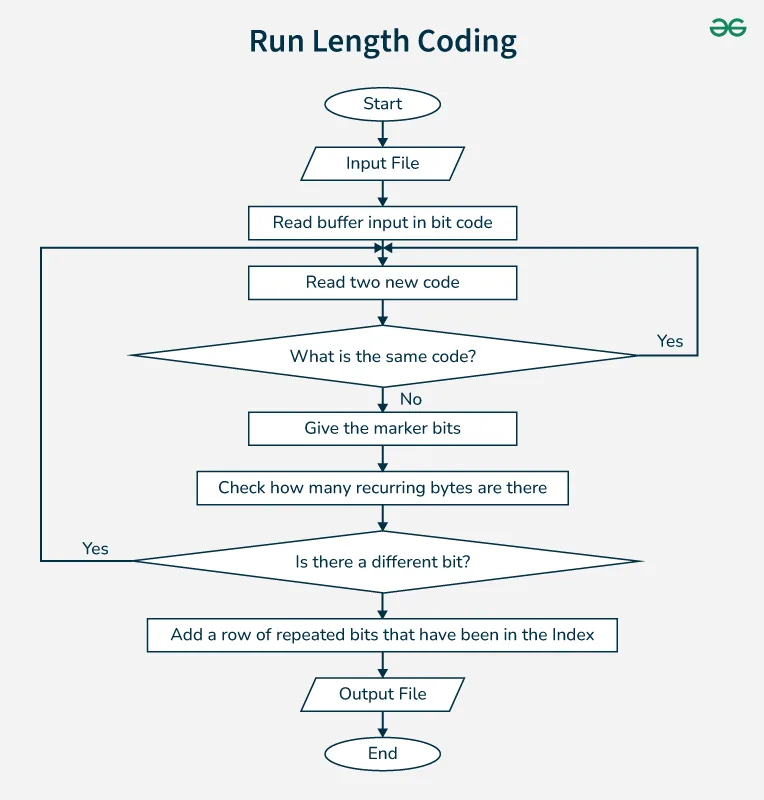
Run-length encoding is one of the simplest lossless methods, replacing consecutive repeating data values with a single token and a repeat counter [4]. It works well on basic line drawings, solid backgrounds, and fax signals that contain long runs of identical pixels [13]. However, it struggles on rich text or natural photographs that lack repetitive patterns [6].
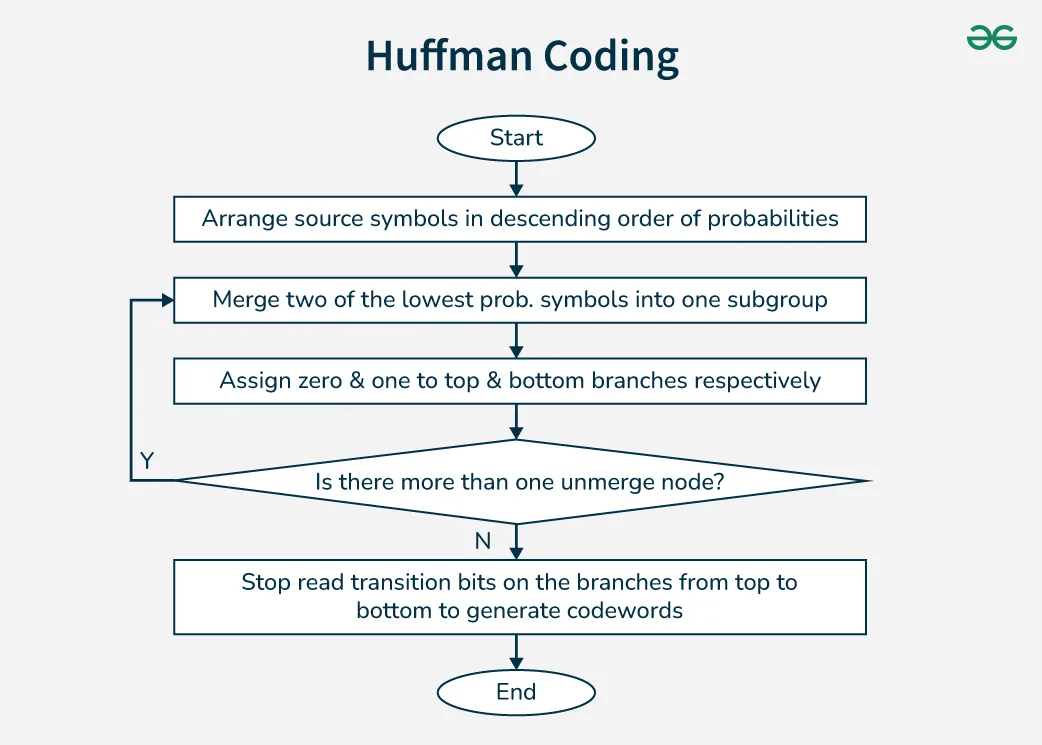
RF Wireless World illustrates run-length encoding using a sample text string where twelve consecutive Z characters followed by a single C compress into concise numerical shorthand [4]. For richer data, entropy coding analyzes symbol frequencies to achieve higher bit density [6]. Invented by David Huffman in 1950, Huffman coding builds a binary tree that assigns shorter bit sequences to frequently occurring characters while assigning longer codes to rare letters [13]. In an example sentence where the letter o and spaces appear multiple times, Stored Bits shows that variable-length codes shrink the total bit count well below the standard eight bits per character [10]. Two symbols with the lowest frequencies receive binary strings of identical length that differ only in their final bit, maximizing encoding efficiency across the entire dataset [4].
Dictionary algorithms push lossless performance further by replacing repeated phrases with memory pointers [9]. Terry Welch refined this approach in the mid-1980s by developing LZW, which soon became the core engine for PKZIP, modems, and CompuServe GIF images [13]. When licensing disputes emerged over Unisys patents, software developers created PNG using the DEFLATE algorithm, which pairs Abraham Lempel and Jacob Ziv’s LZ77 sliding-window pointers with Huffman coding. Those controversial Unisys patents expired on June 20, 2003, leaving dictionary-based compression free for web servers running Apache or Nginx [14].
How Discarding Details Shrinks Multimedia
Lossy algorithms shrink media files by taking advantage of biological limits in human hearing and vision [5]. In 1972, Nasir Ahmed proposed the discrete cosine transform, working with T. Natarajan and K. R. Rao to publish a working algorithm in January 1974 [13]. This transform converts raw pixels or audio waveforms into frequency components, separating major shapes from subtle textures [15].
Because human eyes notice brightness changes much more readily than fine color differences, encoders can safely drop high-frequency data without spoiling the visual impression. The JPEG standard introduced in 1992 applies this mathematical transform across 8×8 pixel blocks before quantizing the resulting values [13]. Quantization rounds off less noticeable frequencies, turning smooth gradients into compact approximations that compress into small byte strings [6]. In professional creative workflows, editing tools in Adobe Photoshop allow photographers to adjust quality sliders and inspect how quantization affects image sharpness. Pushing compression too hard produces blocky artifacts, color banding, and halos around sharp outlines [3]. Anthony Heddings demonstrated that saving a 200 KB PNG as a 50% quality JPEG reduced its footprint to just 28 KB while remaining clear at normal viewing distances [9].
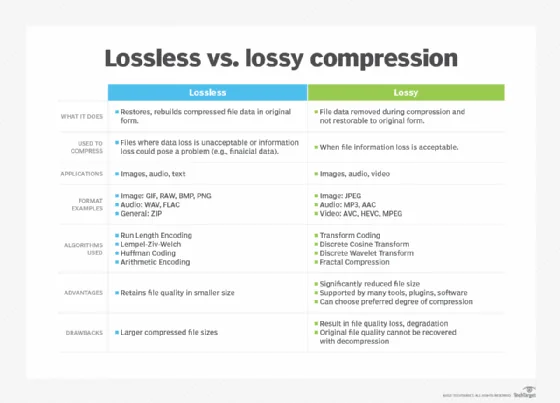
Audio codecs follow similar perceptual rules through psychoacoustic modeling [13]. An MP3 encoder removes audio frequencies that fall outside normal human hearing ranges or notes masked by louder simultaneous sounds [6]. For example, a faint guitar note played at the exact moment of a loud drum hit can be omitted because human ears can’t hear it [9]. Bitrates range from speech-focused settings at 48 kbps up to 320 kbps, where audio clarity closely rivals uncompressed recordings on standard headphones [3].
Why Streaming Relies on Lossy vs Lossless Compression
The choice of lossless vs lossy compression directly dictates how streaming networks distribute video to millions of concurrent viewers [6]. MASV contributor Gary Adcock points out that viewers around the globe spend roughly 84 minutes daily streaming video clips, placing heavy demands on telecommunication networks [11]. Without lossy delivery codecs, streaming high-definition video over consumer internet connections would be completely impractical [6].
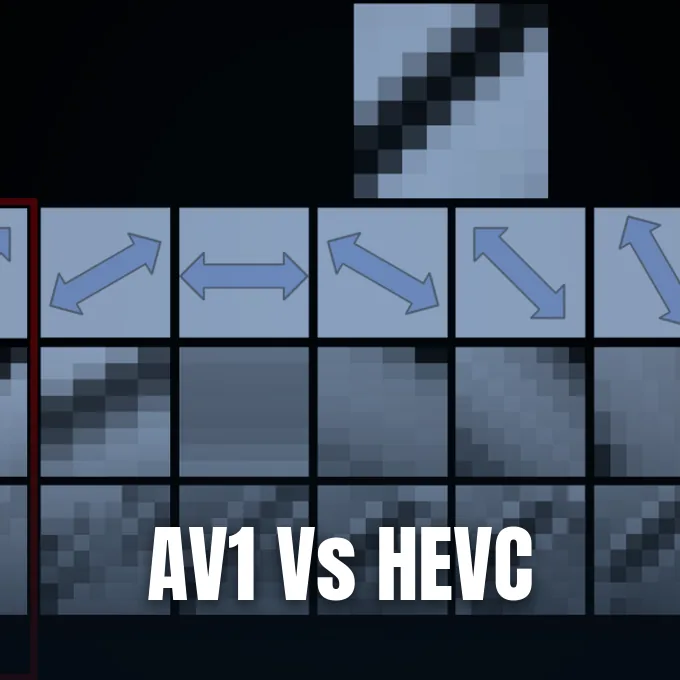
Video streaming accounted for more than 70 percent of all mobile data traffic in 2022, and Ericsson forecasts project that share will reach 80 percent by 2027 [11]. Video codecs meet this demand by combining spatial compression with interframe motion compensation [6]. Instead of encoding each frame as a standalone photo, the codec calculates differences between successive frames and records only the movement vectors [9]. Media engineers evaluate network delivery by comparing the efficiency differences between AV1 and HEVC across high-resolution playback environments. Bitmovin reported in its 9th Video Developer Report from July 2025 that 65% of surveyed developers used H.264/AVC in production, while 41% used HEVC to stream content efficiently [7].
Music streaming shows a similar division between lossy convenience and lossless audio quality [3]. Mainstream platforms like Spotify, Apple Music, and Amazon Music deliver audio through lossy AAC or MP3 streams to save mobile data and prevent stuttering on weak wireless signals [2]. Premium audiophile tiers on Tidal, Deezer, and Apple Music offer lossless streams using codecs like ALAC or FLAC. But Tim Brookes notes that wireless earbuds like Apple AirPods Pro still compress audio over lossy Bluetooth links using AAC, so listeners on wireless headphones still receive lossy playback [3].


Lossless vs Lossy Compression Storage Trade-Offs
Analyzing lossless vs lossy compression requires evaluating both capacity savings and processor consumption across enterprise workloads [1]. Lossless tools typically deliver compression ratios between 2:1 and 5:1, shrinking a 10 MB text archive down to roughly 4 MB [5]. But lossy multimedia formats routinely achieve 10:1 or 20:1 ratios without obvious visual damage [6].
Repetitive text can reach higher ratios, as Anthony Heddings showed by compressing a 3 KB file containing one repeated word down to 158 bytes, achieving nearly 95% compression [9]. However, compression algorithms also demand significant processor power [5]. Encoding and decoding large datasets consume CPU cycles, introducing memory delays that can slow down real-time input and output operations [6]. To manage this workload, enterprise storage vendors frequently offload tasks to specialized hardware components. IBM equips some enterprise storage systems with a hardware acceleration card to run inline compression before writing data to solid-state storage. Storage arrays from Dell XtremIO and Silk K2 use inline data reduction to maximize drive throughput. Systems lacking dedicated hardware often run compression as a background task, balancing storage space against processor load [5].
Backup platforms combine compression with data deduplication to maximize storage efficiency [5]. Does running both techniques together cause unnecessary system friction? Backup software avoids waste by running deduplication first to eliminate duplicate chunks across multiple nightly backups. Once identical file blocks are removed, the system applies lossless compression to shrink the remaining unique data. Barracuda Backup runs this two-stage pipeline on dedicated hardware appliances so that intensive compression jobs don’t compete with active production servers running Microsoft SQL Server or Oracle Database [7].
Database Systems and File Storage
Relational database systems depend on lossless compression because losing a single byte could corrupt financial balances or customer records. PostgreSQL manages large values through an internal mechanism named TOAST, which handles oversized attributes when a database row exceeds the 2 kB threshold on an 8 kB page. Administrators can adjust storage strategies with ALTER TABLE commands [8].
Time-series databases achieve even greater efficiency by organizing data into columnar layouts. Timescale compresses entire columns together, using algorithms tailored to specific data types rather than generic dictionary tools. It applies Gorilla compression to floating-point numbers and delta-delta encoding to sequential timestamps. Michael Gagliardo of Ndustrial reported that this columnar pipeline compressed 64 GB of uncompressed daily industrial sensor data down by 97% reduction, giving their operations a 26:1 compression ratio. Grouping data by secondary columns before compression improves reduction rates further, helping developers manage massive telemetry workloads without bloating cloud hosting bills. Avoiding decimal types ensures the Timescale engine uses its fastest native mathematical compressors on PostgreSQL tables [8].
Operating systems also provide transparent file system compression directly within local storage drives. File systems like ZFS, btrfs, and Microsoft NTFS compress file fragments before writing them to magnetic disks or solid-state memory. In the early days of personal computing, expensive hard drives made utility software like SuperStor Pro and DiskDoubler popular tools for doubling available disk capacity on Apple Macintosh and IBM PC computers. Modern multi-core processors decompress data quickly, making file system compression a practical option for cold storage and archival folders [5].
Why Lossy Compression Fails for Sensitive Files
In mission-critical enterprise environments, lossless vs lossy compression defines the safety boundary for compiled code, financial records, and legal archives. Lossy compression is completely unsuitable for sensitive records because discarded information can’t be restored by any mathematical method [1]. If a lossy encoder removes bits from a compiled software binary, the program crashes immediately upon launch [3]. Legal filings, financial spreadsheets, and Git source code repositories require complete fidelity across every single character [7].
Medical imaging presents a strict environment where file size must never compromise patient diagnoses. Hospitals store thousands of high-resolution MRI scans and X-ray images, organizing them in standardized DICOM archives [6]. In healthcare regulations, clinicians distinguish between reversible lossless storage and diagnostically acceptable irreversible compression, known as DAIC [14]. When reviewing tissue scans, oncologists require full structural fidelity because lossy artifacts can easily obscure faint microcalcifications or mimic malignant lesions [6]. For primary diagnostic reviews, healthcare providers demand lossless compression to ensure every pixel matches clinical reality, preventing diagnostic errors while maintaining legally defensible patient imaging records over decades of clinical review. Preserving subtle edges takes precedence over storage savings [14].

A fundamental mathematical law explains why lossless compression can’t shrink every possible file. By the pigeonhole principle, any algorithm that reduces the size of certain bitstrings must inevitably expand other files by at least one bit. If every file could be compressed losslessly, repeated compression could shrink an entire library down to a single byte, which information theory proves impossible [14]. Random or encrypted data contains maximum entropy with no patterns to eliminate, causing lossless compressors to leave the file size unchanged or slightly larger [5].
Neural Networks and Generative Codecs
Machine learning models are beginning to transform the line between lossless and lossy data compression. Instead of relying on static mathematical formulas, deep neural networks learn underlying data distributions directly from large training datasets [15]. These models can reconstruct complex visual and acoustic textures with remarkable fidelity while transmitting only compact feature vectors across networks [11].
In a detailed research monograph published in Foundations and Trends in Computer Graphics and Vision, Y. Yang, S. Mandt, and L. Theis describe how neural compression frameworks combine rate-distortion theory with variational autoencoders and diffusion models [15]. Video codecs like NVIDIA Maxine, Google VP9, and AIVC take advantage of this approach by tracking facial landmarks and background elements rather than transmitting raw pixels. The encoder sends lightweight mathematical coordinates describing head movements and expressions, while the receiving software uses a neural network to resynthesize the speaker’s face in real time. This context-aware synthesis slashes bandwidth demands while enabling flexible resolution scaling across varied client displays. Camera makers like Sony, ARRI, and RED still rely on hardware acquisition codecs, but neural tools are reshaping delivery pipelines across Disney+, BBC, and PBS [11].
Artificial intelligence models also show surprising strength in scientific and linguistic compression. DeepMind demonstrated that its Chinchilla 70B language model compressed image data to 43.4% and audio data to 16.4% of original sizes, outperforming conventional PNG and FLAC encoders on test benchmarks [13]. In genomics, S. Deorowicz and S. Grabowski note that efficient compression remains vital for handling massive datasets generated by DNA sequencing platforms [16]. Combining neural pattern recognition with lossless entropy coding points toward a flexible future for data management across science and industry [15].
- WEBSITE GeeksforGeeks. (2019, May 22). Difference between Lossy Compression and Lossless Compression. [Article Link]
- WEBSITE Adobe. (2026, January 12). Lossy vs Lossless Compression: Differences & Advantages. [Article Link]
- ONLINE NEWS Brookes, T. (2021, September 3). Lossy vs. Lossless Compression: What’s the Difference? [Article Link]
- WEBSITE RF Wireless World. (2026, August 1). Lossless vs. Lossy Data Compression: Understand the Trade-offs. [Article Link]
- ONLINE NEWS Crocetti, P., & Sliwa, C. (2022, December 8). Data compression. [Article Link]
- ONLINE NEWS Vyas, K. (2023, September 19). What is Data Compression & How Does it Work? [Article Link]
- WEBSITE Barracuda Networks. (2026, November 9). What Is Data Compression? [Article Link]
- WEBSITE Tiger Data. (2023, July 31). What Is Data Compression and How Does It Work? [Article Link]
- ONLINE NEWS Heddings, A. (2018, August 14). How Does File Compression Work? [Article Link]
- WEBSITE Stored Bits. (2025, September 19). How does Data Compression Work? [Article Link]
- ONLINE NEWS Adcock, G. (2023, January 5). What Is AI Video Compression? [Article Link]
- REPORT Korn, D., MacDonald, J., Mogul, J., & Vo, K. (2002, July). The VCDIFF Generic Differencing and Compression Data Format (RFC 3284). [Article Link]
- WEBSITE Wikipedia. (n.d.). Data compression. [Article Link]
- WEBSITE Wikipedia. (n.d.). Lossless compression. [Article Link]
- ACADEMIC JOURNAL Yang, Y., Mandt, S., & Theis, L. (2023). An Introduction to Neural Data Compression. Foundations and Trends in Computer Graphics and Vision, 15(2), 113-200. [Article Link]
- ACADEMIC JOURNAL Deorowicz, S., & Grabowski, S. (2013). Data compression for sequencing data. Algorithms for Molecular Biology, 8(1), 25. [Article Link]


