





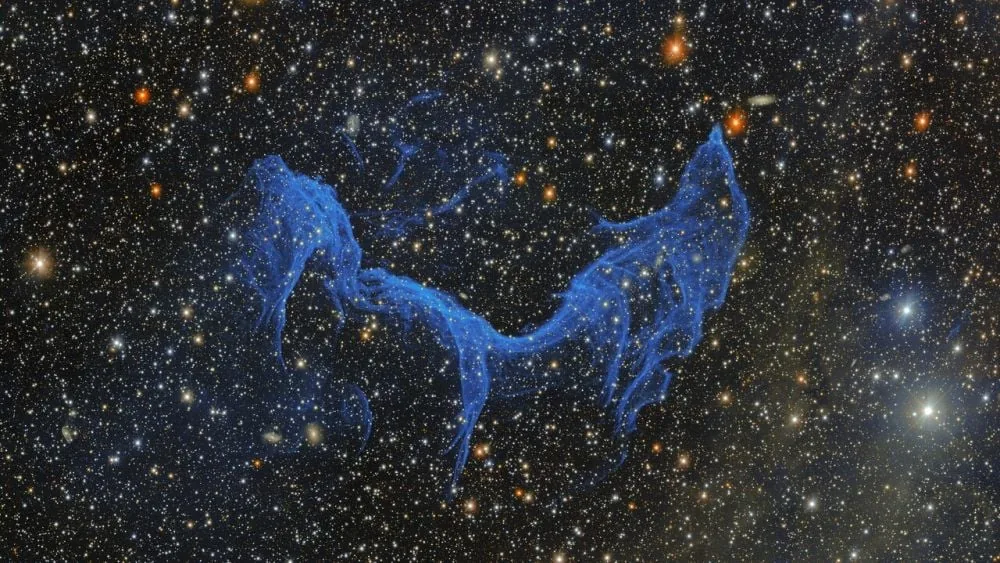
Astronomers using the Dark Energy Camera in Chile have captured a detailed portrait of the Betta Fish Nebula, a glowing cloud of gas drifting roughly 6,800 light-years from Earth in the constellation Centaurus. The expanding formation is the remnant of a massive star that blew apart thousands of years ago, throwing its outer layers into surrounding space. As that stellar debris slammed into colder gas clouds, shock waves heated the material until it began to shine [1]. The new wide-field view reveals how delicate gas structures continue to expand long after the original star died [2].
Appearance of the Betta Fish Nebula
Cataloged by researchers as SNR G295.5+09.7, the celestial structure earned its popular name because its curving filaments look like the flowing fins of a Siamese fighting fish. That visual resemblance depends on how observers trace the rippling patterns of blue and violet gas against the dark sky. In some records, people also call it the Mermaid Nebula because the trailing ribbons appear to form an aquatic tail [1]. The progenitor star exploded between 7,000 and 10,000 years ago, leaving behind a broad bubble of stellar debris that now spans deep regions of interstellar space [2]. As those expanding shells push outward, they continue to interact with surrounding dust and gas [1].
A bright orange star sits conveniently near the front edge of the blue cloud, creating the illusion of an eye for the fish. While that foreground star is not part of the supernova remnant itself, it lines up neatly along the line of sight from Earth. The real interaction takes place where fast-moving ejecta strike the interstellar medium. That collision releases enough thermal energy to excite nearby atoms, making the Betta Fish Nebula glow brightly in optical wavebands [1]. Such interactions reveal how dying stars push raw elements out into galactic space [2].

Supernova remnants act as natural laboratories for scientists tracking the lifecycle of stars. When massive stars end their lives in catastrophic blasts, they disperse heavy elements forged in their cores over millions of years. Those dispersed elements mix into giant gas clouds that later collapse to form new suns and planets [2].
Structure and Stellar Remnant of SNR G295.5+09.7
Hidden deep within the swirling gas lies the crushed heart of the original star, preserved as an ultra-dense stellar corpse. Before the blast, the progenitor star contained multiple times the mass of our Sun, but the collapse compressed that enormous weight into a tiny neutron star measuring only about 20 kilometers (12 miles) in diameter. Even with that compact size, the remnant packs roughly 1.4 times the mass of the Sun into its solid core. As researchers at the National Optical-Infrared Astronomy Research Laboratory pointed out, an object of that size could easily fit inside the city boundaries of Tucson, Arizona. That extreme density means a single thimble of its matter would weigh millions of tons on Earth [1].
This central remnant does not behave like a standard pulsar because it emits no detectable radio pulses and lacks a surrounding pulsar wind nebula. Astronomers can only see it by collecting high-energy X-ray emissions that escape from its scorching surface. In a detailed study published in Monthly Notices of the Royal Astronomical Society (MNRAS 528, 2095–2111), researcher Eppens and colleagues examined whether this unusual core might represent a low-mass bare strange star. Such exotic objects challenge ordinary models of nuclear matter [2].
The Betta Fish Nebula almost never formed at all. Had the original star been slightly more massive, the gravitational collapse would have produced a black hole instead of a neutron star. Under those conditions, the gravitational pull would have trapped the surrounding material, and no glowing clouds could have escaped into space [1].
Wide-Field Imaging with DECam
Capturing the full width of SNR G295.5+09.7 called for an optical instrument built to survey wide areas of the night sky without losing faint details. Astronomers used the 570-megapixel Dark Energy Camera (DECam), which sits on the Víctor M. Blanco 4-meter Telescope at Cerro Tololo Inter-American Observatory (CTIO) in Chile. Operated by the Association of Universities for Research in Astronomy (AURA) under an agreement with the U.S. Department of Energy (DOE) and the National Science Foundation, the mountaintop site provides dry, clear conditions for deep astronomical exposures. High in the Chilean mountains, the facility offers a sharp window into the southern sky [2].
The primary mission of DECam is leading the Dark Energy Survey, an effort designed to measure cosmic expansion and uncover the nature of dark energy. Yet the observatory also dedicates observing time to public-interest science, capturing pictures of glowing nebulae and distant galaxies for audiences worldwide [2]. Astronomical wide-field surveys do far more than take scenic snapshots; like the space-based eROSITA telescope mapping dark matter across large expanses, wide-angle instruments reveal how cosmic forces and expanding gas clouds interact on huge scales.

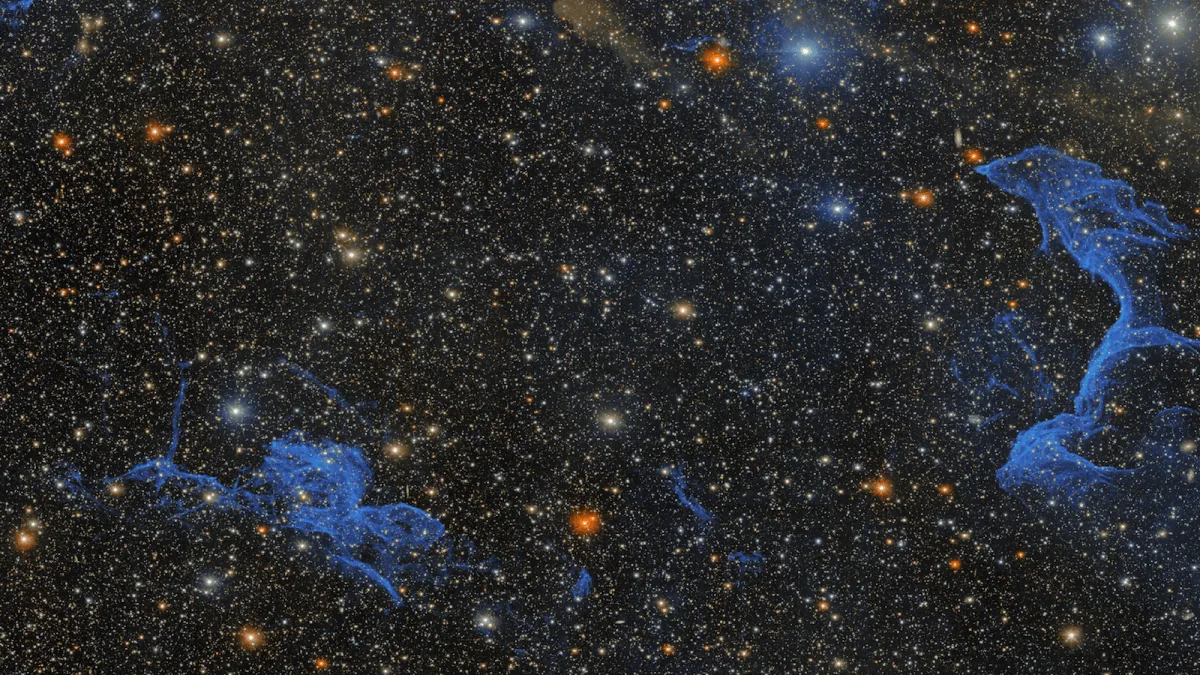
Turning raw data from DECam into a polished portrait takes skilled processing. Image specialists T.A. Rector from the University of Alaska Anchorage, together with D. de Martin and M. Zamani from NSF NOIRLab, blended multiple optical filters to bring out the faint gaseous structure. Over its decade of operation, the camera has assembled a rich public gallery, including wide-field portraits of the cometary globule CG4, the Rosette Nebula, and the Corona Australis Molecular Cloud [2].


Why Observers See Animals in Space Clouds
When people look at chaotic clouds of glowing gas, the human brain instinctively searches for recognizable profiles. Why do random plumes of gas in deep space remind observers of familiar creatures on Earth? The answer lies in pareidolia, a psychological phenomenon where people perceive known patterns in vague visual stimuli [1]. In this remnant, the flowing edges shaped by expanding shocks mirror the fins of a Siamese fighting fish, while a nearby star completes the illusion of an eye [2].
This playful naming tradition extends throughout the history of observational astronomy. Similar shapes appear throughout the night sky, explaining why the Giraffe Nebula resembles an animal when dense dust lanes outline a long neck against starry backgrounds. Giving descriptive nicknames to objects like the Betta Fish Nebula helps researchers share complex discoveries with the public without replacing formal catalog designations like SNR G295.5+09.7 [1].
Physical Properties of Interstellar Clouds
Nebulae are distinct luminescent parts of the interstellar medium made up of ionized, neutral, or molecular hydrogen and cosmic dust. In photographs, they appear as thick curtains of colored smoke. But in reality, they are far more diffuse than any vacuum ever produced on Earth. Most nebulae span hundreds of light-years, yet their material is scattered over enormous volumes [3].
The density differences between terrestrial conditions and interstellar clouds reveal just how empty space can be. Normal air at sea level on Earth contains roughly 1019 molecules per cubic centimeter, whereas the densest nebular clouds reach only about 104 molecules per cubic centimeter. In comparison, laboratory vacuums on Earth typically achieve densities between 105 and 107 molecules per cubic centimeter (a level far denser than nebular gas). If a nebular cloud the size of Earth were compressed together, its total mass would amount to only a few kilograms. Space remains empty even inside glowing stellar clouds [3].
Within these diffuse clouds, gravitational forces slowly pull gas and dust into denser pockets that eventually collapse into newborn stars. Surrounding materials can then condense to form planets and smaller orbital bodies, making nebulae the nurseries of planetary systems [3]. Telescopes often spot young stars emerging from these stellar nurseries, as seen when instruments observe protostars forming in Perseus and illuminating the dense gas around them. Supernova remnants enrich these clouds with heavy metals, providing the chemical building blocks needed for future generations of rocky worlds [2].

Historical Observations and the Betta Fish Nebula
Astronomers have studied nebulae for centuries, long before modern telescopes revealed their physical nature. Around 150 AD, the Greek astronomer Ptolemy recorded five nebulous stars in books VII and VIII of his Almagest, noting misty patches between the constellations Ursa Major and Leo. Centuries later in 964, Persian astronomer Abd al-Rahman al-Sufi described a “little cloud” in his Book of Fixed Stars, marking the earliest known record of the Andromeda Galaxy. Arabic and Chinese astronomers also documented the supernova of 1054 that created the Crab Nebula. These early watchers laid the groundwork for modern celestial catalogs [3].
The invention of the telescope accelerated the pace of celestial mapping. Nicolas-Claude Fabri de Peiresc discovered the Orion Nebula in 1610, an object later observed by Johann Baptist Cysat in 1618 and analyzed in detail by Christiaan Huygens in 1659. Edmond Halley published a short list of six nebulae in 1715, while Nicolas-Louis de Lacaille cataloged 42 entries from the Cape of Good Hope by 1753. By 1781, Charles Messier compiled his catalog of 103 fuzzy objects, helping observers distinguish comets from permanent deep-sky clouds [3].
Observational catalogs grew through the dedicated surveys of William Herschel and Caroline Herschel, who published lists containing thousands of nebular objects starting in 1786. In the early 20th century, astronomers Vesto Slipher and Edwin Hubble proved that most nebulae are lit by starlight and shine within our own Milky Way, separating them from distant spiral galaxies [3]. Today, modern instruments carry that observational lineage forward into new territory. By resolving intricate filaments within the Betta Fish Nebula, the Dark Energy Camera shows how ancient stellar explosions continue to sculpt the cosmos [2].
- ONLINE NEWS Paul, A. (2026, November 25). Dark energy camera captures ethereal Betta Fish Nebula. Popular Science. [Article Link]
- ONLINE NEWS Gough, E. (2026, November 24). A Dark Energy Camera Portrait of the Betta Fish Nebula. Universe Today. [Article Link]
- WEBSITE Nebula. (n.d.). In Wikipedia. [Article Link]
APA 7: PerEXP Teamworks. (2026, November 26). Dark Energy Camera Images Betta Fish Nebula in Centaurus. PerEXP Teamworks. https://perexpteamworks.com/en/betta-fish-nebula-dark-energy-camera/


