





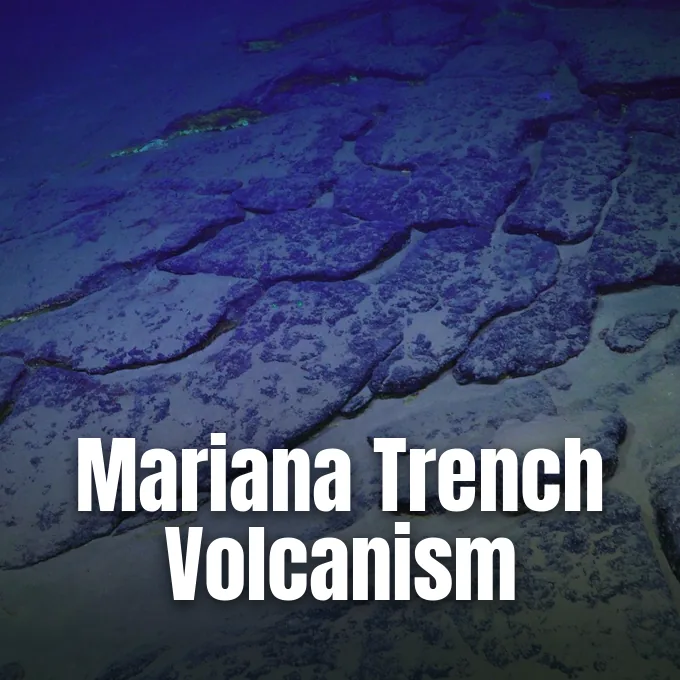
Geologists studying the western Pacific Ocean have detected explosive Mariana Trench volcanism at depths exceeding 6,000 meters below sea level, uncovering the deepest volcanic deposits recorded anywhere on Earth. Dr. Robert J. Stern at the University of Texas at Dallas directed the survey, gathering samples along the steep slopes of Challenger Deep using the robotic vehicle Jason during cruise TN438 [1]. Researchers were surprised to find volcanic ash and shattered rock at such depths because high water pressure and colder mantle rocks near trench boundaries were widely thought to prevent explosive eruptions [2].
Deepest Volcanic Activity at 6,000 Meters
The Mariana Trench cuts through the western Pacific Ocean floor in a crescent spanning roughly 1,580 miles, plunging into an abyss where the summit of Mount Everest would sit submerged under thousands of feet of water. Most scientific models assumed that the frigid waters and heavy pressure near Challenger Deep formed a lifeless wasteland until two divers reported seeing marine animals near the seafloor in 1960 [3]. The latest expedition explored the Challenger Deep Forearc Segment within the Southern Mariana Convergent Margin, deploying the robotic explorer Jason across seven dives that mapped nearly 186 miles of rugged slopes while documenting Mariana Trench volcanism far closer to the trench axis than expected [1].
Video logs showed that the eastern trench segment drops far deeper than the western side. The western wall is steeper. Along this western scarp, 20,000 feet beneath the surface, the Jason crew encountered a thin flat layer of dark volcanic stone [3].
These shattered rock fragments represent pyroclastic debris (the shattered debris of explosive eruptions) that formed when hot magma broke apart upon encountering cold sea water [3]. Geologists had long mapped active volcanic chains far behind trench axes, where sinking ocean crust reaches deep zones hot enough to melt overlying rock [2]. Stern confirmed that these recovered samples represent the deepest pyroclastic rocks documented in the world ocean to date [3].
Welded Ash on the Trench Wall
The recovered ash provided helpful clues about seafloor accumulation. Laboratory analysis revealed that fine ash particles had firmly welded onto rocks at the collection site, proving that the debris retained intense thermal energy when it settled onto the seabed. Molten rock normally chills in cold water within seconds. Because this material fused into hard rock, researchers concluded that the eruptive vents sat close to the collection slope [2].
Had the eruption occurred in shallow waters, the ash would have cooled completely before sinking 6,000 meters down through the water column into the abyss [2]. The vents were nearby. Dr. Robert J. Stern observed that the pyroclastic flow traveled only a short distance down the steep submarine incline [3].
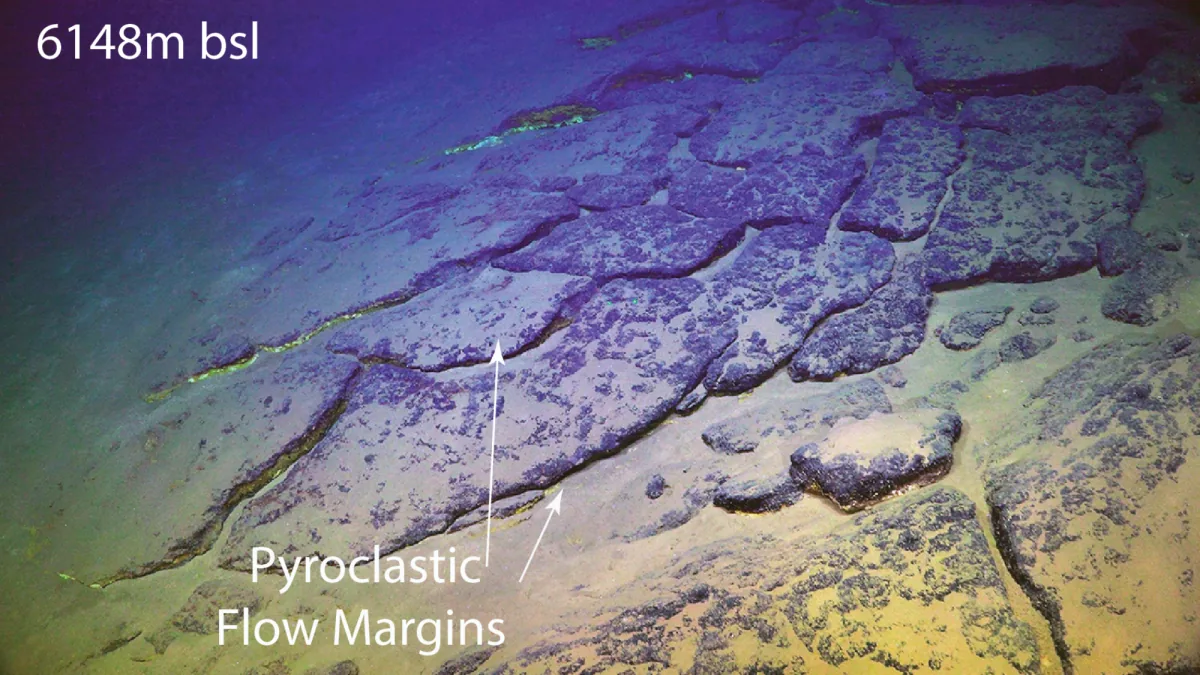
In an academic paper published in Frontiers in Earth Science, Dr. Robert J. Stern at the University of Texas at Dallas and colleagues proposed that deep-sea explosive volcanism at these depths behaves differently from eruptions in shallow air or water. Heavy hydrostatic pressures exceeding 600 atmospheres suppress rapid gas expansion, meaning volatile compounds formed supercritical fluids that propelled ash clouds without generating towering plumes. This mechanism generated dense pyroclastic flows that traveled short distances down the slope, preserving enough heat to weld firmly along the seafloor [1].
The Jason Submersible
Submersible vehicles need heavy titanium hulls to withstand crushing water pressures at the bottom of the Mariana Trench. In 2012, filmmaker James Cameron completed a solo dive into Challenger Deep aboard a custom submarine that cost an estimated $10 million to build. For the cruise TN438 survey, scientists deployed the veteran robotic system Jason/Medea, an uncrewed two-body platform funded by the National Science Foundation and operated by the National Deep Submergence Facility [3].
First built in 1988, the Jason vehicle can operate at depths reaching 21,385 feet (around 6,500 meters) beneath the surface [3]. It links to a research vessel through a six-mile fiber-optic cable that feeds power and real-time navigation commands.
The companion vehicle Medea floats higher along the tether, absorbing the heave of surface waves so Jason stays steady above the seabed. Over decades of service, the robotic team has surveyed hydrothermal vents across both the Atlantic Ocean and Pacific Ocean and explored a 1,600-year-old Roman trading wreck. In the southern Mariana trench, the rover braved near-freezing temperatures and crushing pressure to collect rock cores while examining how Mariana Trench volcanism alters the chemical balance of deep marine trenches [3].

Why Is the Mariana Trench So Deep?
The Mariana Trench plunges to record depths because the cold, dense Pacific plate sinks steeply beneath the younger Philippine Sea plate, pulling the seafloor downward like a colossal conveyor belt. Plate collision began roughly 52 million years ago, carving an abyss that drops nearly 11,000 meters below sea level at Challenger Deep [2]. How could molten material erupt at depths where bone-crushing water pressures normally suppress explosive bubbling? New geological findings suggest that crustal stretching and deep-seated magmatic activity help explain why the trench floor sinks far lower than conventional subduction boundaries [3].
Peter Kokelaar at the University of Liverpool observed that finding active volcanic products directly on the trench wall contradicts standard geological models because the vent location sits far closer to the plate convergence line than expected. “It’s probably the deepest product of an active volcanic system that’s been recorded,” Kokelaar said [2].
Peter Rowley at the University of Bristol explained that the Pacific plate dives deeper under the Philippine Sea plate than earlier models suggested, stretching the upper crust until it fractures and allows buoyant mantle material to rise. “Material that was originally quite deep down, stuff from the upper mantle, is actually quite accessible,” Rowley said. “Possibly this is the deepest volcanism we’ve seen,” Rowley added, highlighting the wide knowledge gaps that remain regarding submarine eruptions [2].
Mariana Trench Volcanism in the Forearc
The research paper divided the Challenger Deep Forearc Segment (CDFS) into two separate geological zones: the Eastern CDFS and the Western CDFS. The Eastern CDFS exposes older mantle peridotite rocks that rose through mechanical extension without extensive melting. In contrast, the Western CDFS contains younger volcanic rocks that formed through magmatic extension, demonstrating that molten rock actively pushed through the thinned crust of the Philippine Sea plate [1].
Tectonic forces driving Mariana Trench volcanism show that the southern subduction boundary stretches vigorously along its deepest slopes, where the western crust thins until molten mantle material punches through weakened fault zones to produce explosive eruptions at depths beyond 6,000 meters. The Pacific plate plunges beneath the Philippine Sea plate [2]. Understanding how deep rocks endure subterranean forces connects to laboratory research on iron oxide’s resilience in the Earth’s depths under crushing loads, where stable mineral crystal lattices help geoscientists model the long-term durability of the Pacific plate margin.
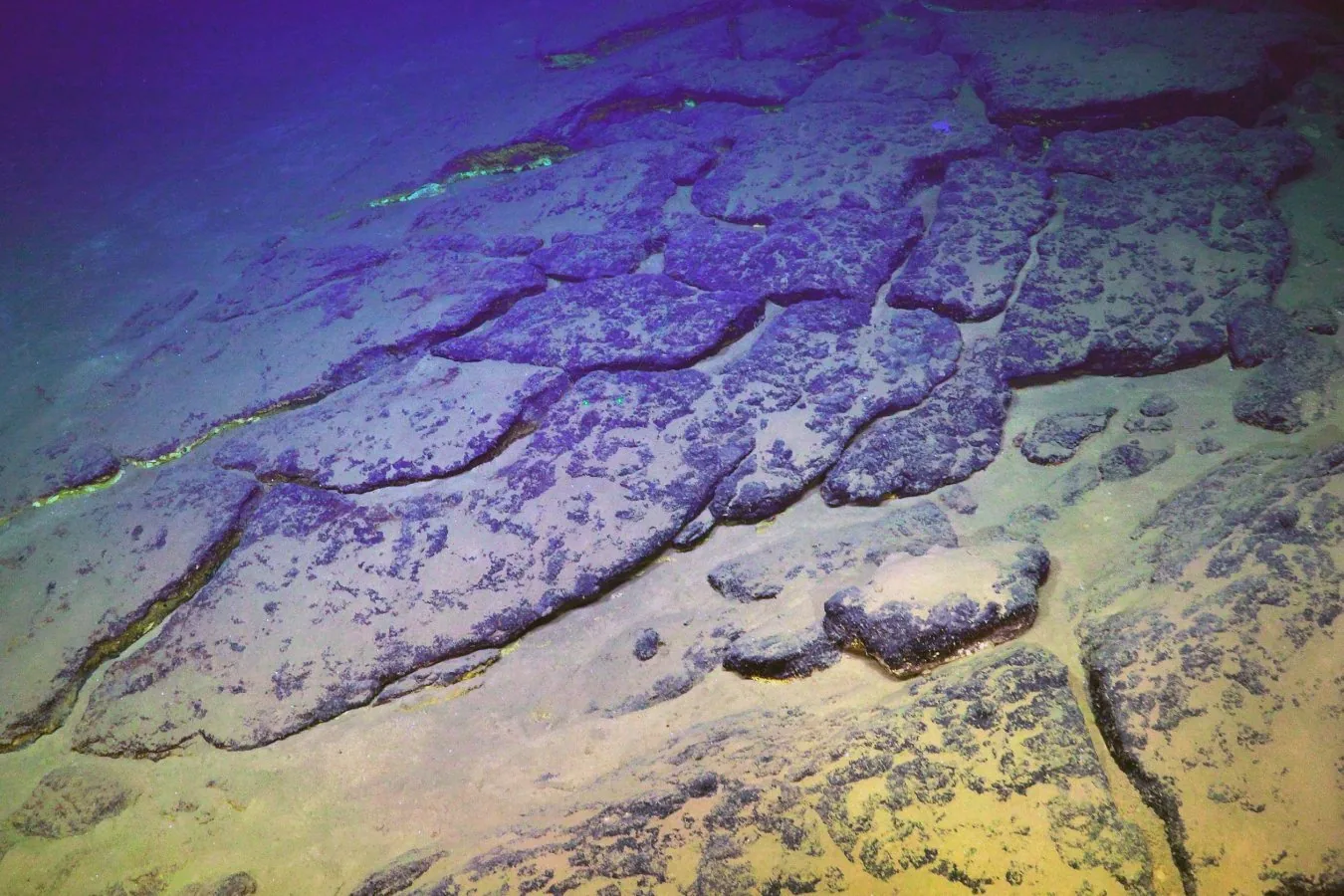
Marine geologists previously assumed that the mantle beneath the forearc was far too cold to generate molten magma so close to the sinking slab. The recovery of welded pyroclastic deposits proves that volatile gases can lower mantle melting thresholds and spark explosive events in forearc trenches. These magmatic conduits show that Challenger Deep is an evolving and tectonically active plate boundary [1].
Seafloor Seeps and Hadal Life
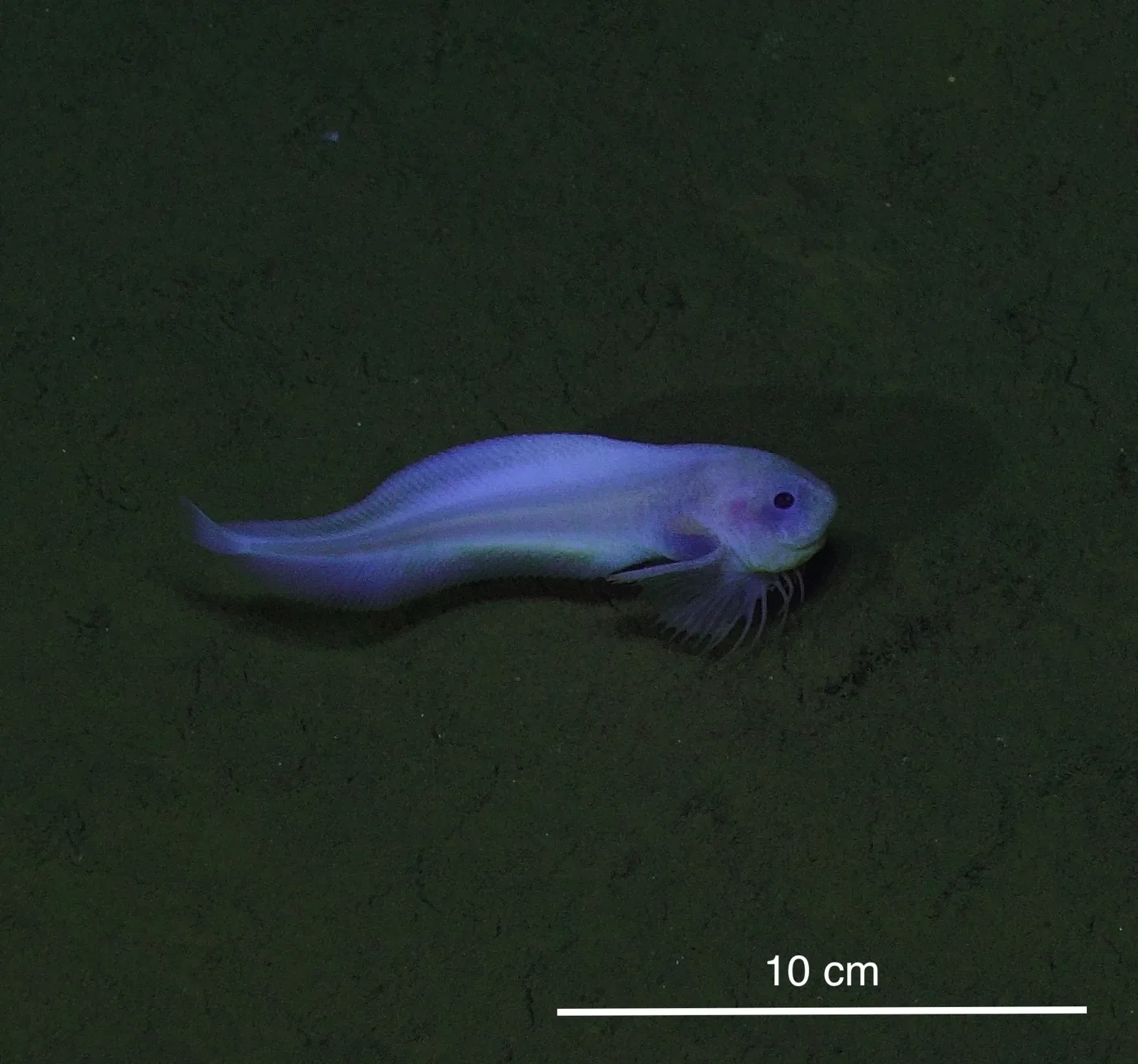
The expedition also explored the Shinaki Seep Field. While volcanic systems on land draw magma from shallow subterranean chambers mapped in seismic surveys of Kīlauea magma reservoirs beneath Hawaii, this deep seafloor venting network expels mineral-laden fluids directly into freezing ocean bottom waters under crushing hydrostatic pressure. Cameras on Jason spotted a purple snailfish (Pseudoliparis sp.) gliding near the seabed at 6,297 meters. The observation occurred during Jason dive J2-1676 [3].
The expedition crew from cruise TN438 performed seafloor cleanup work in Challenger Deep by recovering fluid-sampling instruments that a group of Japanese scientists had deployed in 2016. This recovery operation prevented scientific gear from lingering as discarded debris in the deep abyss [3].
Peter Rowley at the University of Bristol observed that marine geologists still possess far less direct observational data regarding deep ocean trenches than planetary astronomers hold about the arid craters of the moon. Future research cruises will search for the exact vent chimneys that produced these pyroclastic rocks, helping scientists determine how deep-sea magmatism shapes the structural evolution of global ocean basins [2]. The Jason rover completed seven dives during cruise TN438 [3].
- ACADEMIC JOURNAL Stern, R. J., Pujana, I., Anderson, M. K., Chin, E. J., Dygert, N., Harigane, Y., Le Roux, V., Leybourne, M., Ohara, Y., Okumura, T., Segee-Wright, G., & Etheridge, E. (2026). ROVing in the deep: tectonic and magmatic complexities of the Challenger Deep forearc segment, Southern Mariana convergent margin. Frontiers in Earth Science, 14. [Article Link]
- ONLINE NEWS Sparkes, M. (2026). Submarine finds world’s deepest explosive volcanic activity in Mariana trench. New Scientist. [Article Link]
- ONLINE NEWS DeGeurin, M. (2026). Mysterious volcanic rock discovered in the Mariana Trench. Popular Science. [Article Link]
APA 7: PerEXP Teamworks. (2026, November 24). Submarine Expedition Finds Mariana Trench Volcanism at Record Depths. PerEXP Teamworks. https://perexpteamworks.com/en/mariana-trench-volcanism-record-depths/


