





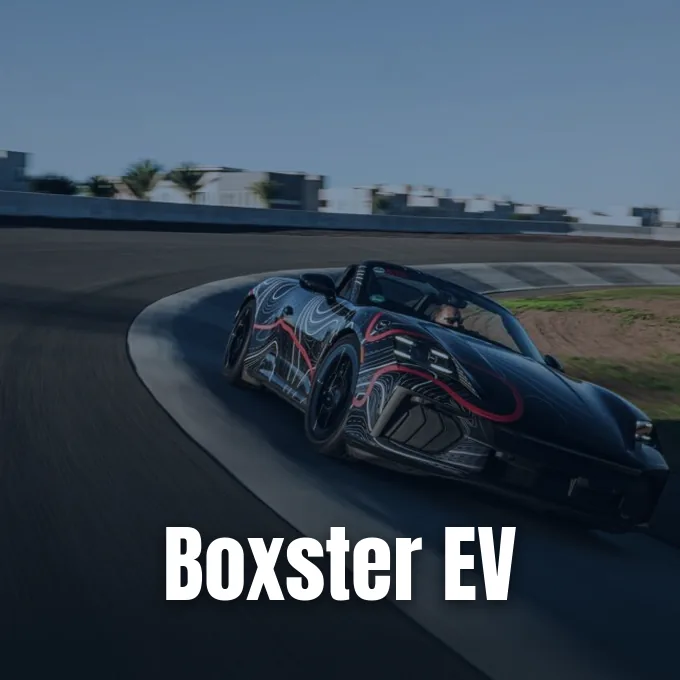
Porsche confirmed on Tuesday that its upcoming Boxster EV will debut in the first quarter of 2027, putting an end to industry rumors that the company had canceled the battery-powered roadster project. The carmaker is running prototypes through final validation stages before starting production in Stuttgart-Zuffenhausen, Germany. “Starting next year, the all-electric 718 Boxster will offer our customers a compelling entry point into the world of two-door sports cars,” Porsche CEO Dr Michael Leiters said in a company statement.
Development teams created a bespoke structural layout known as the E-Core architecture to preserve classic sports car balance without adding excess floor height. Unlike typical passenger electric cars that store cells in a flat underfloor skateboard, this setup packages an 800-volt battery into a vertical block located directly behind the driver and passenger. That placement allows the 718 Boxster to match the weight distribution of traditional mid-engine sports cars, keeping the driver low to the asphalt. It stays agile on tight roads [1].
Central Battery Layout and Cabin Height
Ars Technica evaluated the roadster after traveling from Albany, New York, to Los Angeles, taking the camouflaged prototype through winding canyon roads before joining heavy California traffic. Sitting inside the cabin during city gridlock, the driver was eye-level with the door handle of a Tesla Model Y. The car sits low. That hip point demonstrates how close the bucket seats remain to the ground [2].
Standard electric platforms rely on an underfloor battery pack that inevitably pushes the cabin upward by roughly three inches, which works well for sport utility vehicles but hurts the driving geometry of a low-slung roadster. Porsche avoided that problem by adopting the battery arrangement used in the original 2008 Tesla Roadster, mounting the entire 800-volt module behind the seats where a gasoline engine previously sat. This layout yields a weight balance of 40 percent front and 60 percent rear, concentrating mass near the middle of the chassis to deliver sharp cornering agility through fast transitions. Weight stays centered [3].
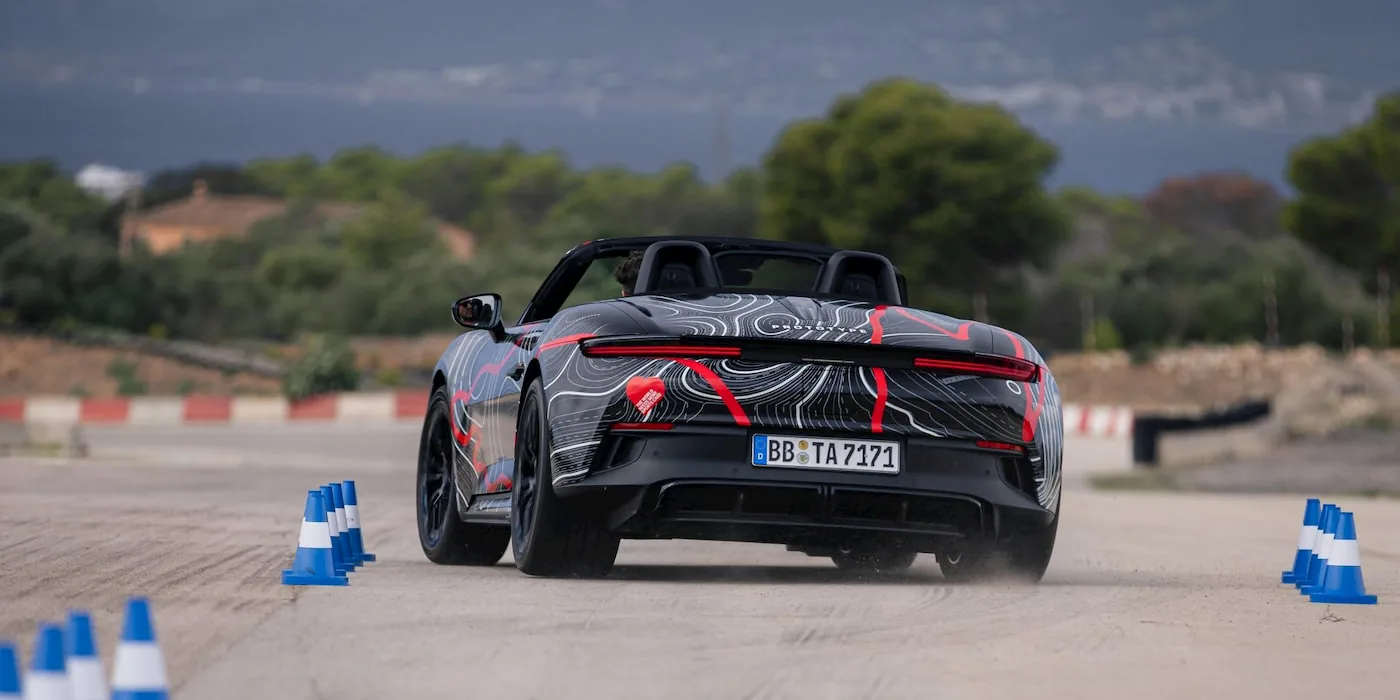
The low seating position fundamentally defines the sensory experience behind the wheel because feeling the road surface directly influences driver confidence on mountain passes. By removing battery cells from beneath the passenger compartment, Porsche preserved traditional cockpit ergonomics while keeping the roofline sleek. The low center of gravity keeps body lean well controlled without needing overly stiff suspension springs [2].
Shared Chassis Hardware from the 911
To keep development costs in check while improving high-speed stability, Porsche borrowed several key mechanical and electronic components from its 911 sports car line. The electric prototype adopts an electromechanical steering system based directly on the 911 Carrera GTS, giving the roadster sharp off-center response. It also introduces active rear-axle steering to the 718 family for the very first time. Rear wheels turn smoothly [1].
Braking and traction hardware also mirror parts used on higher-tier sports cars from the Stuttgart factory. The prototype carries an electronically controlled PTV+ limited-slip differential taken straight from the 911, which actively meters torque between the rear wheels to stabilize the car under heavy acceleration out of tight turns. Porsche fitted the test cars with specialized Pirelli P Zero R performance tires, running 255/35ZR-20 rubber at the front and massive 305/30ZR-21 tires at the back to handle immediate torque delivery. The wheel and tire dimensions match those found on the Porsche 911, giving the lightweight prototype immense grip on fast sweepers [3].
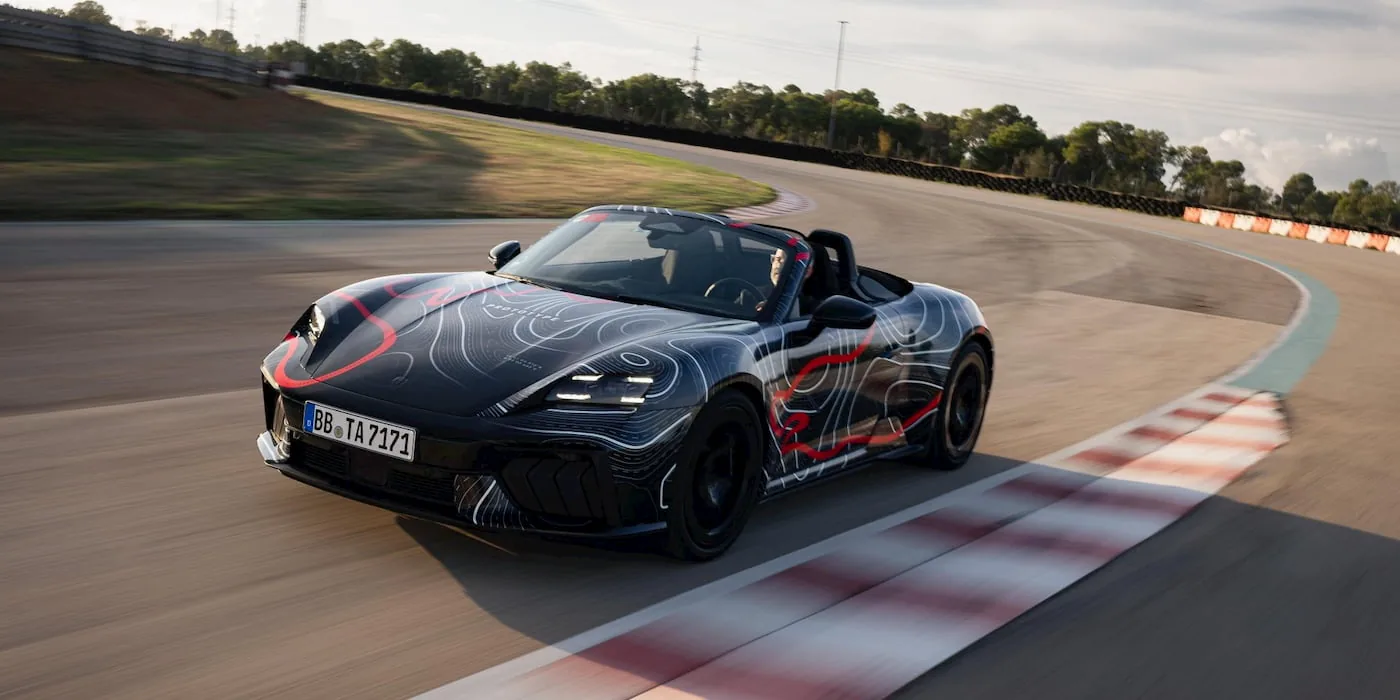
Engineers applied what the company calls intelligent lightweight construction to offset the weight of the high-voltage electrical system. Through optimized materials and shared parts, the overall curb weight of the upcoming electric roadster matches that of the current 911 Cabriolet fitted with the T-Hybrid powertrain. “Our engineers have succeeded in transferring the Boxster’s unique concept to the electric world, further enhancing it in the process,” Leiters said in reporting shared by Electrek [1].
Boxster EV Powertrain and Virtual Shifting
All entry and mid-tier electric Boxster models will send power to the rear wheels through a single rear-mounted electric motor. Outlets including Car and Driver, Motor1, and The Drive noted that this top Boxster EV will become the most powerful 718 model the factory has ever built, accelerating from zero to 100 km/h in under 3.0 seconds and reaching a top speed over 250 km/h (155 mph) [3].
To satisfy drivers who worry that electric cars feel detached, Porsche created a virtual transmission feature called E-Shift, which comes standard on every version of the roadster. Drivers activate the feature using a dedicated control switch mounted on the steering rim, which interrupts motor torque and plays synthesized cabin sounds to replicate the gear shifts of a seven-speed dual-clutch PDK gearbox. The system functions much like the virtual shift systems found in the Hyundai IONIQ 5 N and IONIQ 6 N, providing crisp shift jolts during aggressive driving so track drivers can time their braking points by ear. It gives the motor mechanical character [1].
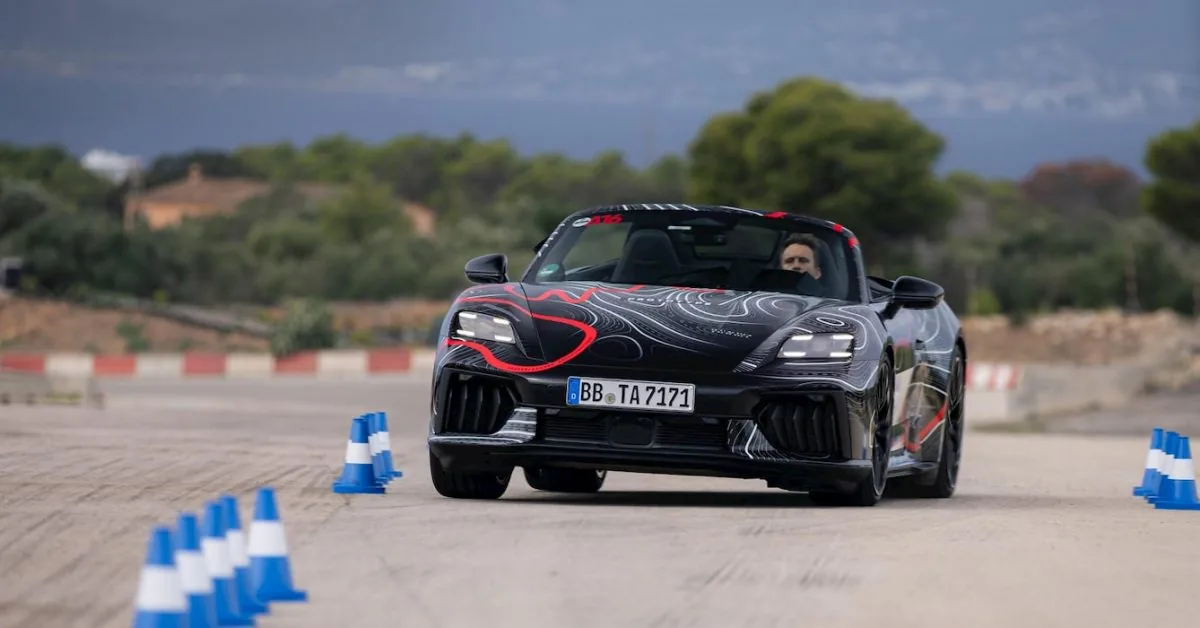
When drivers turn off E-Shift, the steering-wheel paddles control regenerative braking instead of changing virtual gears. Drivers can toggle between three distinct levels of energy recovery, switching between an open sailing mode and stronger deceleration that captures kinetic energy to charge the battery. This flexibility lets the driver adapt the car instantly for highway cruising or steep downhill canyon runs [1].
Global Climate Trials in Sweden and Death Valley
Before clearing the roadster for customer release, Porsche put development prototypes through an extensive testing program across four continents. Test teams logged more than four million test kilometers across twenty countries to evaluate high-voltage electronics and cooling hardware under harsh conditions. The program included winter testing in Sweden and hot desert runs in the United States [3].
During cold-weather testing in northern Sweden, engineers operated prototypes on hard-packed snow and lake ice in temperatures reaching minus 30 degrees Celsius to evaluate battery warming systems and low-traction stability controls. At the opposite environmental extreme, the same mechanical platforms endured brutal desert heat in Death Valley, California, where ambient air temperatures reached 51 degrees Celsius. These hot-weather trials confirmed that the car’s liquid cooling systems prevent battery overheating during sustained high-speed driving. The cooling circuits maintained steady charging speeds even when ambient temperatures pushed prototype components to their design limits [3].
The validation program also tested the electric sports car across varied altitudes and charging networks. Test crews drove prototypes from deep desert basins located 86 meters below sea level to mountain roads reaching 2,750 meters above sea level, while assessing compatibility across five different international charging standards. French automotive outlet Caradisiac reported that prototypes also completed handling evaluations on the asphalt of the Majorca circuit in Spain [3].
Boxster EV Production in Stuttgart-Zuffenhausen
The new roadster arrives after Porsche removed the gas-powered 718 Boxster and 718 Cayman from European showrooms in 2025. European cybersecurity regulations forced Porsche to pull the older combustion platform from key markets, clearing assembly space and speeding up the launch of the battery-powered successor. The transition happened quickly [3].
Production of the roadster will take place at Porsche’s main factory in Stuttgart-Zuffenhausen, where the electric two-seater will share assembly lines with existing sports car models. Peter Johnson of Electrek noted that company leadership expects the electric sports car to win over purists once customer deliveries get underway in 2027. Despite online rumors claiming the program faced cancellation, the recent prototype drive shows that Porsche has completed core development of the battery and chassis layout. With a sprint to 100 km/h in less than three seconds, mid-rear battery packaging, and chassis hardware borrowed from the 911, the Boxster EV is prepared to show that zero-emission roadsters can deliver the driving joy of previous combustion models [1].
- ONLINE NEWS Johnson, P. (2026, November 24). The Porsche Boxster EV is finally almost here, and it will be the most powerful 718 yet. Electrek. [Article Link]
- ONLINE NEWS Ars Technica. (2026, November). Porsche 718 Boxster prototype drive: This electric roadster is real. Ars Technica. [Article Link]
- ONLINE NEWS NewsCord. (2026, November 24). Porsche’s electric 718 Boxster prototype development enters final stretch ahead of 2027 reveal. NewsCord. [Article Link]


