





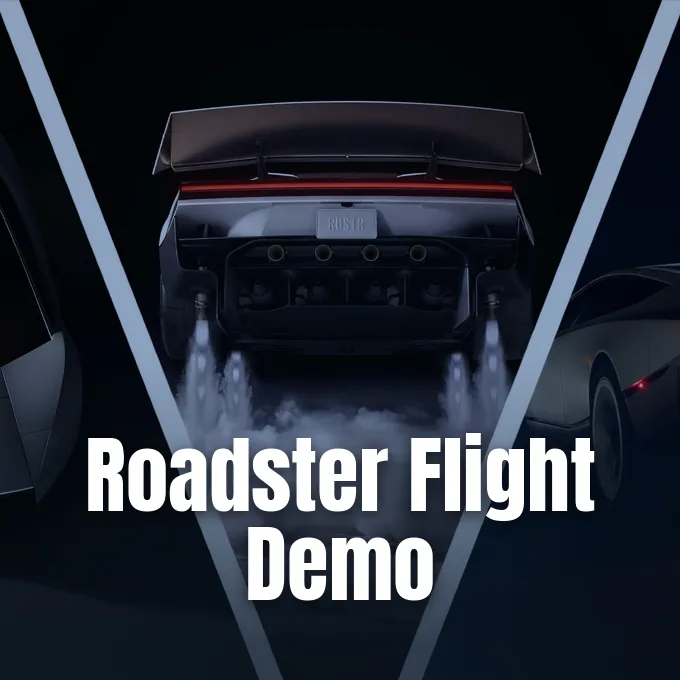
Tesla unveiled its second-generation sports car on Thursday night in Waco, Texas, demonstrating vertical wall climbs, rapid runway launches, and midair flips over rows of parked electric vehicles. The long-delayed Tesla Roadster demo featured cold-gas thrusters developed with engineers from SpaceX and an underbody fan system designed to stick the vehicle to road surfaces [3]. While the show drew attention on X, the prototype shown on stage differs from a showroom car [4]. Tesla chief executive Elon Musk said customer deliveries won’t happen before 2028, and the flight package won’t be street-legal [2].
Aerial Barrel Rolls and Wall Climbs
The Waco presentation opened with an angular coupe driving up a curved ramp to stop vertically against a wall, held in place by underbody suction fans. Tesla Vice President of Engineering Lars Moravy said the underbody system produces up to 2Gs of downforce, allowing the car to hold fast against steep angles. “This car could suck the chrome off a trailer hitch,” Elon Musk said in Texas [3].
Moments later, the vehicle drove inverted along a track and launched into the air to complete what Musk called a midair kickflip before landing on its wheels with help from downward cold-gas nozzles [4]. The prototype jumped directly over a Cybertruck and a Tesla Semi parked on the staging floor [1]. TechRadar reporter Lance Ulanoff watched videos of the airborne hop, while CNET reviewer Antuan Goodwin observed that the test car carried completely dark windows [2]. While the stunt drew cheers, observers noted that the Tesla Roadster demo vehicle looked far from production-ready. It lacked passenger seats, steering hardware, or cockpit instrumentation. Tesla engineers operated the machine by remote control, stripping out cabin mass to pull off the jump [3]. The display showed that rocket thrusters can push a car upward, but it didn’t prove buyers can drive one [4].
Tesla first introduced the coupe in 2017, targeting a 2020 arrival date that slipped repeatedly as Musk prioritized the Model 3, robotics, and robotaxis. A recent Tesla Roadster delay shifted the public demo to mid-October. In 2017, Tesla promised a 1.9-second launch to 60 mph and 620 miles of range. The new prototype abandoned those curves for sharp Cybertruck-style styling and rocket tanks [3]. It’s pure spectacle [4].
How the Tesla Roadster Demo Uses SpaceX Thrusters
Under the chassis, four electric fans create a low-pressure zone that pulls the car toward the pavement, sealed off by adjustable side skirts to prevent outside air from leaking inside. The fan setup consumes 80 kilowatts of power just to pull the vehicle down. Tesla claims this mechanism produces 4,700 kilograms of downforce on a coupe that weighs roughly 1,700 kilograms. That’s an unusual downforce ratio [5].
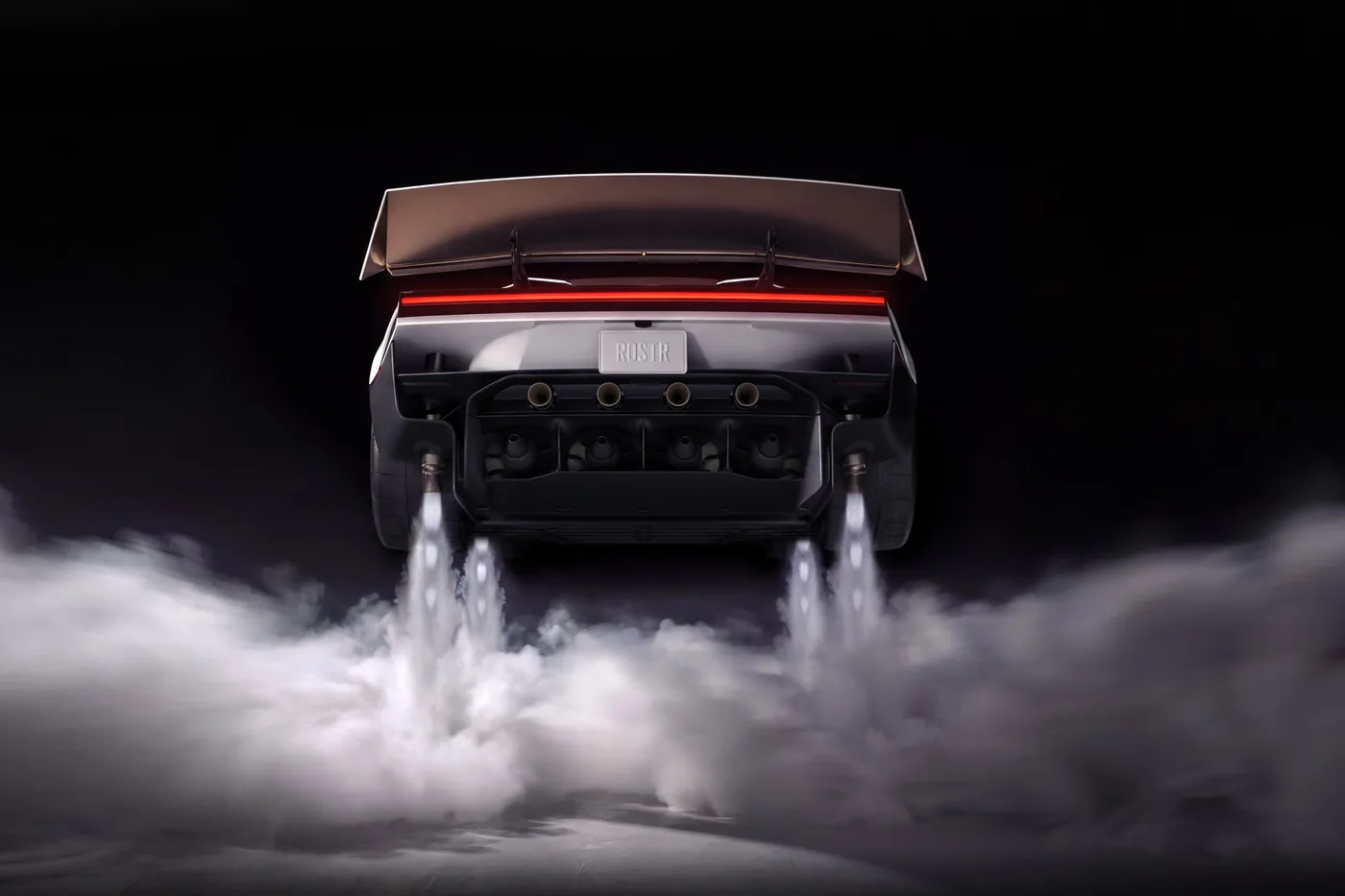
To leap off ramps, the top Rocket model replaces its passenger seat with high-pressure storage equipment. The car carries two separate tanks holding 200 liters and 400 liters, providing 600 liters of compressed air for short bursts of thrust without relying on traditional chemical propellants [4]. Ten cold-gas nozzles sit around the exterior body, including downward thrusters placed at each corner and two front thrusters designed to control vehicle yaw during flight maneuvers. Electrek writer Jameson Dow pointed out that these nozzles release cold gas at high velocity to produce 80 kilonewtons of rear force without burning any liquid rocket fuel [5]. The system relies on SpaceX space technology [3].
While fans add grip by pressing rubber into the pavement, thrusters that push the vehicle upward hurt tire traction. Pushing gas toward the ground lifts vehicle mass off the road, which reduces tire contact and hurts handling. By shooting compressed gas outward during a tight turn, side thrusters can generate lateral acceleration without relying on tire grip, though vertical jumps offer no real handling benefit on track. They won’t help on track [5].


Track Records and Competing Hypercars
Tesla made bold acceleration claims during the presentation, stating the car reached sixty miles per hour in 0.81 seconds during a live acceleration run on stage, following earlier technical glitches with the timing equipment. Tesla later claimed the top Rocket model hits 60 mph in 0.55 seconds with all systems active. That figure uses a one-foot rollout. The base Performance model takes 1.6 seconds [5].
The electric hypercar landscape changed while Tesla spent nearly a decade refining its prototype, as rival automakers shipped track-ready performance cars with verified speed achievements [4]. The Rimac Nevera R reached 300 km/h a full 3.5 seconds faster than a Bugatti Chiron Super Sport [5]. China’s BYD built the Yangwang U9 Xtreme, which uses four electric motors to generate 3,000 horsepower in closed testing. McMurtry’s Spéirling fan car also drove inverted while setting a 0-60 mph benchmark of 1.35 seconds [4]. Other makers proved electric performance on real tracks, including the Xiaomi SU7 Ultra and the Porsche Taycan at the Nürburgring, as well as the track-focused Lotus Evija X [5].
McMurtry’s Spéirling weighs around 1,000 kilograms and pulls 2,000 kilograms of downforce through its fans to achieve high cornering grip. Tesla claims its heavier car corners at over 2G, though the Spéirling pulls up to 3 lateral Gs on track. Standard sports cars usually manage between 1.0 and 1.2 lateral Gs [5]. Following the Tesla Roadster demo in Texas, Tesla asserted that thrusters allow track domination, but competitors are already shipping finished machines to buyers [4].

Delivery Delays for the Tesla Roadster Demo Package
Despite the high-speed maneuvers on stage, basic commercial details remained missing from the presentation. Tesla didn’t announce final pricing, battery pack capacities, or updated curb weights [3]. The company previously targeted a 600-mile driving range in 2017, but newer estimates suggest that number dropped to around 300 miles. A previous plan for a second-generation Roadster reveal aimed at rapid manufacturing, yet the automaker moved production to 2028, leaving buyers waiting [4].
Buyers interested in reserving a car must hand over significant money upfront. The deposit costs $50,000 on the Tesla reservation page [3]. The company outlined three trims: Performance, Thrust, and Rocket. The Thrust model carries a 200-liter air tank, while the Rocket model adds the full 600-liter system by removing the second seat [5]. The top Rocket version will be sold on an invite-only basis. Most reservation holders won’t have access to the flight package [3].
Road legality creates an even steeper barrier for the rocket-equipped machine. Musk admitted the thruster package isn’t expected to receive approval for public street use. Storing 600 liters of air under extreme pressure inside a passenger vehicle raises serious safety concerns regarding how those high-pressure tanks would hold up during traffic collisions [2]. Staged during the Tesla Roadster demo, the prototype functions as an impressive engineering stunt rather than a usable road car. Andrew J Hawkins observed in The Verge that Musk acknowledged the coupe won’t change Tesla’s financial bottom line, especially as the brand focuses on mass production of the Model Y and autonomous robotaxis [4].

Alef Flying Car Competition
As Tesla shared footage of its Texas demonstration, flying car startup Alef Aeronautics fired back with a video stunt of its own. In San Mateo, California, Alef published clips showing its electric Model A taking off vertically and flying directly over an older Tesla Roadster. Alef said the flight marked its 1,000th logged test. “Welcome Tesla to the flying car race, we’ve been here alone for eleven years,” Alef CEO Jim Dukhovny said in a press release [1].
While both companies share early venture capital funding from investor Tim Draper, their vehicles use very different engineering approaches to achieve flight off the ground. Tesla relies on compressed cold gas to toss a heavy coupe into short ballistic arcs. Alef relies on distributed electric propulsion, using internal spinning fans housed within a mesh body that tilts sideways to function as an airplane wing during forward flight [1]. Peter Johnson reported for Electrek that Alef’s vehicle drives on standard roads and lifts off vertically without needing rocket nozzles or high-pressure air tanks. It carries a ballistic parachute [6].
Alef earned an FAA Special Airworthiness Certification in 2023, making its Model A the first true flying car recognized by United States aviation authorities, while Tesla has not begun FAA Type Certification [1] [6]. Alef claims more than 3,600 preorders for the Model A, which lists for $299,999 and requires a $150 deposit. The startup plans to deliver test units to select early buyers by late 2026 before ramping up commercial output in 2027 from its manufacturing facility in Silicon Valley [1] [6]. While Tesla treats flight as a promotional spectacle, Alef is trying to build a certified aircraft [4].
- ONLINE NEWS Gil, B. (2026, October 16). Alef Trolls Tesla With Video of Its Car Flying Over a Roadster. Gizmodo. [Article Link]
- ONLINE NEWS Ulanoff, L. (2026, October 16). I waited so long for this flying Tesla Roadster that I lost all faith in Elon Musk. TechRadar. [Article Link]
- ONLINE NEWS Goodwin, A. (2026, October 16). Tesla Roadster Fires Up SpaceX Tech for ‘Flying Car’ Demo. CNET. [Article Link]
- ONLINE NEWS Hawkins, A. J. (2026, October 16). The incredible flying Tesla Roadster is just for show. The Verge. [Article Link]
- ONLINE NEWS Dow, J. (2026, October 15). Are Tesla’s claims for its new ‘flying’ Roadster real, or is it just full of cold gas? Electrek. [Article Link]
- ONLINE NEWS Johnson, P. (2026, October 15). Alef welcomes Tesla to the electric flying car race by flying over the Roadster [Video]. Electrek. [Article Link]


