





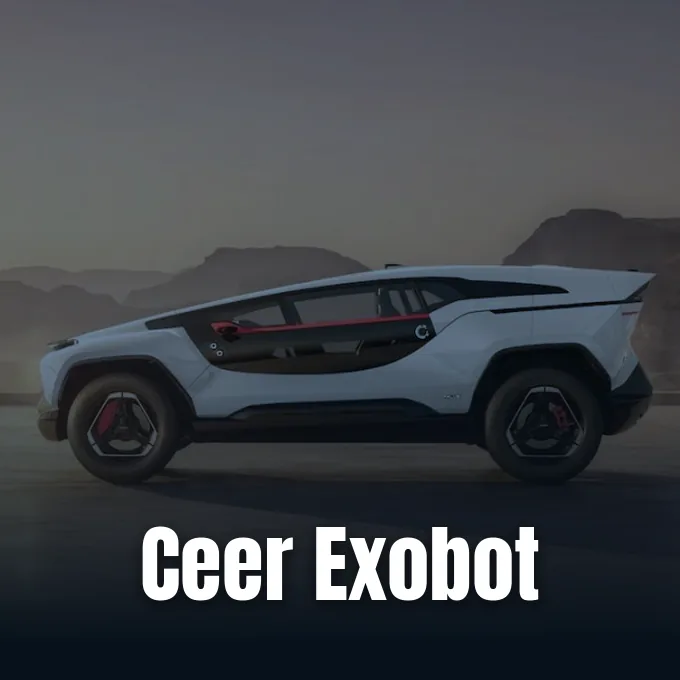
Saudi Arabia’s sovereign wealth fund has pulled the sheet off a pair of hyper-angular electric show cars, aiming to turn an oil kingdom into an industrial manufacturing powerhouse. Crown Prince Mohammed bin Salman, serving as Prime Minister and Chairman of the Public Investment Fund (PIF), officially unveiled the Ceer Exobot electric sedan and SUV on Monday [2]. The enterprise, established as a joint venture with Taiwanese contract manufacturer Foxconn, marks the nation’s first homegrown automotive brand. Both flagship production models are scheduled to reach domestic buyers in 2027 [1].
Ceer Exobot Unveils Radical Sci-Fi Styling
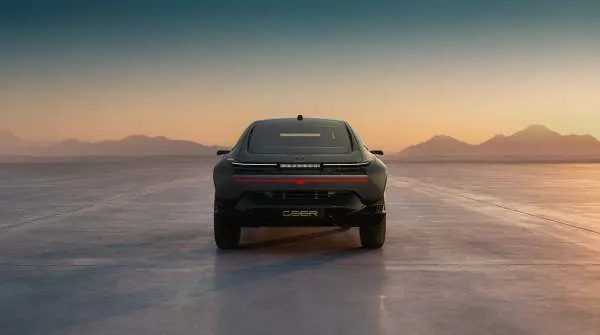
Low-slung supercar proportions define the sedan, pairing a steeply raked windshield that sweeps seamlessly into the hood with a razor-thin, full-width LED light bar set above a sharp forward snout. The styling echoes polarizing two-tone bodywork showcased on the electric Ferrari Luce. Rob Melville designed both vehicles, while Crown Prince Mohammed bin Salman held final design approval [1].
The SUV adopts an armor-plated cyberpunk stance with high ground clearance, sharp angular creases, and a flat tactical roofline reminiscent of cinematic hardware from Blade Runner. Engineers equipped the sport utility vehicle with dramatic upward-opening gullwing passenger doors that directly recall the Tesla Model X alongside historic automotive icons like the classic DeLorean [1]. Earlier this year, automotive spotters photographed a camouflaged prototype testing on European roads that closely resembled a compact Tesla Cybertruck with aggressive proportions [2].
Ceer Exobot styling deliberately courts spectacle. In an attention-driven global market, these wedge-like silhouettes command immediate public attention [1].
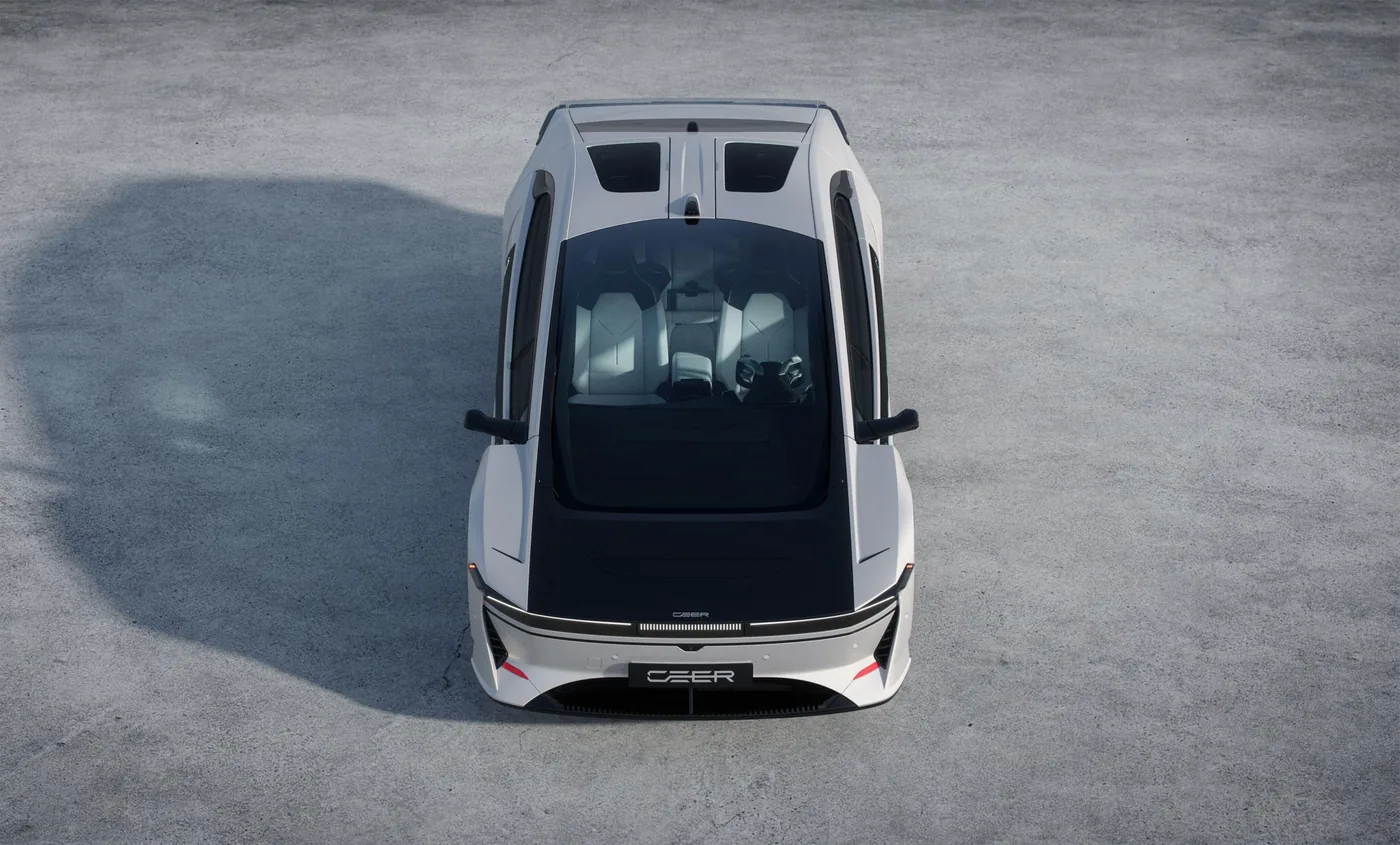
Both production models prioritize exterior visual impact to differentiate the nascent Saudi brand against established luxury manufacturers across global showrooms. Melville previously led design at McLaren. His design team sculpted wide wheel arches and tapered rear aerodynamic profiles to balance wind resistance against imposing road presence across varied driving environments [1].
Performance Specs and Powertrain Architecture
Underneath the angular body panels, the Ceer Exobot SUV carries advanced mechanical running gear specifically engineered to challenge elite international electric vehicle brands across performance categories. A dual-motor all-wheel-drive powertrain generates a combined 850 horsepower (625 kW), launching the heavy sport utility vehicle from 0 to 100 km/h (0 to 62 mph) in 2.6 seconds. Energy flows from a 112 kWh high-capacity battery pack, providing an estimated NEDC driving range of up to 560 km (448 miles) on a single charging cycle. An advanced 800-volt battery architecture enables high-speed DC charging from 10 percent to 80 percent in 30 minutes, minimizing charging downtime on long highway journeys [2].
The Ceer Exobot chassis incorporates steer-by-wire mechanics, an aircraft-inspired steering yoke, active rear-wheel steering, and an adaptive dual-chamber air suspension system. The battery pack holds 112 kWh [2]. Drive modes adapt automatically.
The electric sedan matches the SUV’s 850 horsepower output and 2.6-second acceleration time while extending total driving range up to 670 km under NEDC testing protocols. Both vehicles share a 3,200 mm wheelbase. The sedan measures 5,260 mm in length, 2,102 mm in width, and 1,428 mm in height, whereas the SUV stands 1,693 mm tall across a 5,016 mm body. Inside the cabin, drivers face a 48-inch curved Digital Horizon display stretching pillar to pillar, supported by 3D Navigation, a camera-based mirror system, and custom voice assistant software [2].


Ceer EVs Anchor Saudi Industrial Diversification
The rollout of Ceer EVs functions as an anchor pillar for Saudi Arabia’s broader Vision 2030 economic restructuring initiative. The kingdom wants to diversify its domestic economy away from petroleum extraction by expanding non-oil exports past 50 percent of non-oil GDP and generating half its electric power from renewable sources. Regional sovereign funds similarly back major infrastructure, including Boring Company tunnel projects supported by UAE funding. Ceer is projected to contribute roughly $8 billion (over SAR 30 billion) to Saudi gross domestic product by 2034 [2].
The Exobot SUV and sedan represent merely the initial opening salvo of a much wider long-term commercial push across multiple high-volume global vehicle segments [1]. Ceer plans to introduce seven distinct vehicles over the next five years, expanding its catalog from compact runabouts to midsize family crossovers [2]. By 2030, the company intends to launch five additional models to populate key volume categories across international markets [1].
Both flagship models arrive in 2027. The domestic launch schedule gives engineers ample time to validate cooling and battery efficiency under extreme desert temperatures [1].
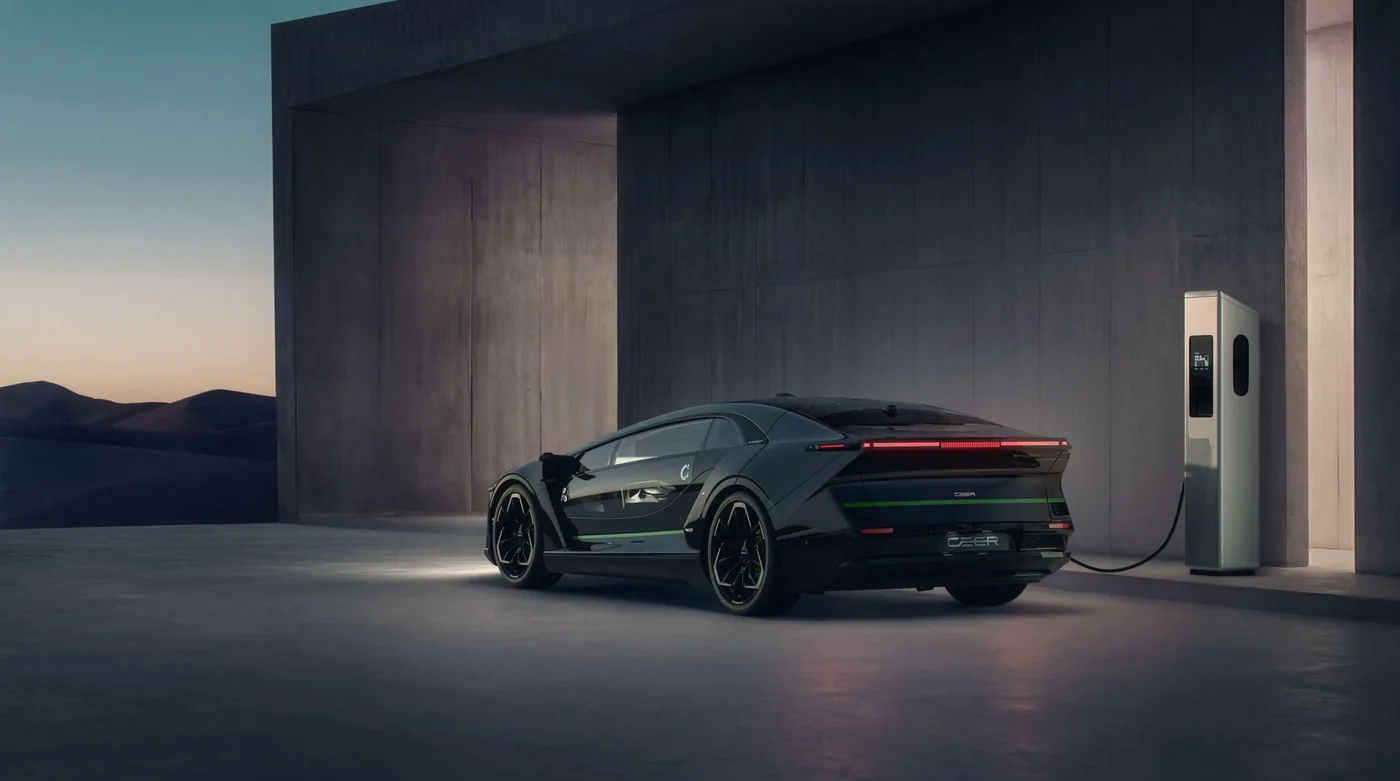
Propulsion will not remain strictly electric across every forthcoming model tier. Subsequent releases will incorporate hybrid and internal combustion drivetrains to match differing consumer demands across developing export territories. Ceer Exobot engineering adapts to market realities [1].
Western Automotive Veterans Lead Engineering Operations
To translate hyper-futuristic concept styling into street-legal production hardware for the Ceer Exobot lineup, Ceer turned to seasoned international automotive executives with extensive manufacturing backgrounds. Chief Executive Officer Jim DeLuca spent 37 years at General Motors, culminating his Detroit career as executive vice president for global manufacturing before taking the helm at Ceer. “We wanted to make sure the world could see what Saudi Arabia is capable of,” DeLuca told Reuters [1]. DeLuca brings veteran leadership.
Engineering integration depends heavily on established international component suppliers rather than purely domestic fabrication. In June 2024, Ceer signed a major technical supply agreement with Hyundai Transys to incorporate integrated three-in-one electric drive systems into upcoming production models. Ceer later partnered with Croatian manufacturer Rimac for high-performance drive hardware. Rimac supplies specialized drive systems [2].
Assembly will take place at the newly built Ceer Manufacturing Complex, situated within King Abdullah Economic City along the Red Sea coast [1, 2]. The automaker described the CMC facility as “the largest automotive production facility in the Middle East and one of the most technologically advanced in the world”. Ceer stated that upcoming vehicles are developed “according to the highest global standards, further strengthening Saudi Arabia’s position as a rising force in the global automotive industry”. Commercial releases will begin with a Limited Launch Edition of the SUV, followed by a fully customizable Plus trim [2].
Manufacturing Ambitions and Commercial Hurdles
Can a nation built on oil revenues successfully transform itself into a competitive exporter of electric vehicles? Launching an automotive brand from scratch represents an unforgiving, capital-intensive manufacturing challenge with a historically high casualty rate. Western markets have recently witnessed well-funded electric startups like Fisker, Lordstown Motors, and Arrival collapse into bankruptcy under punishing production ramp costs. Even California-based Lucid Motors, in which Saudi Arabia’s PIF holds a controlling stake while constructing a local assembly site in King Abdullah Economic City, continues to burn considerable cash [1].
Historical precedent in the Arabian Peninsula illustrates the difficulty of establishing localized vehicle manufacturing plants. A planned Jaguar Land Rover factory stalled out a decade ago. Toyota declined in 2019 [1].
Market timing introduces intense commercial pressure as aggressive Chinese electric vehicle exporters rapidly expand their international market share across high-growth consumer territories in Asia, Europe, and South America. Steep North American tariffs isolate domestic consumers from inexpensive foreign electric models. Whether the Ceer Exobot lineup can successfully manufacture, export, and sell luxury vehicles in volume will test the kingdom’s immense financial reserves against brutal industrial realities [1].
- ONLINE NEWS Hawkins, A. J. (2026, September 22). Saudi Arabia’s new Exobot EVs make the Cybertruck look normal. The Verge. [Article Link]
- ONLINE NEWS Johnson, P. (2026, September 21). Ceer unveils its EXOBOT EVs, Saudi Arabia’s first electric SUV and sedan. Electrek. [Article Link]
- ONLINE NEWS Ars Technica. (2026, September). Saudi Arabia wants a car industry, launches Ceer with two EVs. [Article Link]


