



The CAP theorem states that a multi-node data system cannot promise consistency, uptime, and split tolerance at once during network faults [1]. Computer scientist Eric Brewer first framed this principle in 2000 while working with UC Berkeley and Inktomi Corporation [2]. When physical server links snap, engineering teams must pick between returning stale data or rejecting incoming queries to protect correctness, because network partitions make simultaneous guarantees impossible [1].
What the CAP Theorem States
Eric Brewer presented his conjecture in July 2000 during a keynote at the ACM Symposium on Principles of Distributed Computing [2]. Two years later, researchers Seth Gilbert and Nancy Lynch at MIT published a mathematical proof in ACM SIGACT News that validated the idea, turning Brewer’s conjecture into a formal theorem. The theorem outlines three system properties: consistency, availability, and partition tolerance. Distributed networks store data over multiple servers, and the CAP theorem models how those nodes behave when links fail. Gilbert and Lynch proved the theorem for asynchronous networks in 2002 [1].
Within this model, consistency requires that every read request returns the newest write or an explicit error response [1]. Clients must see identical state everywhere. To preserve consistency, any write accepted by primary database DB1 must copy to replica DB2 before the cluster confirms success, ensuring that an account holder transferring 200 rupees from a 500 rupee balance sees 300 rupees reflected on both DB1 and DB2 [7]. If background sync lags between DB1 and DB2, the cluster exposes conflicting balances [1]. Replicas must agree.
Meanwhile, availability requires that every healthy node returns a valid response for every incoming query without timing out. The response does not need to contain the latest update, but the server cannot reject the client call. Partition tolerance means the cluster keeps working even when physical network links drop, delay, or discard arbitrary messages passing between individual servers [1]. Network cables inevitably suffer faults [2].
Why Network Partitions Cannot Be Avoided
A network partition happens when communication between servers breaks down because of hardware cuts, switch bugs, or cloud outages. Cloud provider Amazon once saw a rodent chew through a datacenter fiber cable, dropping internal connectivity. When links fail between server groups, nodes on one side cannot exchange heartbeat pings or replication logs with machines on the other side, leaving isolated servers to process operations without cluster consensus [4].
Many software tutorials present the CAP theorem as a three-way menu where developers pick any two properties at will. But distributed systems researchers stress that partition tolerance is never optional, because physical networks span real-world switches, routers, and fiber lines that inevitably suffer packet loss and severed links [1, 4]. Fiber cables get cut. When an ATM network links servers in Mumbai and Delhi, an underground cable failure between those two hubs forces an immediate partition [7]. Software attempting to forfeit partition tolerance simply crashes during network disconnections [6].
Because network hardware is fallible, the actual engineering decision during an outage is binary: choose consistency or availability. When network hardware runs smoothly and latency stays low, distributed databases like MySQL and PostgreSQL provide both strong data sync and high uptime together [2, 4]. Brewer’s model only applies when communication breaks, forcing systems to pick either consistency or availability during an active network split [2].
Comparing CP and AP System Designs
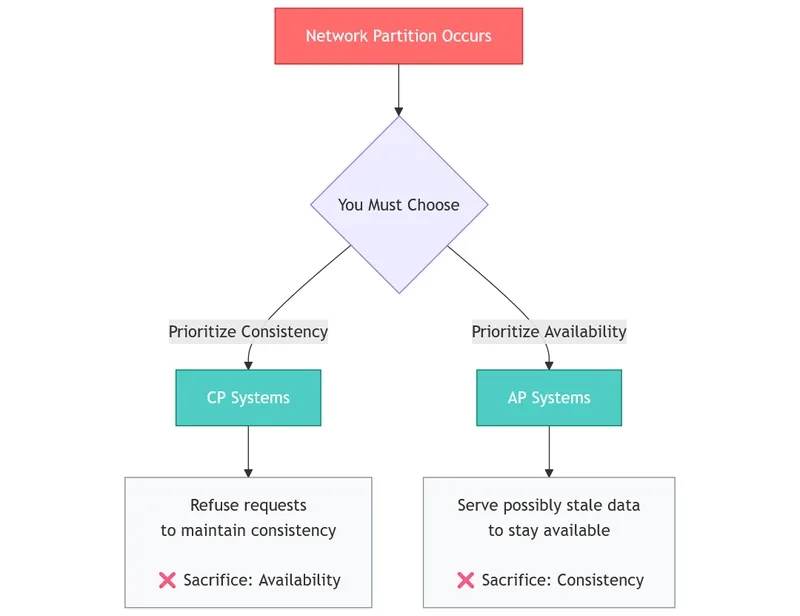
When a network cut divides a cluster, data stores choose between two strategies: CP or AP. A CP design preserves consistency and split tolerance while sacrificing uptime [1, 4]. If a partitioned node cannot reach peer servers to verify recent updates, it returns an error or times out. Systems like Apache HBase, ZooKeeper, and etcd adopt this model [4, 7]. For instance, Kubernetes relies on etcd to store cluster configuration, and if etcd cannot reach a node quorum, it rejects kubectl commands to prevent split-brain state and protect cluster correctness [4].
Conversely, an AP design chooses uptime and split tolerance over immediate data sync [1, 4]. Nodes continue serving read and write requests from local clients even while link breaks block inter-server sync. Users may read stale records or submit conflicting updates across different nodes [4]. Apache Cassandra, CouchDB, and Riak use this model [7, 8]. When the partition heals, these systems resolve divergent records using timestamps, vector clocks, or background repair routines [2, 7].
Engineering teams choose between CP and AP based on the business penalty of data errors versus the cost of downtime. Financial ledgers, stock trading systems, and ticket booking platforms favor CP designs because booking the same concert seat twice produces direct losses [7, 8]. If two passengers reserve the last train seat on conflicting nodes during a network fault, a CP database rejects one request rather than over-selling the ticket [7]. In contrast, social platforms like Twitter and review sites like Yelp prioritize continuous availability, recognizing that showing slightly outdated follower counts is far better than presenting users with an HTTP 500 error screen [4, 8].
Linearizability as the Consistency Standard
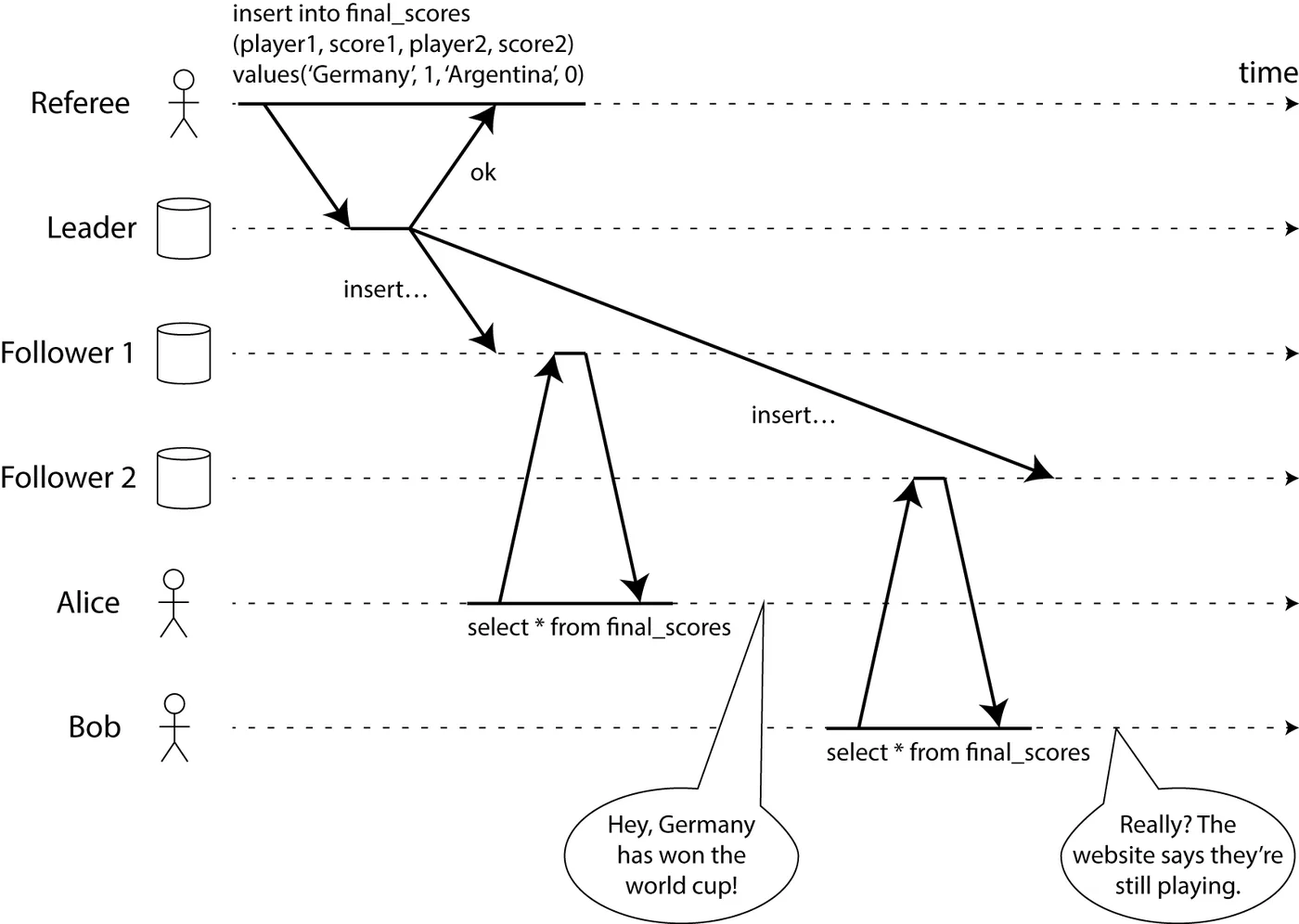
Much confusion stems from comparing consistency in Brewer’s theorem with the consistency term in ACID database transactions [2, 3]. In ACID systems, consistency means maintaining schema constraints, unique keys, and table relations [2]. But in the CAP theorem, consistency means linearizability or atomic consistency [1, 3]. Linearizability makes a multi-node cluster behave like a single memory register updating in real time with globally ordered operations [3].
Under linearizability, if write task A finishes on any node, every subsequent read task B started anywhere in the cluster must return value A or newer state. In a 2015 study, computer scientist Martin Kleppmann used an example of two friends, Alice and Bob, watching the 2014 World Cup final. Alice refreshes her phone, sees the winning goal posted, and tells Bob across the room. Bob reloads his mobile browser. If Bob’s query hits a lagging replica that still displays zero goals, linearizability fails. Because Bob heard the score through an outside audio channel, he expects his query to reflect Alice’s completed write. Kleppmann showed that linearizability needs expensive network coordination across server nodes [3].
Kleppmann released this paper as an unrefereed preprint on arXiv, arguing that linearizability is often too narrow for evaluating real systems [3]. Multi-node data stores frequently adopt weaker models like causal consistency, read-your-writes consistency, or eventual consistency [7, 8]. Amazon DynamoDB allows developers to select strongly consistent reads or eventually consistent reads on a per-request basis to balance latency against data freshness [4, 7].

The Myth of Network CA Systems
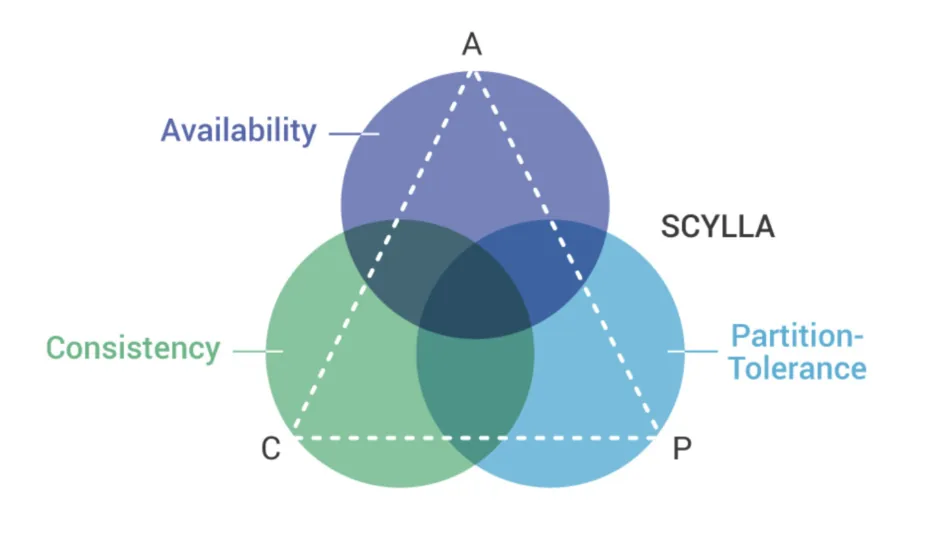
Many textbook diagrams show the CAP theorem as a triangle with three corners: CP, AP, and CA [6, 7]. A hypothetical CA system promises consistency and continuous uptime by giving up split tolerance [1, 4]. Under this model, every query receives a quick and accurate response, but the cluster supposedly lacks any defense against network partitions. In practice, this design cannot exist in distributed environments [2, 4].
Distributed systems researchers agree that a multi-node CA database is impossible [2, 4]. To keep consistency and uptime without handling network partitions, inter-node communication would need to remain completely flawless forever. Physical hardware cannot offer this guarantee because switches drop packets and optical cables fail [4]. If a cluster claiming CA features encounters a network break, it must either reject operations or return stale data, turning into a CP or AP system on the spot because CA cannot survive partitions [2, 11].
Single-node databases like standalone MySQL, SQLite, or PostgreSQL deployments on a single physical server are often labeled CA systems because all transactions run locally on one machine without network splits [2, 7]. A single server eliminates network partitions. But a single host cannot scale horizontally across server clusters, leaving the entire database vulnerable to catastrophic hardware crashes [2, 4]. Yale University professor Daniel Abadi observed that calling single-node setups CA obscures the architectural challenges facing true multi-node systems [11]. Furthermore, researchers Birman and Friedman proved in 1996 that non-commuting operations cannot remain available during network partitions, establishing that distributed architectures cannot ignore partition tolerance [6].

Why the CAP Theorem Needed PACELC
In 2010, computer scientist Daniel Abadi at Yale University argued that the CAP theorem provides an incomplete guide for distributed data stores [11]. Network splits are rare in modern datacenters, meaning databases spend over 99 percent of their operating life in a normal, unpartitioned state [2, 7]. Yet even when networks run cleanly, systems face an ongoing trade-off between latency and data sync. Passing replication messages across distant nodes adds round-trip delays that slow down user operations, making latency a dominant concern during daily runtime [11].
To address this daily tension, Abadi formulated the PACELC theorem. The model states: if there is a Partition (P), trade off Availability (A) versus Consistency (C); Else (E), when running normally, trade off Latency (L) versus Consistency (C) [9, 11]. Under PACELC, databases that pick availability during network splits often pick low latency during normal operation. For example, Amazon DynamoDB, Apache Cassandra, and ScyllaDB are PA/EL systems because they minimize response latency during routine traffic and keep serving requests when network cuts hit. They sacrifice strong consistency to gain speed and uptime [9, 11].
In contrast, databases like Apache HBase and Google Cloud Spanner follow a PC/EC profile, preserving consistency during partitions and accepting higher latency during routine sync [7, 11]. Abadi and his Yale student Alex Thomson highlighted Yahoo PNUTS, commercially named Sherpa, as a rare PC/EL system. PNUTS was presented at the ACM SOCC conference, using master records to reduce normal latency while stopping updates if a master replica becomes unreachable during network cuts [11].
Workload Demands in Production Databases
Modern software teams rarely apply CAP labels as permanent, all-or-nothing system mandates [2, 8]. Instead, large web platforms partition their services into functional zones based on business risk [7, 8]. In e-commerce architectures, browsing product catalogs and loading recommendations rely on AP designs where slight replica lag causes no customer friction [4, 7]. When shoppers check out, the system routes orders to CP components so inventory counts update accurately without double-selling stock, using hybrid patterns to balance business risk [7, 8].
In high-concurrency financial settlements, ledger correctness is a strict regulatory requirement [8, 12]. In a 2026 study, researcher K. Sellappan examined international payment clearing systems, explaining that financial networks historically sacrificed availability during partitions to prevent ledger corruption. Sellappan showed that modern payment platforms solve this dilemma by adopting hybrid consistency architectures. By breaking settlement workflows into distinct consistency zones, these platforms run consensus groups for final settlement while letting edge services provide continuous uptime for query lookups. Financial systems isolate critical settlement paths from public inquiry endpoints to satisfy both regulatory compliance and customer responsiveness across global regions [12].

Modern distributed data stores also provide tunable consistency flags for each query [2, 9]. Apache Cassandra lets developers choose between ONE, QUORUM, or ALL replica read settings [4, 9]. Google Cloud Spanner uses hardware atomic clocks via the TrueTime API to guarantee linearizability globally [7]. MongoDB allows replica sets to require majority write acknowledgment for critical user balances while accepting single-node writes for analytics logs, enabling engineers to tune guarantees per request [2, 4].
Brewer’s Theorem in System Recovery
Twelve years after his original PODC address, Eric Brewer published an article in Computer magazine re-evaluating how engineers use the CAP theorem. Brewer explained that the popular “pick two of three” framing was misleading because it treated consistency and uptime as mutually exclusive choices. In reality, production databases do not forfeit consistency or availability continuously; rather, systems provide both properties together during 99 percent of normal operation when network links remain healthy [2].
Brewer argued that distributed systems should focus on explicit partition handling rather than passive surrender. System architects should design a structured three-step lifecycle for network disruptions: detect the partition promptly, enter an explicit partition mode that limits vulnerable writes, and initiate recovery once connectivity heals. During partition mode, an application might disable checkout writes while still allowing users to browse cached inventory records. By controlling which operations run during a link break, the cluster minimizes data divergence while remaining partially available [2]. Cloud architect Marc Brooker noted that this approach is vital in IoT and mobile systems where devices frequently disconnect in elevators or during power cuts [6].
When network links heal, the cluster starts compensation tasks to reconcile state across nodes. Systems use version vectors, conflict-free replicated data types, or compensating transactions to repair ledger divergences [2, 7]. Brewer pointed out that higher-level atomic operations make partition recovery far simpler in production, allowing engineering teams to manage partitions through explicit recovery rather than passive surrender [1, 2].
- ACADEMIC JOURNAL Gilbert, S. L., & Lynch, N. (2012). Perspectives on the CAP Theorem. Computer, 45(2), 30-36. [Article Link]
- ONLINE NEWS Brewer, E. (2012). CAP Twelve Years Later: How the “Rules” Have Changed. InfoQ. [Article Link]
- PREPRINT Kleppmann, M. (2015). A Critique of the CAP Theorem. arXiv. [Article Link]
- WEBSITE Malik, A. (2026). CAP Theorem Explained: Beyond the “Pick Two” Myth. DEV Community. [Article Link]
- WEBSITE Browne, J. (2009). Brewer’s CAP Theorem. Julian Browne. [Article Link]
- WEBSITE Wikipedia contributors. (2026). CAP theorem. Wikipedia, The Free Encyclopedia. [Article Link]
- WEBSITE GeeksforGeeks. (2020). The CAP Theorem in DBMS. GeeksforGeeks. [Article Link]
- WEBSITE King, E. (2025). CAP Theorem for System Design Interviews. Hello Interview. [Article Link]
- WEBSITE ScyllaDB. (2022). CAP Theorem. ScyllaDB. [Article Link]
- WEBSITE IBM. (2022). What Is the CAP Theorem? IBM Think. [Article Link]
- WEBSITE Abadi, D. (2010). Problems with CAP, and Yahoo’s Little Known NoSQL System. DBMS Musings. [Article Link]
- ACADEMIC JOURNAL Sellappan, K. (2026). Bridging the CAP Theorem: Hybrid Data Consistency Models for High-Concurrency International Payment Clearing Systems. Engineering Science and Technology. [Article Link]


