






Google announced on Monday that it is rolling out new artificial intelligence capabilities for Google Maps to help people build travel schedules and manage everyday errands [1]. The update integrates Gemini intelligence into the conversational assistant, Ask Maps, letting travelers generate Google Maps itineraries for single-day outings or multi-day road trips [2]. Beyond basic turn-by-turn navigation, the software organizes sequential stops, checks live road conditions, searches saved personal lists, and even calls local businesses to book service appointments [3]. The features began rolling out on Android and iOS ahead of the winter holiday season, bringing conversational trip generation to more than 200 countries globally [5].
Building Google Maps Itineraries with Gemini
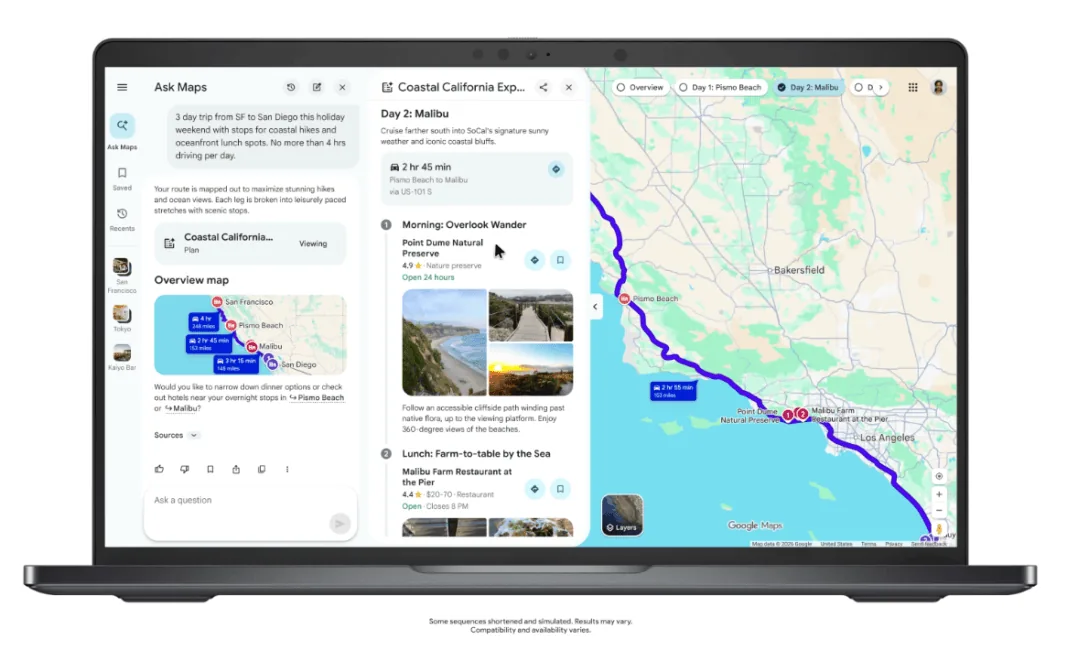
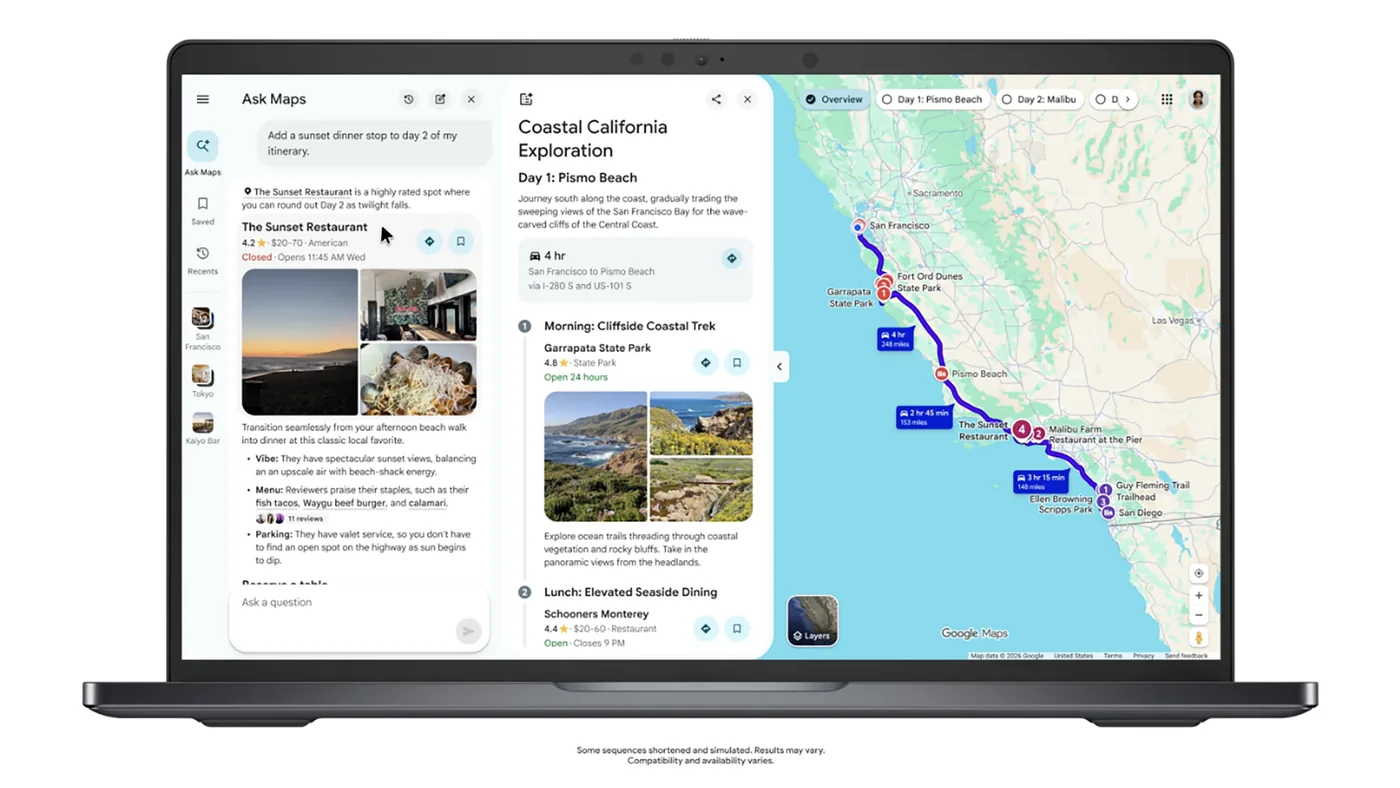
Travelers planning a holiday shopping route or an extended vacation can now ask the navigation service to construct a full schedule from a simple conversational prompt [1]. When someone asks for a three-day road trip with coastal hikes and oceanfront dining, Ask Maps generates a day-by-day itinerary complete with numbered map pins for every scheduled stop along the route [2]. The app arranges the stops in chronological order so drivers don’t have to manually look up separate driving directions between every park, restaurant, and scenic overlook [5]. Google said the system offers insider tips for individual stops, giving visitors practical context about each venue before they arrive [3].
Adjusting a journey while traveling does not force users to wipe their plans and start over [1]. People can ask the assistant to add a scenic viewpoint or a lunch spot along their active route, and the software updates the pins without breaking the broader sequence [3]. Once travelers finish organizing their trip, they can share the plan with family members or export the entire day-by-day schedule to Google Docs on desktop computers [2]. Saved schedules stay accessible inside the app under an “itinerary” badge located in the chat history, making it easy to pull up directions when departure day arrives [5].
For travelers who coordinate stops with family members before departure, Google also built shared spaces for group planning. That collaborative workspace lets groups organize locations together before loading final destinations into their phones. The new itinerary builder takes those ideas further by converting casual suggestions into mapped driving stops with live navigation links [5].
Live Route Details and Road Conditions
When drivers open an active itinerary before hitting the highway, Google Maps itineraries present dynamic data about current driving conditions and upcoming venues [1]. The app displays live traffic slowdowns, current business operating hours, and even details about the “vibe” of a venue so travelers know what atmosphere to expect before stepping inside [3]. Drivers can tap any destination listed in their schedule to launch turn-by-turn navigation without retyping the address [1]. Because these details refresh in real time, motorists can easily tell if an unexpected backup on the highway will delay their arrival at an evening dinner reservation [2].
To help drivers prepare for road challenges before turning on the engine, the app introduces “Know before you go” alerts inside the route preview window [2]. These summaries highlight parking availability near destinations, nearby electric vehicle charging stations, forecasted weather patterns, expected toll fees, and potential traffic bottlenecks [5]. By surfacing parking and charging locations before cars leave the driveway, the update removes the scramble to find open spaces in unfamiliar towns [3]. Google launched these predictive route warnings first for drivers in the United States [6].
Google previously added Gemini CarPlay navigation to vehicles in the United States. Integrating conversational intelligence into car dashboards allows motorists to check real-time road conditions without touching their mobile phones while driving [6]. With new itinerary badges appearing in chat logs, drivers can pull up pre-planned multi-stop routes through in-car interfaces, making holiday road trips smoother and safer [5].


Agentic Calling for Local Appointments
Beyond calculating driving routes, the updated Ask Maps assistant adds agentic capabilities designed to complete practical offline errands for users [1]. Instead of manually browsing directory listings or dialing multiple phone numbers, people can ask Maps to locate open appointment slots for local services [5]. The system searches availability in four specific categories: beauty services, pet care, automotive repair, and home maintenance [3]. If a driver notices a mechanical problem during a road trip, they can instruct the tool to find open auto repair mechanics within a short driving radius [6].
The booking tool also handles communication with store owners by making automated phone calls on behalf of users [1]. For example, a person can submit a prompt like “Find me a 4 p.m. nail appointment near me,” and the AI agent checks neighboring shops before displaying open booking slots on screen [3]. Once the user confirms the details, the software finishes setting up the booking without requiring the customer to wait on hold [7]. TechCrunch reporter Aisha Malik noted that this automated calling system mirrors a broader shift across Silicon Valley, where AI models act as autonomous agents rather than simple chat windows. Meta recently added similar calling tools to its Muse assistant, letting AI agents schedule departmental appointments like visits to the DMV [1].
Appointment finding and automated calling are rolling out initially to users in the United States [2]. Google plans to evaluate user feedback and local merchant interactions before expanding automated merchant phone calls to other global regions [3]. For now, local business owners in the United States receive calls from Google’s automated agent to verify open appointment slots when nearby customers search through Maps [1].
Managing Google Maps Itineraries from Saved Lists
Many Google Maps users keep extensive saved lists containing favorite restaurants, coffee shops, and travel landmarks, but sifting through dozens of bookmarked locations during a busy outing can be cumbersome [3]. The latest update connects Gemini to these personal collections, allowing users to query their bookmarked places using natural conversational speech [5]. Rather than scrolling through map pins manually, travelers can filter their own saved locations based on immediate party size and current table availability [1].
To demonstrate how the feature works when entertaining visitors, Google highlighted a sample prompt: “Which spots saved in my lists have availability for five people in the next 30 minutes?” [3]. When asked, Ask Maps inspects the user’s saved lists, checks live reservation data for nearby venues, and returns matching locations that can accommodate the group right away [5]. This lets hosts quickly find open tables at places they already trust without having to call several restaurants individually or open multiple reservation apps [6].

The saved list search works with Google Maps itineraries, letting travelers drop their favorite saved dining spots into multi-day road trips [2]. If weather conditions change or an afternoon hike finishes early, users can ask Maps to replace an upcoming stop with a highly rated cafe from their saved bookmarks [5]. Because saved list queries are processed against the user’s Google account data, personalized recommendations appear in seconds without disrupting the broader navigation route [1].
Global Rollout and Holiday Travel Trends
Google confirmed that travel itineraries and saved list searches are rolling out globally to all 200 countries and territories where Ask Maps is currently supported [3]. At the same time, the company is expanding Ask Maps availability to 30 countries in Europe, including Germany, Spain, and the United Kingdom [5]. While trip itineraries and list searches are available worldwide, the “Know before you go” route tips and automated appointment bookings remain exclusive to the United States during the initial rollout phase [6].
The update arrives just before peak holiday travel in the United States, where highway congestion regularly snarls family road trips. According to Google travel trend data published by Holly N Jolly, roads are typically quiet on Thanksgiving Day after 12 p.m., making early afternoon the best window to head toward family dinners. Travelers driving long distances face the lightest traffic before 9 a.m. or after 6 p.m. on Wednesday, while Wednesday afternoon between noon and 3 p.m. brings severe congestion. On Black Friday, driving congestion peaks between 11 a.m. and 3 p.m., and returning Sunday drivers can avoid gridlock by departing before noon or after 3 p.m. [4].

Google also tracked seasonal interest surges at popular holiday attractions, showing where road traffic will likely concentrate. Destinations seeing significant spikes include Christmas In The Park in San Jose, the Louisville Mega Cavern in Kentucky, Vitruvian Park near Dallas, and both Wollman Rink and Rockefeller Center in New York. For holiday shoppers running errands around town, Google reported that grocery store lines peak around 2 p.m. on the weekend before Thanksgiving, whereas shopping before 4 p.m. between Monday and Wednesday provides a much calmer experience [4].
- ONLINE NEWS Malik, A. (2026, November 16). Google Maps can now build trip itineraries with real-time details about each stop. TechCrunch. [Article Link]
- ONLINE NEWS Roth, E. (2026, November 16). Google Maps can now create trip itineraries for you. The Verge. [Article Link]
- WEBSITE Khorasani, M. (2026, November 16). New Ask Maps features to help with holiday travel and prep. Google Blog. [Article Link]
- WEBSITE Jolly, H. N. (2026, November 16). Navigate holiday traffic and crowds with Google Maps trends. Google Blog. [Article Link]
- ONLINE NEWS Li, A. (2026, November 16). Google Maps rolling out travel itineraries & list search for Ask Maps. 9to5Google. [Article Link]
- ONLINE NEWS Steele, C. (2026, November 16). Google Maps expands Ask Maps with itineraries, list search, and appointment booking. Android Authority. [Article Link]
- ONLINE NEWS Tim. (2026, November 16). Google Maps Gets New AI Features: Detailed Trip Itineraries, Agentic Capabilities. Droid Life. [Article Link]


