





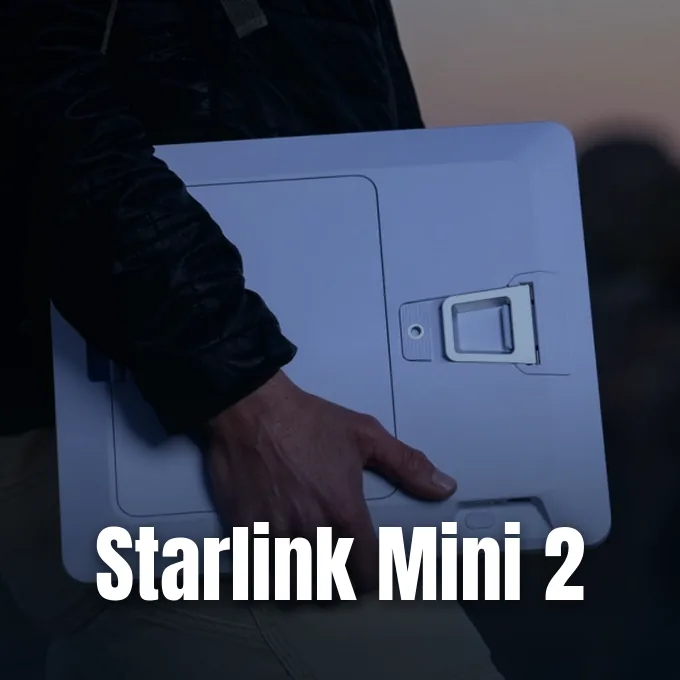
SpaceX announced Starlink Mini 2 on November 10, 2026, adding a built-in swappable battery to its compact satellite internet terminal. The new dish integrates satellite reception, a Wi-Fi router, and swappable power storage into a single compact device about the size of a standard laptop [1]. Early hardware details emerged after invited customers shared order screens online. The updated terminal cuts down overall depth while operating without an external power cable [2].
A Thinner Starlink Mini 2 Dish
SpaceX redesigned the dish casing so that the entire assembly measures only 23.1mm thick, which is noticeably slimmer than the original version. The previous Starlink Mini measured 38.5mm, so SpaceX managed to shave off substantial depth by consolidating the circuit board and antenna array into a single enclosure. That reduction in depth helps travelers slide Starlink Mini 2 into regular backpack compartments without dealing with awkward protrusions. The integrated battery pack increases total weight to roughly 3.5 pounds. That extra mass makes it slightly heavier in the hand than its lighter predecessor, but the unit still retains the general proportions of an ordinary laptop computer so travelers can slip it into standard carrying bags without difficulty [2].
The main appeal of this redesign centers on self-contained portability. Earlier portable setups pushed users to carry separate power packs or stay plugged into vehicle ports just to keep the antenna running [1]. Starlink Mini 2 removes that friction by housing the battery, dish, and Wi-Fi router in a single device.
The Verge reporter Andrew Liszewski explains that the updated casing preserves the clean lines of the Mini family while reworking the rear layout to accommodate the power cell [2]. Invited US customers who ordered the device confirmed that the hardware looks like a sleek slate. Mobile teams can place the terminal on an open table or vehicle hood to start browsing without routing cables through car windows [1]. Setup takes seconds.
Battery Life and USB-C Power
SpaceX claims Starlink Mini 2 runs for up to 4.5 hours on a full charge [2]. It runs for over four hours on internal battery alone [1]. Coverage on Techmeme and reports from The Verge show that this operational window gives researchers, remote travelers, and emergency crews enough time to finish mission tasks without relying on noisy portable generators [2]. Users don’t need a generator. If the charge drops, they simply swap cells.
The terminal supports hot-swapping. This capability lets owners switch out a depleted battery pack for a charged unit without dropping the active satellite connection. SpaceX plans to sell spare batteries separately, so travelers can carry extra units in a backpack for long days in the backcountry [2].
For travelers who prefer wired electricity, the dish can plug into a 60W supply over USB-C. That universal power delivery standard allows users to run the dish from standard laptop adapters, vehicle ports, or portable power stations while simultaneously recharging the swappable battery cell during active operation [2]. Having dual power pathways gives field teams practical options when planning remote routes. If an AC wall outlet or car lighter socket is nearby, they plug in. Out in open country, the swappable battery carries the entire workload.

Roam Unlimited Bundle Pricing
SpaceX prices the package at $999 for invited US buyers on X [2]. The retail purchase includes a full year of Starlink Roam Unlimited service. SpaceX values that annual roaming plan at $2,100, so bundling twelve months of continuous service effectively offsets the equipment cost for travelers who need dependable data on the highway [1]. It lowers entry costs.
The Roam Unlimited plan lets subscribers take their dish across supported service areas without data caps or speed throttling [2]. For digital nomads, van lifers, and field researchers, paying upfront for twelve months eliminates recurring monthly billing chores.

Because the bundled roaming service carries a stated retail value of $2,100, early buyers effectively receive the satellite terminal at a steep discount during this rollout. Customers who already planned to subscribe to Starlink Roam find the $999 price tag economical. Instead of paying separately for satellite hardware and monthly data access, they secure an entire year of high-speed connectivity upfront. The deal makes economic sense for traveling professionals who rely on satellite links in remote work locations [2].
Weather Resistance in the Field
Outdoor durability matters for portable satellite dishes because mobile travelers frequently deploy gear in harsh environments. The dish links with orbital constellations as Starlink satellites deliver broadband from low Earth orbit to ground users. Dust, rain, and grit often threaten delicate electronic components during outdoor expeditions. SpaceX built the revised casing to handle harsh exposure so travelers can leave the dish running on picnic tables, rocky ground, or vehicle roofs without worry [2]. Weather protection keeps communication open in remote wilderness camps.
The terminal retains an IP67 dust- and waterproof rating [2]. That official certification confirms that the new swappable battery bay does not weaken the enclosure against moisture or blowing dust. It withstands temporary water immersion without electrical failure.
Travelers can pack the device into a gear bag easily thanks to the slimmed-down frame. At 23.1mm thick, the body slips smoothly into standard laptop sleeves that would have pinched on the bulkier 38.5mm Starlink Mini [2]. The extra weight from the battery brings the total to roughly 3.5 pounds, but that slight penalty feels minor compared to carrying separate power bricks, cables, and adapters. It creates a practical setup that balances battery run time with backpack convenience for anyone traveling far from cities.
How to Buy Starlink Mini 2
SpaceX is currently offering preorders “by invitation for select US customers,” according to official notice pages on the Starlink website. Selected buyers receive an email prompt with an ordering link to purchase the terminal. That invite-only rollout approach gives SpaceX a controlled way to ramp up assembly lines and collect real-world battery feedback before opening broad public consumer channels [2]. Customers who have not received an invite must wait until future invitation batches roll out.
The Starlink website notes that wider availability is “coming soon” to more customers and countries [2]. Expanding into international regions will help outdoor adventurers who travel through remote places where terrestrial cellular networks do not operate.
As extra battery accessories and wider purchase tiers go live, Starlink Mini 2 sets a fresh standard by pairing a 23.1mm profile and swappable power with bundled high-speed satellite roaming for backcountry travel [1]. Early field reports will show how the battery handles freezing nights and summer heat. It simplifies off-grid life.
- ONLINE NEWS Techmeme. (2026, November 10). SpaceX announces Starlink Mini 2 with a swappable battery that it says can operate for over four hours without an external power source, reportedly for $999. [Article Link]
- ONLINE NEWS Liszewski, A. (2026, November 10). Starlink Mini 2 adds a swappable battery. The Verge. [Article Link]


