





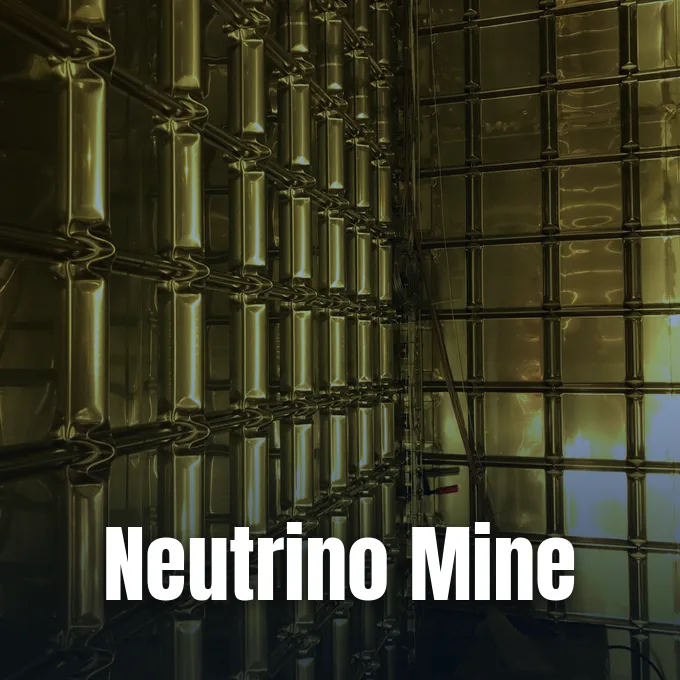
Engineers in the mining town of Lead are preparing to build four underground particle detectors inside caverns blasted from rock a mile beneath South Dakota. The work begins the underground assembly of the Dune experiment, an international collaboration created to examine how ghostly particles called neutrinos travel through the Earth. While miners once dug into the Black Hills for gold, researchers at the Sanford Underground Research Facility now look to these subterranean halls to explore fundamental questions about cosmic evolution and the origin of matter [1].
Deep Underground Neutrino Experiment Setup
Construction of the Deep Underground Neutrino Experiment, known as Dune, is scheduled to begin on Monday in the former Homestake mine in Lead, South Dakota. The US-led project relies on international partners, with the UK serving as the largest foreign contributor to the hardware. British teams from institutions including the Science and Technology Facilities Council are delivering core detector components, event reconstruction computing, and the graphite target that creates neutrinos at Fermilab near Chicago, Illinois. Prof David Newbold, a Dune spokesperson from the Science and Technology Facilities Council, described the underground operation as an alliance with skilled local laborers. “This is a heavy duty engineering operation,” Newbold said. “It’s like building a ship underground” [1].
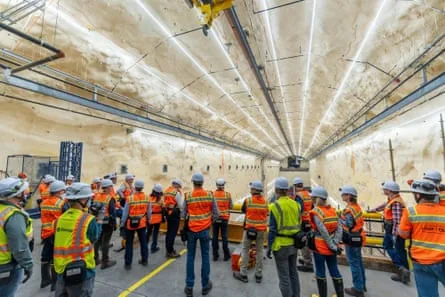
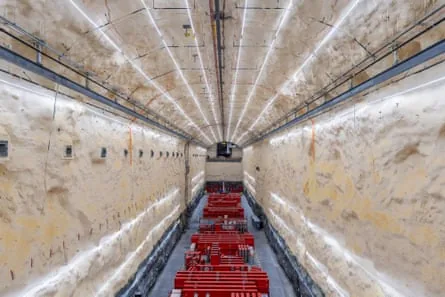
Workers must fit more than 4,000 tonnes of structural steel into the subterranean chambers beneath Lead to support the installation. The four individual detector units will stand five storeys tall inside rock caverns blasted a mile underground before receiving their liquid argon payloads. Once the frames are in place, crews will fill them with a combined 70,000 tonnes of liquid argon chilled to -200C. Engineers anticipate that assembling the modules underground will take nearly three years, while filling the massive cryostats with cold argon will require another full year [1].
Detectors a Mile Beneath Lead
The subterranean chambers at the Sanford Underground Research Facility in Lead sit directly in the path of a particle beam fired from Fermilab near Chicago, Illinois, traveling 800 miles (1,300km) straight through the crust and mantle of the Earth without needing a carved tunnel. Neutrinos lack electrical charge. Because these neutral particles rarely collide with normal matter, almost all of them pass through solid stone unaffected before reaching the underground detectors in Lead. A mile of overhead rock shields the giant instruments from surface cosmic rays, creating the quiet environment needed to spot occasional particle collisions [1].
When an incoming neutrino strikes an argon nucleus inside a Dune detector, the collision creates a flicker of light and an electric charge pulse. Sensitive sensors record these faint signals so physicists can determine the energy, direction, and variety of the incoming particle. Dr Kate Shaw, an experimental particle physicist working on the Dune experiment from the University of Sussex, sees this South Dakota laboratory as an open portal for research. “It’s a super exciting time to be working on this,” Shaw said. “Neutrinos do not make sense yet and they could open a door to new physics” [1].
Neutrino Oscillations and Particle Mass
Within the cosmos, only photons exist in greater numbers than neutrinos, giving these lightweight particles an immense numerical presence throughout space. They are generated in nuclear reactions that power the sun, in natural radioactive decay, and inside artificial particle accelerators such as those at Fermilab. Even for physicists, these neutral particles behave like true oddballs. About a trillion neutrinos pass through a human body every second without leaving any sensation. They exist in three varieties with very small but distinct masses, and they alter their identity from one variety to another as they travel through space, undergoing a transformation that physicists call oscillation. “It’s a very strange behaviour,” Shaw said. “It’s like me throwing you an apple and it turns into a banana” [1].
Resolving the exact mass pattern among these three neutrino varieties is a central unsolved question for particle physics. Which variety is lightest and which is heaviest? The answer could point to undiscovered forces of nature. These subtle particle traits connect to broader inquiries into the nature of the universe, while tracking how flavors shift along the 800-mile flight path from Fermilab in Illinois helps researchers at Lead measure the tiny mass differences [1].


Homestake Mining Legacy
The Black Hills region holds a long heritage in particle physics dating back to the 1960s, when physicist Ray Davis followed miners down the deep shafts of the Homestake gold mine in Lead to build a pioneering underground detector. Davis placed a 100,000-gallon tank inside the cavern. Filled with ordinary dry-cleaning fluid, the container used chlorine atoms to intercept incoming solar neutrinos, converting them into argon atoms whenever rare subatomic collisions occurred deep beneath South Dakota. Davis’s early work proved that deep subterranean caverns could provide the natural shield needed to study elusive subatomic particles without interference from surface cosmic rays [1].
The Homestake mine ended gold mining in 2001, but the facility was later converted into the Sanford Underground Research Facility (Surf). Today, the subterranean complex in Lead hosts the Lux-Zeplin (LZ) dark matter detector, which reported a potential detection of dark matter last month. Robin Lucero, city administrator of Lead whose family has lived locally for generations, welcomed the transition. “We’ve gone from mining the Earth to helping scientists explore the universe,” Lucero said, adding that Surf and Dune bring fresh possibilities for local businesses and young people [1].
Why the Dune Experiment Needs Argon
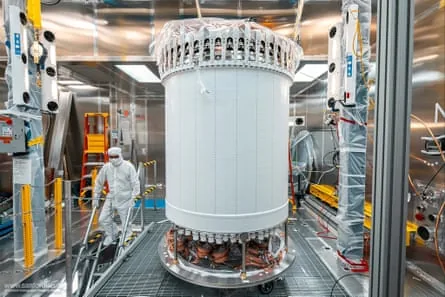
Modern neutrino studies need far denser detection mediums than the cleaning fluid that Ray Davis placed in his Homestake tank sixty years ago. The Dune experiment uses 70,000 tonnes of ultra-pure liquid argon chilled down to -200C inside subterranean cryostats in Lead. Liquid argon provides a high density of atomic targets while remaining transparent to faint flashes of scintillation light. When a passing neutrino strikes an argon nucleus, it knocks loose electrons and creates photons. Sensors record both signals simultaneously. By tracking these simultaneous electrical pulses and optical flashes across the cryostat, computers reconstruct a precise three-dimensional picture of the subatomic interaction, giving physicists the clean data needed to separate genuine beam events from stray background signals in the surrounding South Dakota rock [1].
The underground fabrication of these vast chilled tanks inside the Lead mine presents logistical challenges for engineering crews. Every steel panel and electrical component must travel down narrow Homestake shafts before being assembled into five-storey modules within blasted rock caverns a mile beneath the surface. Prof David Newbold said that putting the detectors together will take nearly three years of sustained work. Crews will then spend another year filling the modules with cold argon before particle beam runs from Fermilab begin [1].
Antimatter Questions in Deep Space
Beyond studying particle masses, physicists hope the Dune experiment will help answer why the universe contains tangible matter rather than equal amounts of antimatter. The Big Bang should have generated matter and its antimatter counterpart in matched quantities, leading to total annihilation and leaving behind only pure radiation. Yet our cosmos is populated by galaxies, stars, and planets composed almost fully of matter. Dune will search for tiny behavioral differences between neutrinos and antineutrinos as they travel 800 miles from Fermilab through the Earth to Lead. Any observed asymmetry in the way these particles oscillate could finally explain why surplus matter survived the earliest moments of cosmic creation, solving one of the most enduring puzzles about why anything exists at all [1].
The subterranean detectors at Lead will also observe natural neutrinos arriving from deep space, gathering new details on stellar collapses and the birth of black holes. Earlier this month, the Nobel prize for physics honored Belgian researcher Francis Halzen, who used a cubic kilometer of Antarctic ice to detect high-energy cosmic neutrinos. Data gathered from these celestial phenomena connects with ongoing astrophysical efforts to model early black hole formation and the evolution of the first galaxies. For the scientists working a mile beneath South Dakota, detector assembly begins a long research campaign. “This really is going to be a golden era,” Prof David Newbold said [1].
- ONLINE NEWS Sample, I. (2026, October 31). From gold rush to cosmic questions: a South Dakota mine and the search for the secrets of the universe. The Guardian. [Article Link]
Cover image: Abitowlish / Wikimedia Commons, CC BY-SA 4.0
APA 7: PerEXP Teamworks. (2026, November 1). Homestake Mine Caverns Host Dune Experiment Assembly Work. PerEXP Teamworks. https://perexpteamworks.com/en/dune-experiment-south-dakota-mine/


