





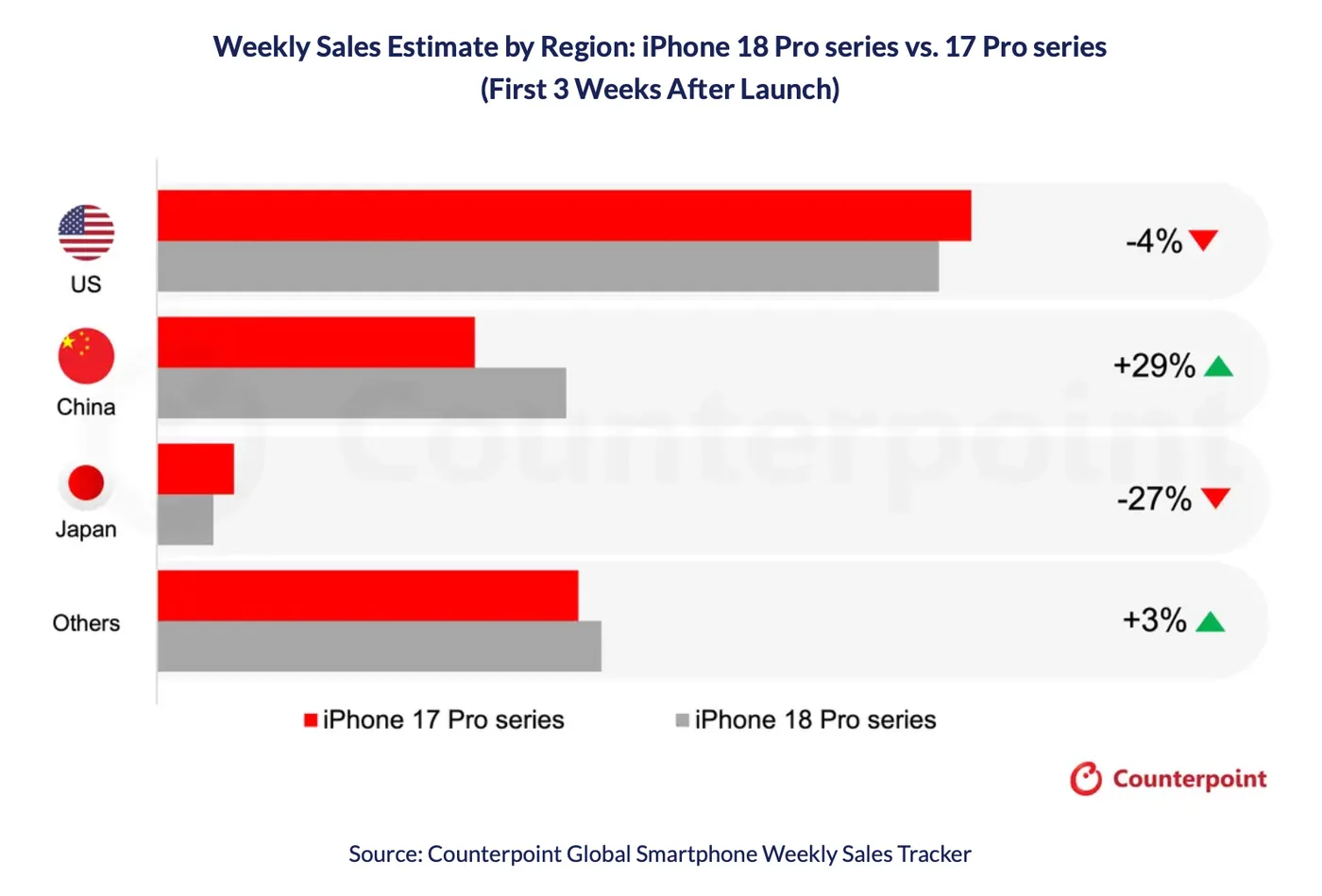
Early global iPhone 18 Pro sales rose 3.1% during the first three weeks of release compared to the previous generation, according to research firm Counterpoint Research. That modest uptick arrived with a sharp divide between international markets. A 29% jump in China and a 28% gain in India carried the product line forward, while shipments fell in mature western countries where shoppers questioned higher launch prices. As Marcus Mendes reported for 9to5Mac, the early figures counter rumors of soft global demand, showing Apple leaning on Asian buyers to steady its premium lineup [1].
iPhone 18 Pro Sales by Region
Counterpoint Research tracked retail transactions for both the iPhone 18 Pro and the larger iPhone 18 Pro Max following their September 18 store debut. The tracker measures sales to shoppers instead of wholesale warehouse shipments sent into carrier channels. Global volumes edged past the iPhone 17 Pro series by 3.1% YoY, but the headline total masked deep splits between individual countries. In an analysis for Analytics Insight, reporters Poulami Saha and Achu Krishnan noted that early global run figures beat the prior year primarily because Chinese demand accelerated. Without that lift, worldwide sales growth would have turned negative [6].
The early supply balance differed from the initial preorder phase, when iPhone 18 Pro pre-orders begin across global time zones with uneven delivery schedules. Apple secured more launch inventory in Asian retail centers this autumn, avoiding the shipping bottlenecks that hobbled the debut of the iPhone 17 Pro twelve months ago. Better stock levels allowed retail stores to fill immediate demand from eager early adopters who queued on day one [2].
The weekly tracker does not disclose total unit numbers, but the percentages reveal shifting buyer habits. Supply made the difference. With living costs elevated and hardware maturing, shoppers in several countries kept older devices longer, relying more on trade-in promotions to justify upgrading [1].
Growth in China and India
Sales in China jumped 29% YoY during the three-week window, making it Apple’s fastest-growing major market for the new generation. Greater shelf availability helped retail outlets capture initial foot traffic without long backorders. Domestic rivals also gave Apple unexpected room to run. Several Chinese Android OEMs raised prices on their own flagship phones, narrowing the historic cost gap that previously protected local brands [1].
India delivered another solid gain, with iPhone 18 Pro sales rising 28% compared to the earlier model lineup over the same initial retail timeframe. That expansion happened despite substantial price increases enacted by Apple at launch. The entry 256GB iPhone 18 Pro reached Rs 1,64,900 in Indian retail stores, while the 256GB iPhone 18 Pro Max climbed to Rs 1,79,900, representing an increase of Rs 30,000 for each device over the 2025 predecessor models that had launched at Rs 1,34,900 and Rs 1,49,900. Official provisional data showed Indian retail inflation reached 5.54% during September, so Apple’s 20% price hike far outstripped everyday living expenses. Even so, affluent shoppers continued upgrading, supported by structured retail financing and carrier trade-in incentives [4].
The strong Indian showing stood in sharp contrast to the wider domestic smartphone market, as Sahil Mohan Gupta reported for Gadgets Now. Counterpoint estimates that overall smartphone shipments in India contracted 20% during the July to September period, dragged down by a 47% collapse in budget devices priced below Rs 20,000. Premium hardware managed to buck that broader slump as higher-income buyers showed little hesitation at checkout counters [4].



Why American and Japanese Buyers Paused
In the United States, iPhone 18 Pro sales dropped 4% compared to the iPhone 17 Pro launch period. American shoppers appeared skeptical about the added value of the newest releases. Counterpoint reported that consumers saw few meaningful improvements in day-to-day features or exterior design to justify spending more on an annual upgrade. Many existing iPhone users chose to keep their current devices, betting that another year of software updates would serve them just fine [1].
Japan recorded an even sharper decline, with sales falling 27% YoY during the three-week window. Samuel Nwite reported for Tekedia that China offsets weakness in mature markets like Japan, where unfavorable foreign exchange rates forced Apple to raise local sticker prices significantly. The Japanese yen’s weakness turned what would have been a routine price update into a steep hurdle for local households. Buyers pulled back quickly, postponing device refreshes or turning to older, discounted inventory in secondary channels [3].
The price resistance also follows rising service costs, after the battery replacement fee for the iPhone 18 Pro rose to $129. Costs climbed across the board. When out-of-warranty servicing turns pricier, casual shoppers often pause before committing to fresh installment contracts, leaving store foot traffic subdued [1].
Component Costs Behind Higher Prices
The higher prices for the iPhone 18 Pro lineup stem partly from surging component costs within the global supply chain. Memory chips have grown far more expensive this year as semiconductor fabricators allocate cleanroom capacity toward high-margin server hardware. Market research firm TrendForce expects conventional DRAM contract prices to climb 10% to 15% in the fourth quarter, with NAND flash storage prices jumping 15% to 20% [4].
That supply squeeze has constrained mobile memory production worldwide, leaving phone makers with fewer cheap components. Apple has not published an official bill of materials detailing how much of its price adjustments trace back to DRAM or flash memory. Industry analysts say that memory contracts negotiate months in advance, but broader cost pressures clearly shaped retail strategies. While Apple absorbed some margin pressure in previous product years, it passed more of that burden to shoppers this season [4].
Hardware upgrades inside the phones added further manufacturing complexity. Both Pro models feature Apple’s A20 Pro processor and a revised internal cooling system designed to manage thermal loads during heavy tasks. Apple also introduced a 48-megapixel main camera sensor equipped with a variable aperture lens that adjusts its opening to control incoming light. Those components increased baseline production costs, even if many consumers felt the changes were subtle on store display tables [4].
Tracking iPhone 18 Pro Sales Into the Holidays
Within the premium lineup, customer preferences shifted slightly toward the smaller form factor. The top-tier iPhone 18 Pro Max captured a 56% portion of combined Pro family volume in the three-week window, down from 57% during the prior cycle. Counterpoint attributed the small change to higher top-end prices and strong momentum in developing markets like India and Southeast Asia, where shoppers favored the lower entry price of the standard 6.3-inch Pro [1].
Another wildcard entered the retail picture on October 23, when Apple released the iPhone Duo, its first foldable smartphone, priced at Rs 2,99,900 in India with a 7.6-inch inner folding screen and a 5.4-inch outer cover display. Because the Duo arrived in Week 43, its launch figures fell outside the three-week window tracked in Counterpoint’s report. Counterpoint Associate Director Sujeong Lim said that the foldable could complicate future Pro Max adoption: “Whether China’s outperformance reflects durable demand or front-loaded buying will become clearer in the coming weeks. The recovery of US and Japanese volumes, and whether the iPhone Duo launching in Week 43 will generate incremental demand rather than cannibalising Pro Max, are the two most consequential near-term variables” [1].
Counterpoint Research Director Tarun Pathak said replacement timelines are stretching as memory prices rise, broader economic pressures persist, and comparisons against a high-selling iPhone 17 lineup take effect. Apple reached a $5 trillion market valuation on early Pro strength according to AppleInsider, but AAPL investors and industry observers cited by MacDailyNews will watch whether holiday demand sustains that momentum before Apple holds its fiscal fourth-quarter earnings call on November 2 [5].
- ONLINE NEWS Mendes, M. (2026, October 27). Report: iPhone 18 Pro sales down 4% in the US, but China drives 3.1% global growth. 9to5Mac. [Article Link]
- ONLINE NEWS AppleInsider. (2026, October 27). iPhone 18 Pro sales beat iPhone 17 Pro figures, but only because of China. [Article Link]
- ONLINE NEWS Nwite, S. (2026, October 28). Apple iPhone 18 Pro sales rise 3.1% as China offsets weakness in US and Japan. Tekedia. [Article Link]
- ONLINE NEWS Gupta, S. M. (2026, October 27). iPhone 18 Pro sales rise as India and China offset price pressure. Gadgets Now. [Article Link]
- ONLINE NEWS MacDailyNews. (2026, October 27). Apple’s iPhone 18 Pro series posts 3.1% higher initial global sales than hit iPhone 17 Pro, Counterpoint says. JOSH Enterprises, LLC. [Article Link]
- ONLINE NEWS Saha, P., & Krishnan, A. (2026, October 27). iPhone 18 Pro sales beat iPhone 17 Pro in early global run, reports. Analytics Insight. [Article Link]


