





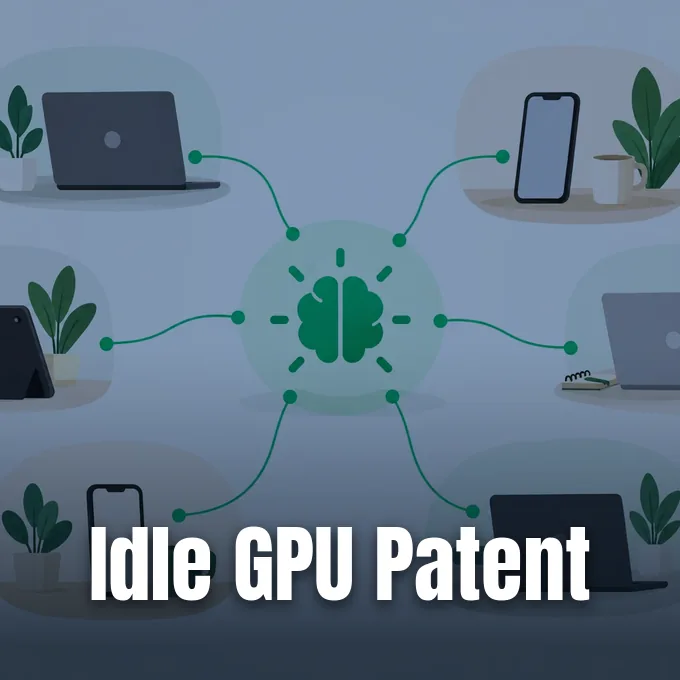
Microsoft published patent application US 2026/0349820 A1 on November 5, 2026, outlining a distributed system to train AI models on idle consumer devices [1]. Submitted by Microsoft Technology Licensing in April 2025, the idle GPU patent explores rewarding device owners with software access, account credits, or money when their hardware sits idle. The system tracks local telemetry and chops large training workloads into micro-tasks matched to available capacity [2]. It creates an architectural framework to harvest unrented edge silicon without guaranteeing that any commercial payout program will launch [1].
How the Idle GPU Patent Decomposes Training
The filing, titled “Opportunistic Micro-training on Edge Devices Using Spare GPU Utilization,” describes an orchestrator that analyzes a neural network’s dependency graph [1]. Instead of running synchronous training jobs that depend on expensive data-center cables, the system hunts for split points where data traffic, extra memory, and data locality remain low [3]. Aditya Vasanth Challapally is named as the sole inventor on the 19-page document. Candidate machines receive micro-tasks based on a capability score: C = w1 × (compute/reference) + w2 × (memory/reference) + w3 × (reliability) + w4 × (thermal headroom/reference). Under that formula, a reference machine rated at 100 GFLOPS against an edge device delivering 150 GFLOPS scores 1.5 [4].
The client software watches graphics utilization, video memory, temperature, and power draw [1]. To stay out of the way of daily PC use, the orchestrator adjusts its polling rate using the formula Sample_Rate = min(100 ms, max(5 ms, beta × utilization × thermal factor)), where beta sits between 0.1 and 0.3. A busy or hot machine gets checked four times less often than an idle desktop [4]. When a player opens a demanding game or GPU temperatures climb, safety limits scale back compute loads, restrict memory use, or pause jobs entirely [1].
The orchestrator also forecasts when a machine will sit free by blending three separate prediction models [3]. The patent defines availability as P(t) = 0.6 × LSTM(history) + 0.3 × Bayesian(recency) + 0.1 × statistical trend, drawing sixty percent of the score from neural history, thirty percent from Bayesian recency, and ten percent from trend lines [4]. That forecast lets the network assign smaller batches to devices that drop offline unexpectedly [3].
Hardware Verification and Reliability Scoring
Consumer desktops connected over residential internet lines run outside clean server rooms, which means machines can drop packets, produce math errors, or return altered data. The filing addresses that untrusted setup by sending identical micro-tasks to multiple independent systems [1]. Because some volunteer systems may be slow or dishonest, returned tensors must pass validation before being combined into the model [2].
Validation checks split into three parts: an agreement check against other peer machines worth 40% of the score, a mathematical check at 30%, and a range check against historical boundaries at 30%. Device reliability uses an exponential rolling average across roughly the last 100 completed tasks. New machines join the pool with a starting score of 0.8. The orchestrator applies a 0.05 penalty for suspicious outliers, but it docks only 0.01 for a simple job failure [4].

Enterprise data centers depend on strict service agreements, as seen in corporate infrastructure shifts where an annual software fee for AI factory agents targets managed corporate compute clusters. In contrast, Microsoft’s design assumes home graphics cards will fail regularly. The document mentions “Byzantine-resistant” protocols five times and “untrusted devices” four times to defend against faulty returns [4]. It weights results from dependable systems higher while dropping corrupt tensors [2].
Electricity Costs and Consumer Payouts
Headlines suggesting that tech giants will hand out easy cash skip the fine print of the filing. FourWeekMBA counted 20 claims in the document, and none of those claims mention compensation, payment, tokens, or rewards [2]. Payment appears only as an optional possibility in the descriptive text rather than an enforceable patent claim [4]. Paragraph [0019] of the description contains the only reference to compensation in the entire text: “In some examples, the system may track the amount of computations each edge device has provided and may compensate the owners of the edge devices. For example, each computation may result in a credit being applied to an owner’s account. The credits may be exchanged for free software, model access credits allow the user to access the model being trained, money, or the like [4].”
Running graphics cards under heavy AI workloads draws steady power from household wall outlets [5]. An explainer from PBX Science points out that drawing an extra 250 watts for four hours a day adds roughly 30 kilowatt-hours per month. At a residential tariff of 35 cents per kilowatt-hour, that added draw costs around $10.50 before any credit arrives [3]. Patentlyze noted that the technology “would add to, not reduce, a participant’s electricity use [2].”

Measured earnings from Salad, a commercial network renting consumer graphics cards, show what home hardware actually earns. For the week of November 2 to 8, 2026, an RTX 5090 averaged gross earnings of $0.363 per hour with 97% availability, while an RTX 4090 brought in $0.272 and an RTX 3090 earned $0.098. At the August 2026 United States residential electricity average of 18.16 cents per kilowatt-hour, running a 450-watt RTX 5090 costs $0.082 hourly, leaving a net payout of $0.281 per hour or roughly $205 per month. Running a 300-watt RTX 3090 nets just $0.044 per hour, yielding $32 monthly after electricity takes 56% of the gross [4].
Confidentiality Hurdles in the Idle GPU Patent
The idle GPU patent spends dozens of paragraphs guarding against bad math, but it stays silent on data confidentiality. A word search across all 19 pages returns zero results for privacy, confidential, encrypt, sensitive, malicious, or poisoning. The framework guards against wrong answers rather than eavesdropping. Sending intermediate tensors to home PCs means unvetted machines hold copies of the training data [4].
Moving training data over consumer internet connections raises regulatory hurdles under health privacy rules like HIPAA or European Union data laws. Export-controlled AI models governed by ITAR or EAR can’t legally send sensitive weights to unknown foreign PCs. Without formal data processing agreements, corporate teams are unlikely to let unvetted consumer hardware handle proprietary workloads [3].
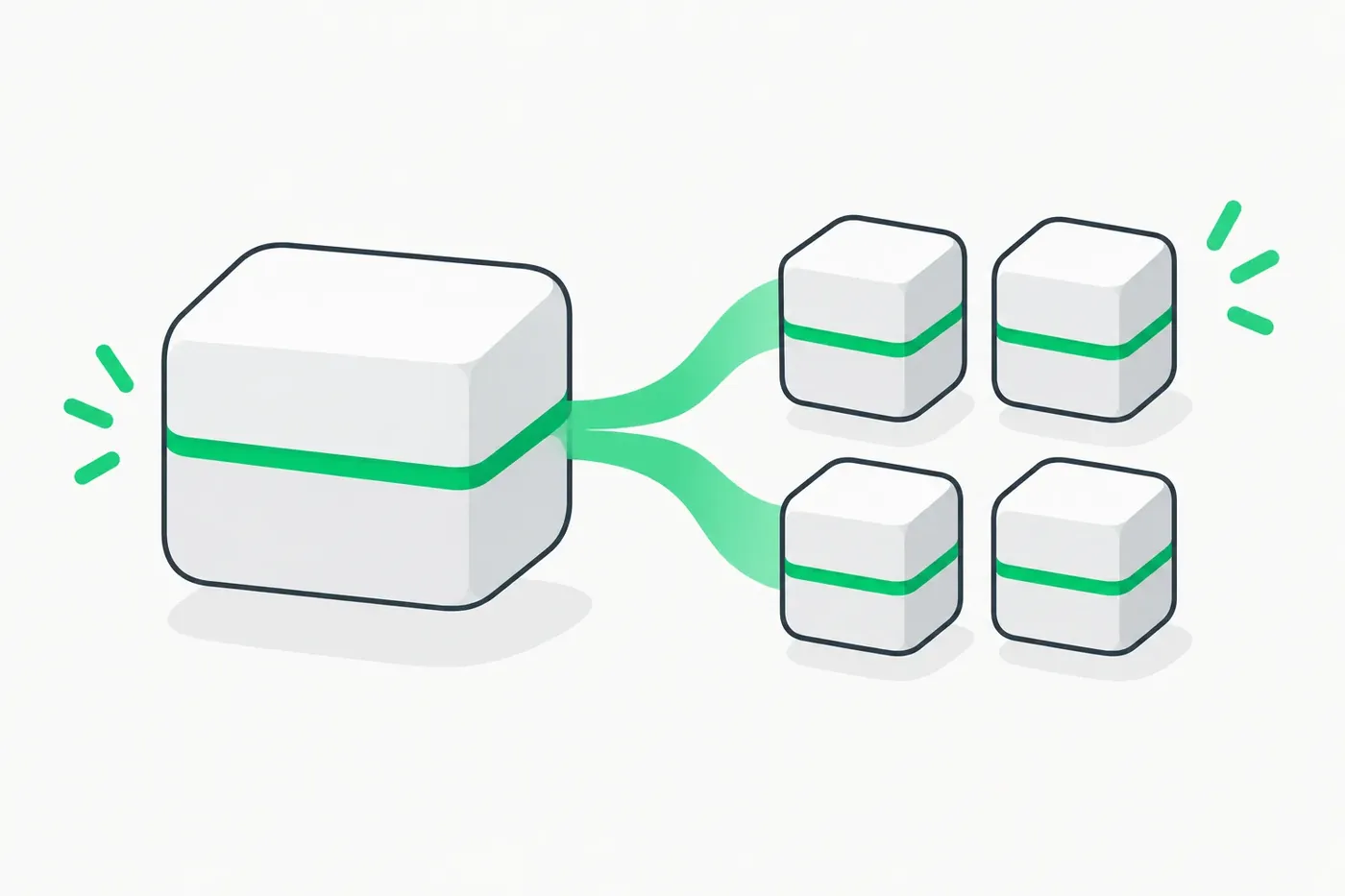
Splitting language model training across residential connections used to look impossible because consumer internet links are thousands of times slower than server interconnects [4]. That challenge shifted after an unreviewed preprint by Douillard et al. (2023) introduced the DiLoCo algorithm, showing that eight distributed workers could match synchronous optimization while communicating 500 times less [7]. While DiLoCo uses inner AdamW and outer Nesterov momentum to sync model replicas, Microsoft’s filing cuts the network itself into decoupled micro-tasks. Consumer cards still lack high-bandwidth NVLink links and error-correcting memory, so edge clusters suit smaller fine-tuning jobs better than giant foundation runs. Nobody trains frontier models across volunteer home desktops [4].
Filing Status Beyond Azure Infrastructure
The filing remains a pre-grant patent application, meaning patent examiners have not approved the claims or granted legal rights [2]. Microsoft has announced no Windows 11 feature, Xbox app toggle, or payout schedule [5]. TechPowerUp pointed out that OpenAI head Sam Altman previously argued that home DRAM sitting unused 95% of the time wastes scarce chip capacity, yet convincing users to run background AI tasks remains difficult after user pushback against Copilot for Gaming [6].
The filing joins other recent intellectual property applications from Microsoft Technology Licensing, such as patent US 20260341309 covering real-time speech and lip movement synchronization. A discussion on Hacker News noted that broad claims might serve as a defensive shield, discouraging independent developers from building consumer training meshes without licensing the tech [3]. Described throughout the idle GPU patent as an opportunistic architecture, the concept currently exists only in patent diagrams rather than working software [5].
- ONLINE NEWS Silva, J. (2026, November 10). Microsoft explores paying users for idle GPU compute. KitGuru. [Article Link]
- ONLINE NEWS Ali, A. J. (2026, November 10). Microsoft idle GPU patent pays PC owners to train AI. Tbreak Media. [Article Link]
- WEBSITE Thakker, Y. (2026, November 10). Microsoft Idle GPU Patent: Pay Gamers to Train AI? explainx.ai Blog. [Article Link]
- WEBSITE Tokenstead. (2026, November 10). Microsoft’s idle-GPU patent: training on your gaming PC. Tokenstead. [Article Link]
- ONLINE NEWS Murphy, D. (2026, November 10). New Microsoft Patent Envisions Paying PC Owners to Train AI on Idle GPUs. ThinkComputers.org. [Article Link]
- ONLINE NEWS DrUsmanSaleem. (2026, November 10). Microsoft Patent Describes Paying PC Owners to Train AI on Idle GPUs. TechPowerUp. [Article Link]
- PREPRINT Douillard, A., Feng, Q., Rusu, A. A., Chhaparia, R., Donchev, Y., Kuncoro, A., Ranzato, M., Szlam, A., & Shen, J. (2023). DiLoCo: Distributed Low-Communication Training of Language Models. arXiv. [Article Link]


