




Child car seats are now standard automobile equipment that reduce child crash fatalities by up to 71 percent when used correctly [1]. Yet for decades after passenger cars first filled American roads, drivers traveled with unrestrained children who rode freely across bench seats without any seatbelts or protective safety gear. Early models were built for adult convenience. Decades of engineering trials and legislative battles gradually transformed these crude holders into protective safety equipment [2].
- Why Were Early Child Car Seats Invented?
- Wire Frames and Windshield Boosters in Early Motoring
- When Did Child Safety Seats Introduce Crash Restraints?
- Automakers Add Padded Shells and Infant Car Seats
- Government Testing and Restraint Mandates Across Nations
- How Did Modern Child Car Seats Standardize Protection?
Why Were Early Child Car Seats Invented?
Early child car seats were invented to keep young children from crawling around vehicle controls rather than to protect them during collisions. When automobiles grew popular in the early twentieth century, drivers faced constant distractions from active toddlers who scrambled around foot pedals, clutch linkages, and emergency brake levers on open cabin floors [1]. These early devices offered no crash protection. Some early designs were little more than burlap sacks hooked over front seat headrests, while other parents cobbled together wooden boxes or canvas slings in home workshops simply to hold their infants in place [4].
Keeping a child stationary was considered a convenience for the adult behind the steering wheel. Because passenger cars lacked seatbelts for adults until decades later, nobody expected child restraints to absorb the violent energy unleashed when two vehicles collided on the road [2]. Instead, early seats functioned as window perches so small passengers could look outside through the windshield during family trips [5]. Few adults used seatbelts then. By lifting toddlers higher into cabin view, drivers could monitor their children through rearview mirrors while keeping both hands on the steering wheel [2].
Wire Frames and Windshield Boosters in Early Motoring
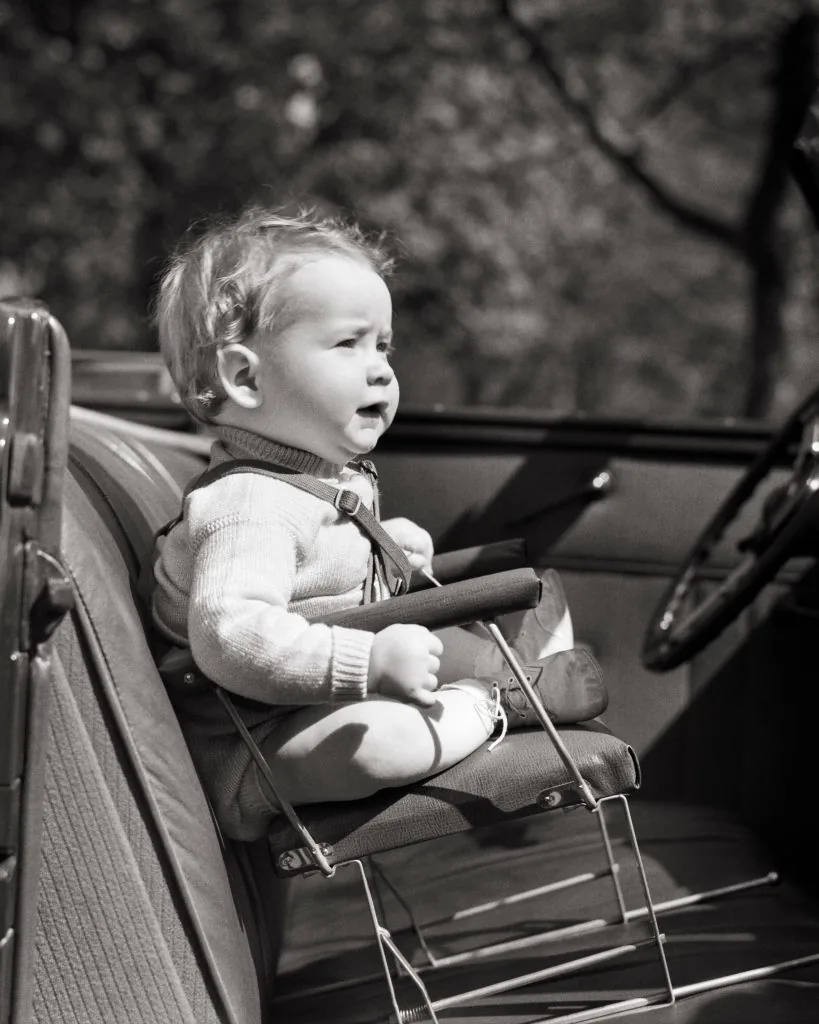
Commercial manufacturing began in 1933 when the Bunny Bear Company introduced the first commercial booster seat, marking an early step before child car seats focused on impact protection. Built from bent metal tubing and leather upholstery, the Bunny Bear seat was designed for installation on front bench seats. It featured a simple lap belt, but its true function was elevating the child for an improved view through the front windshield rather than shielding young bodies from severe crash forces. The device cost very little [2]. Placing a child in the front seat beside the driver created serious hazards that modern passenger guidelines warn against today [1].
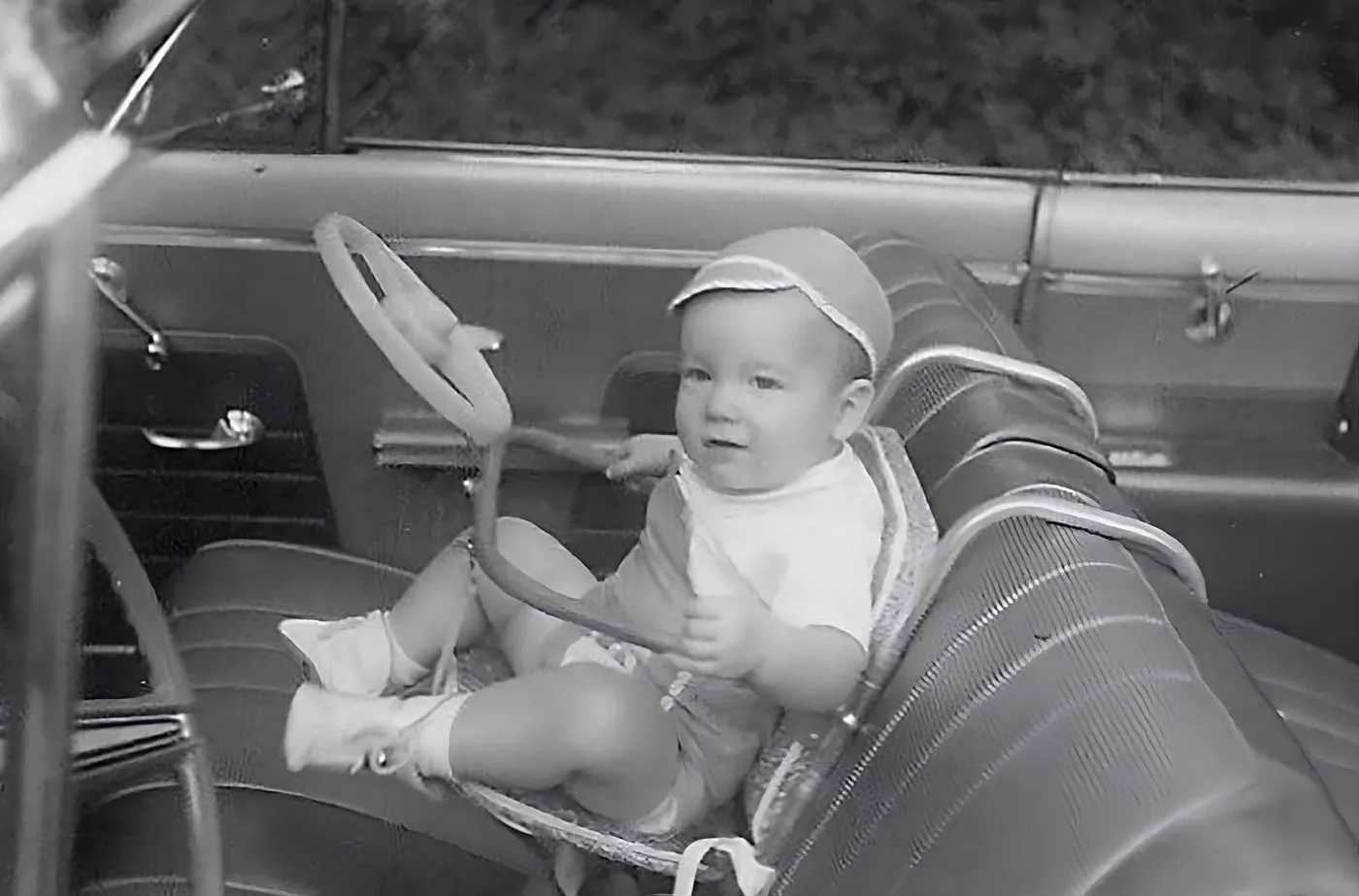
During the 1940s, manufacturers introduced lighter hanging seats that hooked directly over front seatbacks. These seats resembled playground swing buckets made of canvas hung from thin wire frames [3]. Many models even included tiny plastic steering wheels so toddlers could pretend to drive while their parents navigated highway traffic without any real restraint holding the seat [2]. Thin wire hooks provided no anchoring [1]. Contemporary safety studies echo these concerns when examining how families guide child independent mobility safely without compromising on the physical protection required during modern passenger travel.
When Did Child Safety Seats Introduce Crash Restraints?
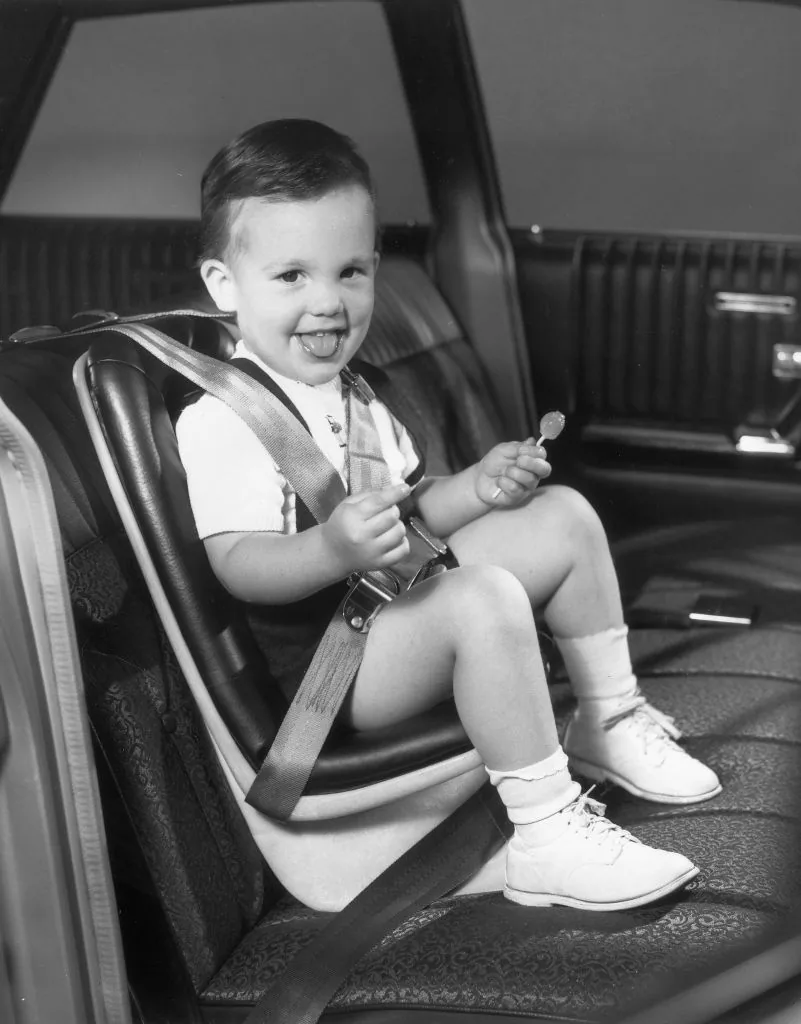
True crash-focused engineering began in 1962 when two independent inventors created protective child safety seats designed to withstand collision forces [2]. In Britain, mother and journalist Jean Ames patented a rear-facing seat equipped with a three-point harness that secured into the car using the vehicle seatbelt on the back bench [3]. Ames called her early model the Boulevard Express, recognizing that rearward seating protected fragile infant necks [4]. Ames later refined her concept into the Jeenay Car Seat, adding a comfortable foam pad and a five-point harness system that anchored toddlers firmly into vehicle back seats [1].
That same year, Denver store owner Leonard Rivkin developed his own seat following an accident [2]. Rivkin was driving when his vehicle collided, throwing his young son from the back seat into the front footwell directly at his wife’s feet. His son escaped without injury. Rivkin researched restraint physics and patented a forward-facing child seat featuring a protective steel frame and a five-point harness system. Like the Ames design, Rivkin used the vehicle safety belt to secure the frame, creating a new manufacturing industry in North America [3].
International researchers quickly reinforced the protective value of rear-facing seating. In 1964, Swedish professor Beril Aldmann observed how Gemini space capsule astronauts lay on their backs to withstand intense acceleration, prompting him to design rear-facing child seats that distributed collision forces across a child’s entire back and skull to reduce spinal injury risks. Aldmann developed the Swedish T-standard, which advises parents to keep children riding rear-facing until at least age four. Sweden still enforces that guideline [3]. Simpler domestic options still dominated American mail-order catalogs, where Sears advertised the Auto Strap harness for just $1.88 [2].


Automakers Add Padded Shells and Infant Car Seats
Automobile manufacturers entered the safety market during the late 1960s with dedicated infant car seats engineered for crash protection in family cars. In 1967, the Ford Motor Company introduced a molded plastic wrap-around seat called the Tot Guard. Described in the May 1972 issue of Popular Science, the Tot Guard featured a padded shield across the child’s torso that absorbed impact energy if the toddler was thrown forward during a front crash. The seat retailed for $24.95 [1]. That price equaled roughly $200 in modern purchasing power, while General Motors introduced its competing rear-facing Infant Love Seat, offering molded plastic support comparable to contemporary infant carriers [3].
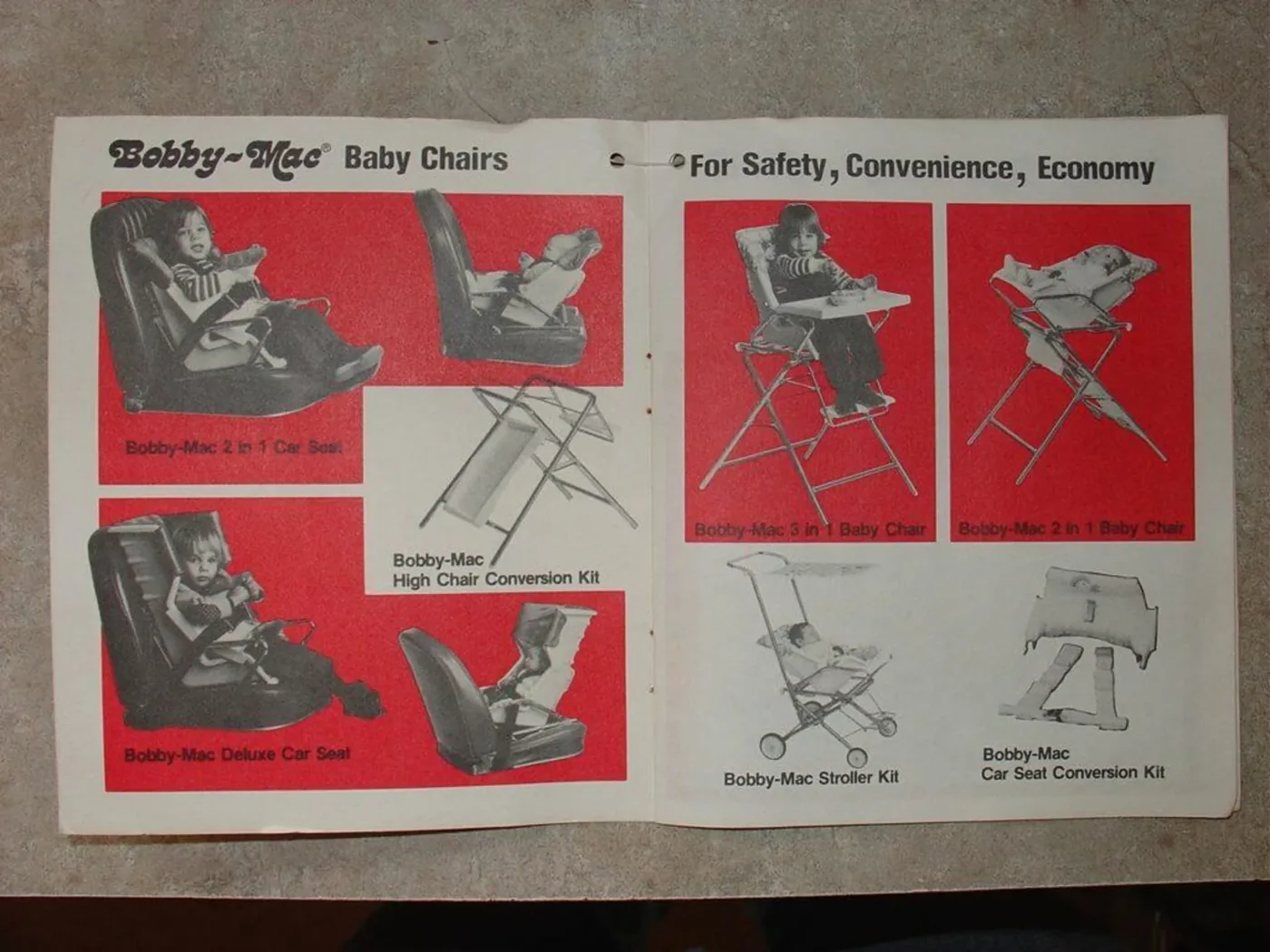
During the 1970s, Bobby Mac introduced convertible seats with a Y-strap harness for rear-facing and forward-facing rides [4]. Yet unregulated designs also proliferated, including baby hammocks suspended by fabric slings from automobile roof liners that offered zero crash protection during sudden stops on the road. These slings provided zero protection [2]. Dangerous models regularly appeared in retail stores because manufacturers faced no mandatory federal crash testing protocols before selling child restraints to the public. Consumers Union tested 15 child safety restraints in 1972. Twelve of the 15 models failed. In that same year, testing revealed that Pride Trimble’s 875 model failed federal crash tests, prompting consumer advocates to demand mandatory standards [1].
Automotive engineers learned that mitigating crash forces required energy absorption principles similar to those studied in other transportation and aerospace sectors [4]. Just as vehicle designers refined protective cabin shells, aerospace researchers today examine how engineering designs cushion spacecraft during high-energy landings on distant planetary surfaces. Molded cushioning and torso containment proved far more effective than early wire perches [1].
Government Testing and Restraint Mandates Across Nations
Federal safety oversight gradually changed child travel from an unregulated family matter into an enforceable legal requirement backed by standardized motor vehicle equipment rules across North America and Europe. In 1970, the United States established NHTSA to enforce federal motor vehicle safety rules [4]. NHTSA introduced its first car seat regulation in 1971, requiring child seats to be secured using vehicle seatbelts [3]. In 1980, Canada mandated that all forward-facing child seats use top tethers to limit forward head movement during collisions [1]. The United States updated its federal standards in 1981, instituting mandatory crash testing protocols for all child restraint manufacturers [3].
Individual American states enacted child restraint laws throughout the early 1980s [3]. By 1985, all American states, Puerto Rico, and the District of Columbia mandated approved child safety seats [1]. Yet compliance remained uneven. Roadside research revealed that only 80 percent of children rode in restraint systems, and 65 percent of those seats were installed incorrectly by caregivers. Parents often struggled with loose vehicle belts and confusing belt paths, showing that legislation alone could not guarantee proper passenger protection [3].
International initiatives followed similar educational and regulatory tracks. In 1985, the Australian government launched the Bassinet Loan Scheme in Victoria, providing nominal-fee infant restraints to parents of infants up to six months old with state support. By March 1988, the initiative distributed 13,271 child seats with backing from the British royal family. Great Britain later introduced the THINK! road safety campaign in 2000, setting a target to cut child road deaths by 50 percent by 2010. British law established in September 2006 that youngsters must use an appropriate safety seat until reaching age 12 or standing four feet, five inches tall [1].
How Did Modern Child Car Seats Standardize Protection?
Modern child car seats standardized passenger protection through vehicle anchor systems, certified inspection technicians, and seatbelt locking hardware. Before 1996, vehicle seatbelts lacked pre-crash locking mechanisms, complicating secure seat installation. Federal rules in 1996 mandated that all passenger vehicles include seatbelts that lock either at the retractor or through locking latch plates on vehicle seats. In 1997, European authorities introduced the ISOFIX rigid anchor standard, which connected car seats straight to vehicle chassis mounting points. The United States followed in 2002 by requiring the LATCH system, known as UAS in Canada, to allow secure installations without relying solely on seatbelts [3].
To help educate parents and reduce widespread installation mistakes, NHTSA launched a nationwide training program in 1997 to certify child passenger safety technicians who inspect seats in local communities. Engineers also addressed evolving size limits as car seat models grew heavier. In 2013, federal regulators set a standard combined weight cap of 65 pounds for lower LATCH anchors, requiring parents to switch to seatbelt installations as children grew. State booster laws expanded as well, beginning with California in 2002 for children under 40 pounds. Most children need booster seats until passing a five-step readiness test between ages 10 and 12 [3].
Rigorous testing protocols now ensure that seats remain secure during multi-directional impacts. Regulators also rejected unsafe experimental concepts, such as a 2002 front-seat rear-facing design by Xportation Safety Concepts that would have placed infants directly in front of active vehicle airbags. Federal regulators never approved it [1]. According to passenger safety research, properly buckled child safety seats reduce the risk of injury in collisions by up to 82 percent [3]. What began in the 1930s as a burlap sack or wire perch has become an indispensable life-saving engineering shield for young passengers on every journey [1].
- ONLINE NEWS Durn, S. (2026, October 3). 13 unbelievable child car seats from the past century. Popular Science. [Article Link]
- WEBSITE Rare Historical Photos. (2023, August 20). Odd and unsafe baby car seats from the past that moms wouldn’t buy today. Rare Historical Photos. [Article Link]
- WEBSITE Pratt, M. (2026, September 15). The history of car seats: How child passenger safety changed. Safe in the Seat. [Article Link]
- WEBSITE Rodriguez, M. (2023, October 28). Navigating through history with baby car seats from the past. Bygonely. [Article Link]
- WEBSITE Vintage Everyday. (2019, September 1). 20 baby car seats from the mid-20th century moms wouldn’t buy today. Vintage News Daily. [Article Link]
- ONLINE NEWS NewsLocker. (2026, October 3). 13 unbelievable child car seats from the past century. NewsLocker. [Article Link]
APA 7: PerEXP Teamworks. (2026, October 4). Child Car Seats Evolved from Window Boosters to Life Savers. PerEXP Teamworks.


