





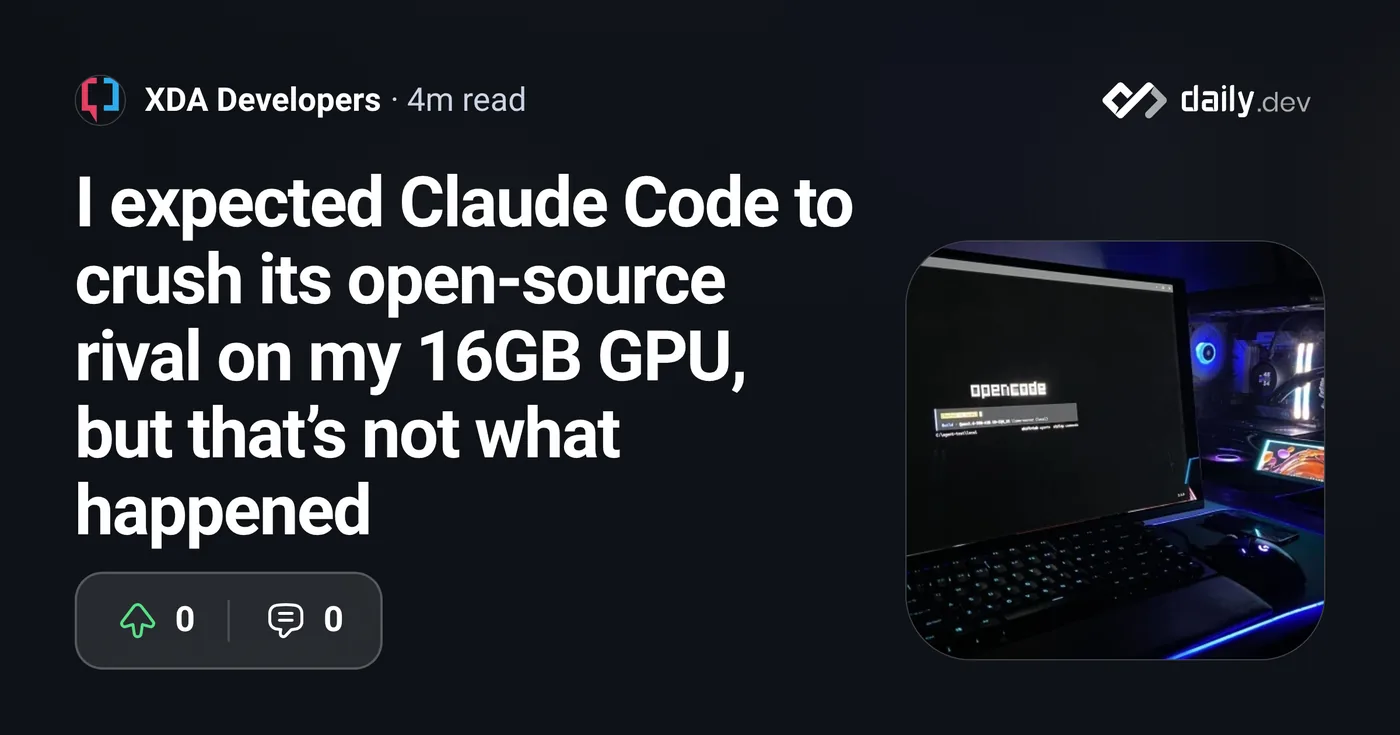
Abhinav Raj published benchmark results on November 8 showing that an open-source coding stack running on a consumer GPU matched Anthropic’s Claude Code CLI on a practical tool-building test. Testing on a desktop PC equipped with an Nvidia RTX 4070 Ti Super graphics card and an AMD Ryzen 5 7600X processor, the local setup used OpenCode v2.2.0 as a harness and Alibaba’s Qwen3.6-35B-A3B model to generate a custom telemetry utility without internet access. The offline agent satisfied every functional requirement in 3 minutes and 44 seconds while consuming less than a fifth of a cent in household power. Claude Sonnet 5.5 finished the same task in 2 minutes and 42 seconds with greater visual polish, but the test proved that local models running on Nvidia silicon now match proprietary cloud agents on core software utility [1].
OpenCode Benchmark Against Claude Code CLI
Abhinav Raj gave both systems an empty workspace directory and an identical prompt to build an Nvidia telemetry utility in Python. The script had to query nvidia-smi once per second, log power draw, temperature, utilization, VRAM usage, and core clock values to a timestamped CSV file, and accept a custom duration flag. It also needed to calculate average and peak power metrics before rendering a dual-variable trend chart as a PNG file, followed by an automated 30-second verification pass without any human guidance [1].
Running Claude Sonnet 5.5 on high effort through Claude Code CLI, Anthropic’s agent finished the assignment in 2 minutes and 42 seconds, verifying calculations against the CSV log while separating power and temperature into distinct visual panels. The model stated that the script required the matplotlib library. Anthropic’s agent executed its 30-second benchmark run three separate times, repeatedly editing label alignment on the generated graphs to deliver cleaner charts. That session consumed $0.37 in usage credits from Raj’s $20 monthly Claude Pro subscription [1].

OpenCode running Qwen3.6-35B-A3B completed the task in 3 minutes and 44 seconds without human intervention. The model located nvidia-smi independently, wrote the Python code, revised its logic before testing, and produced a telemetry script whose reported 27.32W average and 74.83W peak power matched the raw CSV data and manual validation checks. Although the run omitted installation commands for pandas and matplotlib, the script satisfied all six prompt requirements on the first pass [1].
Hardware Setup and Offloading Strategy
Fitting a 17.7GB model onto a 16GB graphics card required architectural adjustments. Qwen3.6-35B-A3B uses a mixture-of-experts design that activates roughly 3 billion parameters per token during inference, allowing Raj to run Unsloth’s UD-IQ4_XS quantization through the llama.cpp runtime server. Raj passed the --n-cpu-moe parameter to llama-server, assigning 12 expert layers to system RAM. The RTX 4070 Ti Super retained enough GDDR6X memory to support a 128K context window and keep total VRAM usage near 15.7GB, while Raj applied Qwen’s standard coding samplers [1].
Raj locked OpenCode v2.2.0 to his local llama-server to block cloud fallback and disconnected his Windows desktop from the network before starting. Generation speed held at 65 to 70 tokens per second, and prompt processing peaked at 1,837 tokens per second. Electric power for the test worked out to roughly a fifth of a cent [1].

Similar memory behavior emerged in earlier tests conducted by Kunal Ganglani on Ubuntu 24.04 with CUDA 12.6. Ganglani benchmarked an Nvidia RTX 4070 Ti Super bought for $489, evaluating Alibaba’s Qwen3-Coder at 4-bit quantization with DeepSeek-Coder-V2 and Paige Bailey’s Apache 2.0 licensed Gemma 4 from Google DeepMind. Running through Ollama, Qwen3-Coder held 14GB of VRAM and delivered 38 tokens per second without spilling memory into system RAM. Ganglani said that consumer GPUs now handle single-file tasks without the monthly fees tied to cloud APIs like Claude Sonnet 5 and Sonnet 5.5 [3].

Task Results on Local Silicon
Kunal Ganglani evaluated 50 developer tasks across single-file generation, unit test creation, bug diagnosis, multi-file refactoring, and code review on his Ubuntu 24.04 workstation. Claude Sonnet 5 averaged 13.2 out of 15 points, but Alibaba’s Qwen3-Coder reached 12.4 points, closing the overall gap to under 6%. On single-file coding, Qwen3-Coder matched Claude Sonnet 5 with a score of 13.1 to 13.0. In unit test generation, Alibaba’s local model led with 13.0 over Claude’s 12.8. Anthropic’s Claude showed a clearer lead on multi-file refactoring, scoring 13.6 against 11.4 because coordinating changes across several files requires deeper reasoning. On bug diagnosis, Claude scored 13.8 against 12.5 for Qwen3-Coder [3].
Wider testing from CodeClashDev placed Claude Code and OpenAI’s Codex CLI neck-and-neck on standardized evaluations. On SWE-bench Pro, Claude Opus 4.6 with Claude Code achieved 57.5% to edge GPT-5.3-Codex with Codex CLI at 57.0%, while Terminal-Bench 2.0 saw Google’s Gemini 3.1 Pro via Gemini CLI score 53.8% alongside Claude Sonnet 4.6 at 53.0%. When CodeClashDev tested a full REST API build with five TypeScript data models, Claude Code finished in 9 minutes with 73 tests, but OpenCode required 16 minutes to generate 94 integration tests [4].

Earlier repository evaluations showed how Claude Code cuts local search time by 96% with README maps when indexing unfamiliar codebases. OpenCode connects directly to Language Server Protocol instances so the underlying model can inspect compiler diagnostics and fix syntax errors as it writes code, while offering Git-based undo across 75 provider backends [4].
Claude Code CLI Versus Open Alternatives
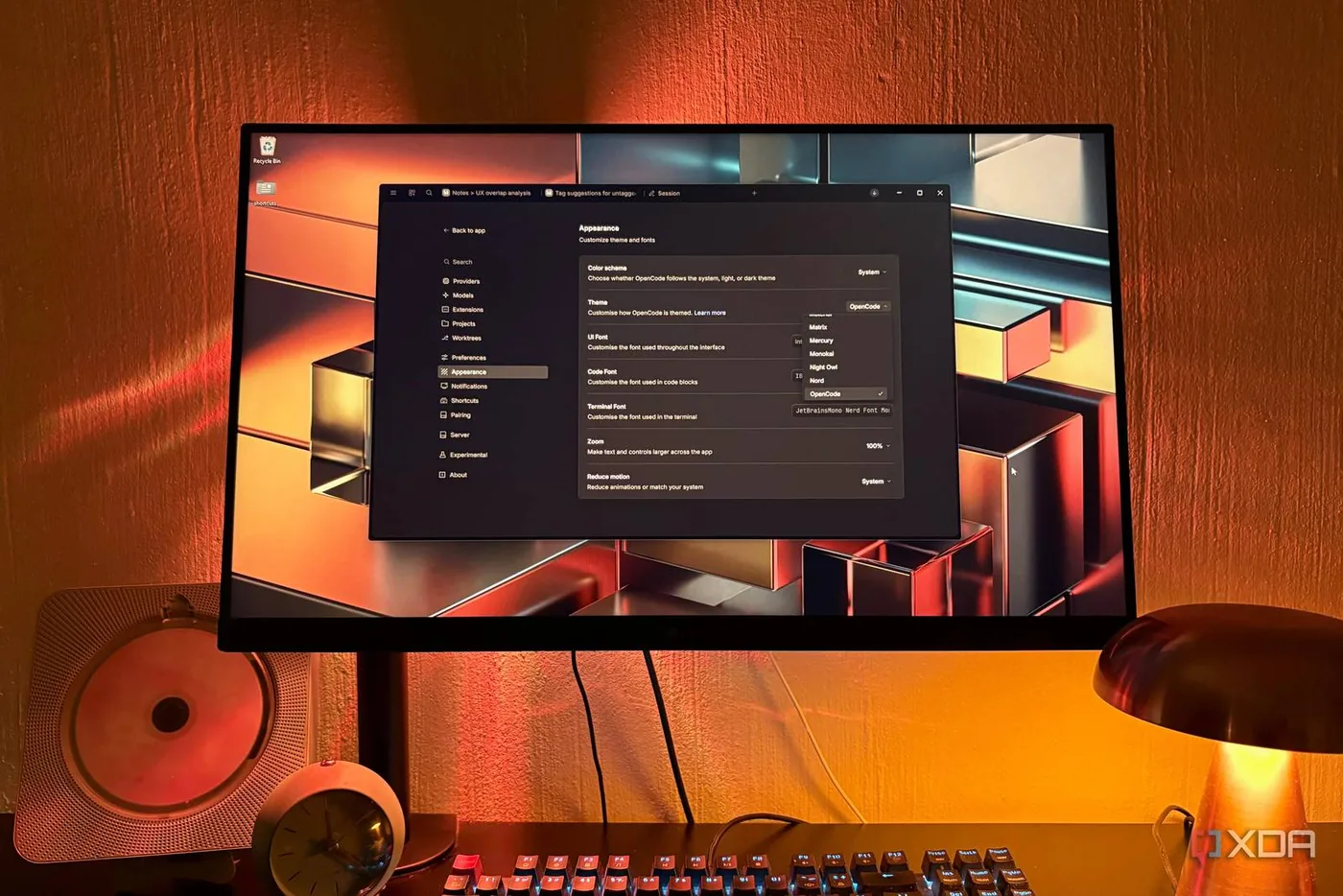
Interface design shapes how developers interact with local and cloud assistants. Nolen Jonker described switching his daily workload from Claude Code’s desktop interface to OpenCode’s desktop application on Windows, macOS, and Linux. Anthropic houses its desktop coding environment inside the main Claude app as a dedicated tab, which draws from the same monthly message budget as standard chat sessions. Jonker said that OpenCode 2.0 runs as a unified background service connecting terminal, web, and desktop windows under one agent [2].
Workflow files also behave differently between the two environments. Jonker moved his custom skills from Claude Code by calling them with the @ symbol in OpenCode, but the open agent reads project directions from AGENTS.md rather than CLAUDE.md [2]. Reports from daily.dev showed that OpenCode can drift when running Claude skill files because it ignores advanced trigger constraints and tool restrictions [7]. OpenCode balances that limitation with an embedded browser panel opened with Ctrl+Alt+B, enabling the agent to read web console errors on its own. Version 2.2.0 also added desktop plugins and custom themes in October [2].
Other open frameworks offer different balances between convenience and local execution. Block developed Goose as an open-source coding agent, which Twitter, Square, and Bluesky founder Jack Dorsey endorsed on X in July. David Gewirtz tested Block’s Goose with Ollama and Qwen3-coder on an Apple Silicon Mac Studio with an M4 Max chip and 128GB of RAM. Gewirtz said in ZDNET that generating a WordPress plugin took five rounds of correction, but setup was straightforward and performance remained steady without sending source code to external servers [5].
Pricing and Offline Workflow Realities
Financial trade-offs remain central to the choice between cloud subscriptions and local silicon. Anthropic’s Claude Code plans range from Claude Pro at $20 a month to Claude Code Max tiers priced at $100 and $200 monthly for heavy development teams [4]. Kunal Ganglani calculated that a developer spending heavily on Anthropic’s $2 per million input and $10 per million output token rates recovers the $489 cost of an Nvidia RTX 4070 Ti Super in roughly seven to eight weeks [3]. For individual runs like Abhinav Raj’s test, the electricity cost of a fraction of a cent contrasts with the $0.37 usage charged for Claude Sonnet 5.5 [1]. OpenCode also allows developers to connect existing GitHub Copilot accounts with zero added expense [4].
Privacy requirements also divide cloud agents from self-hosted setups. Developers can configure Claude Code CLI to connect with Ollama using local bridge settings, but Anthropic’s official client still connects to the internet for authentication and telemetry [3]. Open tools like OpenCode and Aider can run in completely isolated environments, letting engineers build software on sensitive repositories without network packets leaving the machine [1, 4].
Local inference can’t replace cloud models for every complex refactoring session, but recent tests prove that consumer hardware handles daily programming assignments reliably. Alibaba’s Qwen3.6-35B-A3B and Qwen3-Coder match frontier Anthropic models on single-file creation and test suites and save developers hundreds of dollars in annual subscriptions [1, 3]. For builders running an Nvidia RTX 4070 Ti Super with 16GB of GDDR6X memory, the gap between cloud services and local agents has narrowed from an unbridgeable chasm to a small difference in polish [1].
- ONLINE NEWS Raj, A. (2026, November 8). I expected Claude Code to crush its open-source rival on my 16GB GPU, but that’s not what happened. XDA Developers. [Article Link]
- ONLINE NEWS Jonker, N. (2026, November 5). I ditched Claude Code’s desktop app for its open-source rival that does the same jobs for free. XDA Developers. [Article Link]
- WEBSITE Ganglani, K. (2026, March 27). Local LLM vs Claude for Coding: When a Local GPU Is Enough. [Article Link]
- WEBSITE CodeClashDev. (2026, May 6). Claude Code vs Open Source AI Coding Agents — I Tested Them All for 30 Days. [Article Link]
- ONLINE NEWS Gewirtz, D. (2026, February 8). I tried a Claude Code rival that’s local, open source, and completely free – how it went. ZDNET. [Article Link]
- WEBSITE daily.dev. (2026, November 8). I expected Claude Code to crush its open-source rival on my 16GB GPU, but that’s not what happened. [Article Link]
- WEBSITE daily.dev. (2026, October 3). After a month switching between Claude Code and its open-source rival, I only open Claude for one kind of task. [Article Link]


