




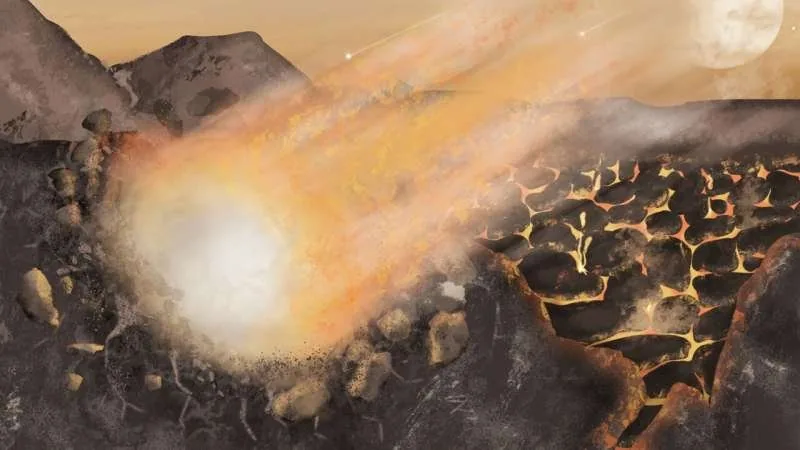
Planetary scientists have long debated how the basic chemical ingredients for biology first reached the young Earth. For decades, a leading hypothesis proposed that early cometary bodies seeded the planetary surface with carbon and nitrogen compounds. New orbital models challenge that assumption. Advanced computer simulations indicate that comet impacts were far too violent to deliver delicate organic materials intact, because extreme shock heating and atmospheric friction broke down incoming chemical structures before they reached the ground [1].
The Long-Standing Delivery Hypothesis
Comets hold primitive mixtures of volatile chemicals preserved from the birth of our solar system. When these icy bodies travel through space, they carry carbon- and nitrogen-rich compounds that can combine to form sugars and DNA under the right conditions [2]. Because early Earth suffered frequent collisions during its opening billion years, researchers hypothesized that comets functioned as cosmic delivery vehicles. That concept seemed elegant because it solved a major puzzle about how an originally molten surface acquired the chemical precursors necessary to start living systems [1].
Recent planetary discoveries have forced specialists to reconsider those traditional assumptions. In coverage published by Science News, Nicolle Zellner, a physicist at Albion College in Michigan who was not involved in the new study, said that scientists must revisit older theories as knowledge of both cometary structure and early orbital dynamics advances. In the geologic history of Planet Earth, chemical conditions evolved as atmospheric pressure and mantle activity shifted over hundreds of millions of years. Finding organic compounds inside comets floating in deep space does not show that those molecules could arrive at the surface in a functional state [2].
Carrying ingredients across space represents only the first hurdle for prebiotic chemistry. Fragile molecules must survive atmospheric entry and remain concentrated enough to react. Dispersed chemicals cannot trigger biological pathways [1].
Comet Impacts in Atmospheric Simulations
To test whether organic compounds could survive the violent descent, Richard Anslow, a planetary scientist at the Met Office in Exeter, United Kingdom, led an investigation with colleagues from the University of Cambridge [2]. Their study, published on October 28, 2026, in Scientific Reports, evaluated the physical forces acting on comets entering an atmosphere. The research team, including co-authors C. H. McDonald, A. Bonsor, P. B. Rimmer, and A. S. P. Rae, combined dynamical models of short-period comet orbits with atmospheric entry simulations and surface cratering calculations to see how comet impacts unfold [1].
Anslow said: “Even though we see that comets contain all of these molecules in really high concentrations, it’s not straightforward to go from there to saying we’re going to have all of these available for prebiotic chemistry on the surface of the Earth.” [2]. Most comets sweep toward Earth at hypervelocity speeds and plunge downward at steep angles. That trajectory forces incoming materials to endure intense deceleration, creating extreme heat that tears complex molecular chains apart before the body strikes the ground [1].
Earlier work reviewed by Knowridge Science Report explored whether comets might slow down through repeated gravitational encounters with closely spaced planets [3]. While such compact orbits might permit gentler landings in certain distant extrasolar systems, our solar system lacks the tight planetary spacing required for that braking mechanism. Comets struck Earth at velocities that shredded fragile chemical payloads [1].

The Fragility of Hydrogen Cyanide
The research team centered its investigation on hydrogen cyanide, a volatile molecule regularly detected in comets that plays an important role in prebiotic pathways [1]. Hydrogen cyanide possesses a strong chemical bond between its carbon and nitrogen atoms. That triple bond releases energy during subsequent reactions, providing the chemical drive needed to build more complex biological precursors. The bond also makes hydrogen cyanide unusually stable compared to other carbon-bearing compounds [2].
Because of that structural durability, hydrogen cyanide served as the ultimate test case for cometary delivery. Anslow said: “It’s probably one of the more robust molecules to surviving impacts… So if things look bad for hydrogen cyanide, then we think it’s going to be much harder for other, more complicated molecules that are more likely to be broken down during these impacts.” [2]. The models indicated that if hydrogen cyanide breaks down during atmospheric entry, more fragile organic building blocks like amino acid precursors would have virtually no chance of surviving the collision [1].
Atmospheric conditions on early Earth were probably far denser than modern air, amplifying friction and heating during entry [2]. Cometary ice vaporizes almost instantly under such conditions, exposing volatile chemicals to shock waves that reach thousands of degrees. High concentrations in space do not translate into usable feedstock on the surface [1].


Why Comet Impacts Offered Few Windows
Detailed computer simulations showed that surviving hypervelocity entry requires an exceptionally narrow combination of physical factors. For hydrogen cyanide to survive the crash without being broken down by heat, an incoming comet had to measure larger than 100 meters across, move at an unusually slow velocity, and collide with Earth at a shallow, oblique angle. Comets meeting those exact criteria were exceedingly uncommon during early solar system history. Across more than a billion years of simulated orbital collisions, the researchers determined that only one comet impact on average would have delivered a meaningful amount of intact hydrogen cyanide to the planetary surface, making successful chemical delivery a rare event rather than a routine occurrence [2].
Impact timing created an even tighter bottleneck for the beginnings of biology. Calculations show that the frequency of comet impacts declined rapidly during the first 500 million years of Earth’s history, leaving only a small handful of opportunities for successful organic seeding [3]. A comet that delivered prebiotic chemicals also had to strike dry land instead of the ocean. If the impactor plunged into water, any surviving chemicals would disperse and dilute immediately, preventing the high concentrations required to kick off self-sustaining organic reactions [2].
Planetary Conditions on Mars
After evaluating Earth, the researchers applied their calculations to neighboring worlds, analyzing whether comet impacts could have safely deposited organic matter on other bodies in the inner solar system [1]. Their models showed that Mars presented somewhat more favorable conditions for the survival of organic compounds [3]. Mars possesses a thinner atmosphere and a smaller planetary mass than Earth, meaning incoming bodies encounter less atmospheric drag and strike the surface at much lower speeds [2].
Lower collision speeds reduce the peak thermal shock experienced by volatile molecules, allowing a greater fraction of carbon-based compounds to survive the crash [2]. But the authors warned that higher survival odds do not mean that life ever began on Mars, or even that significant comet delivery actually occurred on the Martian surface [3]. Early collisions influenced every rocky world, including the massive celestial body that impacted Earth and gave rise to the Moon during the chaotic formation of the inner planets.
Could unusual orbital architectures support organic delivery elsewhere? Planetary systems where giant gas worlds like Jupiter gently deflect incoming bodies might help preserve delicate chemicals. Yet without specialized orbital layouts that decelerate comets, rocky worlds face destructive collisions [1].
Alternative Origins for Organic Molecules
With cometary delivery appearing far less plausible, scientists are directing their attention toward other mechanisms that could supply the starting materials for life. Carbon-rich asteroids known as carbonaceous chondrites represent a leading candidate for delivering prebiotic compounds. At Western University in London, Canada, planetary geologist Gordon Osinski evaluated these outcomes from an independent perspective, noting that carbon-rich asteroids might provide a more dependable pathway for organic delivery [2].
Osinski said that the study “definitely will make people think twice about comets being the originator for the delivery of organics.”. He expressed hope that researchers will reproduce the Cambridge team’s orbital simulations and apply similar modeling techniques to carbonaceous chondrites. Unlike comets, certain asteroids travel at lower orbital velocities relative to Earth, which could allow a higher proportion of volatile molecules to endure the heat of atmospheric entry [2].
Extraterrestrial delivery is not the only viable pathway for early biochemistry. Terrestrial sources, including submarine hydrothermal vents and volcanic systems, could have generated rich pools of organic precursors directly from Earth’s own internal heat and chemical reservoirs [2]. While the ultimate origin of biology is still unresolved, the new calculations show that comet impacts were improbable sources for the primary feedstock of life [1].
- ACADEMIC JOURNAL Anslow, R. J., McDonald, C. H., Bonsor, A., Rimmer, P. B., & Rae, A. S. P. (2026). Cometary impacts an unlikely pathway towards the origins of life on Earth. Scientific Reports, 16(1). [Article Link]
- ONLINE NEWS Ware, S. (2026, October 28). Comets probably didn’t deliver life’s building blocks to Earth. Science News. [Article Link]
- ONLINE NEWS Knowridge Science Report. (2026, October 29). Comets may not have delivered life’s building blocks to Earth after all. [Article Link]
APA 7: PerEXP Teamworks. (2026, October 30). Prebiotic Chemicals Survived Comet Impacts Far Less than Thought. PerEXP Teamworks. https://perexpteamworks.com/en/comet-impacts-early-earth-delivery/


