





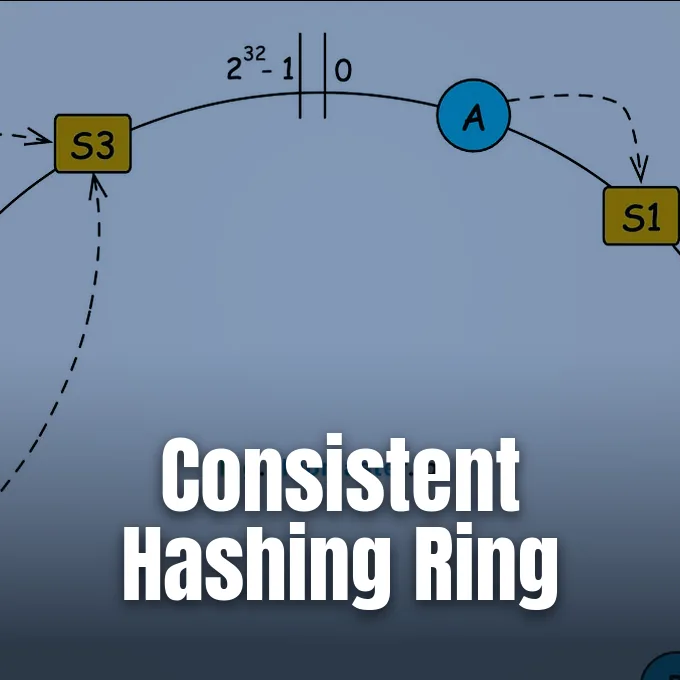
Consistent hashing is a distributed algorithmic technique that maps both storage servers and incoming data keys to a shared circular space, minimizing key reassignment when cluster membership changes [4]. In static setups, systems map requests by calculating a modulus of the key hash against the total node count. When a server crashes or capacity expands, that divisor changes, triggering broad cache misses and unnecessary data transfers. Consistent hashing resolves this vulnerability by ensuring that adding or removing a single node forces only a small fraction of keys to relocate to neighboring machines.
- Why Modulo Hashing Breaks Under Scale
- How Consistent Hashing Builds the Ring
- Key Reassignment During Node Additions and Removals
- Virtual Nodes and Load Distribution
- Managing Hotspots in Consistent Hashing Clusters
- Implementation Patterns in Production Software
- Consistent Hashing Compared to Alternative Approaches
- Academic Refinements for Cloud Infrastructure
Why Modulo Hashing Breaks Under Scale
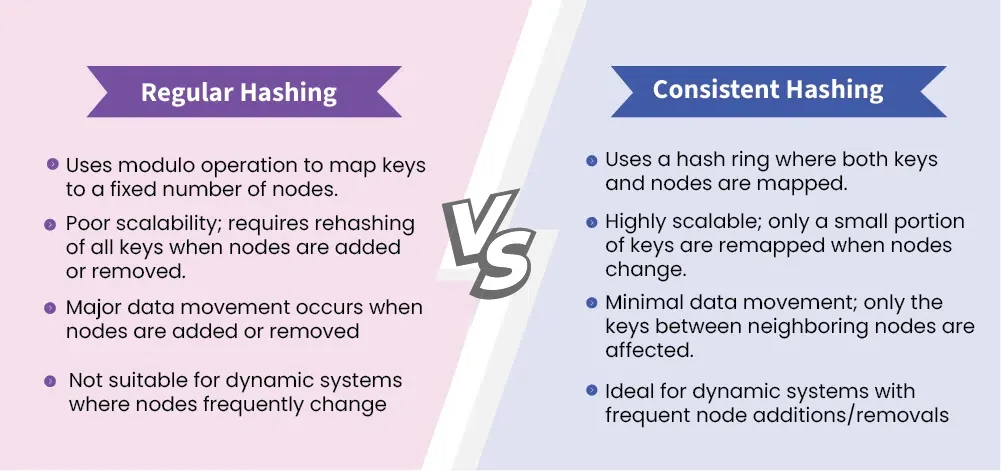
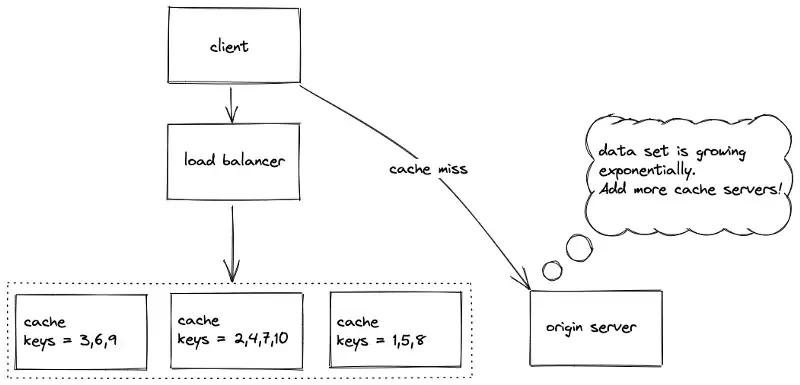
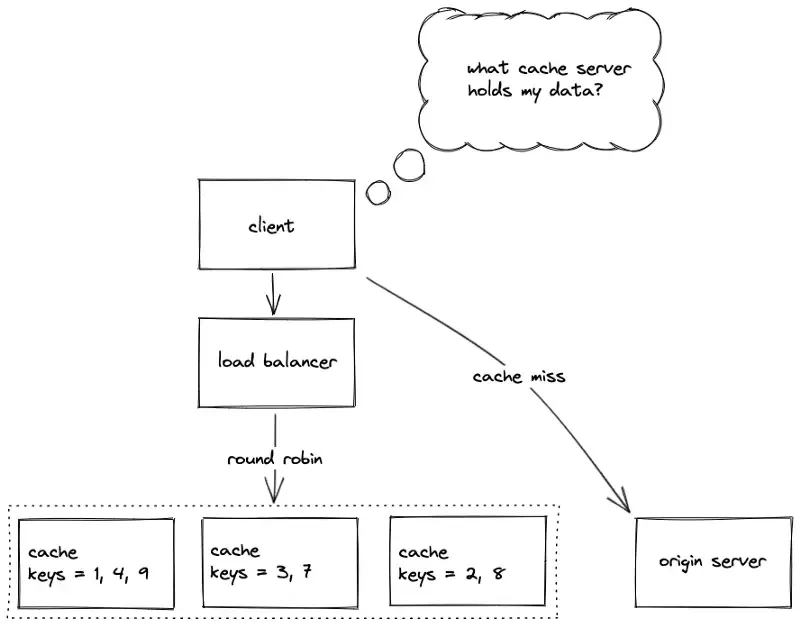
In distributed caching engines like Memcached, modulo hashing assigns incoming data records by computing a hash and applying the formula hash(key) % N, where N is the total server count in the pool [5]. For example, hashing key 42 modulo 5 routes the request to server S2. Key 17 also lands on S2 because 17 modulo 5 is 2. It is simple to code.
A single backend server addition or removal instantly shatters this static predictability when traffic grows. If an administrator adds server S5 to make six servers, the formula changes to hash(key) % 6, moving key 42 from S2 to S0 and key 17 to S5. In a test documented by developer Greg Holt for OpenStack Swift, expanding a hundred-node pool to one hundred and one nodes caused 9,900,989 of 10,000,000 keys to remap [10]. The node expansion forced 99.01% of all stored data to relocate over network links. The resulting reshuffle causes an accordion effect that invalidates cached records, driving hit rates down to near zero while background migrations saturate network adapters.
When cache entries suddenly point to empty servers, applications face what software engineers call a thundering herd, where client requests that normally hit fast memory buffers instead surge into backend databases, causing heavy query latencies and service outages [9]. Modulo routing forces distributed infrastructure to choose between painful operational lock-in and risky maintenance windows. Systems cannot grow on demand if every added machine wipes out existing state. Solving this fragility needs a circular ring.
How Consistent Hashing Builds the Ring
Computer scientists David Karger, Tom Leighton, and Daniel Lewin introduced consistent hashing in 1997 at MIT [1]. Their research targeted distributed web caches during an era when sudden traffic spikes routinely crippled web servers. Web pioneer Tim Berners-Lee later credited Daniel Lewin with solving this major bottleneck, which users of the early World Wide Web frequently experienced as slashdotting. Lewin and Leighton co-founded Akamai Technologies in 1998, deploying the algorithm on Akamai CDN edge servers. The MIT team published their findings in the STOC ’97 conference proceedings.
The ring structure spans a fixed numerical integer space, typically running from 0 to 2^32 – 1 in standard thirty-two-bit systems, wrapping its highest value directly back to zero [7]. Servers join the circle by hashing their host string or IP address. Neo Kim showed this in System Design using a ten-bit space from 0 to 1023. Data keys hash into the exact same numerical space. To find where a record belongs, a client locates the key point on the circle and travels clockwise until it meets the first server, which immediately takes ownership. For example, if S1 sits at position 300 and a key lands at 250, S1 owns it. S0 owns any key that wraps past the end.
Lookups on the ring execute with logarithmic efficiency. A client sorts all server points in memory and uses binary search to discover the smallest node value greater than or equal to the key hash [2]. Search routines resolve queries in O(log N) time, where N is the server count. Wrap-around handles boundary cases cleanly.
Key Reassignment During Node Additions and Removals
Cluster changes highlight why consistent hashing works so well in production [5]. When engineers add server S5 between nodes S1 and S2 on the ring, S5 claims responsibility only for keys sitting in the range between S1 and its own position. S2 yields those keys to S5. Every other host in the pool, including S0, S3, and S4, keeps managing its assigned keys completely untouched, meaning that adding one node to an N-node cluster moves roughly 1 / (N + 1) of the total keys. The rest of the cluster keeps serving read requests without noticing the topology change.
Node departures proceed with equal symmetry when hardware fails or maintenance begins [6]. If server S4 goes offline, the ring removes its coordinate from the active routing table. Keys previously owned by S4 now map clockwise to S0. Surviving healthy servers do not move their assigned partitions at all. Work stays localized.
The mathematical difference between these two strategies grows wider as infrastructure expands [9]. In a pool of ten servers, removing one host under modulo hashing displaces ninety percent of the entire dataset, forcing massive network transfers. Consistent hashing limits that displacement to roughly ten percent of keys. In a hundred-node cluster, a single failure affects just one percent of cached items, ensuring that the vast majority of traffic continues reaching warm cache instances uninterrupted. Predictable migration limits prevent server reboots from triggering cache storms.
Virtual Nodes and Load Distribution
Basic consistent hashing has a significant practical limitation when applied to small clusters [9]. Because standard hash functions distribute values randomly, three or four physical servers can easily hash close together. If Server A sits at 100, Server B at 200, and Server C at 300, Server A handles ninety-seven percent of keys. Server A suffers heavy hotspots.
To eliminate storage skews, architectures map each machine to multiple coordinates known as virtual nodes or vnodes [11]. In the AlgoMaster Newsletter, Ashish Pratap Singh showed how servers S1, S2, and S3 avoid clumping by using identifiers like S1-1, S1-2, and S1-3. S1 maps to points 10, 70, and 120, while S2 takes 50, 80, and 160, and S3 lands at 30, 90, and 140. Chris Moos built this into his C hash-ring library with 128 replicas per host. In distributed database deployments, Apache Cassandra configures 256 virtual nodes per machine by default. Dozens of virtual points along the perimeter smooth out density gaps, so that when a machine leaves, its load disperses evenly across many remaining peers rather than crushing one neighbor.
Virtual nodes also give administrators a clean mechanism to balance heterogeneous hardware within a shared fleet [6]. In modern data centers, servers often possess varying memory and CPU capabilities. Rather than treating all machines equally, an operator can assign four hundred virtual nodes to a powerful 64 GB host and only one hundred virtual nodes to a smaller 16 GB node. The high-capacity machine naturally absorbs four times as many ring segments without requiring custom routing rules. Capacity differences blend directly into the ring structure.


Managing Hotspots in Consistent Hashing Clusters
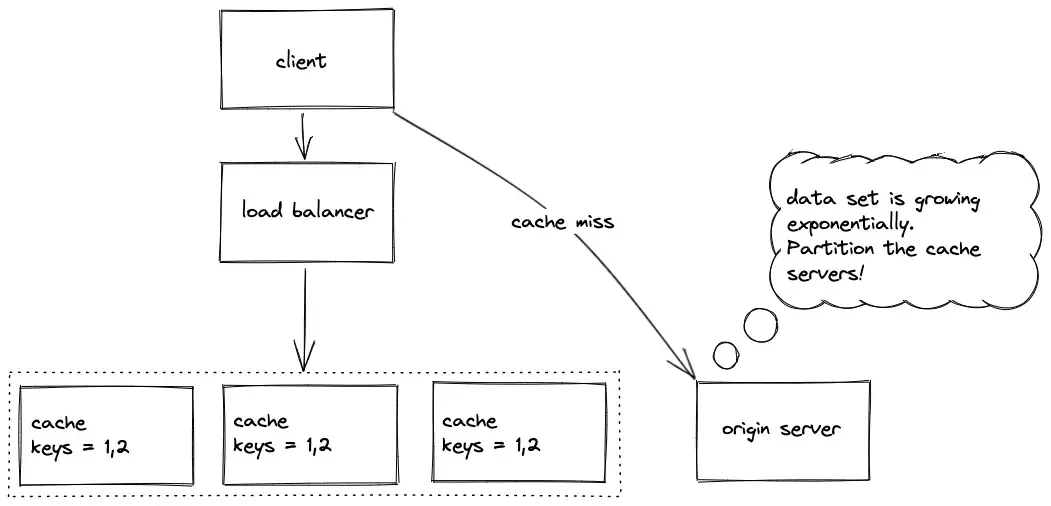
Even when virtual nodes distribute keys with mathematical precision, unexpected query spikes can still overload individual machines [6]. How does a cluster cope when a single key experiences heavy public interest? Consistent hashing balances the ownership of distinct keys, but it cannot predict the traffic volume associated with each key. If an online ticketing platform hosts reservations for a major stadium concert, that single event ID might draw a million queries a minute. Concentrated read traffic can quickly overwhelm S1.
Distributed engineering teams combat read hotspots by combining consistent hashing with read replication and key salting techniques [8]. Instead of sending all queries for a hot record to one host, developers append small random numerical suffixes to the key, such as ticket-event-0 through ticket-event-9. Each salted variation hashes to a separate ring location, scattering incoming reads among ten independent machines. Large-scale services like Amazon DynamoDB, Apache Cassandra, ScyllaDB, and Discord also monitor partition load dynamically to split hot ranges and throttle abusive callers before backends saturate. Application salting keeps backends stable.
High availability also needs storing duplicate copies of each data object on separate servers [7]. When a write arrives, the coordinator node stores the primary copy and walks clockwise to place replicas on the next N – 1 servers. Replicas skip co-located virtual nodes to provide real fault tolerance. Zone isolation protects against localized switch outages.
Implementation Patterns in Production Software
Hash ring implementations in application code store server points in sorted memory [12]. Software engineer Tom White described early Java designs with TreeMap, while Amir Salihefendic released early Python recipes. In Python, classes named ConsistentHashRing rely on the bisect module to find server positions along array indices, whereas Java platforms use java.util.TreeMap ceiling calls to return clockwise nodes in logarithmic time. Engineers prefer fast non-cryptographic hashes like MurmurHash, xxHash, CityHash, or FNV-1a to minimize CPU overhead. In C benchmarks on Intel Core 2 Duo hardware, developer Chris Moos measured over 2.2 million lookups per second when querying 128 replicas per node across 1,000 keys.
Distributed databases often pair hash rings with other structural primitives to guarantee cross-node consistency [8]. In systems like Apache Cassandra and Amazon DynamoDB, partitioned nodes periodically exchange state information using background gossip protocols. When replicas drift out of sync due to network partitions, nodes verify and synchronize partition segments using Merkle trees without transmitting entire datasets over the network. The hash ring determines which nodes own each partition, while cryptographic trees identify exact byte discrepancies between replicas during background repair jobs. Both mechanisms allow storage engines to maintain high availability and eventual consistency simultaneously within globally distributed data centers.
Storage engines also combine ring placement with probabilistic memory filters to minimize disk read latency [11]. When a query reaches a storage node identified by the ring lookup, the local database checks in-memory Bloom filters to discard missing keys instantly. Early checks discard non-existent keys before touching disk partitions. Storage layers stay responsive under heavy read pressure.
Consistent Hashing Compared to Alternative Approaches
While consistent hashing remains the standard partitioning method for distributed caches, computer scientists have designed notable alternatives [3]. In 1996, researchers David Thaler and Chinya Ravishankar at the University of Michigan invented rendezvous hashing, also known as highest random weight hashing. Systems like the GitHub load balancer, Apache Druid, Apache Ignite, IBM Cloud Object Store, and Apache Kafka use rendezvous hashing. The algorithm computes a hash for every candidate node paired with the object key: weight = hash(key, node). The client selects the node that produces the highest numerical weight. Because each pairing is computed independently, rendezvous hashing achieves minimal key remapping without managing an ordered ring structure, making it particularly resilient when nodes enter and exit pools with high frequency.
Production systems frequently weigh consistent hashing against fixed hash slots when architecting distributed storage [6]. Redis Cluster, for example, avoids circular hash rings entirely, dividing its total keyspace into 16,384 discrete slots using the formula CRC16(key) mod 16384 to partition keys across master instances. Administrators assign contiguous ranges of slots to individual master nodes. When expanding or shrinking a cluster, operators explicitly migrate slots and their associated keys between machines. Explicit slot assignments simplify inspection, but migrating keys between master instances still needs cluster coordination.

Architectural trade-offs dictate which partitioning pattern best fits a given engineering workload [2]. Consistent hashing excels in Couchbase, Riak, Voldemort, OpenStack Swift, and Akamai CDN edge servers. Systems like Apache Kafka and the GitHub load balancer favor rendezvous hashing for worker distribution. Fixed slot sharding provides predictability for transactional databases.
Academic Refinements for Cloud Infrastructure
Academic researchers continue to refine consistent hashing to overcome its residual balance trade-offs in modern cloud environments [13]. In a 2015 non-peer-reviewed preprint, authors B. Appleton and M. O’Reilly proposed multi-probe consistent hashing, which achieves an optimal peak-to-average load ratio using multiple lookups per key without storing extra virtual node coordinates. In a separate 2016 non-peer-reviewed preprint, researchers V. Mirrokni, M. Thorup, and M. Zadimoghaddam designed an algorithm with bounded loads [14]. Their algorithm sets a user-defined balancing threshold, proving that clusters can limit maximum server overload to a constant factor while moving an expected constant number of keys during node updates. These theoretical advances address key concentration without inflating memory footprint.
Recent investigations also tackle memory use in large-scale Internet of Things deployments [15]. In a 2023 study published in ACM Transactions on Internet Technology, authors C. Dong, F. Wang, and D. Feng introduced DxHash, an algorithm that generates pseudo-random sequences to place keys across server rings. Their experimental evaluations showed that DxHash reduces memory footprint by up to 98.4% compared to AnchorHash while matching state-of-the-art lookup and update throughput. The authors also formulated a weighted variant to adapt to heterogeneous server capacities.
Cloud elasticity presents unique dynamics that general hash rings were not originally designed to handle [16]. Writing in IEEE Transactions on Parallel and Distributed Systems in 2021, researcher Y. Nakatani presented Structured Allocation-based Consistent Hashing, or SACH. By separating scheduled scaling from unexpected hardware crashes, SACH maintains tight load balancing without sacrificing fault-tolerant failover speed.
- CONFERENCE PAPER Karger, D., Lehman, E., Leighton, T., Panigrahy, R., Levine, M., & Lewin, D. (1997). Consistent hashing and random trees. In Proceedings of the Twenty-Ninth Annual ACM Symposium on Theory of Computing (STOC ’97), 654-663. [Article Link]
- WEBSITE Wikipedia. (n.d.). Consistent hashing. [Article Link]
- WEBSITE Wikipedia. (n.d.). Rendezvous hashing. [Article Link]
- WEBSITE GeeksforGeeks. (2023). Consistent Hashing – System Design. [Article Link]
- ONLINE NEWS Singh, A. P. (2025). Consistent Hashing Explained. AlgoMaster Newsletter. [Article Link]
- WEBSITE King, E. (2025). Consistent Hashing for System Design Interviews. Hello Interview. [Article Link]
- WEBSITE Kim, N. (2022). Consistent Hashing Explained. System Design. [Article Link]
- WEBSITE ByteByteGo. (2026). Consistent Hashing Explained. [Article Link]
- WEBSITE Singh, A. (2026). How Consistent Hashing Works. Ajit Singh – Software Engineering Blog. [Article Link]
- WEBSITE Holt, G. (2011). Building a Consistent Hashing Ring. Swift Documentation. [Article Link]
- WEBSITE Moos, C. (2015). hash-ring: C Hash Ring Library. GitHub. [Article Link]
- WEBSITE Bayer, M. (2012). The Absolutely Simplest Consistent Hashing Example. Techspot.zzzeek.org. [Article Link]
- PREPRINT Appleton, B., & O’Reilly, M. (2015). Multi-probe consistent hashing. arXiv:1505.00062. [Article Link]
- PREPRINT Mirrokni, V., Thorup, M., & Zadimoghaddam, M. (2016). Consistent Hashing with Bounded Loads. arXiv:1608.01350. [Article Link]
- ACADEMIC JOURNAL Dong, C., Wang, F., & Feng, D. (2023). DxHash: A Memory-saving Consistent Hashing Algorithm. ACM Transactions on Internet Technology, 24(1), 1-22. [Article Link]
- ACADEMIC JOURNAL Nakatani, Y. (2021). Structured Allocation-Based Consistent Hashing With Improved Balancing for Cloud Infrastructure. IEEE Transactions on Parallel and Distributed Systems, 32(9), 2248-2261. [Article Link]


