





Intel has opened early software enablement for its upcoming silicon generations, posting the first Coral Rapids Linux kernel patches and initial code for future Razor Lake client processors. Intel engineer Tony Luck submitted the patch on November 13, 2026, registering CPU family and model identifiers for both lineups in the x86 tree [1]. The submissions arrive roughly two years before hardware shipments, giving open-source distributions time to prepare their software stacks.
Early Coral Rapids Linux Kernel Submissions
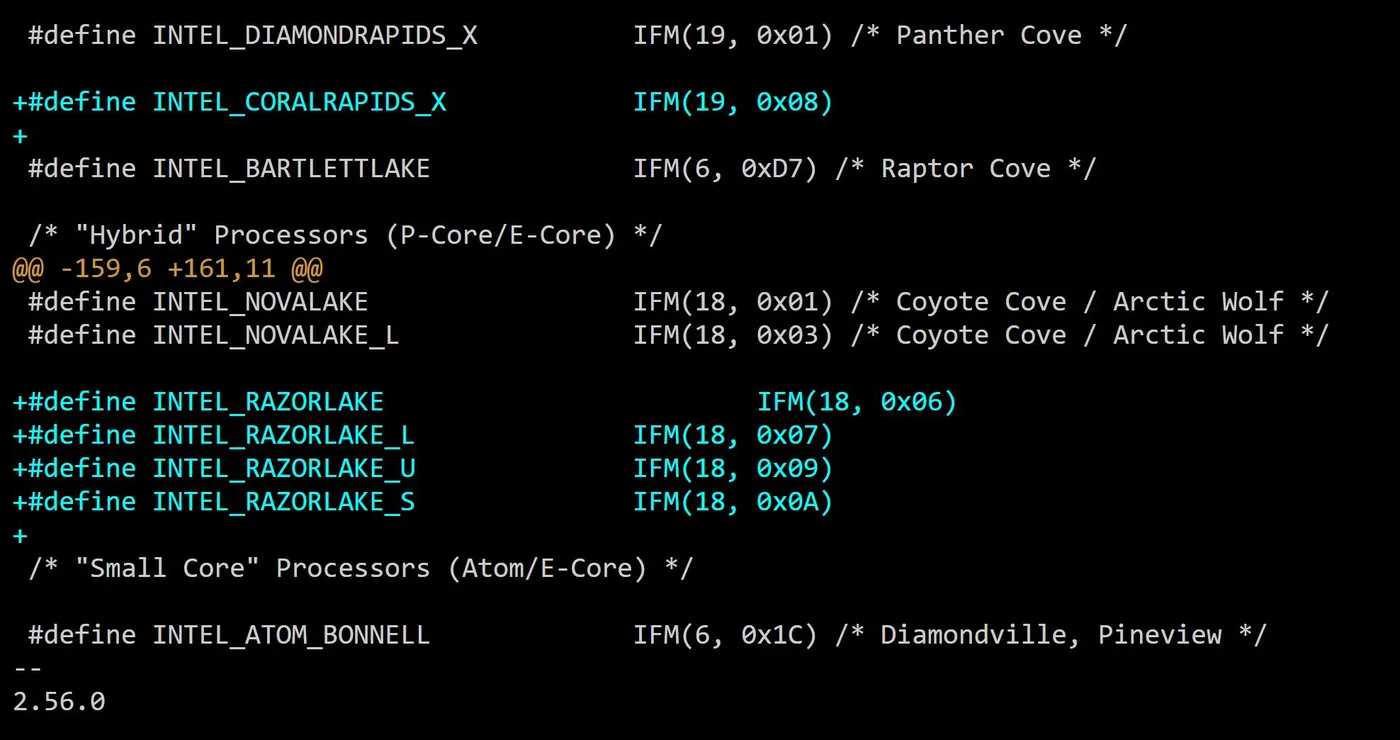
The submission to the Linux kernel maintainers is small, adding just seven lines of code to the list of Intel processor families. According to the commit notes posted by Luck, the numbers come from Intel’s November 2026 “Intel Architecture Instruction Set Extensions and Future Features” document [4]. The patch doesn’t carry performance claims, clock speeds, or core counts. Instead, it completes a necessary routine step because the kernel must recognize chip identifiers before any follow-on feature patches can hook into low-level hardware routines. Submitting this groundwork early follows Intel’s long habit of upstreaming silicon support to the open-source community years ahead of production launches. Surprises are avoided.
The two codenames belong to very different tiers in the company’s multi-year hardware plans. Coral Rapids represents Intel’s future Xeon data center family, while Razor Lake serves mainstream desktop and laptop computers [1]. Neither lineup has a retail release for 2026 or 2027. Both platforms target releases around 2028.
Upstream kernel development follows a calendar that moves much slower than retail chip packaging. Operating system distributors such as Red Hat Enterprise Linux and Ubuntu LTS rely heavily on mainline kernel releases to build their enterprise products, and merging hardware support early gives maintainers a wide window to test low-level stability across upcoming deployments [6]. When engineer Tony Luck submitted the definitions on November 13, 2026, it marked the shift of Coral Rapids and Razor Lake from secret planning into open engineering. Mainline adoption lets cloud hypervisors and performance libraries audit basic boot paths before physical silicon powers on.
Model Identifiers in Family 18 and 19
Under the x86 CPU table, the initial Coral Rapids Linux code registers Family 19, Model 8 as the identifier for the next-generation server platform [3]. That separates it from current Xeon generations and confirms it will follow Diamond Rapids in the data center family.
Razor Lake takes four separate model slots within Family 18, claiming models 6, 7, 9, and 10 [4]. These entries correspond to the L, U, and S variants designed for distinct power envelopes on desktop and mobile motherboards. Nova Lake sits in the exact same family grouping, using models 1 and 3. That shared family number reflects architectural continuity between Nova Lake and Razor Lake, with two of the new models designated for desktop sockets and two intended for mobile form factors. Because Linux needs to know a processor’s family and model numbers before later patches can enable new instructions, locking these four IDs into the tree gives engineers the base they need. Hardware teams rely on these early definitions to validate kernel boot logic.

Software architect Mian Muhammad Ashfaq said early upstream model IDs give enterprise infrastructure teams time to audit and simulate boot routines before hardware arrives [5]. Registering model numbers early lets kernel maintainers build correct hardware detection branches into operating system trees. It’s a standard step in silicon bring-up, but it confirms the hardware roadmap is moving forward in code. Without these numbers, developers can’t test compiler flags or build drivers for upcoming systems.


Razor Lake Continuity with Nova Lake Features
On the compiler side, Intel’s patches to the GNU Compiler Collection reveal key details about Razor Lake’s internal features. The target patch for the GNU Compiler Collection adds the -march=razorlake compiler flag, confirming that the upcoming client family shares the exact instruction set architecture of Nova Lake [2]. Rather than introducing a disruptive overhaul to client instructions, Razor Lake refines the platform while keeping existing instruction sets intact. Both Nova Lake and Razor Lake are slated to use Intel’s Griffin Cove performance-core design, giving desktop and mobile systems higher efficiency per clock cycle. That stability helps software developers who want reliable performance targets across successive consumer generations.
Desktop system builders also gain useful signal from the platform’s hardware continuity. Razor Lake desktop parts are expected to reuse the LGA 1954 socket introduced by Nova Lake-S, allowing motherboard manufacturers to preserve socket designs across successive product cycles [1]. In client roadmaps, earlier shifts reported around Intel’s Nova Lake APU transition to Razor Lake set the stage for these desktop and mobile lines. Socket continuity protects motherboard investments.

According to roadmap details cited by Indie Kings from disclosures linked to Intel CEO Lip-Bu Tan, Razor Lake spans consumer desktop chips (Razor Lake-S) and high-end mobile silicon (Razor Lake-AX) [2]. The line follows Nova Lake, which represents the Core Ultra 400 series built on Intel’s 18A-P manufacturing node. By keeping instruction continuity across these desktop lines, Intel lets software developers reuse compiled binaries without rewriting code for new consumer hardware. Mainstream buyers won’t need immediate compiler updates just to run existing software on the newer silicon.
Compiler Support for Coral Rapids Linux Stacks
While Razor Lake focuses on desktop continuity, Coral Rapids brings substantial instruction changes to enterprise servers. Intel submitted compiler patches adding support for AVX10_VPMLDSABFLYDQ, an instruction that accelerates packed butterfly operations used in the Module-Lattice-Based Digital Signature Algorithm (ML-DSA) for post-quantum cryptography [2]. Security engineers tracking Coral Rapids Linux enablement can prepare encryption libraries well before quantum-resistant standards become mandatory across enterprise networks. The compiler additions ensure cryptographic software compiles cleanly on modern Linux distributions.
The server patches confirm an extensive set of instructions, including AVX10.2, AMX-FP8, AMX-FP16, AMX-AVX512, AMX-TF32, APX_F, MOVRS, SHA512, SM3, and SM4 [3]. The code uses AVX10.2 rather than the newer AVX10.3 specification, which arrived too late in the development cycle to make this silicon generation. A separate patch series posted the same day addressed AVX10.3 with AVX10_BMM support, but Coral Rapids won’t carry that newer standard or the follow-on ACEv2 specification. These extensions give data center workloads hardware acceleration for matrix multiplication and advanced cryptography, providing server operators with concrete performance improvements in high-density computing racks. Early compiler intrinsics make these capabilities visible.
Intel plans to merge these compiler additions in time for GCC 17.1, which is due in early 2027 [3]. That timeline gives distributions a full year to package the updated compiler before Coral Rapids reaches commercial deployment on the Intel 14A process node around 2028. Because enterprise Linux distributions adopt major compiler releases slowly, upstreaming the -march=coralrapids target years ahead prevents software friction when new servers ship. It’s a proven practice that keeps open-source toolchains aligned with Intel’s hardware roadmap.
Long Timelines for Enterprise Distributions
For enterprise IT teams and data center operators, these upstream commits provide a reliable timestamp rather than immediate purchasing guidance. A report from linux.org.hk said IT teams in Hong Kong planning server refreshes rely on upstream progress to schedule long-term budget cycles and rack consolidation [6]. Mainline Linux kernel and compiler integration ensures popular enterprise distributions like RHEL and Ubuntu LTS inherit hardware support naturally without relying on proprietary out-of-tree vendor patches. That continuity helps operators plan infrastructure deployments years into the future, knowing operating systems will recognize the silicon on day one. Procurement cycles run in years.
The current patches represent only the opening act in a multi-stage enablement process. Future patch rounds must add performance monitoring counters for capacity planning, thermal controls for rack density, socket topology descriptions, and reliability, availability, and serviceability (RAS) features for uptime [6]. Until those deeper subsystems land in mainline trees, engineers can’t measure real workload throughput or power behavior. Software teams watching Coral Rapids Linux developments will track these upcoming submissions to see how the architecture matures over the next two years.

Developers working with early toolchains can use container platforms such as Docker or Podman to test cross-compilation environments against future CPU flags [7]. Hardware sampling and production silicon remain distant milestones, but the appearance of Coral Rapids and Razor Lake in open-source repositories confirms Intel’s 2028 roadmap is advancing on schedule. With model identifiers now locked into mainline trees, the software foundations are firmly set for Intel’s next-generation client and server platforms. Toolchain readiness ensures open-source developers have mature compiler support ready before new processors ever reach customer systems.
- ONLINE NEWS Khan, S. (2026, November 14). Intel Razor Lake gets its first Linux kernel patch ahead of a 2028 launch, with desktop chips expected to reuse Nova Lake-S’s LGA 1954 socket. Wccftech. [Article Link]
- ONLINE NEWS Indie Kings. (2026, November 14). Intel begins Linux enablement for Razor Lake & Coral Rapids. Indie Kings. [Article Link]
- ONLINE NEWS BigGo Finance. (2026, November 14). Intel opens Linux, GCC enablement for Razor Lake and Coral Rapids CPUs years before 2028 debut. BigGo Finance. [Article Link]
- ONLINE NEWS KA. (2026, November 14). Intel’s Razor Lake and Coral Rapids get their first Linux kernel patch. Tech Prolonged. [Article Link]
- ONLINE NEWS Ashfaq, M. M. (2026, November 14). Intel prepares early Linux kernel enablement for 2028 Razor Lake and Coral Rapids architectures. Cyberoly. [Article Link]
- WEBSITE linux.org.hk. (2026, November 14). First Linux kernel patches emerge for Intel’s Coral Rapids and Razor Lake. linux.org.hk. [Article Link]
- WEBSITE Hsecurities. (2026, November 14). Intel Linux kernel enablement: Coral Rapids & Razor Lake support details. Hsecurities. [Article Link]


