




Intel will not deliver a high-performance Nova Lake APU for entry-level gaming desktops, shifting the anticipated processor design into the next generation. Hardware leaker Jaykihn reported that the planned desktop SKU with 12 Xe3P graphics cores was cancelled for the Nova Lake-S family and reclassified under Razor Lake. The shift postpones a single-chip desktop configuration designed to run modern games without a discrete graphics card. Intel has not confirmed the roadmap change publicly, leaving release timetables subject to future silicon revisions. [1, 2]
A Postponed Nova Lake APU Design
The original proposal outlined a capable budget processor. According to reporting from Jake Roach at Tom’s Hardware, the cancelled SKU combined 4 P-cores, 8 E-cores, and 4 LPE-cores with 12 Xe3P graphics execution blocks to create an inexpensive onramp to a gaming desktop that bypassed standalone cards entirely. Enthusiasts welcomed that layout. Jaykihn originally flagged the beefed-up design for the Nova Lake architecture before revealing that the planned Nova Lake APU will not appear in the initial rollout. [2]
The reclassification alters delivery expectations rather than confirming fundamental architectural overhauls. Zak Killian noted for HotHardware that moving the 12Xe parts to Razor Lake primarily signals a later arrival window for prospective desktop buyers. It does not imply that Intel scrapped the underlying graphics design. Because Intel never announced an official release date for the part, the delay reflects internal catalog reshuffling. The design simply will not accompany the initial Nova Lake generation. [1]
For budget builders, integrated graphics chips represent an attractive path toward affordable gaming. Without a capable processor, users must purchase discrete add-in boards or settle for older platforms. PerEXP Teamworks highlighted a similar dynamic when reviewing how the AMD Ryzen launch expands budget AM4 options for cost-conscious desktop gamers seeking low system prices. Intel’s delay keeps that low-cost desktop field uncontested for longer. [1, 2]
Power Demands and Motherboard Delivery
Power delivery presents the most obvious physical hurdle for an ambitious integrated GPU. Technical details shared by Roach indicate that the 12 Xe3P Nova Lake APU required a dedicated 65W power budget exclusively for graphics. Supporting that load necessitated two VCCGT phases (the motherboard voltage regulation phases dedicated to integrated graphics) on compatible motherboards. Intel’s Arc B390 graphics chip in Panther Lake processors can sustain up to 80W in high-power mobile profiles. [2]
Mobile form factors balance those wattage demands differently. While Panther Lake silicon operates across handheld devices such as the MSI Claw 8 EX AI+, those portable units target conservative sustained power ceilings. Concentrating an 80W graphics component on a desktop socket creates substantial packaging density. Can mainstream desktop motherboards justify dedicated dual-phase power circuits for entry-tier processors? [2]
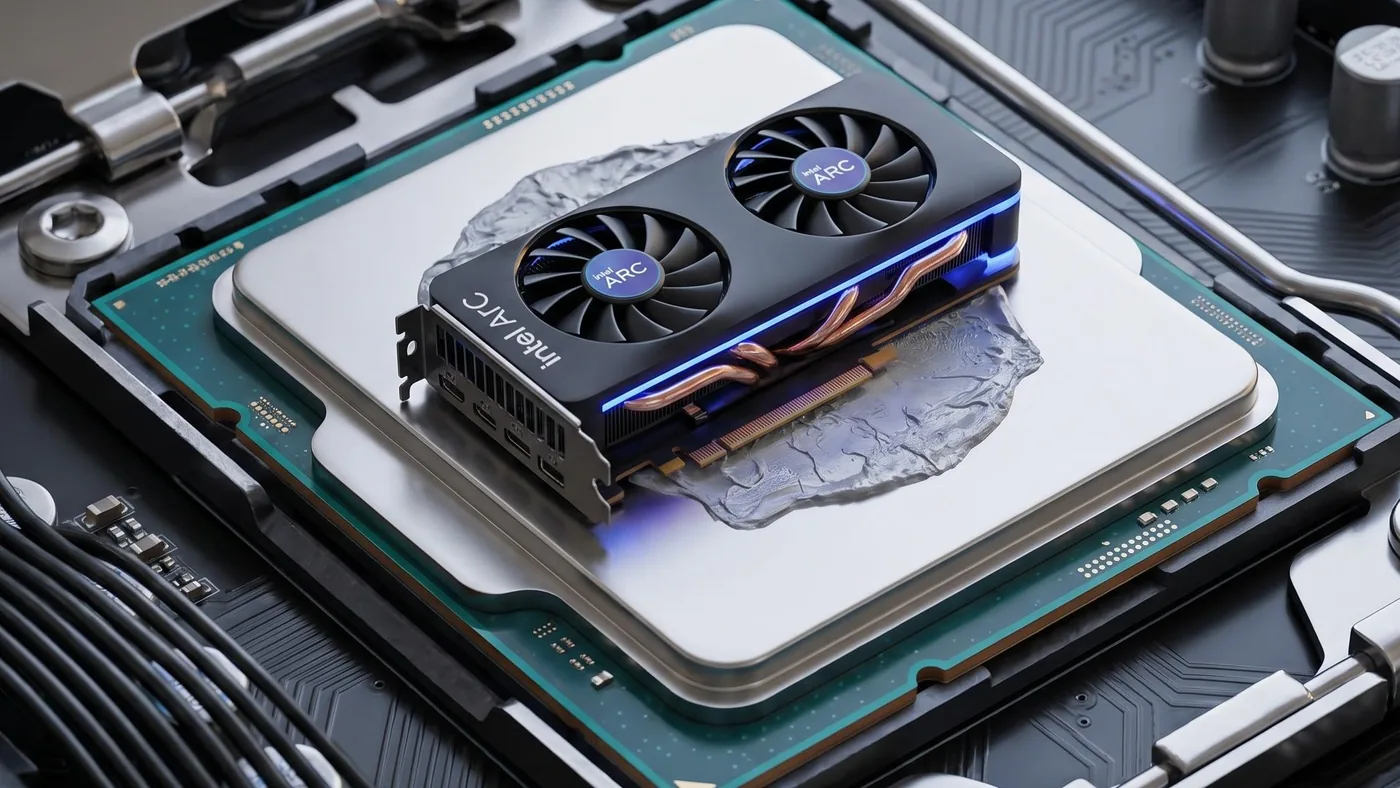
Desktop silicon requires dedicated thermal headroom. An 80W graphics processor sharing substrate real estate with general compute cores forces difficult thermal compromises during sustained gaming sessions. [1, 2]


Xe3P Graphics Architecture and Silicon Scale
The underlying graphics architecture represents a substantial architectural step over current integrated components. Intel designed the Xe3P architecture with scalability in mind, slating it for deployment in its Crescent Island AI accelerator before any desktop silicon announcement occurred. Architectural specifications detail support for up to 32 Xe cores and deeper XMX engines equipped for low-precision data types including FP8 and FP4, and an enlarged 512KB L1 cache allocated to each individual Xe core. Crescent Island pairs those execution blocks with a 32MB unified L2 cache structure. Bringing a 12-core slice of that architecture to a consumer desktop chip promised substantial improvements over earlier Arc G-series hardware. Translating that server-grade computational density into a consumer package requires extensive validation that Intel appears unwilling to rush. [1, 2]
In current hardware, Intel’s Core Series 3 Panther Lake lineup demonstrates what 12 Xe3 cores can accomplish in consumer systems. Killian pointed out that Xe3P provides a major architectural revision over the Arc B390 GPU found in Panther Lake and the Arc G3 Extreme. The enhanced microarchitecture promised higher graphics throughput for a desktop Nova Lake APU, potentially outperforming existing mobile flagships while operating within a standard desktop motherboard socket. That advantage remains deferred. [1]
Intel faced similar architectural trade-offs in mobile markets. Earlier rumors indicated that Intel planned a dedicated mobile counter to AMD’s Strix Halo and Gorgon Halo processors, designated as Nova Lake AX. That design relied on a double-wide memory bus (a broader memory interface that widens bandwidth for integrated compute tasks) paired with unified memory pools. Rumors suggest Intel postponed that mobile design as well, repositioning it as Razor Lake AX while recycling Nova Lake CPU cores. [1, 2]
Desktop Stacks and Cache Battles
Thermal constraints on the desktop platform become sharper when looking across the broader Nova Lake-S product stack. Leak disclosures cataloged by Roach reveal that Intel’s desktop lineup scales up to a flagship 52-core dual-tile model with a 175W TDP, combining (8+16)+(8+16)+4 cores with 288MB of bLLC cache. A secondary 44-core dual-tile configuration matches that 175W envelope with 264MB of cache. These high-end models appear aimed directly at high-end desktop workstations to rival AMD Threadripper processors. [2]
Lower down the stack, single-tile chips climb to 28 cores configured as 8+16+4 with 144MB of bLLC at 125W. Lower tiers scale through 24, 22, 16, 12, 8, and 6-core variants targeting 65W and 35W power bands. The 12-core graphics block would have consumed nearly the entire thermal budget of a 65W package. Power headroom remained scarce. Fitting a full 12 Xe3P graphics tile alongside primary compute cores was only ever plausible on a specialized low-core SKU designed specifically for cost-conscious desktop gaming systems. [2]
The Nova Lake generation carries immense commercial pressure for Intel following the lukewarm reception of Arrow Lake. Robert Hallock, enthusiast channel vice president at Intel, previously hinted to Tom’s Hardware that the company has plans to counter AMD’s gaming-focused X3D processors in future generations. Select SKUs are rumored to incorporate bLLC (Intel’s term for big last-level cache) to close that gaming divide. Leaked schedules point to an announcement in Q4 with retail chips arriving in Q1 2027 on the new LGA1954 socket and Z990 motherboards. [2]
The Razor Lake Alternative for Builders
Shifting the graphics-heavy silicon to Razor Lake aligns the design with updated manufacturing capabilities. HotHardware reported that Razor Lake desktop processors are slated to adopt revised P-core and E-core architectures. The node has shifted. Furthermore, Intel is expected to target TSMC N2X (the 2nm-class semiconductor manufacturing process from TSMC) fabrication for select tiles across the product line. Advanced manufacturing could alleviate the extreme thermal density bottlenecks that complicated placing an 80W-capable graphics accelerator inside the Nova Lake thermal envelope on standard desktop motherboards. [1]
Will desktop enthusiasts embrace integrated graphics once Razor Lake arrives? For budget builders, a competent 12-core GPU provides a legitimate GPU-less configuration that maintains the full customization and upgrade flexibility of a DIY PC build. Enthusiasts can assemble a modern gaming system without allocating hundreds of dollars to an entry-tier graphics card. Delaying that option means budget builders must continue navigating compromises between expensive discrete hardware and modest integrated display outputs. [1]
Intel has not published revised launch dates for Razor Lake or confirmed how it will price high-performance desktop APUs. If leaker timelines prove accurate, the mainstream Nova Lake stack will debut without an integrated graphics powerhouse, pushing the Nova Lake APU concept into the Razor Lake generation. Until Intel confirms its packaging choices onstage, system builders looking for an inexpensive single-chip desktop solution will have to keep waiting for the next generational turn. [1, 2]
- ONLINE NEWS Killian, Z. (2026, September 16). Intel’s Beefy 12-Core Xe Desktop iGPU May Slip From Nova Lake To Razor Lake. HotHardware. [Article Link]
- ONLINE NEWS Roach, J. (2026, September 15). Intel reportedly cans 12Xe option for Nova Lake-S desktop — gaming APU design said to resurface with Razor Lake. Tom’s Hardware. [Article Link]


