




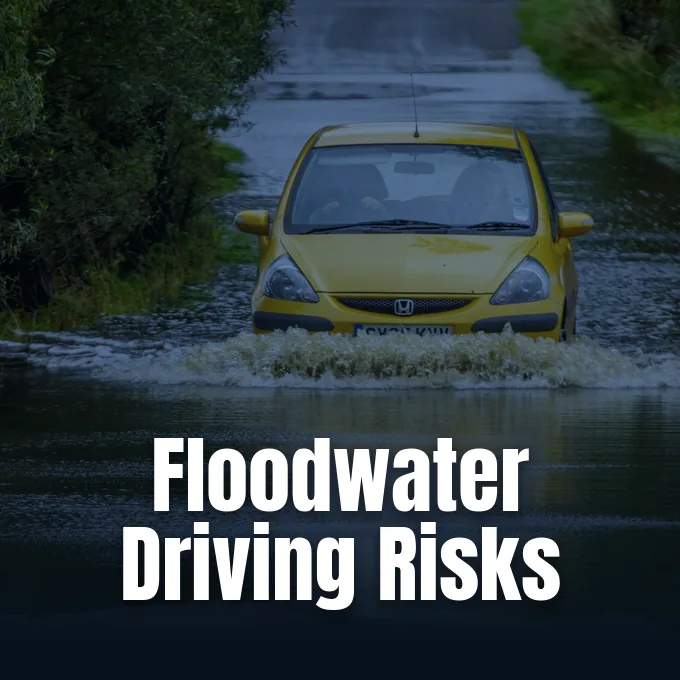
Heavy seasonal downpours regularly turn quiet thoroughfares into treacherous aquatic channels. While public anxiety during flood alerts typically centers on damaged residential property or delayed train schedules, driving through water remains the leading cause of death in vehicle-dependent regions. Intensified rainfall driven by broader shifts in global climate patterns has repeatedly transformed everyday commutes into fatal traps. Modern passenger cabins maintain water-tight seals that initially float, allowing deceptive currents to sweep automobiles into deep channels within seconds. In England alone, preventable vehicle submergences claimed high-profile lives across Derbyshire in 2021, Liverpool in 2023, and Lancashire in 2024 [2].
Why Driving Through Water Becomes Fatal
Investigating the behavioral motivations behind these fatal incidents requires analyzing how motorists assess environmental road hazards. A research team comprising Matthew Watkins, M. B. Javareshk, T. Goodge, J. Blundell, and D. Crundall published an empirical evaluation in Transportation Research Part F: Traffic Psychology and Behaviour, examining human decision-making at flooded roadway junctions [1]. Their empirical investigation revealed that motorists routinely underestimate hydrological forces when approaching submerged crossings. Much like other deadly meteorological disasters across Europe, localized flash floods expose vulnerable populations who assume familiar commuter routes remain safe during torrential storms. Watkins also detailed these vehicle dynamics in a 2026 academic preprint, though readers should note that this specific preprint document has not yet undergone formal peer review [2].
Drivers frequently miscalculate the physical consequences of driving through water during sudden storms. Most vehicle operators mistakenly assume that the absolute worst outcome of crossing an inundated section of tarmac is an expensive repair bill for ruined wiring or a stalled transmission. The reality is far grimmer. Moving water exerts immense lateral pressure against vehicle body panels, converting ordinary family sedans into unguided watercraft that drift away from solid ground. When a floating car encounters submerged boulders, bridge parapets, or drainage culverts, it frequently capsizes, resulting in catastrophic drowning before emergency rescue crews can arrive [2].
Misjudging Flow Velocity and Hidden Depths
To quantify public misperceptions surrounding flood hazards, Watkins and colleagues conducted a comprehensive national survey involving 185 licensed drivers across the United Kingdom. The survey findings revealed a striking asymmetry in driver comprehension. Approximately 80% of participants demonstrated accurate risk awareness regarding static water depth, correctly identifying depths above 25 centimeters (roughly 10 inches) as unsafe for standard vehicular passage. Why do knowledgeable motorists still plunge into life-threatening floodwaters? The survey answers clarified that drivers evaluate hazard severity almost exclusively through vertical depth while remaining virtually blind to the destructive kinematic momentum of moving currents. When researchers asked drivers specifically how they would assess flow velocity, participants repeatedly answered in terms of water depth rather than current speed [1].
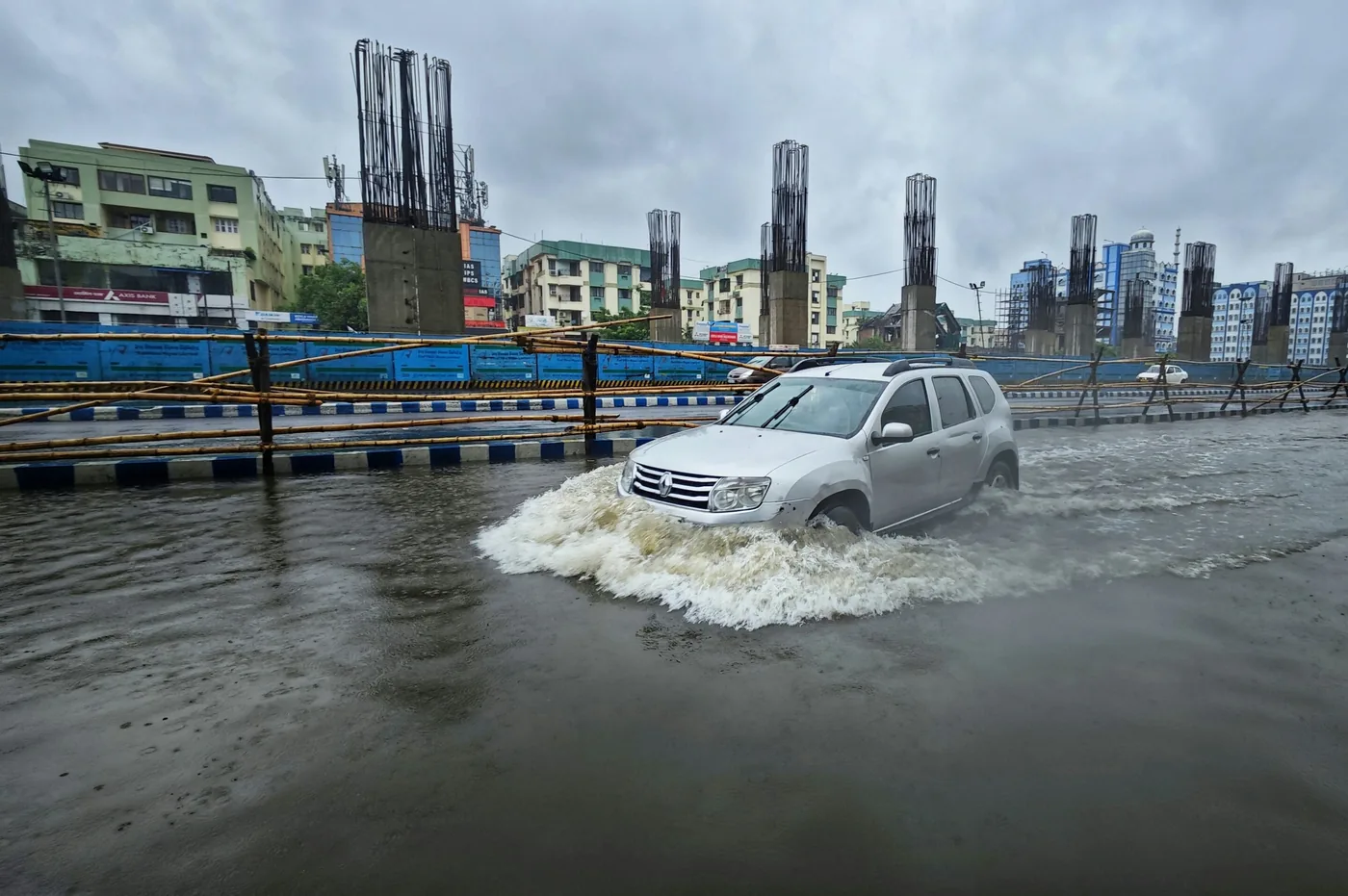
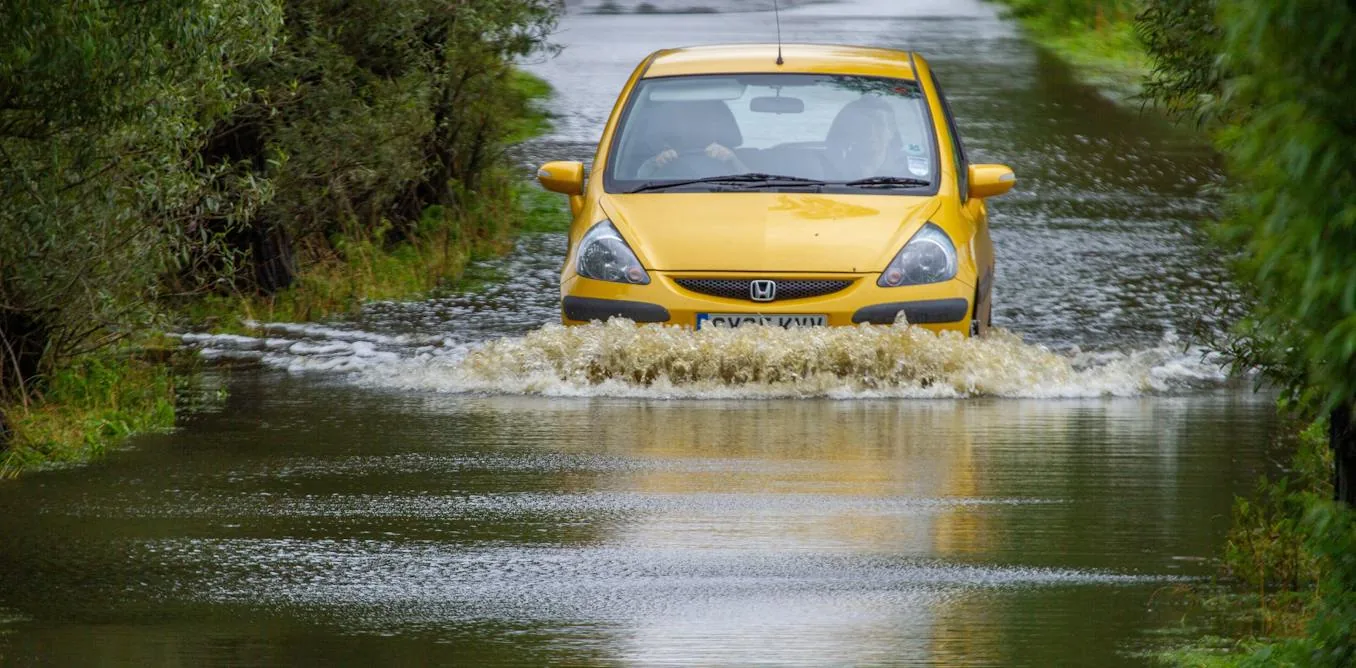
Depth alone does not dictate survivability. Standing water may submerge an engine block and immobilize electrical systems, but swift currents generate relentless dynamic thrust that shears tires off the pavement surface. Surface disturbances provide crucial perceptual cues. Visible surface ripples or churning whitewash signal that floodwater is traveling at hazardous velocities, yet untrained motorists routinely overlook these hydrodynamic indicators. Because human vision struggles to gauge transparent fluid velocity from behind a windshield, drivers consistently underestimate how driving through water exposes their vehicles to irresistible hydrodynamic drag [2].
Vehicle Buoyancy and the Overturning Risk
Modern automobiles float surprisingly well. When driving through water, engineered seals preserve cabin air, creating spontaneous buoyancy that swiftly detaches tires from the roadbed [2].
Automotive manufacturers construct passenger compartments with tight acoustic dampening and weatherproofing barriers (such as dense rubber door gaskets) that unintentionally trap hundreds of liters of air inside the cabin. When driving through water rising above the door sills, Archimedes’ principle asserts itself with devastating speed. The vehicle transitions from a roadbound machine governed by wheel friction into a floating vessel governed by fluid displacement. Once tires lose physical purchase on asphalt, directional steering and braking systems become entirely useless, leaving the car at the mercy of downstream river flows [2].
Floating unsteadily down a floodway constitutes only the initial stage of vehicle loss. As the unmoored chassis drifts with the torrent, it inevitably strikes immobile obstructions such as bridge abutments, boundary fences, or submerged drainage embankments. Impact forces during this buoyancy phase immediately destabilize the vehicle’s elevated center of gravity, causing the cabin to roll over into deeper water. Inverted vehicles rapidly fill with turbid water as hydraulic pressure seals the doors shut, leaving trapped occupants with virtually no viable escape route [2].


Mechanical Vulnerabilities Across Engine Types
Motorists often assume that larger personal vehicles grant universal immunity during severe weather events. However, automotive mechanical architecture varies substantially across makes, models, and fuel systems. In conventional internal combustion engines, air intake manifolds sit at varying elevations within the engine bay. If water splashes into the intake tract, liquid enters the cylinders and causes instant catastrophic failure, a destructive phenomenon known mechanically as hydrolock. Pistons shatter instantly. Because water cannot compress like atmospheric air, hydraulic pressure destroys internal motor components and permanently halts vehicle propulsion [2].
Crucially, even vehicles of identical exterior dimensions and chassis ride heights perform entirely differently when driving through water across flooded roadways. Differences in air intake positioning between gasoline and diesel configurations mean that a depth safely negotiated by one model can instantly disable another vehicle traveling in identical conditions. Motorists observing a preceding automobile successfully cross a flooded stretch routinely infer that the crossing is passable for their own car. This peer copying represents a deadly gamble. What worked for a high-clearance delivery truck or an elevated diesel crossover will prove fatal for a lower passenger sedan attempting the exact same traversal [1].
Driver Behavior and Roadside Signage Failures
Why do educated drivers deliberately ignore hazardous conditions on familiar routes? The study by Watkins and co-authors examined regulatory compliance, discovering that UK motorists display far greater respect for mandatory stop signs and posted speed limits than for static flood warnings. In fact, The Highway Code in the United Kingdom contains virtually no official guidance on how motorists should approach submerged road crossings or negotiate forded highways. Left without formal driver education on water hazards, individuals contemplating driving through water rely on informal cognitive heuristics. Drivers routinely justify dangerous crossings by watching other motorists proceed ahead of them, treating another car’s temporary success as definitive proof of safety [1].
Distrust toward static roadside signage further compounds this systemic behavioral breakdown. Local municipal councils and highway maintenance agencies frequently leave folding flood warning boards deployed on road shoulders days or weeks after receding floodwaters have drained away. Motorists quickly learn that static signs often indicate dry tarmac, breeding widespread skepticism and complacency. To address this failure, the research team developed an experimental dynamic LED signage prototype capable of providing real-time flood warnings. Testing driver responses across ten comparative signage conditions, the researchers demonstrated that dynamic digital displays achieved superior memorability and compliance for eight out of ten signs, with drivers fixating on the prototype flood sign at nearly double the rate of conventional static boards [1].
Dynamic Signage and Practical Flood Guidelines
Mitigating roadway deaths demands clear behavioral thresholds paired with modernized warning infrastructure. When motorists encounter standing water across an unfamiliar road, navigating the hazard requires measuring physical depths against surrounding landmarks rather than guessing road centerlines. Water gauges at fords, partially submerged fence posts, road boundary markers, and grass verges offer reliable reference indicators. The researchers established strict numerical benchmarks: drivers of standard passenger cars should never enter standing water deeper than 10 centimeters (approximately 4 inches), while sport utility vehicles with elevated chassis should avoid water surpassing 30 centimeters (roughly 12 inches) [2].
Road topography introduces further complications that deceive oncoming drivers. The deepest channel does not always sit in the center of the crown; compromised road shoulders, collapsed culverts, and washed-out road edges frequently create invisible abysses beneath murky surfaces. Whenever visible ripples indicate rapid crosscurrents, driving through water becomes an unacceptable gamble. Turn around immediately. If any doubt remains regarding flow speed or submerged depth, executing a prompt turn and seeking an alternative overland route preserves vehicle integrity and saves human lives [2].
- ACADEMIC JOURNAL Watkins, M., Javareshk, M. B., Goodge, T., Blundell, J., & Crundall, D. (2026). An investigation into driver’s perceptions of road flooding and adherence to signage. Transportation Research Part F: Traffic Psychology and Behaviour, 120, 103639. [Article Link]
- PREPRINT Watkins, M. (2026). Driving through water is the biggest cause of death during floods – here’s how it can happen. [Article Link]
APA 7: PerEXP Teamworks. (2026). Most Flood Fatalities Occur When Driving Through Water. https://perexpteamworks.com/en/driving-through-water-flood-deaths/


