



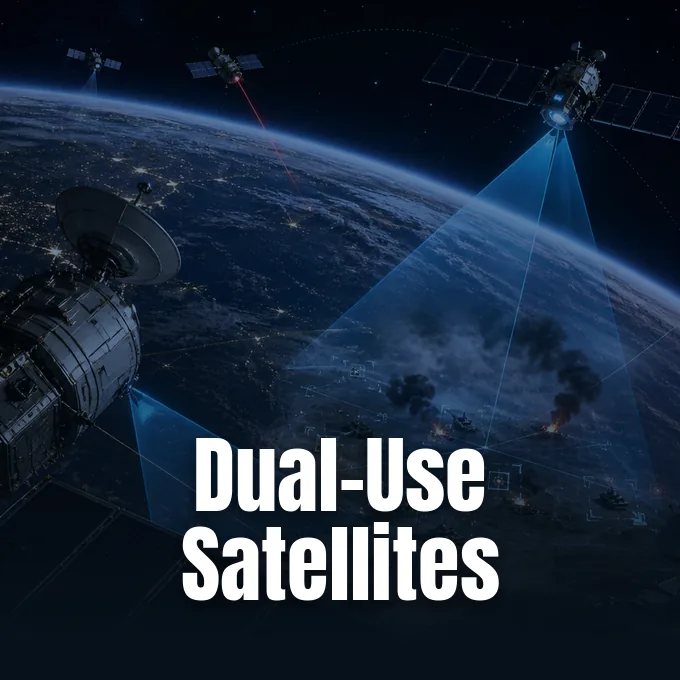
Dual-use satellites now carry civilian broadband and military communications through the same orbital hardware, blurring the historic line between peaceful space flight and open warfare. Researchers Carolle Varughese, Sarah Hendrica Bickerton, and Priyanka Dhopade examined this friction in an unreviewed 2026 preprint analyzing New Zealand’s growing space ties. While governments rely on private constellations for daily navigation and finance, defense contracts turn those same commercial platforms into potential military targets. Ministers committed nearly $24 million toward an overseas defense satellite constellation while New Zealand owns zero sovereign hardware in orbit [1].
- What Are Dual-Use Satellites?
- New Zealand and the Wideband Global SATCOM Dilemma
- Can Dual-Use Satellites Lose Civilian Protection in War?
- Commercial Satellite Constellations on the Tactical Battlefield
- Targetability Versus State Responsibility Under the Outer Space Treaty
- Why Orbital Debris and ASAT Weapons Complicate Space Governance
What Are Dual-Use Satellites?
Dual-use satellites are spacecraft built to carry out civilian tasks while also supporting military missions. In earlier decades, governments built separate security orbiters, keeping civilian observation craft detached from defense communications. That division faded as private aerospace companies launched multi-purpose platforms that sell high-speed data access to ordinary citizens, businesses, and armed forces alike. A single imaging platform can deliver surface maps for agriculture, assess urban growth, and track troops moving near an international border [4].
Everyday economic systems depend on orbital links for banking, shipping logistics, and atmospheric tracking. Environmental monitoring programs show how orbital missions map Earth’s atmosphere and oceans to help scientists predict storm damage and observe climate patterns. Yet the same optical sensors and synthetic aperture radar tools that trace ocean currents can pinpoint hostile vessels at sea during naval confrontations. As space technology writer Ruta S Kulkarni said, the line between peaceful space activities and military operations continues to blur as low Earth orbit becomes crowded with dual-purpose hardware. When private networks handle both tasks, identifying whether an orbiting spacecraft serves a peaceful purpose or a tactical war effort becomes difficult for rival states to determine, leaving civilian data streams vulnerable to disruption [4].

New Zealand and the Wideband Global SATCOM Dilemma
New Zealand’s space industry grew into a sector worth an estimated NZ$2.5 billion, as revealed during the Christchurch Aerospace Summit. Government officials moved to deepen ties with overseas partners, allocating nearly $24 million toward a satellite project led by the United States Department of War for the Wideband Global SATCOM constellation. New Zealand also renewed its participation in Operation Olympic Defender, a multinational military alliance that seeks to safeguard orbital security. However, this defense alignment creates an acute dilemma because New Zealand does not own the satellites that deliver its civilian banking, navigation, and telecommunications [1]. If foreign satellite operators restrict data access or lose orbital nodes during a confrontation, New Zealand has no say over private network decisions [2].
Industrial economies share this orbital vulnerability. The space strategy of the United Kingdom estimates that satellite services contribute 18% of its GDP, showing how reliant basic civilian commerce has become on orbital hardware. Canadian Prime Minister Mark Carney described this shifting international environment as a “rupture” in the global order, where great power rivalries force nations to seek self-protection as long-standing international rules weaken. In response, the United Kingdom created the Space Effects Squadron to counter orbital threats [1].
Middle powers must now balance national security arrangements against the risk of escalating international tensions. Signals meant to protect national infrastructure often look threatening to neighboring states, turning deterrence measures into a double-edged sword. Drawing on legal and scientific expertise offers one avenue for smaller nations to encourage transparency and lower the likelihood of miscalculation in orbit [1].

Can Dual-Use Satellites Lose Civilian Protection in War?
Dual-use satellites lose their legal protection as civilian objects under international humanitarian law whenever their services make an effective contribution to military action. Article 52(2) of Additional Protocol I to the Geneva Conventions states that civilian objects become lawful military objectives if their “nature, location, purpose or use makes an effective contribution to military action” and their neutralization offers a “definite military advantage” under circumstances ruling at the time [3]. Commentary from the International Committee of the Red Cross specifies that this advantage cannot be merely potential or indeterminate [6]. Consequently, a privately owned spacecraft ceases to enjoy immunity the moment an armed force uses its data stream to direct combat forces or guide weapons [3].
Private contracts make this legal threshold difficult to manage during modern hostilities. Defense agencies frequently purchase imagery or communications from private contractors rather than building government platforms [5]. Maxar Technologies, for example, sells high-resolution Earth pictures to urban planners and humanitarian groups while also supplying imagery used to train military personnel and conduct tactical assessments [3]. During the 2022 fighting in Ukraine, Maxar captured images of a 40 km-long Russian military column near Kyiv, while aid workers simultaneously used data from the same provider to track refugee movements [6]. Because military and civilian data travel across identical sensors, an adversary targeting the military data link inevitably damages civilian users who share the payload [5].


Commercial Satellite Constellations on the Tactical Battlefield
Space systems first took on direct combat roles during Operation Desert Storm in 1991, an intervention often described as the first “space war” because coalition forces used the Global Positioning System for navigation and precision airstrikes. Three decades later, military reliance shifted toward massive commercial satellite constellations (CSCs) operating in low Earth orbit. In Ukraine, units relied on SpaceX Starlink terminals to stream live drone reconnaissance video and preserve military command networks, prompting Ukraine’s Minister of Digital Information to call the private network the “blood of the entire Ukrainian communication infrastructure”. This wartime coordination showed that private satellite networks can sustain a national defense effort when terrestrial communications collapse [6].
Military forces expanded these private integrations during the US-Israel War against Iran in 2026. Armed forces linked Starlink communications to the Low-cost Uncrewed Combat Attack System (LUCAS), a loitering munition platform built to counter Iran’s Shahed-136 drone architecture. Task Force Scorpion deployed these networked drones within a contested electronic-warfare battlespace to strike opposing positions. Identifying a specific targetable node within such a mega-constellation presents enormous practical barriers, because thousands of small satellites circle Earth at 17000 miles per hour. An adversary attempting to sever tactical military feeds cannot isolate an individual civilian satellite without attacking the entire shared network [6].
Targetability Versus State Responsibility Under the Outer Space Treaty
The intersection of military targeting rules and international space law generates a profound legal contradiction. In an analysis published by VU Amsterdam, legal scholar Sofia Niiles, with editing by Caterina Ecclesia and Lara Lamie, examined how commercial satellite operations disrupt existing treaties. Under Article VI of the 1967 Outer Space Treaty, states bear international responsibility for all national space activities, whether carried out by governmental agencies or private non-governmental corporations. The licensing state must authorize and continually supervise the space activities of its licensed companies, remaining legally accountable for their conduct in orbit [3].
This regulatory structure clashes with the laws of armed conflict. International humanitarian law evaluates whether an object may be attacked based on the tactical role it plays in combat, regardless of who owns it. If State A licenses a private communications satellite, and the military forces of State B use that satellite during an armed conflict against State C, State C can lawfully target the spacecraft under humanitarian law. Yet space law continues to attribute the satellite’s activities to State A, the licensing state that never entered the war. Communications links also depend on terrestrial and lunar ground station routing networks that remain situated on neutral civilian soil. This legal mismatch erodes the concept of neutrality and risks drawing non-belligerent nations into international combat disputes [3].

Why Orbital Debris and ASAT Weapons Complicate Space Governance
Kinetic attacks on dual-use satellites threaten the long-term usability of low Earth orbit. When an anti-satellite weapon strikes a target at orbital velocity, the kinetic collision shatters the hull into thousands of hypervelocity fragments that threaten every surrounding spacecraft. The 2019 Indian ASAT test, for instance, created over 400 pieces of trackable space debris that orbited for years with functioning satellites [6]. Kiran S Pillai, founder of the Vastuta Think Tank, explained in defstrat.com that private satellite systems generally prioritize low production costs over physical armor, leaving them vulnerable to kinetic strikes, signal jamming, and cyberattacks against ground relays [5]. Because distributed mega-constellations cannot be dismantled easily with conventional weapons, nations may face temptations to deploy indiscriminate methods that endanger the entire space environment [6].
Diplomatic efforts to govern military space activities remain divided by competing geopolitical priorities. Western nations advocate applying international humanitarian law and the Woomera Manual on International Law of Military Space Operations to orbital conflicts, arguing that clear rules of engagement limit civilian suffering. Conversely, China and Russia oppose formalizing targeting rules for orbital combat, warning that such standards legitimize space warfare, and instead promote the Prevention of the Placement of Weapons in Outer Space treaty to ban space-based hardware [6]. Resolving this diplomatic impasse requires binding transparency standards that separate civilian infrastructure from military command links before an orbital crisis disrupts vital global services [1].
- PREPRINT Varughese, C., Bickerton, S., & Dhopade, P. (2026). The same satellite can have military and civilian functions. This creates a dilemma for NZ. [Article Link]
- ONLINE NEWS Varughese, C., Dhopade, P., & Bickerton, S. H. (2026). The same satellite can have military and civilian functions. This creates a dilemma for NZ. The Conversation. [Article Link]
- ONLINE NEWS Thompson, E. (2026). Space power and its double edge: New Zealand’s growing satellite dilemma. Newsealand. [Article Link]
- WEBSITE Niiles, S. (2026). Dual-Use Satellites and the Law of Armed Conflict: The Tension Between Targeting Rules and State Responsibility in Outer Space. VU Amsterdam. [Article Link]
- ONLINE NEWS Kulkarni, R. S. (2026). How invisible dual-use satellites are blurring the dangerous lines between peace and war in space. Spacetech Times. [Article Link]
- REPORT Pillai, K. S. (2026). Civil Military Convergence in Space: When Commercial Satellites Become Military Targets. defstrat.com, 20(1), 39. [Article Link]
- ONLINE NEWS ISSRA Insights. (2026). Orbiting Combatants: “Commercial” Satellite Constellations and the Law of Armed Conflict. [Article Link]
APA 7: TWs Editor. (2026, October 5). Can Dual-Use Satellites Become Lawful Military Targets? PerEXP Teamworks.


