





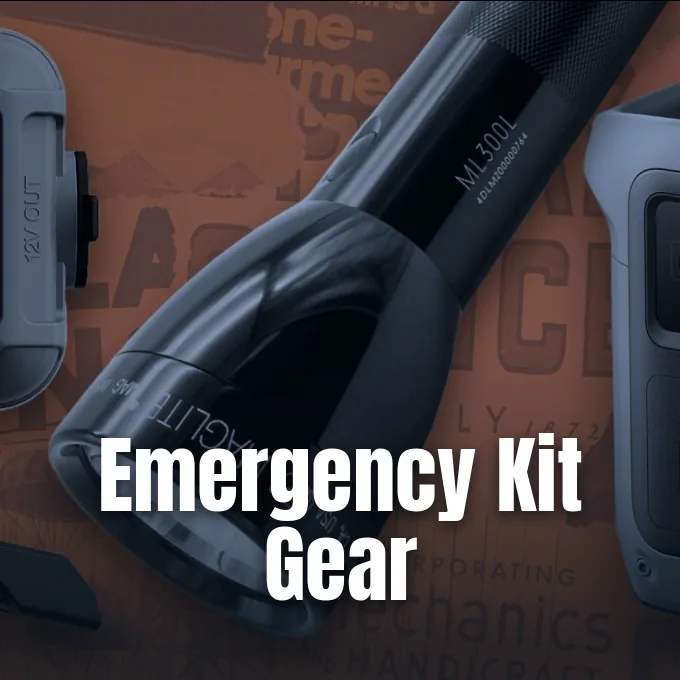
Stan Horaczek reported for Popular Science that seasonal holiday discounts offer households a practical way to assemble an emergency kit without paying steep retail prices. Federal guidance from the Ready.gov initiative advises assembling basic survival gear well before winter freezes hit, though purchasing emergency hardware all at once often strains family budgets. Horaczek said that “building a kit yourself means you know how every piece works before the lights go out” [1].
Emergency Kit Advice From FEMA
Disaster preparedness begins with simple household inventory rather than expensive prepackaged emergency kit boxes. Federal disaster recommendations organized by Ready.gov structure items into a basic disaster supplies kit, advising families to separate grocery staples from hardware gear. Bottled drinking water, non-perishable canned food, a manual can opener, medical prescriptions, small paper cash bills, pet food, and official paper identification copies belong in a filing cabinet or pantry rather than an online shopping cart. Athena Aktipis authored a guide showing that a starter go-bag and vehicle kit take very little effort to assemble when using existing household goods. Horaczek advised shoppers to “skip what you already own” such as working flashlights, standard duct tape rolls, or plastic storage bins. He urged families to put saved funds toward backup power and car recovery gear instead [1].
Certain life-saving supplies rarely receive holiday markdowns. Brand quality matters far more than seasonal discounts. Popular Science found no holiday price cuts on NOAA weather alert radios or name-brand first aid kits. Horaczek urged families to purchase a certified hand-crank weather alert radio and a stocked medical kit at regular retail prices instead of settling for unreliable unbranded discount bundles. Dependable communication channels warn families of incoming storms when telephone networks fail [1].
Portable Power Stations for Outages
Electrical grid failures leave households cut off from heating controls, communications, and lighting unless they maintain dependable storage batteries. The Bluetti Elite 30 V2 offers an affordable entry into home power backup at $227, marked down from its regular $449 retail price on Amazon. Bluetti built the unit with a 288Wh lithium iron phosphate (LiFePO4) battery rated for more than 3,000 charge cycles. The system recharges to 80 percent within 45 minutes between winter storms. Its 600W inverter supplies sufficient current to run internet modems, Wi-Fi routers, home lighting, and mobile phone chargers. At roughly 9.5 pounds, the unit moves easily between rooms, although its 288Wh capacity cannot run kitchen refrigerators [1].
Larger power stations handle heavier electrical draws when storms knock down distribution lines for multiple days. The EcoFlow RIVER 2 provides a 256Wh LiFePO4 battery with a 300W inverter for $209, down from $319, which EcoFlow says recharges in about one hour. For broader household needs, the Bluetti Elite 100 mini delivers 1,004.8Wh of capacity for $379.99, reduced from $799, though its 700W inverter limits peak wattage. Meanwhile, the EcoFlow DELTA 3 Classic costs $438.90, discounted from $559. It packs 1,024Wh of storage with an 1,800W output, a 3,600W surge capacity, a 100W USB-C port, and a 10-millisecond uninterruptible power supply mode. Bluetti also reduced its Elite 100 V2 to $493 from $729, which provides 1,024Wh of capacity and 1,800W output [1].
Compact power banks keep personal phones running when families step away from heavy battery stations. The EcoFlow Rapid 20,000mAh bank costs $29.99 with a built-in cable, a digital display, and 45W charging. Anker sells its Zolo 20,000mAh bank for $32.99, while its 25,000mAh laptop bank drops to $91.19 with 165W output across three USB-C ports. Additionally, the EcoFlow TRAIL 200 DC station costs $89, supplying 192Wh of LiFePO4 power without an AC outlet [1].
Vehicle Jump Starters and Tire Tools
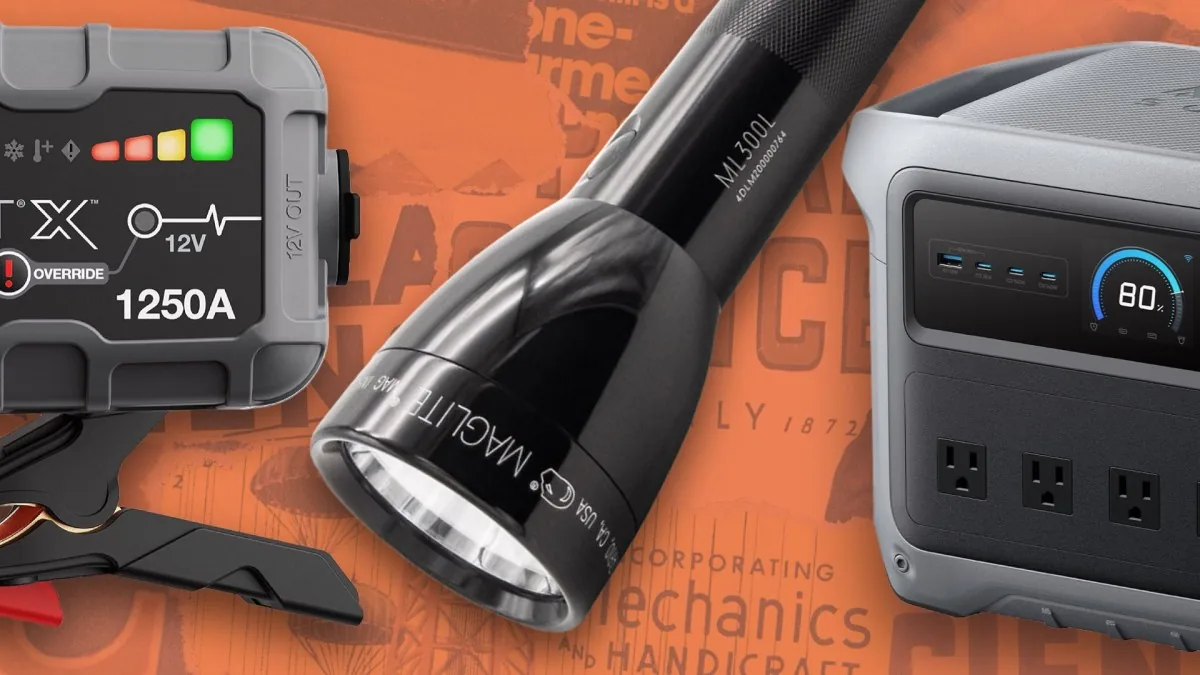
Freezing temperatures weaken vehicle batteries during cold weather. Motorists can find themselves stranded in driveways or on remote roads without assistance. The NOCO Boost X GBX45 jump starter sells for $99.96 on Amazon. It delivers 1,250 peak amps capable of starting gasoline engines up to 6.5 liters and diesel engines up to 4.0 liters. NOCO equipped the unit with spark-proof clamps, reverse-polarity protection, and an integrated 100-lumen light with SOS and strobe patterns. Its bidirectional 60W USB-C port lets drivers recharge drained mobile phones inside a disabled car during winter storms. Heavy pickup owners running larger diesel engines can choose the Weego 70, which drops to $109.99 from $154.99 with a 2,500-amp rating suitable for all gas motors and diesels up to five liters [1].
Keeping tires properly inflated and starter batteries conditioned prevents roadside breakdowns before winter travel begins. The NOCO GENIUS1 battery charger costs $23.77, down from $39.95. It supplies a 1-amp charge with temperature compensation for cold garages. For road emergencies, the Schumacher SL1674 jump starter provides 1,500 amps with 10W wireless charging for $77.62. For tire emergencies, the NOCO AIR10 inflator sells for $79.96, running off 12V vehicle sockets to fill a tire from zero to 40 PSI in 3.8 minutes. Drivers who carry these tools inside a car emergency kit can resolve minor issues without calling roadside assistance. To keep phones charged on the road, the NOCO XGrid XV65 two-port USB-C car charger costs $20.96. The two-port plug converts a running vehicle into a 65W charging station [1].


Flashlights for Extended Blackouts
Rechargeable lights work well during brief blackouts. However, multi-day winter power outages demand lighting hardware that operates reliably on disposable alkaline cells without needing charging cords. The Maglite ML300L 4D LED flashlight drops from $59.99 to $42.29 on Amazon, using four standard D cells to generate up to 1,002 lumens of illumination across a 511-meter beam while delivering up to 434 hours of runtime on its lowest setting. It weighs several pounds. Users should pair this heavy aluminum torch with hands-free headlamps when checking basement breaker panels. Smaller pocket options also receive discounts, including the two-cell Mini Maglite Pro for $18.74 with a holster, spare batteries, and a 332-lumen output with candle mode [1].
Hands-free illumination keeps fingers free for work. The Coast FL85R rechargeable headlamp costs $34.96. It casts a 1,000-lumen focusing beam with white, red, and green diodes for outdoor repairs. Budget buyers can purchase the Energizer LED Headlamp PRO two-pack for $15.79. Both headlamps feature IPX4 water resistance and a 260-lumen output. For room lighting, the Coleman Classic rechargeable LED lantern sells for $37.79. Pocket carry options include the ThruNite Archer 2A Pro for $29.95 with IPX8 waterproofing and the Coast Slayer flashlight for $50.52. In addition, a 48-pack of Energizer AA and AAA alkaline batteries costs $21.84, while 24 cold-resistant Ultimate Lithium AA cells sell for $33.11 to keep emergency lights functioning in freezing conditions [1].
Clean Water Storage Solutions
Federal disaster guidelines state that every individual needs at least one gallon of clean drinking water each day during an extended winter storm crisis. The Scepter 2.5-Gallon Military Water Container sells for $34.15 on Amazon. It features food-grade, BPA-free plastic construction that stacks securely without collapsing under pressure. A matching spring-loaded Scepter military spout costs $21.56. This accessory prevents accidental spills when pouring heavy water cans into cooking pots. Standard thin grocery store water jugs often split and leak when stored for several months in cold basements or vehicle trunks. Investing in rugged military containers ensures households maintain sanitary hydration reserves when municipal water treatment plants lose power or issue precautionary boil-water notices following stormy weather flooding [1].
What should families use to purify local water when utility lines stop flowing? Countertop filter dispensers and portable bottles remove dangerous contaminants when boiling is impossible. The LifeStraw Home 18-cup countertop filter dispenser costs $45.10, down from $64.95, and its multi-stage filtration removes bacteria, parasites, microplastics, and heavy metals such as lead from tap water. Mobile emergency kit bags benefit from the LifeStraw Go 1-liter filter bottle two-pack at $64.50. Outdoor boiling requires reliable heat. The Coleman Classic single-burner backpacking stove costs $25.39, delivering 10,000 BTUs of adjustable cooking power for outdoor meal preparation. For personal carry, Nalgene 32-ounce wide mouth water bottles drop to $11.99, serving as durable drinking containers or watertight storage holders for matches and small gear [1].
Emergency Kit Safety Alarms for Outages
Running gasoline generators, indoor space heaters, or outdoor camp stoves during winter outages introduces deadly combustion gases into residential living quarters. A battery-powered carbon monoxide detector forms a practical piece of safety gear in any home emergency kit. The First Alert CO400 battery carbon monoxide alarm six-pack sells for $94.03, reduced from $135.99. Homeowners can install a sensor outside every sleeping area. For combined coverage in central hallways, the First Alert SMCO100 combination smoke and carbon monoxide alarm costs $105.33, down from $124.99. These standalone safety detectors operate on independent dry cells. They protect sleeping residents from odorless combustion fumes even when main household electrical power drops completely offline during winter storms [1].
Fire suppression tools and protective breathing gear protect families during storm recovery operations. The First Alert EZ Fire Spray four-pack sells for $46.74, discounted from $54.99. It provides compact aerosol extinguishers suitable for suppressing small kitchen grease fires or vehicle engine flare-ups. These aerosol cans supplement full-size ABC dry chemical extinguishers without replacing standard firefighting equipment. For air safety during basement cleanup or debris removal, Honeywell DF300 flat-fold N95 respirators cost $10.88 for a 20-pack. Alternatively, 3M 8511 NIOSH-approved N95 masks sell for $16.99 for 10 respirators. Built-in exhalation valves keep workers cooler during heavy cleanup labor [1].
- ONLINE NEWS Horaczek, S. (2026, November 27). Build a home or car emergency kit on the cheap during these Black Friday sales. Popular Science. [Article Link]
APA 7: PerEXP Teamworks. (2026, November 28). Popular Science Gathers Emergency Kit Hardware for Black Friday. PerEXP Teamworks. https://perexpteamworks.com/en/emergency-kit-discounts-home-car/


