





Senior software engineer Brian Jenney addressed a question spreading across tech firms on October 22, 2026, writing in IEEE Spectrum about whether AI coding tools can replace software builders. As machine models create fast prototypes, engineering teams still protect live systems from security bugs, legal liabilities, and deployment crashes. Tech leaders often assume that faster code typing eliminates the need for staff, but practitioners argue that software engineering involves far more than typing lines of code [1, 4].
The Illusion of Quick Demos
In his analysis for IEEE Spectrum, Parsity founder Brian Jenney said that weekend software demos give non-technical managers a false sense of simplicity. Company bosses watch a prompt generate a basic web page, so they assume human coders are obsolete. But that prototype works only under clean conditions without real users pushing bad inputs. Complexity returns fast. Once code plugs into older enterprise databases with millions of lines of legacy logic, satisfies accessibility mandates, and passes security reviews, systems demand human oversight. Jenney compared treating code typing as the sole bottleneck to Titanic lookouts spotting an iceberg tip and assuming nothing lurked below the surface of the cold ocean water. When AI tools produce working snippets during brief demonstrations, integrating that code into enterprise systems introduces hidden security bugs, complex deployment steps, and long-term maintenance burdens [1].
Jenney recalled working on teams where executives asked developers why they could not match ChatGPT from OpenAI or Claude from Anthropic in five seconds. Some tech leaders hope curated prompt notebooks can substitute for human workers [1]. QuantumSoft founder Ion Cojocaru said that belief is a risky illusion. Large language models, or LLMs, predict words from training patterns, but they do not understand corporate stacks or fragile tools dating back to the 2019 era. “Logs lie. Dashboards mislead. Documentation drifts,” Cojocaru said, warning that a broken fix from an AI agent becomes an expensive company liability for tech firms [5].
Live software failures do not look like clean textbook exercises. Instead, issues emerge from messy edge cases and unpredictable dependencies that automated tools miss [5]. A weekend demo is not finished software [1].
Why Engineering Teams Spend Little Time Coding
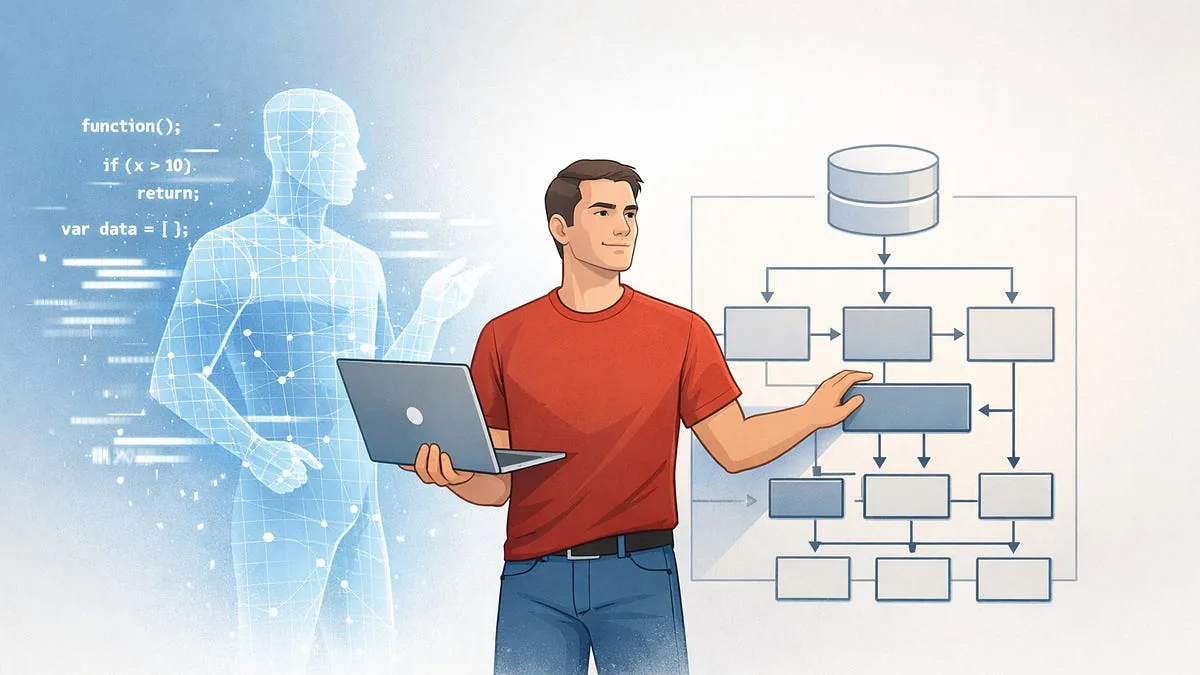
Tech leaders who cut engineering staff often misunderstand daily developer workflows. An analysis from NameOcean, the developer of Vibe Hosting, showed that typing code accounts for roughly 20 percent of an engineer’s work, whereas the remaining 80 percent goes to research, system architecture, design reviews, testing strategies, debugging, and system maintenance. Codebases behave like gardens that decay without constant care. Senior developers spend their days in architecture reviews and on-call rotations. They do not merely type syntax [2].
To explain why faster code completion does not cut overall headcounts, NameOcean applied Amdahl’s Law. In computer science, this rule measures the overall speedup gained by improving just one segment of a multi-step task. NameOcean calculated that if AI tools make code generation 50 percent faster on the 20 percent of the job devoted to typing, total productivity rises by roughly 7 percent. It is not a 50 percent leap. It is not even 25 percent. Speeding up one small part of a larger workflow yields modest overall returns [2].
This math shows why hiring freezes aimed at replacing programmers fall short. Cutting workers removes senior judgment, not routine typing. NameOcean uses models like Claude and tools like Ollama on Vibe Hosting for drafting, but senior engineers design the system foundation. When software boards test whether model output reflects genuine logic, debates mirror how mathematicians confront AI in mathematics to separate raw pattern matches from verified proofs. Tools handle rote chores, but engineering teams steer the architecture [2].



Code Ownership and Accountability
Software manager Richard Zhang wrote on Substack that AI models lack ownership, because accountability requires praise or reprimand while algorithms feel neither fear nor ambition. When code breaks in production, managers cannot discipline a bot that simply promises to remember the lesson next time. Zhang said that businesses cannot run on systems that accept zero liability for errors [3].
Zhang said that AI tools produce mediocre work in fields requiring deep craft. Zhang noted that Apple built its famous Think Different campaign around emotional obsession and rebellious misfits, traits an agreeable pattern-following model can never possess. Models draw on public web patterns where basic front-end setups look clean, but they fail on intricate business logic hidden inside private stacks that require custom architectures. An engineer who knows the system will outperform an outside agent. Zhang compared AI tools to high-priced consultants who arrive with shiny slides but lack local context. If models ever developed genuine desire, he warned, tech would drift toward The Matrix [3].
Recent tech cuts have not proved that computers can replace developers. When Elon Musk cut 80 percent of workers at Twitter, now X, remaining engineers quietly absorbed the load. That strain stays hidden until systems break. Zhang said that AI-generated code from vibe coding still needs human caretakers. Companies cutting developer headcounts will eventually need more engineering teams to clean up the mess [3].
The Risk of Erasing Junior Developers
In Forbes, Sticky Strategy CEO Matthew Cloutier warned that cutting entry-level developers damages long-term software health. Some tech executives think that because models write simple code, junior coders are no longer needed. Cloutier called that belief dangerous. Every senior architect and engineering director began as a junior coder learning how systems act in practice. Dropping junior roles wipes out the pipeline that builds future engineering teams [4].
At Sticky Strategy in Los Angeles, junior programmers face firm limits on automated tools, because Cloutier believes that coders who lack fundamentals cannot safely inspect, fix, or modify AI-generated logic. He quoted Aristotle: “For the things we have to learn before we can do them, we learn by doing them”. Prompt shortcuts cannot teach failure modes. Novices build fragile programs. Cloutier also cited management expert Peter Drucker, who warned: “There is nothing quite so useless, as doing with great efficiency, something that should not be done at all”. Without mastery over basic control flow and system boundaries, junior engineers turn into operators who run prompts but cannot debug code when outages strike production environments [4].
Cloutier set up a graduated access plan at Sticky Strategy in Los Angeles. Junior coders must master manual programming first. Senior staff then use AI to cut out boring boilerplate tasks. The company rule is simple: if you cannot explain the code, you cannot ship it. Teams track bug counts, recovery time, and design churn instead of raw coding speed [4].

New Roles for Engineering Teams
Writing on LinkedIn, cloud and platform engineering specialist Jyotirmayee Pradeep Kumar argued that AI will reshape rather than kill development jobs. Automated tools cannot answer alarms at two in the morning. When live servers fail, human operators step in [6].
Data shows that AI tools alter workflows without removing the need for human judgment. Research from MIT and GitHub showed that coders finish specific tasks 55 percent faster when using GitHub Copilot. Speed alone does not make code safe. The World Economic Forum’s Future of Jobs Report 2025 projects that AI will displace 92 million jobs globally and create 170 million new roles across tech sectors. Jobs requiring human judgment stay strong [7].
Workplace research from McKinsey found that 76 percent of workers use AI on the job, but skilled coders still earn top pay. Developer Ademola Akanmu said that tools like Copilot work only when paired with sound architecture, disciplined prompt design, and system context that models cannot supply alone. Without human guidance, models produce confident hallucinations. As tech firms balance speed against stability, engineering teams remain the bedrock of safe software delivery and protect the skilled talent needed to guide modern platforms [4, 7].
- ONLINE NEWS Jenney, B. (2026, October 22). Engineers guard the line between fast demos and safe products. IEEE Spectrum. [Article Link]
- WEBSITE NameOcean. (2026, April 29). Beyond code generation: Why AI won’t replace your engineering team (and why that’s good news). NameOcean. [Article Link]
- WEBSITE Zhang, R. (2026, March 4). Why AI cannot replace engineers. Walk The Path. [Article Link]
- ONLINE NEWS Cloutier, M. (2026, February 17). AI won’t replace engineers—but weak technical leadership will. Forbes. [Article Link]
- WEBSITE Cojocaru, I. (2025, July 17). Replacing engineers with AI? Here’s why that’s a risky illusion. QuantumSoft. [Article Link]
- WEBSITE Kumar, J. P. (2026, August 8). AI won’t replace developers – it will redefine engineering teams. LinkedIn. [Article Link]
- WEBSITE Akanmu, A. (2026, July 5). Why AI will not replace your engineering team but will transform their output. LinkedIn. [Article Link]


