





The European Space Agency logged steady scientific progress across several flight programs during October 2026, pairing robotic exploration with human spaceflight and educational outreach. Field teams completed Mars rover training trials in Spanish terrain while orbital sensors monitored Martian clouds and mapped auroral rings circling Earth. Astronaut Sophie Adenot concluded her stay on the International Space Station, returning to Earth after 237 days in orbit. [1]
European Space Agency Mars Preparations
Field engineers supporting the European Space Agency advanced preparations for surface operations on the Red Planet through practical testing in challenging terrestrial environments. The Rosalind Franklin rover team traveled to desert terrain in Spain to conduct simulation runs, evaluating mobility systems and navigation protocols in conditions that closely mimic Martian topography. Operating in dry sand and rocky gravel gave engineers practical insight into how the vehicle will handle rough slopes and loose soil density once it touches down on Mars. These field exercises help the operations crew refine control procedures, test command latency, and train instruments to identify promising geochemical targets for future sampling. Engineers ran mobility tests over steep dunes to observe how the wheels grip loose soil under varying weight distributions. Data gathered from these Spanish trials will help software teams optimize autonomous pathfinding algorithms before flight software is finalized. [1]
While rover teams practiced in Spain, the Mars Express orbiter gathered fresh clues about a giant cloud structure in the Martian atmosphere, tracking how water vapor and dust interact high above volcanic terrain [1]. To help citizens follow such research programs, the agency distributes This is ESA, an illustrated guide explaining institutional goals and scientific tracks in all Member State languages [2]. The publication explains current European space missions.
Sophie Adenot Orbital Return
Human spaceflight activities saw a scheduled transition when European astronaut Sophie Adenot returned to Earth after completing 237 days in space. Adenot lived aboard the International Space Station, where she conducted microgravity experiments focused on human physiology, material physics, and fluid behavior in orbital conditions. Her research supported long-term studies designed to monitor how prolonged exposure to weightlessness affects muscle mass, bone density, and cardiovascular regulation. Flight surgeons met Adenot upon landing to begin physical recovery protocols and gather post-flight physiological samples for laboratory comparison. During her stay, Adenot also helped maintain life support machinery and participated in joint science runs with international crewmates. Medical teams continue to study her adaptation metrics to help space agencies develop better countermeasures for astronauts on future deep space voyages. [1]
Station operations continued smoothly as international partners launched new crews and logistics flights to maintain orbital laboratory work. On October 1, SpaceX Crew-13 lifted off following a delay caused by an oxidizer tank leak, carrying commander Jessica Watkins, pilot Luke Delaney, Canadian Space Agency (CSA) specialist Joshua Kutryk, and Roscosmos specialist Sergey Teteryatnikov. SpaceX CRS-35 delivered additional science supplies on October 13 [3].

Smile Mission Auroral Ring Observations
Orbital observation instruments delivered panoramic perspectives on planetary space weather when the European Space Agency documented northern light activity from high above the atmosphere. The Smile spacecraft captured the full auroral ring circling Earth, mapping the boundary where solar wind particles collide with the upper atmosphere to generate geomagnetic light displays. Gathering an unbroken view of the auroral oval allows space weather scientists to track energy transfer between the solar wind and the terrestrial magnetic envelope in real time. These images help forecasters understand how geomagnetic disturbances affect navigation satellites, power grids, and orbital communications during solar peaks. Tracking the entire polar light ring simultaneously allows researchers to correlate solar flare eruptions with immediate ionospheric responses. The findings provide space weather models with accurate boundary measurements, improving forecasts that protect satellites in low Earth orbit. [1]
Atmospheric observations coincided with seasonal sky events, including the Draconid meteor shower on October 8 and 9 and the Orionids on October 21 and 22, which occur when Earth crosses debris trails shed by Halley’s comet. Commercial orbital deployments also proceeded on October 1, when SpaceX Transporter-18 launched 45 satellites via Exolaunch, carrying Taiwan’s Formosat-8B telescope and Spain’s OSSIE transfer vehicle built by UARX. [3]
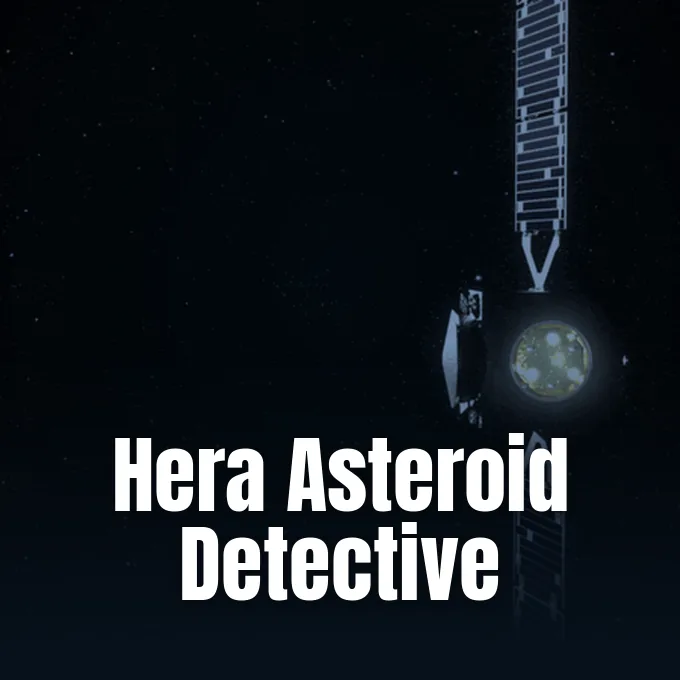

Hera Asteroid Reconnaissance
Deep space exploration advanced when Hera transmitted its first images of the asteroid system it is traveling to investigate, providing engineers with optical calibration data while validating navigation sensors. The spacecraft captured distant views of its target bodies as flight controllers verified optical tracking instruments before upcoming trajectory maneuvers. These test images confirm that onboard cameras operate within calibration margins after months of cruising through interplanetary space. Planetary defense researchers tracked the probe as part of detailed Hera asteroid arrival preparations scheduled for deep space rendezvous, where the spacecraft will examine asteroid deflection effects from previous kinetic impact experiments. Flight teams analyzed pixel sharpness and thermal stability across the imaging arrays to ensure the sensors withstand harsh space conditions. The resulting imagery confirms that Hera is ready to map the crater and surface structure of its target asteroid. [1]
Planetary observation from ground observatories also peaked during October due to favorable celestial geometry. Saturn reached opposition on October 4, positioned opposite the Sun from Earth’s vantage point, which boosted the ringed planet’s brightness by 0.3 magnitude and offered clear views of the Cassini divisions through small telescopes. Mercury reached greatest elongation east on October 12, standing at its widest evening separation from the Sun before setting shortly after dusk. [3]

ESA Public Outreach and Open Days
The European Space Agency expanded its public outreach during October, opening research centers and testing facilities to thousands of visitors during institutional Open Days. Citizens toured clean rooms, inspected robotic equipment, and spoke with specialists who explained European space exploration goals and educational programs. The agency also teamed up with Pokémon to introduce space science to younger audiences through interactive exhibits and educational media [1]. This collaborative project connected with World Space Week from October 4 to 10, when organizers arranged to send Pikachu to the International Space Station as an educational ambassador. The initiative sought to spark interest in astronomy among students by combining popular characters with genuine orbital science [3]. The event helped bring space concepts to new audiences [1].
The United Nations General Assembly established World Space Week to commemorate two foundational dates in space exploration: the launch of Sputnik 1 on October 4 (1957) and the signing of the Outer Space Treaty on October 10 in 1967, which established rules for peaceful exploration of celestial bodies [3]. In addition, ESA procurement frameworks and commercial incubator programs support European companies in turning laboratory concepts into flight hardware [2]. Independent outlets including Astronomy Watch follow these mission developments to keep observers informed about European aerospace initiatives [4].
International Collaboration on the MMX Mission
Multilateral cooperation stood out on the launch calendar with the planned departure of the Martian Moons eXploration mission, led by Japan’s space agency working with NASA, the European Space Agency, CNES, and DLR. Slated for launch on October 19 at 20:41 BST, this five-year mission seeks to clarify the origins of the Martian moons Phobos and Deimos, resolving whether they are captured asteroids or collision remnants. Before touching down on Phobos to extract geological samples, the spacecraft will deploy a small rover named Idefix, developed by French and German agencies. The rover will move across the low-gravity surface to study soil mechanics ahead of the main landing. [3]
The main spacecraft will collect surface material and secure it inside a Sample Return Capsule designed to return to Earth in 2031, with a scheduled landing in Australia. This retrieval will provide the first geological samples from the Martian system brought to Earth for detailed laboratory analysis. The mission scheduled its departure in the same month as other international launches, including South Korea’s fifth Nuri flight carrying 15 satellites on October 7 and testing preparations for the SpaceX Starship 15 vehicle. [3] The capsule lands in Australia in 2031.
- PRESS RELEASE European Space Agency. (2026, October 30). What happened this month at the European Space Agency? (October 2026). [Article Link]
- WEBSITE European Space Agency. (2026, October 29). European Space Agency. [Article Link]
- ONLINE NEWS Mosley, E. (2026, October 5). What’s Happening in Space: October 2026. National Space Academy. [Article Link]
- WEBSITE Astronomy Watch. (2026, March 8). ESA Space News | Latest ESA Missions & Discoveries. [Article Link]
Cover image: ESA – European Space Agency / Wikimedia Commons, CC BY-SA 3.0 igo
APA 7: PerEXP Teamworks. (2026, October 31). ESA Tracks Planetary Clouds and Asteroid Images in October. PerEXP Teamworks. https://perexpteamworks.com/en/european-space-agency-october-science/


