






Global efforts to harvest clean power increasingly look toward ocean currents, where astronomical cycles deliver predictable kinetic energy. While conventional marine turbines struggle with punishing hydrodynamic loads, engineers at the University of Edinburgh have tested a passive alternative. The research team fitted flexible tidal blades with chordwise rubber trailing edges to absorb turbulent forces without sacrificing power output [1]. Experimental trials at the FloWave facility confirmed that this compliant design matches the total energy yield of rigid turbines while cutting fatigue-inducing load spikes by up to one-third.
The Undersea Energy Resource
Coastal tides represent one of the most dependable clean energy resources because planetary orbits govern their flow rather than unpredictable weather patterns. Marine energy assessments estimate that ocean currents could supply 50 terawatt-hours each year across Europe, while coastal channels in the United States hold roughly 220 terawatt-hours annually. Near-term deployment roadmaps target 1 gigawatt of installed capacity in the United Kingdom by 2035, with international targets projecting 300 gigawatts worldwide by 2050 [1].
A global resource review led by D. S. Coles identified 426 candidate sites with suitable characteristics for tidal stream development across 19 countries. Aggregated data from 262 of those locations revealed a theoretical resource of 1,000 terawatt-hours per year across six nations, which corresponds to roughly 115 gigawatts of continuous annual power. When evaluating realistic technical, environmental, and financial constraints, a practical extraction assessment identified 110 terawatt-hours annually across 90 primary sites. Among evaluated territories, the United Kingdom, Indonesia, and New Zealand showed the strongest potential to build national-scale electrical networks from their coastal streams [2].
Despite this theoretical wealth, sea conditions impose punishing physical strains on marine turbines. Water is more than eight hundred times denser than air, so incoming currents generate heavy thrust against rotating foils. Subsea rotors must endure turbulent eddies and velocity shear without breaking [1].
Why Active Pitch Systems Fail
Commercial tidal developers often borrow engineering solutions from terrestrial wind energy, installing active pitch systems to rotate turbine blades as flow speeds shift. These electro-mechanical assemblies turn rigid foils along their spanwise axis to regulate power output and limit peak loads during fast currents. But ocean depths create an unforgiving workplace. Corrosive seawater attacks metallic gears, while high pressures challenge rotating seals and internal electrical sensors [1].
Offshore operating data reveals the severe penalty of complex rotating hardware. An operational study of roughly 350 offshore wind turbines led by James Carroll found that pitch mechanisms are the single largest contributor to overall system failure rates [5].
In marine environments, unscheduled maintenance can’t be handled with a simple repair visit. Fixing a jammed pitch actuator requires specialized offshore support vessels, calm weather windows, and expensive maritime crews, which quickly drives up the levelized cost of energy [5]. In addition, motorized pitch systems react too sluggishly to counter sudden turbulent fluctuations. While electric motors can track slow changes across a twelve-hour tidal cycle, their actuator speeds can’t soften rapid turbulent eddies or wave-induced orbital currents in real time. These rapid load spikes jolt internal drivetrains thousands of times each day, accelerating premature fatigue [1].
Testing Flexible Tidal Blades at FloWave
To eliminate failure-prone mechanical actuators, an international research team led by Ignazio Maria Viola tested chordwise compliance as a completely passive alternative. Co-authors Zhehong Zhang, Junchen Tan, and Eric-Carin Neba built a model turbine to examine how flexible tidal blades behave in turbulent currents without relying on internal motors or sensors. Instead of twisting the entire blade along its span, the experimental rotor uses material flexibility to adjust shape naturally under water pressure [1].
The experimental campaign took place at the FloWave Ocean Energy Research Facility at the University of Edinburgh, which houses a 25-meter diameter circular basin that generates complex wave-current interactions. A detailed facility characterization conducted by D. R. Sutherland and colleagues showed that FloWave reproduces realistic marine flow conditions with turbulence intensities between 5% and 11% and integral length scales spanning 0.18 to 0.41 meters [4]. In this controlled ocean environment, Viola’s team tested their 1.2-meter diameter rotor across a wide range of nominal inflow velocities from 0.5 to 1.0 meters per second, recording load responses at tip-speed ratios between 3 and 9 [1].
The experimental turbine featured a cut-in velocity ratio of 0.2 and was tailored for optimal energy conversion at an inflow speed of approximately 0.85 meters per second. Calibrated torque sensors and load cells tracked power output, thrust forces, and root bending moments during each run [1].


Mechanical Friction in Passive Rotors
Before exploring flexible rubber materials, marine researchers investigated passive pitch control through spring-loaded mechanical hubs. In those older setups, rigid blades were mounted on rotational bearings at the blade root, where a pre-loaded torsional spring resisted hydrodynamic twist. As water currents strengthened, hydrodynamic moments overcame the spring resistance, allowing the entire blade to pivot and reduce its angle of attack [1].
While theoretical models suggested that passive pitching springs could eliminate load spikes, physical tank trials revealed stubborn mechanical limitations. Experiments on a 1.2-meter turbine conducted by S. Gambuzza and Ignazio Maria Viola confirmed that friction resistance inside root bearings substantially degrades passive pitch responsiveness [3].
Gambuzza’s experimental study showed that bearing friction and rotational inertia prevent spring-loaded blades from shedding rapid load peaks caused by turbulent eddies [3]. Furthermore, submerged bearings and dynamic seals must remain watertight through decades of ocean service. If marine debris or grit enters a mechanical pivot assembly, the mechanism can jam, leaving the turbine exposed to damaging hydrodynamic loads during extreme tidal surges. These mechanical vulnerabilities convinced Viola’s research group that eliminating moving parts entirely was necessary to ensure the long-term reliability of ocean turbines [1].

Blade Camber Flattening Under Load
To build a rotor with zero moving joints, the researchers turned to natural fluid systems for guidance. Organisms across marine and terrestrial ecosystems, ranging from flexible fish fins to wind-blown trees, passively change shape through distributed material compliance to manage fluid forces. By applying these biological principles, Viola and co-authors designed a fixed-pitch blade where structural deformation handles load mitigation directly through fluid-structure interaction [1].
Rather than relying on spanwise twisting (a technique common in aeroelastic wind turbine blades), the new design implements chordwise flexibility. The leading section of the blade is thick and completely rigid, providing structural stiffness and carrying bending moments into the hub. In contrast, the trailing edge consists of flexible rubber that extends along the entire chordwise span from root to tip. As hydrodynamic pressure builds across the foil, water forces the compliant rubber section to bend upward, flattening the cross-sectional camber of the blade and shedding excess lift [1].
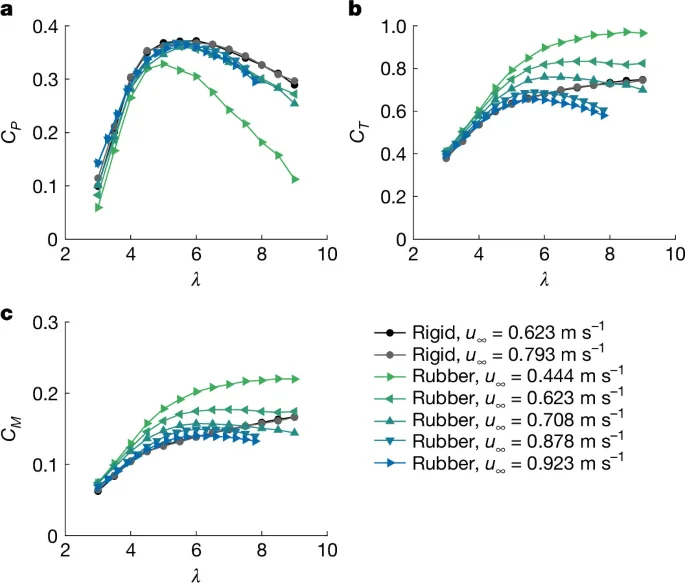
At the rated inflow velocity of 0.878 meters per second, the compliant rotor matched the power output of a conventional rigid blade, achieving a peak power coefficient of approximately 0.37 near optimal tip-speed ratios between 5.5 and 6. Fluid-structure deformation occurred instantaneously without sensor lag [1].
How Flexible Tidal Blades Protect Turbines
The key operational benefit of chordwise compliance emerges during peak flow conditions when water speeds exceed design ratings. In simulated tidal cycles, rigid rotors without pitch control experience surging thrust forces that threaten structural components. Under identical inflow profiles, flexible tidal blades shed excess hydrodynamic loads automatically: when tip-speed ratios rise past 6, the flexible trailing edge flattens further under pressure, reducing the thrust coefficient and shielding the turbine from peak mechanical stress [1].
Dynamic load analysis confirmed that chordwise deformation dampens high-frequency turbulent spikes by up to one-third compared with rigid blades. Rapid turbulent eddies deform the rubber trailing edge locally, absorbing unsteady forces before they transmit into the rotor hub, shaft, and electrical generator. By filtering out these punishing load cycles passively, the compliant design prevents fatigue accumulation while matching the full energy yield of active pitch turbines across complete operational cycles [1]. Removing mechanical pitch assemblies also eliminates the primary cause of offshore turbine failure identified in commercial operational data [5].
Passive load shedding offers a practical engineering path to lower the levelized cost of ocean energy. Marine operators can build lighter support structures, deploy simpler drivetrains, and reduce costly offshore service visits. Flexible tidal blades provide the durability needed to make tidal stream generation economically viable [1].
- ACADEMIC JOURNAL Zhang, Z., Tan, J., Neba, E. C., Morival, S., Frankowski, K., Daval, B., & Viola, I. M. (2026). Flexible rubber blades for tidal turbines. Nature. [Article Link]
- ACADEMIC JOURNAL Coles, D. S., Adcock, T. A. A., Cornett, A., Haas, K., Jo, C. H., Liu, H., Miles, J., Novo, P. G., & Thiébot, J. (2025). A review of global tidal stream energy resources. Proceedings of the Royal Society A: Mathematical, Physical and Engineering Sciences, 481(2328). [Article Link]
- ACADEMIC JOURNAL Gambuzza, S., Pisetta, G., Davey, T., Steynor, J., & Viola, I. M. (2023). Model-scale experiments of passive pitch control for tidal turbines. Renewable Energy, 205, 10–29. [Article Link]
- ACADEMIC JOURNAL Sutherland, D. R., Noble, D. R., Steynor, J., Davey, T., & Bruce, T. (2017). Characterisation of current and turbulence in the FloWave Ocean Energy Research Facility. Ocean Engineering, 139, 103–115. [Article Link]
- ACADEMIC JOURNAL Carroll, J., McDonald, A., & McMillan, D. (2016). Failure rate, repair time and unscheduled O&M cost analysis of offshore wind turbines. Wind Energy, 19(6), 1107–1119. [Article Link]
Cover image: Rundvald / Wikimedia Commons, CC BY-SA 4.0
APA 7: PerEXP Teamworks. (2026, November 12). Flexible Tidal Blades Match Turbine Yield While Shedding Fatigue. PerEXP Teamworks. https://perexpteamworks.com/en/flexible-tidal-blades-match-energy-yield/


