



The Browser Company halted new feature development for Arc following Atlassian’s buyout, prompting displaced users to seek unbundled alternatives across the desktop web. Zen Browser has emerged as a reliable refuge, offering vertical tabs, split view, and clean workspaces without unwanted artificial intelligence agents. Former Arc loyalists now turn to this open-source project to preserve their daily workflow [1].
Atlassian Acquisition and the Arc Freeze
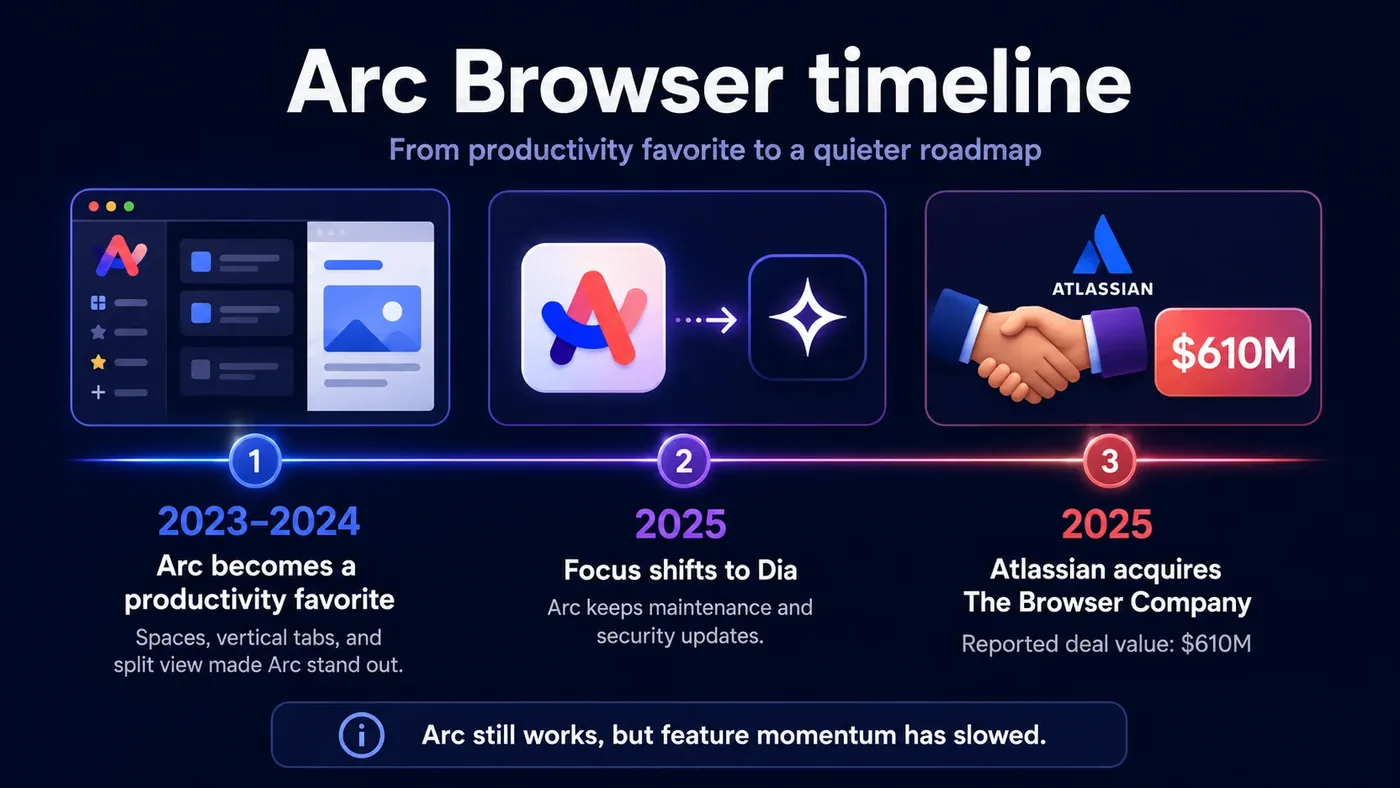
Arc attracted an enthusiastic audience by redesigning desktop web navigation around vertical sidebars, persistent tab spaces, and built-in split panels on top of Google’s Chromium rendering engine. That momentum stopped abruptly in May 2025 [3].
Josh Miller, chief executive of The Browser Company, explained the decision bluntly: “for most people, Arc was simply too different, with too many new things to learn, for too little reward”. The engineering team redirected its attention to Dia, a browser focused on automated agents. Later that year, BusinessWire and Reuters reported that Atlassian acquired The Browser Company for $610 million in cash, completing the acquisition on October 21, 2025 [3]. Arc still receives Chromium security fixes, but new interface development has ceased completely. The transition gained urgency following announcements detailing the planned Arc Browser shutdown, leaving long-time users searching for an interface with vertical tabs and isolated spaces.
Terrence O’Brien at The Verge reported that Arc will officially be no more, writing that he switched to Zen and hasn’t missed it [1]. He found Arc’s later updates increasingly bloated. Taylor Quinn at Creator Newsdesk said content creators who relied on Arc for daily research felt stranded when development shifted to AI-centric software [6].
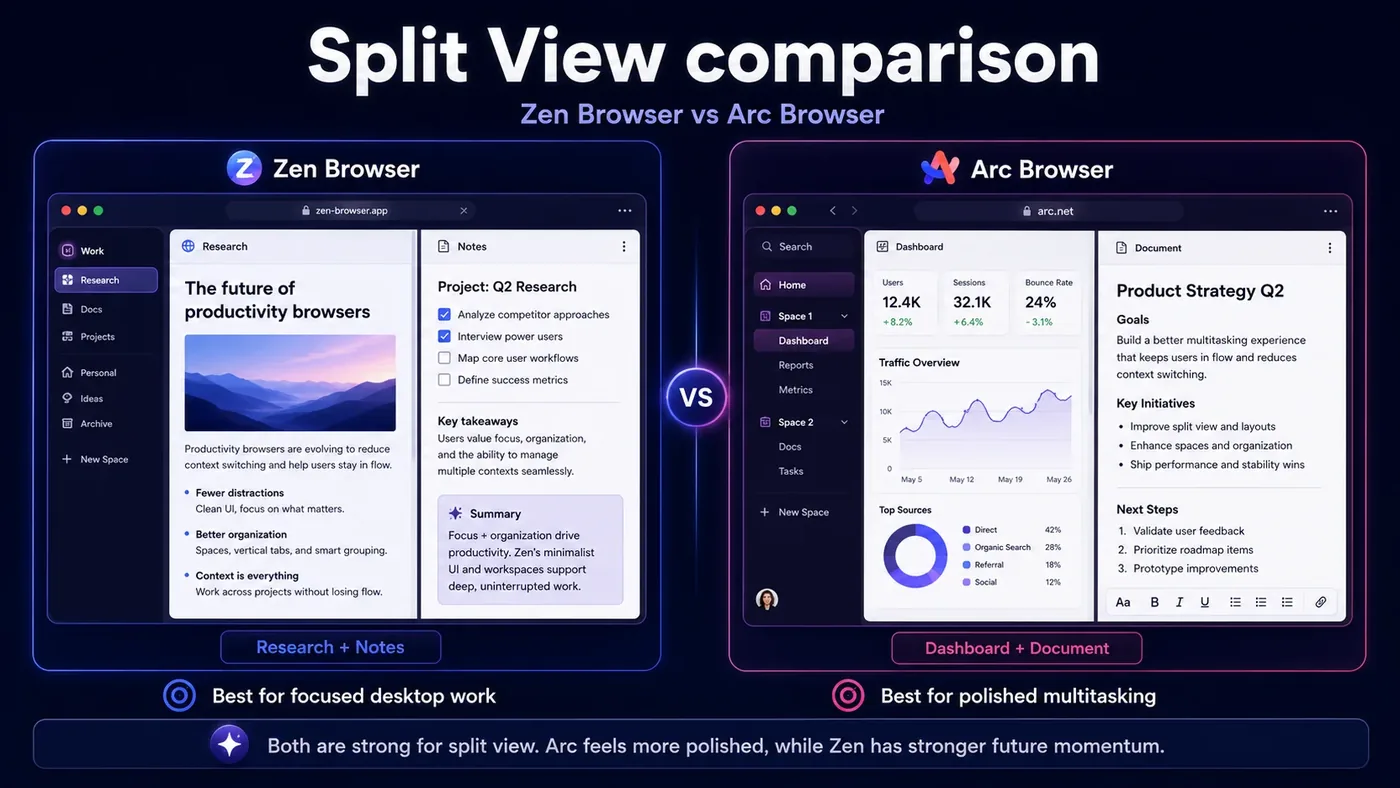
Workspace Organization in Zen Browser
Zen Browser arrived in July 2024. Built on Mozilla’s Gecko engine, the community project reproduces Arc’s sidebar hierarchy by anchoring persistent pinned favorites near the top of the left rail as active pages stack neatly below without intrusive advertisements or sponsor banners. Users switch workspaces with shortcuts Cmd+1 through Cmd+8, and Cmd+Shift+E creates new contexts [3]. Unlike Arc’s implicit profile system, Zen ties workspaces to Firefox Multi-Account Containers, meaning work and personal Google accounts can live in the same window without leaking session cookies between different tabs [4].
The software also adopts Arc’s quick interaction habits. Zen Glance lets people hold the Alt key while clicking a link to open a floating pop-over preview, saving them from cluttering their workspace with temporary tabs. Pressing Command+T or Ctrl+T opens a floating command bar [1].
For split-screen multitasking, Split View tiles up to four tabs in horizontal, vertical, or two-by-two grid layouts so researchers can keep documentation visible on one side and a working draft on the other without juggling separate application windows [2]. Keyboard shortcut Cmd+Alt+C triggers Compact Mode, stripping away borders for clean reading [4]. Community members also install Zen Mods to customize active tab indicators, redesign scrollbars, or reshape floating picture-in-picture video frames.


Performance Benchmarks on Apple Silicon
Zen runs on macOS 14 Sonoma and newer releases. Distributed as a universal binary for Intel and Apple Silicon Macs, the browser also provides official installers for Windows and Linux distributions [2]. The interface feels responsive in daily use, but synthetic benchmarks expose real performance gaps between rendering engines [4].
Independent testing by Jitbit ran the Speedometer 3.0 benchmark on an M3 Pro MacBook in private mode to evaluate web application responsiveness under realistic script conditions. Zen scored 31.6 points on the benchmark. That score trailed vanilla Firefox 134 at 34.8 points, Safari 18.2 at 37.6 points, and Chrome 132 at 37.7 points, leaving Zen roughly 16 percent behind leading Chromium engines. Kshetez Vinayak at SupaSidebar said this difference comes from the extra overhead of the custom UI shell and the Mods system running over Gecko [4]. Complex web applications like Figma and Google Docs reveal that gap during extended work sessions.
Memory footprints and battery consumption also require user tradeoffs. Jitbit revised initial memory assessments after discovering that Zen distributes RAM consumption across separate Isolated WebContent, Utility, and WebExtensions processes rather than a single master thread. On battery life, Zen does not match Safari’s 24 hours of video playback on the M4 MacBook Pro, because Apple optimizes WebKit directly for hardware decoding [4].
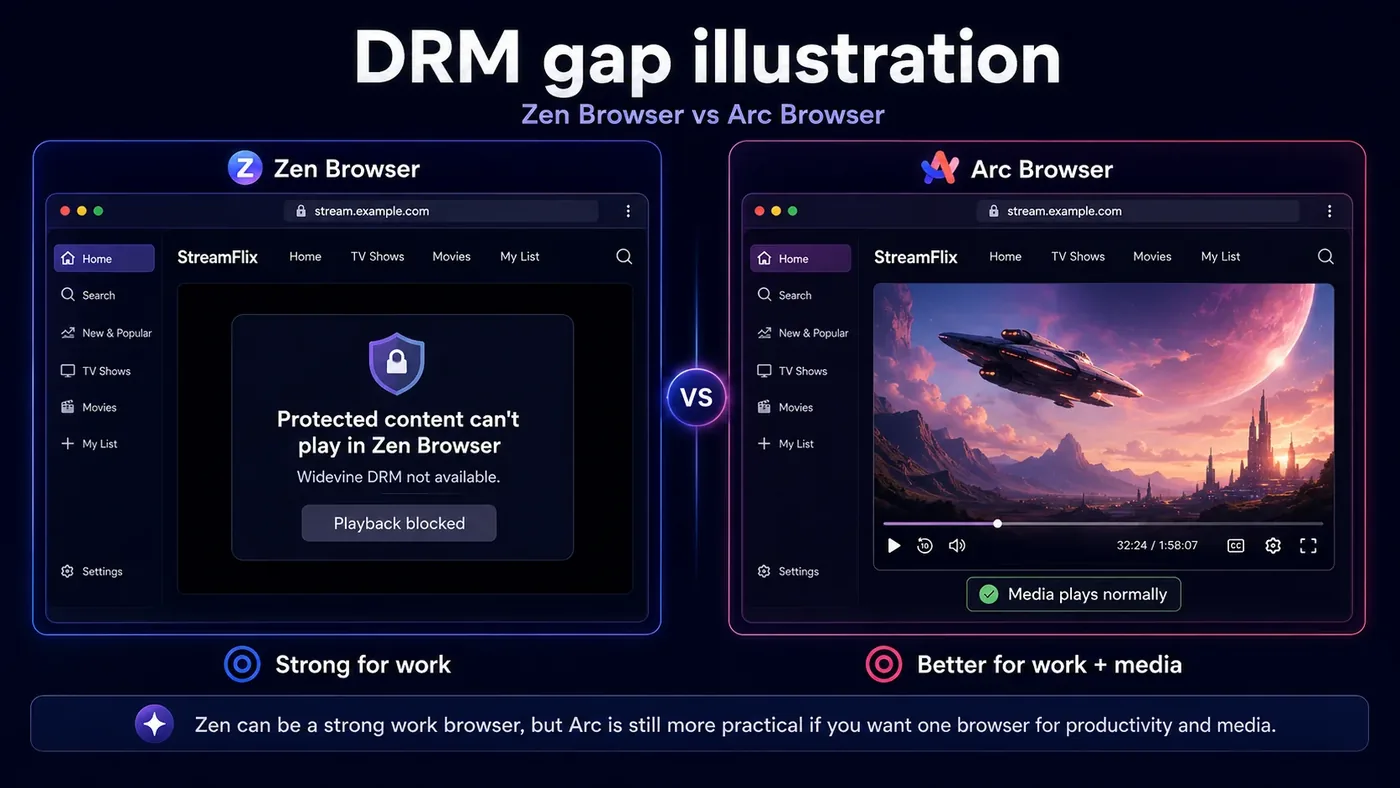
Widevine DRM Licensing Gaps
Zen Browser currently can’t play DRM-protected media files. Major streaming platforms including Netflix, Spotify, Disney+, HBO Max, Amazon Prime Video, and Apple Music consistently fail during audio and video playback tests [2]. The browser currently lacks a Widevine license from Google [1].
The Zen development team is working to obtain Widevine certification from Google, but official licensing discussions take time. Displaced users often keep a secondary browser installed. Terrence O’Brien said he launches Chrome whenever he needs to stream a movie or access audio web applications that depend on Web MIDI, an interface where Firefox engine support remains incomplete [1]. Running Spotify in the background during work hours means keeping a separate desktop application open next to the browser window.
Add-ons also require workflow adjustments. Arc ran extensions from the Chrome Web Store, but Zen connects to Mozilla’s AMO catalog for Firefox add-ons [2]. NoobClaw reported that digital marketing teams must verify that their daily analytics and capture tools have stable Firefox releases before abandoning Arc completely [5].

Zen Browser Open Source Momentum
Unlike Arc’s closed proprietary foundation, Zen Browser publishes its complete source code publicly on GitHub under the Mozilla Public License 2.0, where the primary repository at zen-browser/desktop has already surpassed 41,000 stars among enthusiastic developer communities [3]. The browser relies entirely on donations and volunteer labor. That grass-roots financial foundation frees the small development group from venture capital pressures to monetize browsing logs, monitor page navigation, or harvest personal user records [1].
Community contributions have sustained regular software releases. By June 2026, the browser reached version 1.20.x on Firefox 151, advancing to version 1.21.6b on Firefox 152.0.5 by July 2026 [3],. The development team also maintains an experimental Twilight pre-release channel to test interface features before shipping them to stable desktop builds [4]. In May 2025, Zen introduced site-level Boosts similar to Arc’s appearance tweaks, though users currently write their own styles without a central repository [1].
Zen emphasizes user privacy on its homepage: “Beautifully designed, privacy-focused, and packed with features. We care about your experience, not your data” [1]. Andrew Dyuzhov at Sigma AI Browser said this stance appeals to people who feel overwhelmed by mainstream browsers forcing automated assistants into everyday browsing [2]. For power users who want an organized layout with vertical tabs, workspaces, and open-source code, Zen provides a practical haven as Arc approaches retirement [3].
- ONLINE NEWS O’Brien, T. (2026, October 25). Zen Browser is the Arc replacement I was looking for. The Verge. [Article Link]
- WEBSITE Dyuzhov, A. (2026, October 19). Zen Browser vs Arc: Which Browser Is Better for Productivity in 2026? Sigma AI Browser. [Article Link]
- WEBSITE Vinayak, K. (2026, June 17). Zen vs Arc Browser (2026): Which One Should Mac Users Actually Pick. SupaSidebar. [Article Link]
- WEBSITE Vinayak, K. (2026, July 14). Zen Browser Mac Review (2026): The Open-Source Arc Alternative, Tested. SupaSidebar. [Article Link]
- ONLINE NEWS NoobClaw. (2026, October 25). Zen Browser AI-free Arc alternative for creator workflows. NoobClaw. [Article Link]
- ONLINE NEWS Quinn, T. (2026, October 25). Zen Browser Steps In as Top Arc Alternative After Atlassian Shift. Creator Newsdesk. [Article Link]


