



Did the standard flagship tablet quietly vanish from high-end mobile computing? Samsung answered that question on September 30 by unveiling the Galaxy Tab S12 lineup, introducing the Galaxy Tab S12 Plus and the supersized Galaxy Tab S12 Ultra while omitting an 11-inch entry slate entirely. Long known for matching Apple stride for stride in portable productivity, the Korean technology giant is pushing its premium slates toward higher performance brackets. Both devices arrive in retail stores on October 7 with starting prices of $1,199.99 and $1,399.99 [1].
Galaxy Tab S12 Strategy Drops the Base Tier
The absence of a base model marks a stark strategic shift for Samsung’s mobile division. In 2024, the manufacturer delivered the Tab S10 Plus and Tab S10 Ultra, bypassing an 11-inch form factor before reversing course in 2025 with the compact Galaxy Tab S11 and Tab S11 Ultra. Now, the 11-inch baseline has disappeared once more, leaving the year-old Tab S11 as the sole 11-inch option for consumers wanting a smaller flagship chassis [2].
Samsung eliminated the sub-thousand-dollar threshold that previously anchored the series. By establishing the 12.6-inch Galaxy Tab S12 Plus as the entry tier at $1,199.99, the company raised the baseline entry cost by several hundred dollars [1]. Customers seeking current-generation silicon must now spend at least $1,200 [6]. The 11-inch form factor sits vacant [2].
Escalating memory component costs prompted Samsung to streamline manufacturing lines around high-margin, oversized slates rather than building a cheaper 11-inch model with narrower profit margins. Both models will ship in Gray and Silver finishes starting October 7. Samsung offers Gray and Silver colors [1].
Hardware Redesign Brings Slimmer Frames and Vapor Cooling
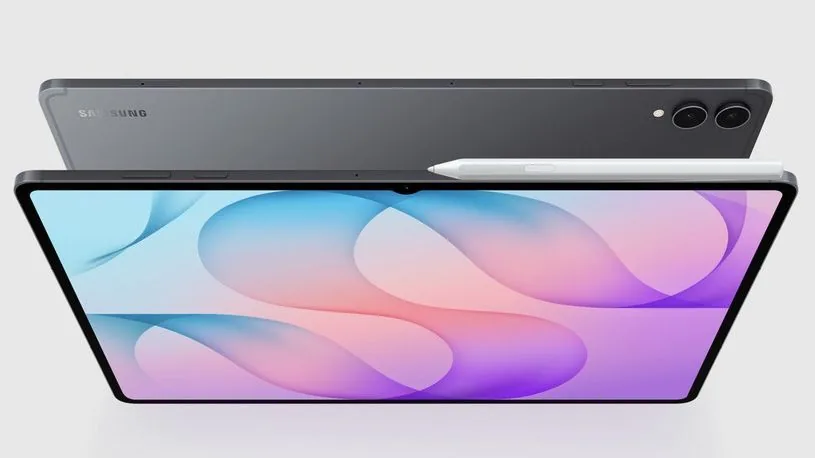
Despite carrying immense footprint dimensions, both tablets achieve remarkable physical slimness across their reinforced aluminum unibody enclosures. The flagship Galaxy Tab S12 Ultra measures just 5.1mm in thickness and weighs 692 grams, shaving fractions of a millimeter off the previous Tab S11 Ultra (which measured 5.55mm thick), while the 12.6-inch Tab S12 Plus trims its profile down to 5.3mm compared to the 5.6mm depth of the older Tab S10 Plus [2]. Both tablets earn an IP68 rating for water and dust ingress protection, ensuring they can survive continuous immersion in fresh water up to a depth of 1.5 meters for thirty minutes without structural failure [8].
Visual presentation centers on high-refresh Dynamic AMOLED 2X panels. The Tab S12 Ultra features an expansive 14.6-inch display running at 2960 x 1848 resolution, while the Tab S12 Plus presents a 12.6-inch screen with 2800 x 1752 pixels. Both panels deliver adaptive 120Hz refresh rates, in-display fingerprint sensors, and 1,600 nits of peak brightness [8]. In laboratory measurements conducted by Tom’s Guide, the Ultra recorded 862 nits in standard dynamic range and reached 916 nits under high dynamic range testing [7].
Samsung replaced the flat vapor chambers of previous generations with an engineered 3D vapor chamber designed to spread heat away from the processor during extended gaming and video exports [3]. Camera arrays remain practical: the Ultra carries a 13MP primary shooter and an 8MP ultrawide sensor with a 12MP ultrawide front webcam, whereas the Plus relies on a single 13MP rear camera and the same 12MP front lens [1].



MediaTek Dimensity 9500 Powers the Tab S12 Series
Under the hood, Samsung opted for MediaTek’s 3nm Dimensity 9500 chipset across the entire range [2]. The processor previously powered high-end flagship smartphones such as the Oppo Find X9 Pro and Vivo X300 Pro. According to official performance figures released by Samsung, the new silicon delivers a 19% boost in CPU throughput, a 17% gain in graphical processing, and a 61% acceleration in neural processing unit (NPU) operations over the Tab S11 Ultra [1].
Synthetic benchmarks validate those processing claims during independent testing. In Geekbench 7 cross-platform testing, the Tab S12 Ultra achieved a multi-core score of 9,403, surpassing conventional ultraportable computers such as the Dell XPS 13 equipped with an Intel Core 5 320 processor, which notched 7,879 points [4]. Geekbench 6 lab runs yielded 3,229 in single-core and 9,763 in multi-core performance. Apple’s M5 chip maintains a lead [7].
Endurance remains a decisive selling point for road warriors. The Ultra houses an 11,600mAh battery rated for up to 23 hours of video playback, while the Plus incorporates a 10,600mAh cell promising 21 hours [3]. In testing, Engadget recorded 19 hours and 39 minutes during continuous local video playback. Reviewer Sam Rutherford observed that ‘longevity simply isn’t a concern with the Tab S12 Ultra and it’s closer to something that needs to be charged once every two days instead of nightly — even if it’s your primary device’ [4]. Both tablets support 45W Super Fast Charging 2.0, reaching full capacity in roughly 95 minutes, though Samsung includes no wall adapter in the retail packaging. Neither tablet includes a wall charger [2].
Software Bundles Expand While DeX Retains Desktop Roots
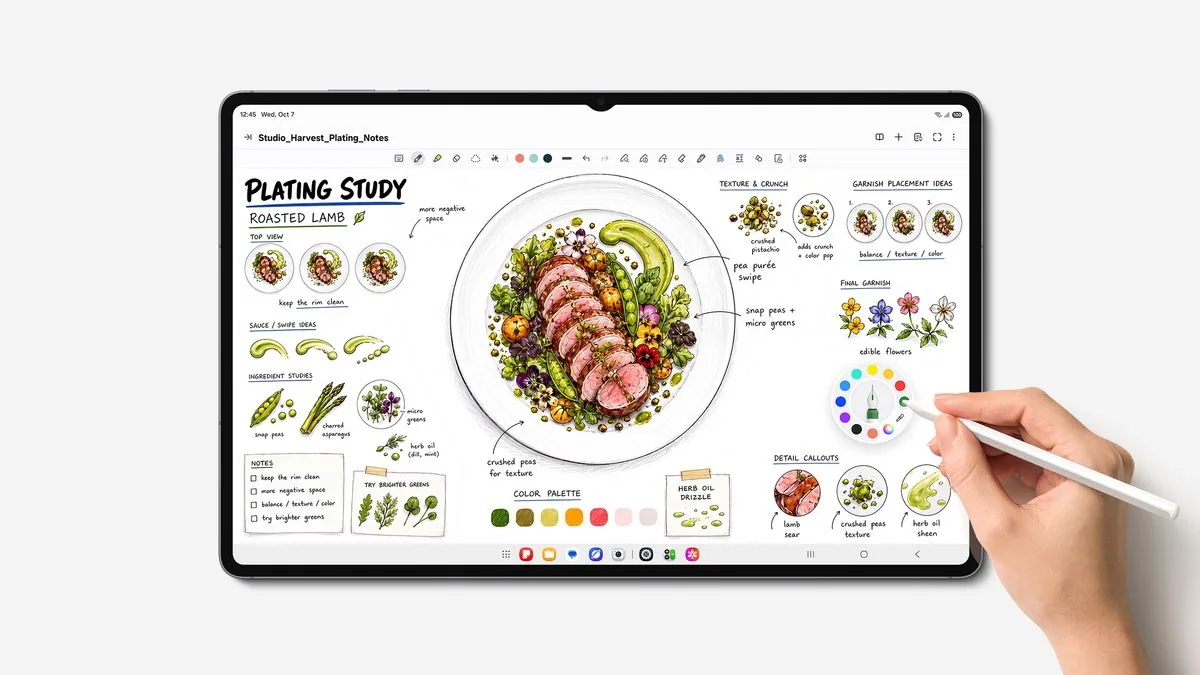
Software capabilities expand through Samsung’s integration of One UI 9 based on Android 17. The interface brings Multi Window enhancements that permit users to run three applications simultaneously, including Samsung Notes, streaming video, and conversational AI tools [8]. The system also introduces Note Assist for real-time document summarization, Now Nudge for contextual alerts, and seamless AirDrop cross-compatibility with Apple devices [2]. A broader overview of features is available in our detailed analysis of the Samsung One UI 9 rollout across Galaxy devices.
Productivity partnerships form a significant component of the value equation. Samsung pre-installs Adobe Photoshop with dedicated stylus optimization with four months of free access to the Photoshop mobile plan [5]. Buyers also receive a six-month trial of Google AI Pro with advanced Gemini features, six months of Notability, a full year of Goodnotes, and a 66% discount on the LumaFusion video editor with a Creator Pass [3].
Stylus input remains complimentary across both slates. Every box includes an S Pen utilizing electromagnetic resonance (EMR) digitizer technology, meaning the plastic hexagonal stylus never requires battery charging [4]. However, converting the tablet into a laptop replacement requires separate investments. The optional Pro Keyboard carries a dedicated touchpad and a Galaxy AI shortcut key that launches Perplexity. Tony Polanco of Tom’s Guide noted in his evaluation that while the slate excels at entertainment, ‘Samsung isn’t looking to reinvent the wheel’ [7].

SmartTag 3 Debuts as Tablet Prices Shift Higher
Samsung also introduced the SmartTag 3 tracker. The compact accessory works across both iOS and Galaxy devices, running up to 790 days in power-saving mode [1].
The tracker is 35% smaller and 33% lighter than the previous SmartTag 2. It incorporates an extended Compass View for directional finding and a new Place Notification feature that alerts owners whenever an item leaves a designated boundary. The tracker goes on sale in South Korea on October 7, with international availability scheduled for 2027. Battery life reaches 550 standard days [1].
Global pricing reflects mounting cost pressures throughout the technology sector. The Galaxy Tab S12 Ultra commands $1,399.99 for its 12GB RAM and 256GB storage base model, climbing higher for 512GB and 1TB configurations that include 16GB of system memory [3]. The Galaxy Tab S12 Plus starts at $1,199.99 with 12GB of RAM and up to 512GB of internal storage, with both slates accommodating up to 2TB microSD cards [8]. Samsung backs both slates with seven generations of OS upgrades and seven years of security patches, cementing an extended lifecycle for premium buyers [5].
- ONLINE NEWS Oberoi, K. S. (2026, September 30). Samsung launches Galaxy Tab S12 series, and the base model is nowhere to be found. Android Authority. [Article Link]
- ONLINE NEWS Rogerson, J. (2026, September 30). The iPad Pro-rivaling Galaxy Tab S12 Ultra is Samsung’s slimmest and most powerful slate yet. TechRadar. [Article Link]
- ONLINE NEWS Steele, C. (2026, September 30). Samsung reveals ultrathin Galaxy Tab S12 series and nearly a full day of battery life. Android Police. [Article Link]
- ONLINE NEWS Rutherford, S. (2026, September 30). Samsung Galaxy Tab S12 Ultra review: The apex Android tablet. Engadget. [Article Link]
- ONLINE NEWS Schoon, B. (2026, September 30). Samsung Galaxy Tab S12 series goes official from $1,199 with Photoshop pre-installed. 9To5Google. [Article Link]
- ONLINE NEWS Hector, H. (2026, September 30). I’ve spent two weeks with the Samsung Galaxy Tab S12 Ultra. TechRadar. [Article Link]
- ONLINE NEWS Polanco, T. (2026, September 30). I tested the Samsung Galaxy Tab S12 Ultra for a week — and it’s the best Android tablet yet. Tom’s Guide. [Article Link]
- ONLINE NEWS Bhatia, S. (2026, September 30). Samsung’s new Galaxy Tab S12 tablets are thinner, faster and more expensive. Android Central. [Article Link]


