





Google announced its latest frontier artificial intelligence model, Gemini 4 Neon, at 6:00 PM ET on November 18, 2026, positioning the release as an accessible balance between deep reasoning performance and daily operational cost. The rollout arrives shortly after the debuts of Gemini 4 Argon, Gemini 4 Carbon, and Gemini 4 Hydrogen, extending Google’s elemental family to users on lower subscription tiers. While Google previously provided free Gemini Tasks agent access in six countries, Neon focuses on heavy coding and enterprise workflows that demand sustained output during long runs [1].
Gemini 4 Neon in the Elemental Lineup
Google designed the new release to bridge the gap between the deep logic of Carbon and the fast speed of Hydrogen. In earlier stages of this rollout, Google introduced Gemini 4 Argon for coding and cyber defense tasks. Gemini 4 Neon targets daily office work without Carbon’s heavy computing bills. It sits in the middle [1].
According to Stephen Schenck of Android Authority, Google built Neon to hold steady output during multi-step tasks in workplace software, science analysis, and code design [1]. The release arrives as AI competition heats up across the industry. Anthropic recently made its Nasdaq debut, closing up 17% at $97.17 after opening at $111.50, which lifted its market valuation to nearly $2 trillion and intensified competitive pressure across the frontier artificial intelligence industry [2]. With rivals raising billions, Google needed a versatile engine between Carbon and Hydrogen. Google shared that Neon is “all about high-performance work for enterprise, the sciences, and software development,” offering a direct counterweight to rival platforms built by Anthropic and OpenAI. It provides deep logic without eating up the heavy computing power needed for Carbon [1].
The strategy mirrors tier systems used by rival labs. Rather than offering a single AI model for all jobs, Google now provides focused options for varied budgets. Neon serves coders who need more reasoning depth than Hydrogen provides, but who do not want top-tier Ultra prices [1].
Benchmark Performance
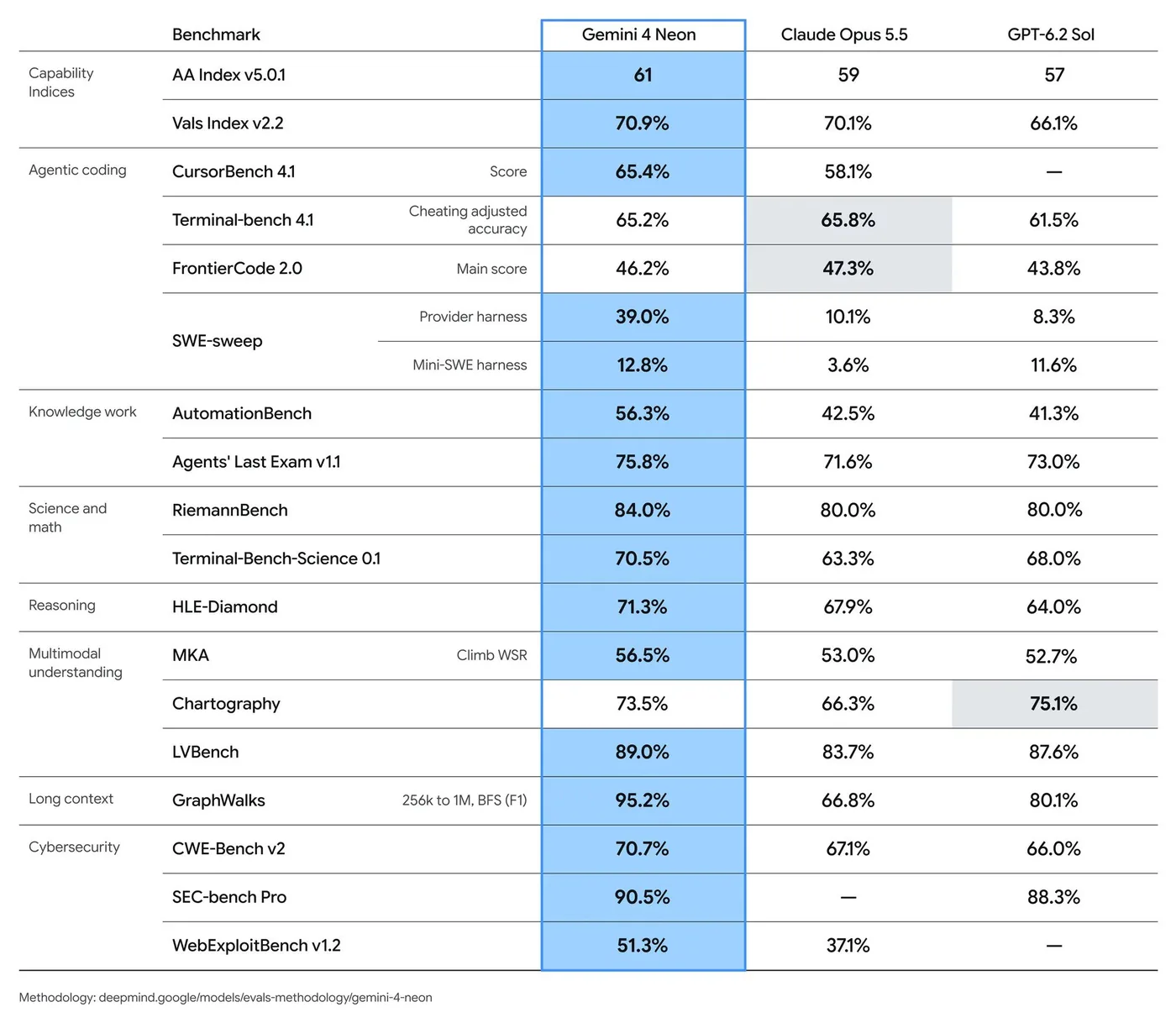
Early tests place the model in strong contention against rival tools from OpenAI and Anthropic across multiple software metrics. Stephen Schenck reported that the engine landed in the top three spots across multiple industry evaluation benchmarks for logic and code generation. It runs fast. Coders get heavy model quality on real programming problems without sluggish response delays or expensive cloud bills [1].
When small models handle lengthy conversations, they often lose track of initial project parameters or drift into invalid code syntax during extended execution. Test data shows that Neon keeps its precision intact during extended operations, allowing software engineers to run iterative test cycles without watching the system fail on complex software tasks [1]. The International Energy Agency expects global data center investment to reach $4T by 2030, with fewer than 100 top AI setups needing 50GW of power, matching peak United Kingdom demand [2]. That growing power strain forces Google to build efficient models that run clean logic without wasting grid energy [1].
While Carbon remains Google’s deepest thinking tool, Neon delivers comparable accuracy on core coding tasks with much lower latency to keep software development fast and interactive. Benchmark comparisons confirm that teams do not sacrifice analytical depth when prioritizing execution speed [1].
Gemini 4 Neon Token Rates
Pricing stands out as the most practical change for independent developers and smaller technical teams. Google charges $3 for every million input tokens and $15 for every million output tokens processed by Gemini 4 Neon, while discounting cached queries heavily [1].
For teams that run repetitive prompts or maintain persistent agent instructions, Google provides discounts on cached input tokens. In production setups where autonomous tools query APIs continuously throughout the workday, input token volume accumulates quickly, but storing prompt templates, code libraries, and system definitions cuts overall API expenses by a wide margin. Discounts apply to cached queries. Lower base rates paired with caching allow small startups to deploy automated research agents without fearing surprise bills, reshaping the economic equation for everyday development teams. By lowering economic barriers, Google makes frontier logic viable for teams that previously found Carbon too costly for routine testing [1].
The $15 output rate undercuts competing frontier models that bill higher fees for generating complex software solutions. Teams can draft unit tests, refactor legacy functions, and generate documentation within reasonable cloud budgets [1].
Desktop Control on macOS
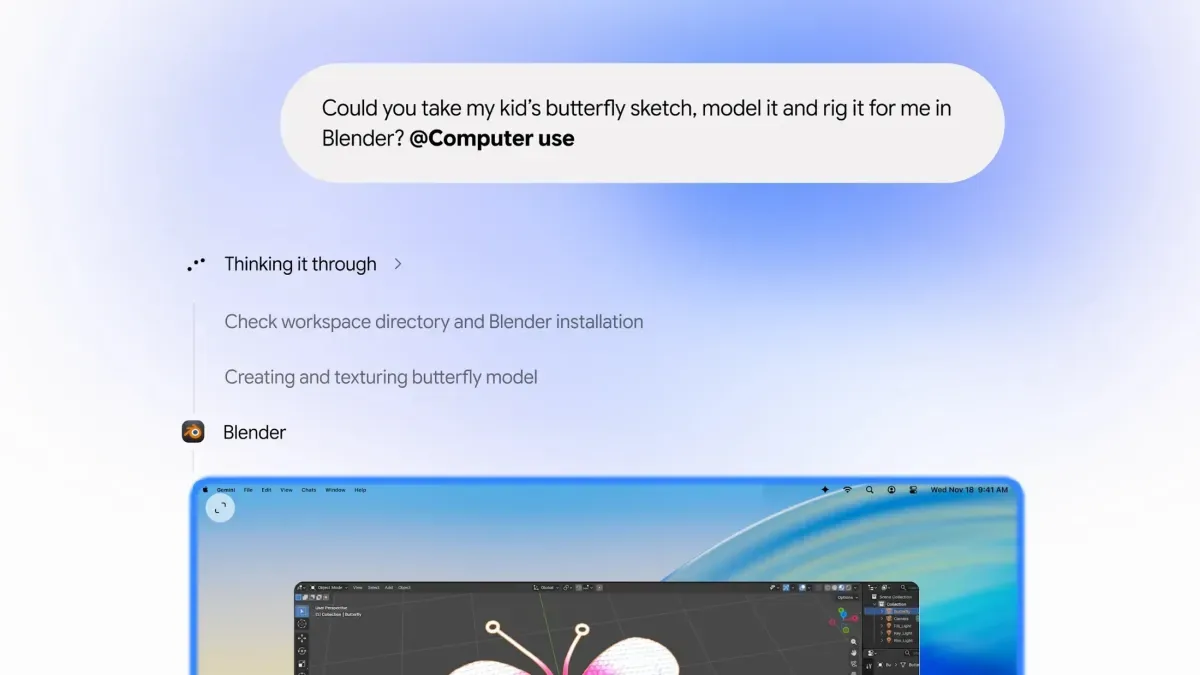
The arrival of Neon coincides with expansions in Google’s desktop ecosystem. Sarah Perez of TechCrunch reported on Techmeme that Google brought automated computer actions to macOS users running the Gemini desktop client. The tool handles background tasks across local files, desktop software, and web windows. This desktop automation is available to users in the United States on AI Plus, Pro, and Ultra subscriptions [2].
Background desktop tools turn personal computers into active workplaces by letting assistants execute multi-step procedures without constant user supervision. A user can prompt the assistant to pull numbers from a spreadsheet, check facts online, and assemble a briefing in another app. The agent works quietly while the user tackles other assignments. Apple is building similar browsing agents. According to Mark Gurman of Bloomberg, Apple is developing autonomous agents to write code, browse the web, and navigate devices, while Aisha Malik of TechCrunch noted on Techmeme that Snap launched its Easy Lens CLI for external tools like Claude Code, Cursor, and Codex. Lily Hay Newman reported for Wired that Google built a “Mirror Dimension” simulated web environment to test autonomous browsing tools under isolated conditions without exposing user files. Connecting Neon’s logic with macOS desktop control gives technical professionals a practical method for automating repetitive daily chores without manual switching [2].

This macOS feature gives Pro subscribers real utility on desktop hardware. Instead of managing isolated chat windows, users hand off multi-step chores to the client, bringing web research and local desktop files into a single coordinated workflow [2]. Work stays on the desktop.
Access in the Gemini App
Setup requires no waitlist. Google added the model to the standard model selector in the Gemini application, making it available on day one to subscribers on Google AI Pro plans [1]. A single click activates the engine.
The shift in subscription access signals a clear departure from Google’s earlier release strategy. When Google launched Carbon, access was restricted to top-tier AI Ultra subscribers, but the decision to open Gemini 4 Neon to Google AI Pro members eliminates that steep financial barrier. By opening Gemini 4 Neon to Google AI Pro members, Google lowers the bar for entry while providing deep logic for everyday development loops and multi-step tasks. Freelance programmers, university researchers, and startup founders now get frontier reasoning capabilities on predictable monthly budgets without paying for an Ultra upgrade [1]. It expands high-level tools to a wider user base.
With Neon joining Carbon, Hydrogen, and Argon, Google’s model portfolio offers distinct solutions for diverse technical needs. Users can pick the exact tool that matches their budget and workflow, whether analyzing data on the web or automating tasks within desktop software [1].
- ONLINE NEWS Schenck, S. (2026, November 18). Gemini 4 Neon is ready to get some work done for AI Pro power users. Android Authority. [Article Link]
- ONLINE NEWS Perez, S. (2026, November 19). Google adds computer use to Gemini for macOS. Techmeme. [Article Link]


