




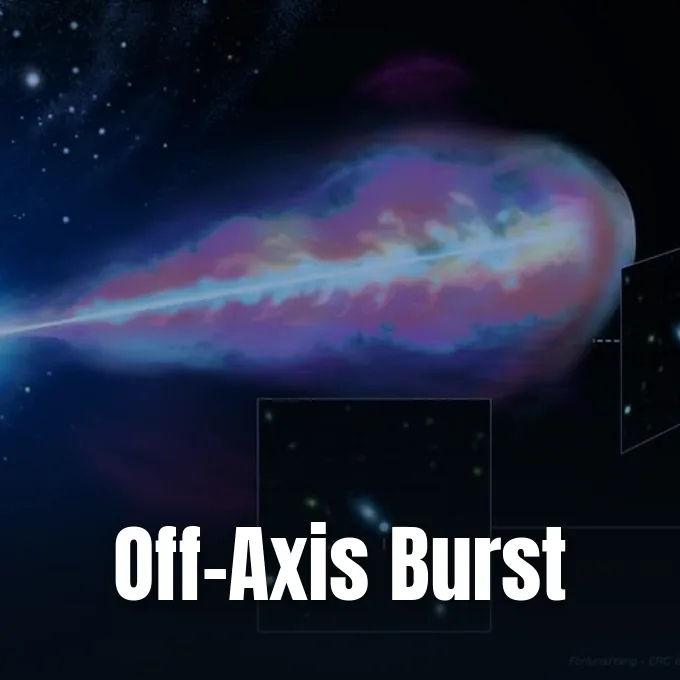
On March 10, 2026, NASA’s Fermi Gamma-ray Space Telescope detected an unusual flash of high-energy light from deep space. The event, named GRB 260310A, released a comparatively modest amount of energy during its prompt burst, which led observers to assume it was a relatively weak cosmic explosion. Yet within hours, the GRB 260310A afterglow began brightening across visible light, radio waves, and X-rays until it rivaled some of the brightest stellar blasts recorded in modern astrophysics [3].
Initial Detection of GRB 260310A
Gamma-ray bursts (GRBs) rank among the most energetic events in the known universe, second only to the Big Bang in total energy release. When the core of a massive star collapses at the end of its life, it leaves behind a compact neutron star or black hole while driving ultrarelativistic plasma jets into space at velocities approaching the speed of light. During those brief seconds, a standard burst can release as much energy as our Sun will generate across its entire ten-billion-year lifespan of nuclear fusion. In typical bursts, these jets point directly at Earth, producing brilliant prompt gamma radiation that lasts twenty to thirty seconds before declining into longer wavelengths. The gamma flash from GRB 260310A lasted almost one minute. The signal seemed subdued. However, it released an isotropic equivalent energy of roughly 3.5 × 10^50 erg, which appeared surprisingly small for such an event [2].
Ground-based follow-up at the Calar Alto Observatory in Spain confirmed that the burst was associated with a broad-lined Type Ic supernova at redshift z ≃ 0.153. Although telescopes detect hundreds of gamma-ray bursts each year, this event puzzled astronomers because its faint initial burst did not fit standard patterns. The research was published in The Astrophysical Journal Letters. “We see hundreds of GRBs every year, but the oddballs are the most informative ones,” said Roberto Ricci, a radioastronomer at Italy’s National Institute of Astrophysics [3].

The Delayed Optical and X-ray Flare
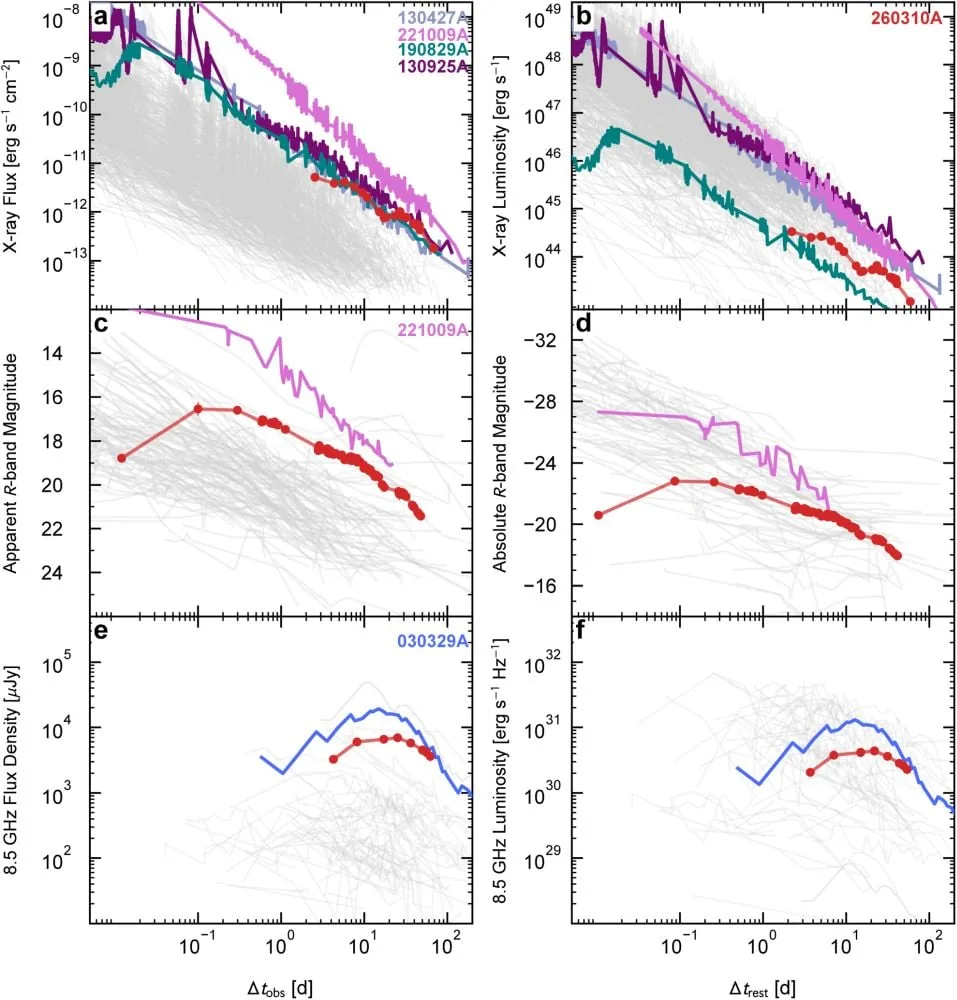
Automated alerts quickly mobilized observatories across the planet to track the fading debris field. Standard afterglows dim steadily right after the gamma prompt fades, but GRB 260310A followed a different path. Its visible light afterglow gradually climbed over several hours with a slow rising slope of α ≈ −1. The optical flare peaked late at roughly 0.1 day after detection. During this delayed peak, the visible afterglow shone with high brightness, briefly outshining the supernova’s entire host galaxy [2].
The high-energy emissions followed an even stranger course. After a phase of fast decay, the X-ray afterglow began brightening again around twenty to thirty days after the initial blast. It stayed bright for about one week before slowly fading away into background noise. Space telescopes monitored the source for up to 68 days without detecting any shift in its underlying spectral properties [1].
Broadband measurements soon revealed that the GRB 260310A afterglow belonged to an elite group of energetic events. Both its optical and X-ray afterglows ranked among the top 1% in observed brightness when compared against decades of cataloged bursts. Radio observations using the Karl G. Jansky Very Large Array in New Mexico similarly placed its radio emission within the top 5% of all recorded events. The contrast was striking. An explosion that produced minimal prompt gamma energy had generated one of the brightest multiwavelength afterglows ever documented by astronomers [2].
Ruling Out False Signals
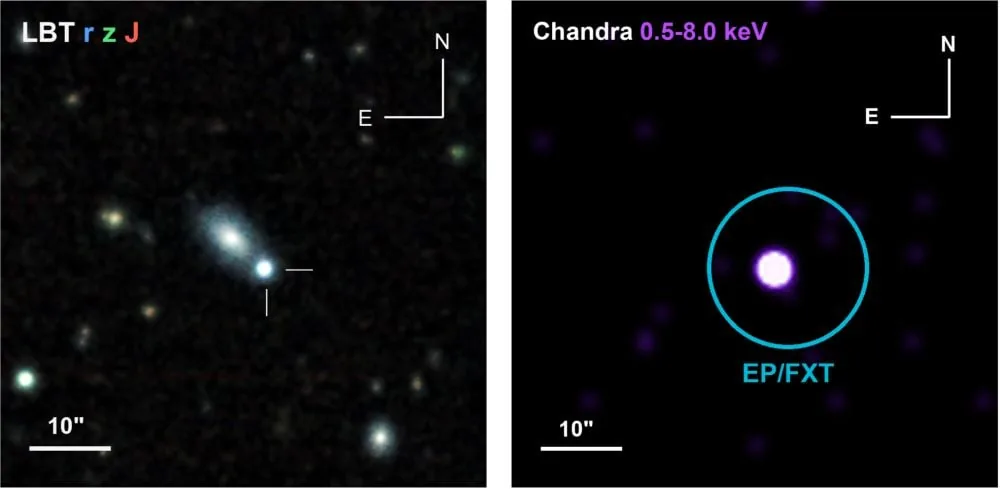
A late re-brightening in X-rays after three weeks is rare in gamma-ray burst science, and it initially caused skepticism among the observers. Yu-Han Yang, a postdoctoral scholar in the Department of Physics at the University of Rome Tor Vergata who coordinated the X-ray campaign, suspected that another object might have skewed the readings. An unrelated background star or a flaring galactic nucleus lying along the same line of sight could produce misleading light. “At first, I thought another X-ray source was contaminating our observations. But the brightening really came from the afterglow,” said Yang [3].
Distinguishing between genuine transient flares and overlapping background objects needs high spatial precision. The researchers secured Director’s Discretionary Time on NASA’s Chandra X-ray Observatory, which provides the sharp angular resolution necessary to isolate compact sources in crowded sky regions. Optical images of the GRB 260310A field from the Large Binocular Telescope were paired with Chandra data to pinpoint the coordinates with high fidelity. The comparison demonstrated that NuSTAR’s broader detection window contained only this single fading transient. Chandra resolved the question. The delayed surge came from the expanding blast wave itself [2].


Physics Behind the GRB 260310A Afterglow
Explaining why an apparently dim gamma-ray flash evolved into a record-setting afterglow became the main goal of the investigation. Lead author Yu-Han Yang said that viewing angle plays a major role in how astronomers perceive cosmic outflows. Standard models are built on bursts whose relativistic beams point right toward Earth, maximizing the observed prompt energy. “Much like a flashlight, the jet appears brightest when seen head-on,” said Yang. “Most of our models are calibrated using events seen from that same perspective. This burst gave us a chance to look beyond that glare,” said Yang [2].
In the case of GRB 260310A, the jet was aligned away from our line of sight, meaning Earth sat off-axis. Relativistic beaming initially focuses gamma-ray photons into a tight forward cone, causing off-axis observers to miss the brunt of the initial explosion. As the outflow plows into gas surrounding the dying star, the jet decelerates, which causes its beaming cone to widen over days and weeks. “We looked at it from a side angle,” said Yang. “As the jet slowed down, its light became visible over a wider range of angles, allowing us to probe the jet’s shape, from its outer edges toward its inner core” [2].
Broadband spectral analysis confirmed that emission across radio and X-ray frequencies arose from synchrotron radiation generated by two interacting shock structures. A reverse shock traveling backward into the ejecta dominated early radio emission and contributed to the optical light, while an outward forward shock drove the energetic X-ray output. Polarization measurements taken with the Karl G. Jansky Very Large Array at 15 GHz revealed a low linear polarization of roughly 1.7% at 55 days after the burst. Both shocks occurred together. Forward shock emissions dominated late-stage radiation [1].
Two-Component Jet Structure
Traditional models representing gamma-ray bursts as uniform, single-angle cones can’t explain events that exhibit multiple distinct peaks over months of observation. A single low-velocity jet seen head-on can’t combine an early peak with a late rebrightening, whereas an off-axis two-component configuration naturally accommodates both features. To resolve the discrepancy in GRB 260310A, the researchers applied a two-component jet model consisting of an ultra-fast narrow core surrounded by a wider, slower sheath. The early optical brightening arose from the broader sheath interacting with nearby gas, whereas the later X-ray flare emerged several weeks later when the dense inner relativistic core decelerated enough for its beamed radiation to expand directly into our line of sight [2].
Astrophysical calculations indicated that this compact central beam contained vast power that remained hidden during the initial detection. Theoretical models suggest that the stellar core channeled the equivalent of roughly one billion years of total solar energy output into a pencil-thin stream. “What appeared to us as an unremarkable GRB might have looked like a monster explosion to an observer looking straight down the jet’s core,” said Yang [2].
Observations of the GRB 260310A afterglow provided the first direct observational test of reverse-shock physics within an off-axis geometry. While conventional observations capture only the blazing center of a burst, off-axis vantage points allow scientists to examine the transverse profile of cosmic jets. The core remained narrow. The complex light curves prove that energetic outflows possess detailed internal architecture that can’t be reduced to simple spherical geometry [1].

What Future Observatories May Reveal
Capturing the full evolution of GRB 260310A was possible only through quick coordination among space and ground instruments. Prompt alert notices distributed by space missions such as Fermi, the China and ESA Einstein Probe, and ESA’s XMM-Newton enabled ground telescopes across multiple continents to begin tracking the expanding blast wave across radio, optical, and high-energy bands. Ground instruments, including the Large Binocular Telescope in Arizona and the Karl G. Jansky Very Large Array, gathered the high-resolution data needed to resolve the outflow’s geometry [2].
Astronomers expect to discover more off-axis bursts as next-generation survey facilities begin routine observations. Advanced observatories, such as the newly completed Vera Rubin Observatory in Chile, will conduct wide-field sky surveys capable of detecting faint transient afterglows across vast cosmic distances. “We could explain individual features of this burst, but fitting them all into the same picture proved much harder,” added Ricci. Finding additional off-axis events will allow astrophysicists to test whether two-component jets are common in collapsing stars or represent rare structural anomalies [3].
- ACADEMIC JOURNAL Yang, Y., Ricci, R., Troja, E., Yadav, M., Yin, Y. I., Sánchez-Ramírez, R., O’Connor, B., Passaleva, N., Castro-Tirado, A. J., van Eerten, H., Dichiara, S., Galluzzi, V., Dehsorkh, N. S., Agudo, I., Aceituno, J., Busmann, M., Caballero-García, M. D., Fernández-García, E., Gruen, D.,. Kutyrev, A. (2026). An Extremely Bright Slow-rising Afterglow from an Off-axis Jet in GRB 260310A. The Astrophysical Journal Letters, 1011(1), L22. [Article Link]
- ONLINE NEWS Gough, E. (2026, October 30). This Gamma-Ray Burst Wasn’t Dim, It Was Just Misunderstood. Universe Today. [Article Link]
- ONLINE NEWS Paul, A. (2026, October 29). Gamma-ray burst is one of the brightest in decades. Popular Science. [Article Link]
APA 7: PerEXP Teamworks. (2026, October 31). GRB 260310A Afterglow Outshone Host Galaxy from Off-Axis Jet. PerEXP Teamworks. https://perexpteamworks.com/en/grb-260310a-afterglow-off-axis-jet/


