






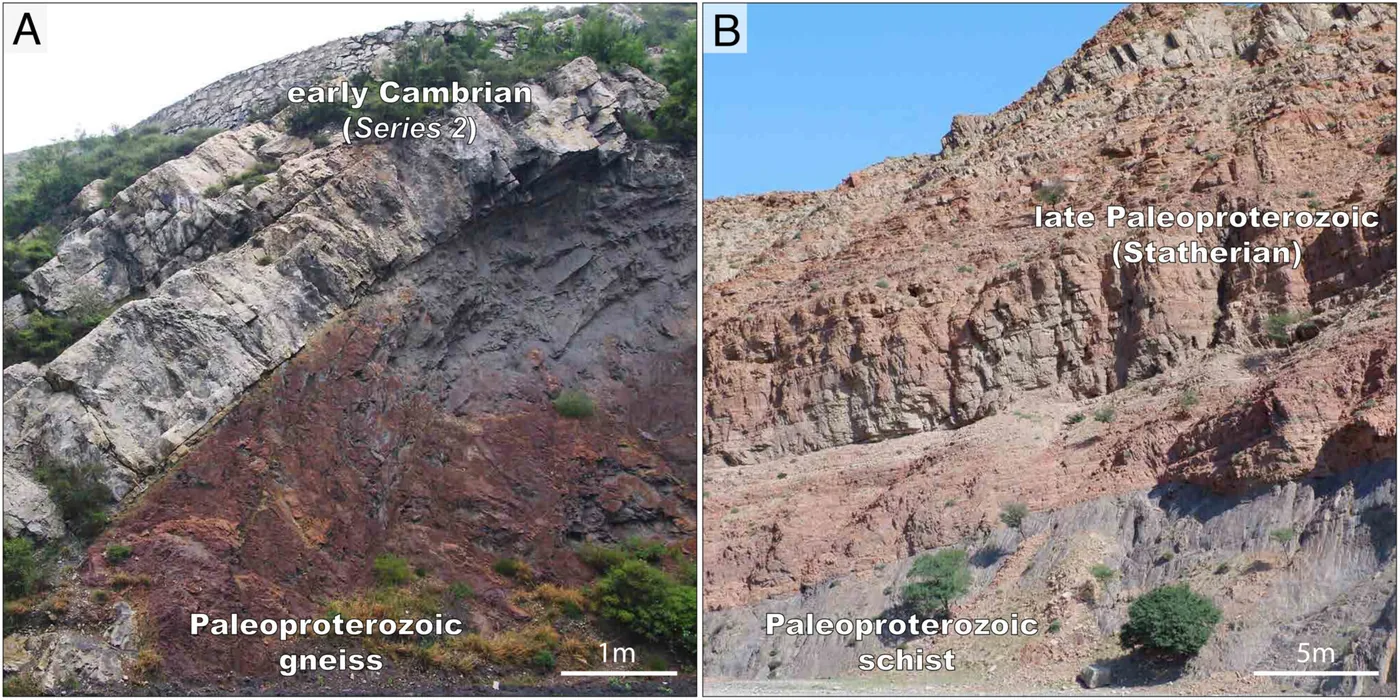
Earth holds a rocky puzzle that has perplexed field geologists for more than a century: across vast stretches of the globe, up to a billion years of geological history has vanished from the stratigraphic record. This planetary gap, known as the Great Unconformity, is famously exposed where Cambrian sedimentary rocks sit directly on top of ancient crystalline basement that is hundreds of millions of years older [2]. New computational models published in Nature reveal that deep mantle convection currents pushed continents upward before letting them sink, triggering continental erosion [1].
The Grand Canyon Stratigraphic Gap
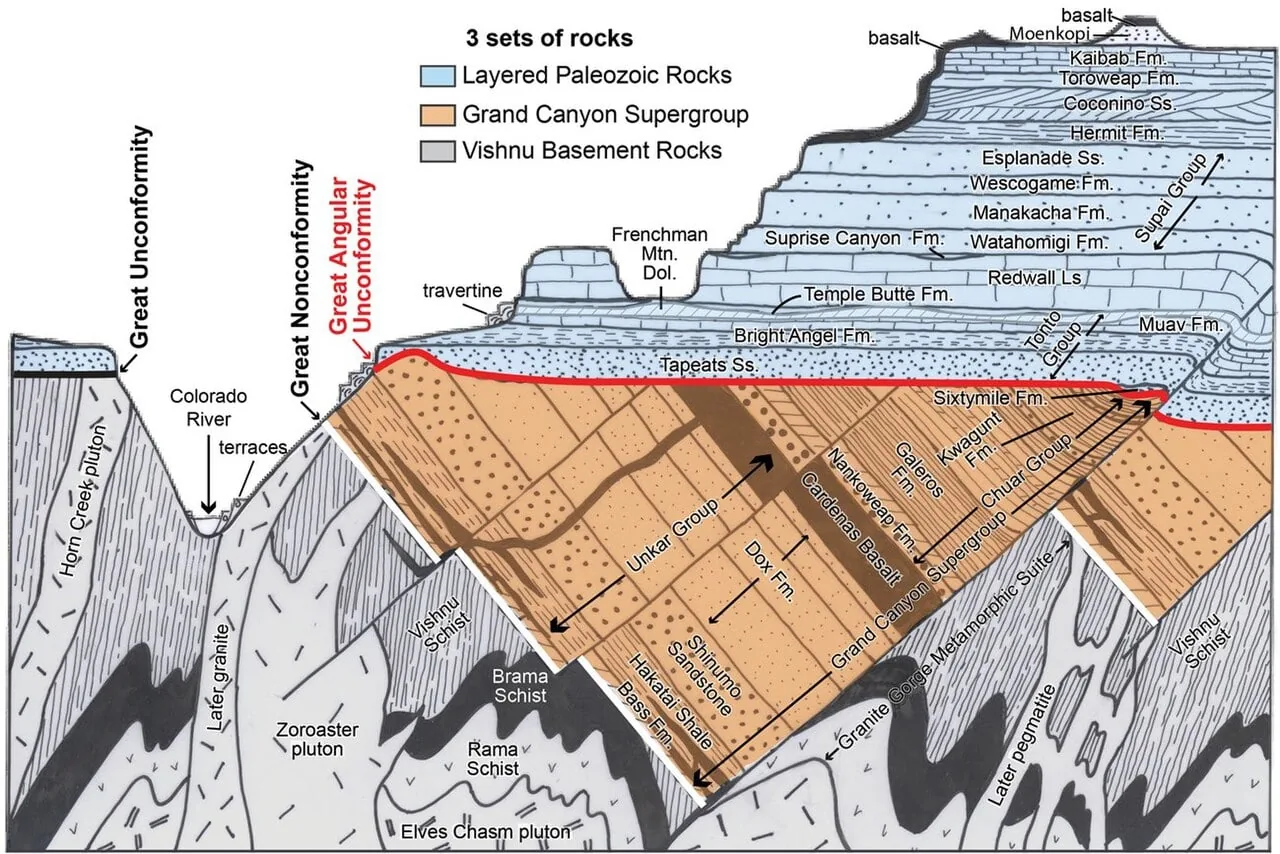
Explorer and geologist John Wesley Powell first documented the missing rock during his 1869 expedition through the Grand Canyon [9]. Along the steep canyon walls, flat sedimentary beds from the Cambrian period rest directly over ancient crystalline basement rocks that formed between 1.4 and 2.0 billion years ago [2]. Roughly 1.2 billion years vanished across the Great Unconformity at the canyon [12].
The missing rock represents up to a quarter of Earth’s total history, creating a gap that geologists have debated for generations. “Imagine a book where a huge section in the middle has been ripped out,” said Santosh Dhungana, a doctoral researcher at the University of Wollongong in Australia. “The Great Unconformity is that gap in Earth’s story, with the narrative jumping from the early chapters straight to a much later part of the story,” Dhungana said [12].

At the Grand Canyon, the National Park Service reported that smaller structural gaps called disconformities also interrupt the strata, though they are less evident to the naked eye. These stratigraphic absences range from two hundred million to more than one billion years across different continents, including Europe and Asia [12]. The missing strata sit directly below the Cambrian explosion, when diverse animal body plans first emerged in the fossil record [2].
Continental Rise and Fall
To solve the mystery of where the missing rock went, Dhungana and his doctoral supervisor Nicolas Flament investigated deep physical forces operating within Earth’s interior [1]. Earth’s mantle forms a hot, solid rocky interior extending roughly 2,900 kilometres deep, circulating slowly over tens to hundreds of millions of years. As hot mantle plumes rise and cold slabs sink, they generate vertical forces that push continental crust upward or drag it downward by hundreds of metres. The Australian supercomputer Gadi ran their models [2].
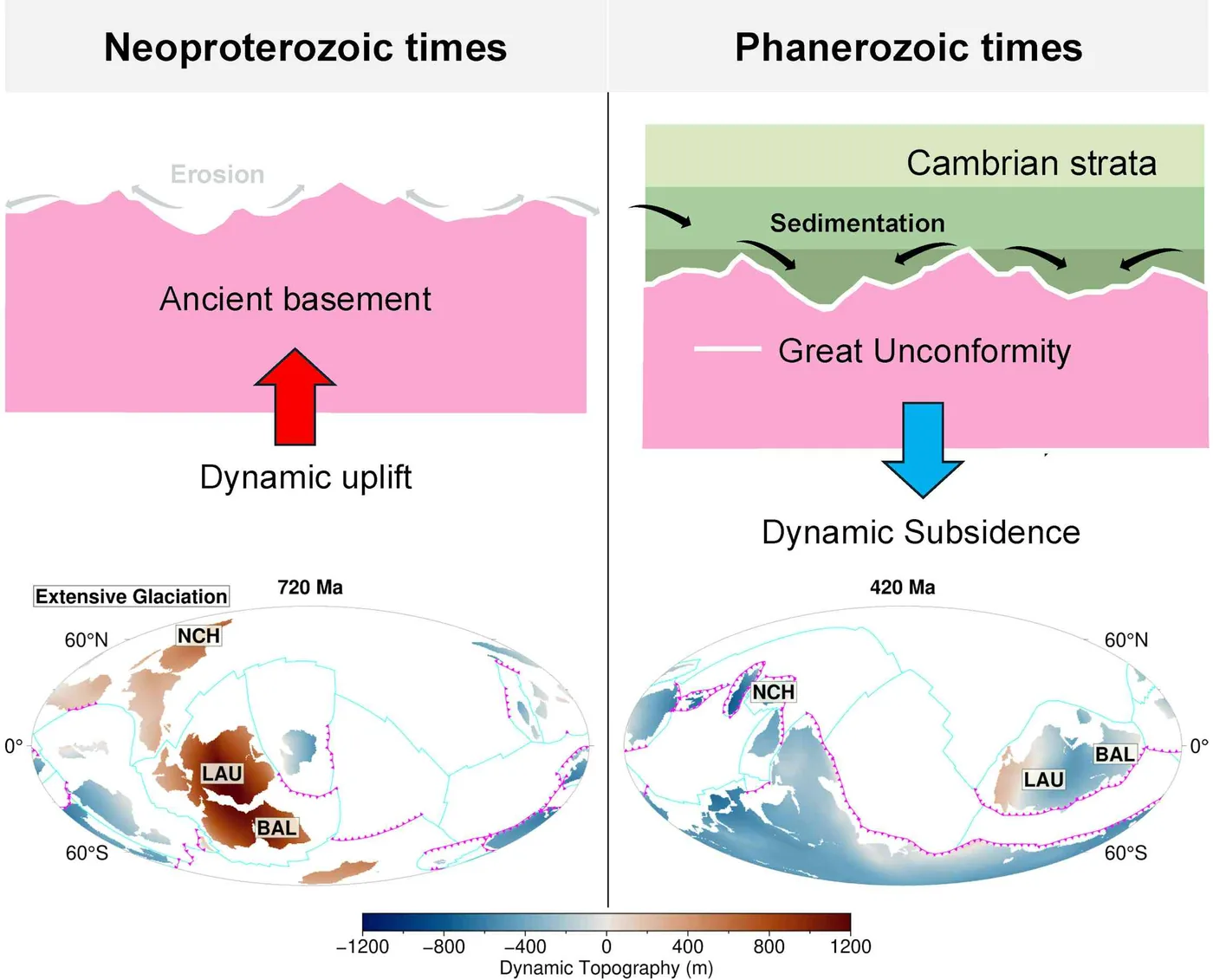
The computer models revealed that mantle currents pushed three major continental landmasses—Laurentia (modern North America), Baltica, and North China—upward between one billion and 540 million years ago during the Neoproterozoic era [1]. This prolonged uplift lifted the land high above sea level, exposing sedimentary covers to long-term surface erosion until only hard crystalline basement remained at the surface [2]. Beginning around 540 million years ago, the mantle circulation pattern changed, causing these landmasses to slowly sink into the ocean during the Phanerozoic eon [1]. New marine waters and arriving sediments then gradually buried the worn rock surface, resulting in the Great Unconformity preserved today. “A single, long period of uplift followed by a long period of sinking would have been the ideal recipe for removing the rock and preserving the worn surface,” Flament said [12].
Glaciers on Uplifted Continents
The period of continental uplift predicted by the Australian supercomputer models coincided closely with the Cryogenian period, between 720 million and 635 million years ago [2]. During this extreme climatic interval, known as Snowball Earth, massive sheets of glacial ice encased large portions of the planet and reached near equatorial latitudes [6]. Glaciers grind down continental rocks far more effectively than rivers, especially across gentle slopes, and they scraped away vast quantities of exposed rock as they slid downhill toward ancient oceans. Modern glaciological surveys, including research teams drilling 500 metres deep into Greenland ice, continue to study how massive ice sheets alter underlying topography. When glaciers retreated, the scraped sediment poured into the oceans, altering marine chemical compositions [2].
Some continents show little erosion. Australia and South America underwent only two brief cycles of uplift and subsidence after 900 million years ago, which did not provide the sustained conditions required to carve and preserve a massive gap [2]. When Laurentia and Baltica sank during the Cambrian, rising oceans deposited thick sediments over the eroded basement [1]. The influx of weathered continental minerals changed ocean chemistry, providing mineral nutrients that helped trigger the evolutionary explosion of marine animals [2].


Rifting Along the Laurentian Margin
While mantle convection operated on a global scale, regional tectonic rifting also carved vast swaths of continental rock [3]. Around 800 million years ago, the ancient supercontinent Rodinia began pulling apart, separating Laurentia from a crustal block that now forms part of Australia [4]. Thomas Gernon, a professor of Earth science at the University of Southampton, led a study in Geology showing that this rifting created a towering continental cliff [3]. The feature, named the Great Escarpment of Laurentia, stretched across western North America from Alaska to Arizona and rose between 3,300 and 6,500 feet high [6].
“You’re standing at the base of a towering cliff, perhaps one or two kilometers high that stretches as far as the eye can see in both directions,” Gernon said to Earth.com when describing the landscape [4]. Erosion varied across distance. Near the crest of the cliff, approximately 5 miles of rock was stripped away, but the erosion estimate dropped to 1.2 miles at a distance of 125 miles inland [3]. In the western Grand Canyon, rocks cooled by about 270 °F over 200 million years, confirming that more than 3.7 miles of rock was removed slowly through prolonged erosion [4].
In a companion study published in Science, Gernon and his team showed how an escarpment created by tectonic rifting spurred the growth of the East Antarctic Ice Sheet roughly 34 million years ago [5]. Rocky peaks along such escarpments functioned as glacier factories that gathered snow and ice. Alan Collins, a geologist at Adelaide University in Australia, said linking the rock loss to the breakup of Rodinia offers a convincing explanation [6].
Great Unconformity Scars Across North America
Because the Laurentian escarpment extended across thousands of kilometres, researchers traced its erosional impact far beyond Arizona. Ancient rocks pushed up to the surface appear along an extensive corridor that includes Utah, Idaho, Wyoming, Colorado, Texas, Oklahoma, Arkansas, Missouri, and Illinois. Three prominent geological features along this line preserve scars associated with the Great Unconformity: the Llano Uplift in Texas, the Arbuckle Mountains in Oklahoma, and the Ozark Dome in Missouri. In Missouri, previous geological surveys estimated that roughly 3.7 miles of rock had been stripped away by erosion [4].
Marine waters arrived surprisingly late. At the Grand Canyon, the oldest sandstone above the unconformity dates to 508 million years ago, roughly 30 million years after shallow seas flooded other parts of the continent. The high continental rim blocked marine flooding until erosion wore it down completely. Modern analogues in Brazil and South Africa display similar topography, where Gondwana breakup escarpments sit an average of 209 miles inland [4]. Remote sensing surveys analyzing deformation in other regions, including the ancient folds of the Monterrey mountains, document how structural uplift controls regional erosion.
Great Unconformity Evidence from Ancient China
New evidence from northern China shows that the erosion responsible for the missing strata did not occur at the same time everywhere. A research team led by Rong-Ruo Zhan and Liang Duan from Northwest University in China analyzed basement rocks from five sites across the North China Craton [7]. Co-author Nicholas Christie-Blick, a geologist at Lamont-Doherty Earth Observatory of Columbia University, said that if Cryogenian glaciation was the primary driver, a sharp cooling pulse would appear around 700 million years ago [8]. The North China data showed that basement rocks cooled fastest from 2.1 to 1.6 billion years ago, dropping by at least 370 °C as they rose through the crust [7].
This earlier cooling window corresponds to the tectonic assembly of Columbia, one of Earth’s earliest supercontinents, which formed around two billion years ago [11]. Liang Duan said that cratonic basement rocks formed at depths of 25 kilometers, and about 60 percent of the erosion occurred before 1.6 billion years ago. In addition, thermochronologic dating showed that roughly 75 percent had taken place before 1.35 billion years ago [8]. In the eastern Grand Canyon, preserved sedimentary strata from the Cryogenian period show that glaciers did not strip away all surface rock in that region [9]. Similarly, Dr. Rebecca Flowers of the University of Colorado argued in 2020 that geologists should view the Great Unconformity as multiple regional episodes rather than a single global event [10].
- ACADEMIC JOURNAL Dhungana, S., & Flament, N. (2026). The deep Earth origin of the Great Unconformity. Nature, 659(8139), 106-112. [Article Link]
- ONLINE NEWS Flament, N., & Dhungana, S. (2026, November 4). Earth’s rocks have a missing layer spanning up to a billion years. We finally know where it went. The Conversation. [Article Link]
- ACADEMIC JOURNAL Gernon, T. M., Hincks, T. K., Rugen, E. J., Brune, S., Braun, J., & Marshak, S. (2026). Exhumation of Grand Canyon’s basement along the Great Escarpment of Laurentia. Geology. [Article Link]
- ONLINE NEWS Ralls, E. (2026, August 27). Grand Canyon is missing a billion years of rock, and a lost cliff may be why. Earth.com. [Article Link]
- ACADEMIC JOURNAL Gernon, T. M., Hincks, T. K., Goodwin, P., Paxman, G. J. G., Brune, S., Rohling, E. J., Keir, D., & Braun, J. (2026). Continental breakup–driven uplift instigated East Antarctic Ice Sheet formation. Science, 393(6806). [Article Link]
- ONLINE NEWS Joel, L. V. W. (2026, October 9). How the Grand Canyon could have lost 1 billion years of geologic history. Science News. [Article Link]
- ACADEMIC JOURNAL Zhan, R., Duan, L., Zattin, M., Christie-Blick, N., Wan, B., Wei, R., Yang, Z., Wang, J., Gou, L., Olivetti, V., Chen, K., & Zhang, X. (2026). Tectonism rather than “snowball Earth” glaciation is responsible for the Great Unconformity. Proceedings of the National Academy of Sciences, 123(9). [Article Link]
- ONLINE NEWS Columbia Climate School. (2026, March 11). Earth’s “Missing” Billion Years: Study Links the Great Unconformity to Early Tectonics. State of the Planet. [Article Link]
- ONLINE NEWS Puiu, T. (2026, August 19). Earth Is Missing a Billion Years of History. We Finally Know Why. ZME Science. [Article Link]
- ACADEMIC JOURNAL Flowers, R. M., Macdonald, F. A., Siddoway, C. S., & Havranek, R. (2020). Diachronous development of Great Unconformities before Neoproterozoic Snowball Earth. Proceedings of the National Academy of Sciences, 117(19), 10172-10180. [Article Link]
- ONLINE NEWS Orf, D. (2026, March 5). Earth’s Geological Record Is Missing 1 Billion Years. Scientists Just Found Out Where They Went. Popular Mechanics. [Article Link]
- ONLINE NEWS Lee, G. (2026, November 4). Why the Grand Canyon May Be Missing 1.2 Billion Years of History. Gizmodo. [Article Link]
- ONLINE NEWS University of Wollongong. (2026, November 4). New modeling links gaps in Earth’s geological record to rising and sinking continents. Phys.org. [Article Link]
- ACADEMIC JOURNAL Keller, C. B., Husson, J. M., Mitchell, R. N., Bottke, W. F., Gernon, T. M., Boehnke, P., Bell, E. A., Swanson-Hysell, N. L., & Peters, S. E. (2019). Neoproterozoic glacial origin of the Great Unconformity. Proceedings of the National Academy of Sciences, 116(4), 1136-1145. [Article Link]
APA 7: PerEXP Teamworks. (2026, November 5). Mantle Convection Explains the Great Unconformity Rock Gap. PerEXP Teamworks. https://perexpteamworks.com/en/great-unconformity-missing-rock-gap/


